
Rent is not just the money you pay a landlord. In economics, it means something far bigger and far more significant.
Economic rent is any payment above what is needed to keep a resource in use.
Land earns rent, because the land already exists and would be there whether or not anyone paid for it.
Risk-free interest on government bonds is rent, because the money already exists and the return is unearned.
And a large slice of what accountants call "profit" is not really profit at all: it is rent, extracted from workers, from customers, and from the planet. In a small business, profit genuinely rewards the owner's skill, knowledge and risk-taking. But in a large company, much of what is called profit is actually a return to monopoly power, brand dominance, or exploitation.
The difference matters, because rent is the hidden engine of inequality. It disguises the exploitation of employees, of people, and of the environment, and it means we overtax work while under-taxing extraction.
The answers to the problems created by economic rents are not complicated.
First, recognise rent. Second, reduce it, whether it comes from land, interest and excess profits.
Third, shift the tax burden away from earned income and onto rent.
Fourth, constrain rents on land and property, control excessive interest, eliminate monopoly profits, and protect workers with better minimum wages and union rights.
And finally, realise that when you tax rent instead of work, you stop rewarding value extraction and start rewarding the people who actually create value. That's what would happen in a just world.
This is the audio version:
There is no Debate Ammunition for this video, but there is this infographic:
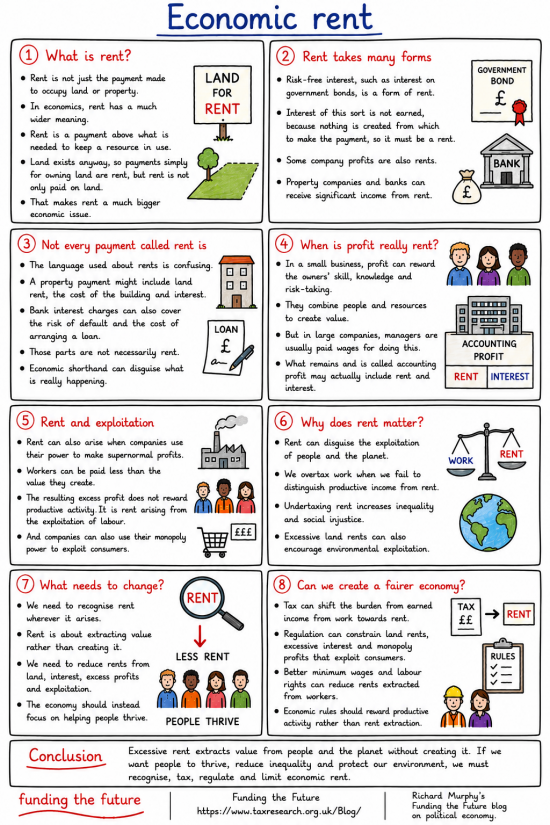
I wrote this infographic. AI created the image.
This is the transcript:
Hello, I'm Richard Murphy, and this is Understanding Economics. That's the series of videos that I'm creating, which explains economics in the way that I see it. Now, I stress, this is my view. It is not anybody else's view necessarily, but I think it will help you. Why? Because economics, as it is taught, is almost incomprehensible to most people, including those who study it, and this view is presented in a way that I want everyone to be able to understand, and that's why I call it Understanding Economics.
In this video, what am I talking about? I'm talking about rent. Rent is a subject that is most definitely misunderstood in the way that most people talk about it. In fact, rent is a very particular type of issue inside economics. And for once, I am using the term rent in the way that most economists would. That's important because this makes it clear how unfair rents are.
And rent is not just the payment made to occupy land or property. In economics, rent is a payment above what is needed to keep a resource in use. And let's be clear, land exists. It has, and it always will. It can always be put to use. So making any payment for land that already exists is simply a payment to the owner and not to the land itself, and that means it must be rent. It's above the value of what is necessary to put the land to use.
But rent, though, is not only paid on land. Risk-free interest, such as interest on government bonds, is also a form of rent. The money that is saved in a government bond exists anyway. It's been created by the government as a consequence of its spending. So why do we have to pay for it to be deposited with the government? That's a very good question.
The return is unearned. It's a rent.
And some company profits are also rents. They're not a return to the particular form of labour that economists call enterprise, so they must be rents. Property companies and banks can receive significant income from both rents on land and from interest. By definition, they are rent-seekers. They are not profit makers.
And what you will already begin to gather is that the language around this issue can be confusing. We have to be careful. But that also means that we have to understand that some things that are called rent are not rent.
So if we look, for example, at the payment for a piece of property and not just the land that is beneath it, the rent that we pay could include the payment for the land, which is a rent, plus a payment for the cost of the building, which is not a rent because it's a return on the effort expended to build the thing. But there may also be some interest included in that payment because the owner borrowed money to build the building and you are compensating them for that.
In other words, this payment of what we call rent can comprise both a payment for the use of the asset - a hire charge - an element of interest, which is a rent, but of a particular form, and rent on the land.
And bank interest charges, which we can easily call a rent, can, in fact, include the cost of risk insurance, which the bank has to take because some people default on their loans, and the cost of arranging a loan, which is a return to the human labour involved.
In other words, again, the language that we use is complicated and has to be used with care because the simple terms that we use do not necessarily explain the economic reality of what the transaction is all about.
So, why do I call profit a rent? This is one of the most confusing areas that I think exists inside the economy, but I think this distinction is really important.
In a small business, profit can reward the owner's skill, knowledge, and risk-taking. I don't dispute that. I think that's real. These people who set up businesses combine their skills and resources to create real value by taking risk. We call that combination of skills enterprise, and the return is called profit. But it is a particular return of a particular sort to a particular type of labour, which is that of the entrepreneur.
In large companies, directors and managers are usually paid wages for doing this. Why else would they do it? They haven't got another form of compensation available to them. But wages, in this case, are a cost that is deducted from sales before accounting profit is calculated. And I stress the point here. What an accountant calls profit is not what an economist calls profit and is not what I'm calling profit. So let's be clear about that distinction. We are living in a world where words are used inappropriately, and I'm going to try to use them with care.
In particular, what I'm saying is that when a company takes its revenues and takes off its costs, which include those of the people who generate the profits, what is left over is called profit by accountants, but may be better described as a return to rent in the form of land and in the form of interest and in one other form as well, which is the return to exploitation.
Now, the return to exploitation that a company can make, particularly a large company, will arise for one of two reasons.
First of all, workers can be paid less than the value that they create. The resulting excess profit does not reward productive activity because if it did, the workers would get it. There would be no part of this gain included in profit, but there is. So it is rent arising from the exploitation of labour.
And the other form of exploitation that a company can make is to exploit their market power to make an excess return over and above what an economist will call the normal rate of return, which is broadly speaking , equivalent to the risk-free interest rate.
This is the return to monopoly abuse. The return to a brand, the return to being a large company, the return to being almost the only operator in your sector - I'm looking at you, Google, and I'm looking at you, Amazon, when I say things like that. These are returns to market exploitation. They are part of accounting profit , but they're actually economic rents.
So why does rent matter? There are four reasons why we need to worry.
Rent can disguise the exploitation of employees, people as a result of market abuse, and the planet. All are causing major stresses in our society at present. And that is why we need to understand rents.
We can also overtax work when we fail to distinguish productive income from rent. We should be taxing rents. We should not be taxing workers heavily, but at the moment in the UK, we actually do the reverse. We tax income more than rents, and that makes no sense at all.
And by under-taxing rents, we increase inequality and social injustice.
Whilst excessive land rents can also encourage environmental exploitation, and none of us can afford to see that happen.
So what needs to change? We need to recognise rents whenever they arise. That's the first point. Understanding what rent is is vital to understanding that we need to do something about it.
Rent is about extracting value rather than creating it. That is the simplest explanation we can provide. It distorts our economy. It gives a false sense of prosperity. It suggests the wrong people are being paid for value created by human endeavour. In that case, we need to reduce rents from land, interest, excess profits, and exploitation.
The economy should instead focus on helping people to thrive, and in that case, we need to create a fairer economy. Tax has a role to play in this. It can shift the burden from earned income towards rent. Our politicians could decide to do that.
Regulation can also be used. It can constrain the rents on land. It can control excessive interest rates. It can be used to eliminate monopoly profits. And better minimum wages, trade union rights and statutory protections for workers can reduce rents extracted from labour.
In all of this, we should be looking at how we can create economic rules that reward productive activity rather than rent extraction.
Now these rules are possible. They just need people who care to create them, and right now, we don't have the politicians who do that. If they did care, they would know that excessive rent extracts value from people and the planet without creating it.
If we want people to thrive and we want to reduce inequality, and we want to protect our environment, and I suggest that everybody should want those things, we must recognise that tax and regulation can be used to limit economic rents. A century or more ago in the USA, major politicians understood that. They challenged large companies that were abusing markets and people. We need to see such action again. It worked then. It could work now. And that is the reason why I create these videos on Understanding Economics. They show the kinds of policies we need to make our world work for the better.
Down below this video, you will find a list of all the videos we've made so far in a playlist. Have a look at them. Start from the beginning. It's a very good place to start, as somebody once said. And if you do, you will end up with a better view of how our economy could be organised for the benefit of everybody, and most especially you.
Poll
Previous posts in this series
- Understanding economics: Introduction Article
- What is economics? Article. Video. Infographic.
- What is the economy for? Article. Video. Infographic.
- What is microeconomics? Article. Video. Infographic.
- What is macroeconomics? Article. Video. Infographic.
- What are economic resources? Article. Video. Infographic.
- What is income? Article. Video. Infographic.
Thanks for reading this post.
You can share this post on social media of your choice by clicking these icons:
There are links to this blog's glossary in the above post that explain technical terms used in it. Follow them for more explanations.
You can subscribe to this blog's daily email here.
And if you would like to support this blog you can, here:

 Buy me a coffee!


The post generates this thinking from me…..In terms of public reputation and perception, tax has really suffered a bad rap over the years and rent has got away with murder as far as I am concerned.
That old saying about the two certainties in life needs to be rewritten – its ‘Death and Rent’ not death and taxation.
It also makes one reflect on monopoly power. So often, the Right talks of state taxation as an abuse of power even when the state has created and legalised the currency that gives them their wealth and power. That is not seen as legitimate at all by Neo-liberals, yet they never acknowledge publicly that a state monopoly is actually a monopoly owned by a democratically accountable body through the voting system.
Contrast that with the the little clubs that are the board rooms and private ownership of powerful companies trying to monopolize markets.
However, whilst not admitting this publicly, you can tell that the private monopolists do actually know how the system works because that is why they seek to corrupt it with their money and over power it with their lobbying. It one sense, they also legitimize the state by trying to control it, by giving it so much attention.
When you look at it at like that, the subterfuge of Neo-liberalism – well actually – the bullshit of Neo-liberalism – is amplified tenfold. Their whole position is just a self justifying confection.
Much to agree with
Sorry for the delay – blame bird watching
Thank you for making a valuable distinction. Though not immediately obvious, your explanation is clear. The infographic helps enormously.
Thank you also for your commitment to aiming for taxes that reward what the nation needs, discourages the opposite and reduces the outrageous scandal of inequality.
Current levels of associated poverty are inherently unfair but the failure to provide a good education, training and jobs for those ‘at the bottom’ contributes, I am convinced, to the alienation which probably contributes to the sort of alleged organised crime around the head-on crash on the A66 that resulted in seven deaths including those of police officers.
Thanks, Joe. Appreciated.
Rent. In the case of e.g. (fully depreciated) electricity networks the 6% per annum return on the asset base is needed to pay for, yachts, mistresses etc i.e. the necessities of life – to those that own the companies (or the shares in them). Take a look @ Nat Grid (or SSE) to get a feel for this (4% yield on a monopoly – what’s not to like?). In the case of water, the arrangement features a people carrousel from regulator to regulated – ensuring that the status quo (maximum extractus) continues. The City is happy and UK serfs are forced to pay up, with politicos “just following orders” & repeating the City’s mantra, “markets know what’s best”.
One wonders about the discussions held between BoE, FinMin and the bankers over the past 6 months wrt Burnt-ham “we have it all under control, he’s just like Starmer, knows little and is pliable, ideal chap to be PM he will do what he’s told – water? nah nothing to worry about there – no chance of nationalisation”.
It is difficult to rank the different sources of rent – in UK they all seem to be rising – Land and property, Interest and finance, Monopoly power, Exploitation of workers<p>
The uk economy seems to be being hollowed out by ‘inward investment’ by global monopolies and private equity extracting ever more rent.<p>
Marx might have characterised most modern day rent as ‘absolute rent’ which is inherent to the capitalist mode of production rather than differential rent – which arises from local and/or specific opportunities for specific capitalists to extract more than others.<p>
And as you say Richard – there are plenty of tools to limit and/ or tax unearned income – but as Angela Rayner made clear after receiving fees from the property industry she has already ruled out limiting rents.<p>
And more broadly the Labour Together faction are funded by the very vested interests benefitting from rising rents, so no chance Burnham will do anything to change the trajectory of rising rents<p>
A good (good?) recent example of “rent” would be the fees and fines levied by Vodafone on their longsuffering franchisees, a dispute recently settled out of court, no liability admitted, NDA in place. “Brutus is an honourable man”.
https://www.theguardian.com/business/2026/jul/16/vodafone-settles-legal-claim-brought-by-62-former-franchisees
Agreed
I recall, as a young person, hearing my elders talking about tax rates on ‘unearned income’.
Michael Hudson says 19th century classical economists wanted to tax economic rent to prevent landlords and bankers from draining the economy. I think he cited J S Mill, Ricardo and Marx! It is a zero sum game . One side wins and the other loses. He argues that modern mainstream economics hides this distinction and pretends all financial income is earned. And as you say even US politicians understood that once. So did many British politicians. To me the question is why don’t they do so now?
I agree with Michael Hudson.