
Most people think economics is about money. It isn't. Economics is about how society organises itself to meet people's needs and help everyone thrive.
In this first episode of my new Understanding Economics series, I explain why economics is much bigger than money, markets or finance, and why understanding it matters to every one of us.
I begin with three simple questions that every society must answer:
• What should we produce?
• Who should do the work?
• Who should benefit?
From there, I explore why governments matter, why markets are only one part of the story, why resources are more important than money itself, and why power shapes every economy.
This series is designed for everyone who has ever wondered how the economy really works but found traditional economics confusing, overly technical or detached from everyday life. I'll explain economics in plain English, starting with the basics and gradually building towards the big ideas that shape our societies.
Whether you're completely new to economics or want to rethink what you've previously been taught, this series will help you understand the economy and how we can make it work better for everyone.
If you enjoy the video, please subscribe and follow the Understanding Economics playlist as new episodes are released. I will publish new videos regularly, and this series will build into a complete introduction to economics as if people matter from first principles.
This is the audio version:
There is no Debate Ammunition for this video, but there is this infographic instead:
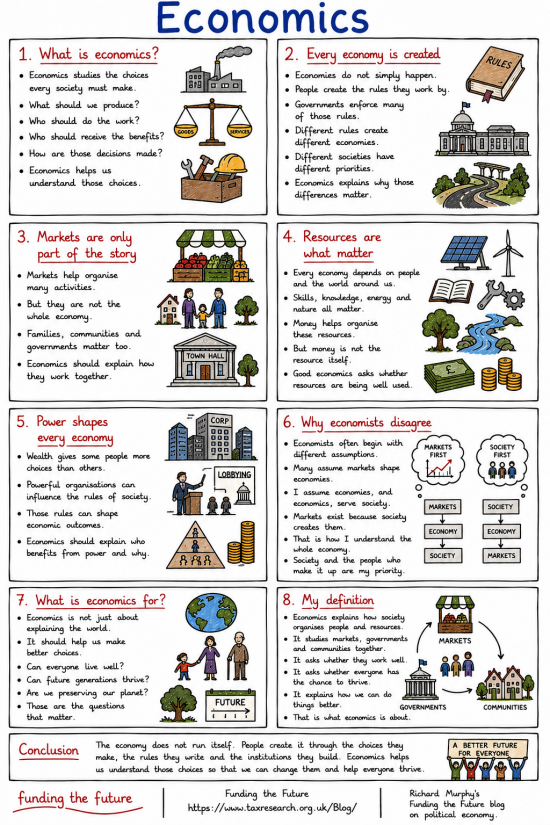
This is the transcript:
Hello, I'm Richard Murphy, and welcome to Understanding Economics, a new series of videos I'm planning on this channel, which is going to be published over months and maybe even years because economics is an enormous subject. But I have discovered over my years involved in the subject, and I've been studying it for 50 years, that it's very often explained in ways that are far more complicated than is required. I want to change that, so in this series, I'll start with the basics and build step by step to the big ideas that really change the world.
My aim is simple. I want you to understand how economies work and how we can make them work better, and that second point is at least as important as the first. There's no point studying economics if we don't make things better as a result. So, the whole point of this series is to improve your ability to make the world a better place.
So let's start right at the very beginning. What is economics?
I have to start by shattering an illusion. Economics is not mainly, or even largely about money. That may surprise many people, but the fact is economics is the study of how any society organises itself when it comes to meeting needs.
But asking that question is not enough. I think economics must ask the question: how can we help everyone thrive? It's not good enough to just meet need. We want to thrive. We want to live well.
So let's start with some basic propositions that I think everyone will agree upon because, well, let's be honest, they're not very hard.
Let's start with the fact that every society has an economy. It doesn't matter what sort of society you're looking at. It has an economy because there are needs and people work to meet them. And so every society must decide what to produce, and then every society must decide who does the work. And then after that, every society must decide who receives the benefits.
Those are the fundamental choices that shape the society we live in. They are what economics is about, in a nutshell. Everything else I talk about in however many videos we make in this series is trying to answer those basic questions.
What do we produce?
Who does the work?
And who benefits?
That's it.
But economies do not simply happen. Every economy is created by the rules a society adopts, and it is governments of any and every sort, and there are a very large variety, that create and enforce many of those rules. So government is central to economics, and different rules create different economies. Change the rules, and you change the economy.
Saying this, I have to shatter another illusion. Just as money is not what economics is all about, nor are markets. Markets are only part of the story when it comes to economics. Markets help organise many activities, but individuals, families, communities, and governments also matter too. They play a major part in the decision-making processes in any economy. And markets are, anyway, just tools, and not masters. We should be the masters. So economics should explain how all these players work together so that people can thrive. Markets cannot do that in isolation, and let's not pretend they can.
And there is something else to note that is also far too rarely said these days. The availability of resources matters most when it comes to economics. Every economy depends upon there being people, knowledge, energy, and nature to meet needs. Money helps organise those resources; that is indisputable, but money is not a resource in itself. Prosperity depends on using resources well. That's how people get to thrive, and so we need to work out how resources are organised in the economy. That's what economics is about.
And there is another incredibly important point, which is often unsaid, and it needs to be added at this point, because when those decisions are made about how to organise resources, power shapes the economy. Wealth gives some people more power than others. Power influences the rules of society. Those rules shape economic outcomes. Economics should explain who benefits and why, and who loses as a consequence and what we can do about it. So, power is an absolutely fundamental component in our discussion of economics.
And it has to be stressed that economists disagree on some of the things I've just said. It's only right and proper that I say that up front because they begin in a different place to me. Many economists start with an analysis of markets. I don't. I start with society. I put people first, not money first. Markets exist because society creates them, and I believe the economy and the study of it should serve society and not the other way round.
But not everyone agrees with me. The opinions I will offer in this series are, however, biased by my view that people come first and that all of economics has to be looked at through that lens. But other people have different views. But let's be clear: they are biased too; they're just biased in a different direction to me. One of the jobs you have as a person who understands economics is to work out what bias you want to adopt, and to be able to understand the biases that other people have adopted.
So, in summary, economics explains how society organises people and resources. It studies markets, governments, and communities and how they can and should work together. It asks whether they work well. It asks who benefits from them doing so, and it asks how we can do better if we want to help people, by which I mean everyone thrives.
If you want to answer those questions, this series is for you. And in that case, look out for more videos. Subscribe to this channel. We do produce a video every day unless something intervenes, like one of us being ill, and look out for those in this series.
We will be putting the economic series in a separate playlist. We will highlight them. You will be able to find them all. Watching them in some broad sequence will probably help, but every topic will be meant to stand on its own for you to watch in isolation, if that's what you want.
I look forward to you joining us for this series. It's going to be an exploration. It should help you understand the world you live in. If it does, it will have succeeded.
Poll
Thanks for reading this post.
You can share this post on social media of your choice by clicking these icons:
There are links to this blog's glossary in the above post that explain technical terms used in it. Follow them for more explanations.
You can subscribe to this blog's daily email here.
And if you would like to support this blog you can, here:

 Buy me a coffee!

This returns to the question of what economics is, and once more places people and their flourishing at the centre. Economics, in this account, is the study of how societies organise the creation, distribution and use of resources so that people can live well together. Provisioning, institutions and care take precedence; markets and scarcity are treated as secondary considerations.The intention is admirable. Few would argue against the aim of living well. The difficulty lies in the shift of emphasis. Once scarcity is set aside as the defining constraint, the hard choices that scarcity imposes do not vanish. They are merely reassigned to those who claim the authority to organise the organising. Who decides what “well” means in practice, and by what process are competing claims reconciled when resources prove insufficient for every declared need? Money is a tool rather than the purpose of economic activity. Yet tools shape what is possible. An accounting system that records claims without regard to the real capacity to meet them does not expand that capacity; it merely postpones the reckoning. The same institutions that are asked to manage societal capital are themselves subject to the ordinary human failings of short-termism, capture and imperfect information.Economics has long been the study of trade-offs under constraint. Redefining it as the management of collective well-being does not remove the constraint. It simply changes the vocabulary in which the inevitable disagreements about priorities are conducted. Living well together remains a proper aspiration. Whether a discipline that begins by softening the language of scarcity is best equipped to deliver the means to that end is a question that still requires an answer grounded in evidence rather than aspiration alone.
Thanks
I used to say – even here – that economics was the study of human behaviour around how money was divided up in society. You’ve taken a step back further to the ‘thinking bit’ and I am happy with that because it humanises the process.
I also used say that economics was social science trying to pass itself off as a technical science (math, formulae and other gubbins) to prove that there were absolute laws and explain it as a phenomenon.
Money is not natural phenomenon like gravity, life or the universe. Mankind made money, and all modern economics does is mystify it in order to allocate it badly.
Great effort.
Thanks
I remember reading the word derives from a Greek term for good housekeeping. (not like Margaret Thatcher’s housewife economics ) Stewardship might be another.
I got google AI to define.
Stewardship means the careful and responsible management, care, or control of something that belongs to someone else or is shared by everyone. It is the job of looking after a resource and making sure it stays safe, healthy, and strong for the future.
I think that covers it quite well.
The word “economics” – oikonomikos – is about the way to run a family or household. We extrapolate from the smallest social group to much larger ones – communities, cities, states, the world.
The household analogy sits at the heart of it and immediately misleads us through the fallacy of composition: the whole does not have the same characteristics as its constituent parts.
There are economics – of exchange or barter, or gifts and expectation, or duty and care and mutual obligation – even in communities and societies without currency or money.
Notably, the internal economy of the family or household is very different to the economy of our larger society. Few of us are paying our partners or parents for cooking and cleaning and other domestic care services provided. The true household analogy would value each person as a brother or sister, and would not be so focused on the income each brings or the debts each owes.
Agreed