
What is income? It sounds like one of the simplest questions in economics, but the answer matters enormously.
In this episode of Understanding Economics, I argue that income is not simply money received or money spent. At the level of the economy as a whole, income is the real value we can create and use without leaving ourselves and our planet worse off.
That distinction changes how we think about wages, profit, interest and rent. Conventional economics treats all four as forms of income.
But do interest and rent actually create anything, or do they transfer income created by other people?
And how much corporate profit represents genuine enterprise rather than economic rent extracted through ownership, market power or the extraction of value from labour?
There is an even bigger issue. If economic activity depletes natural resources, destroys environmental capital or consumes assets that cannot be replaced, can we really describe what results as income? Or are we mistaking the consumption of capital for a false measure of prosperity?
That question takes us directly to climate change, inequality and the way we measure economic success.
Understanding income means asking where value really comes from, who creates it, who receives it and whether our apparent prosperity can be sustained.
This is part of my Understanding Economics series, which explains economics from first principles and asks whether the conventional answers still make sense.
This is the audio version:
There is no Debate Ammunition for this video. There is, however, this infographic:
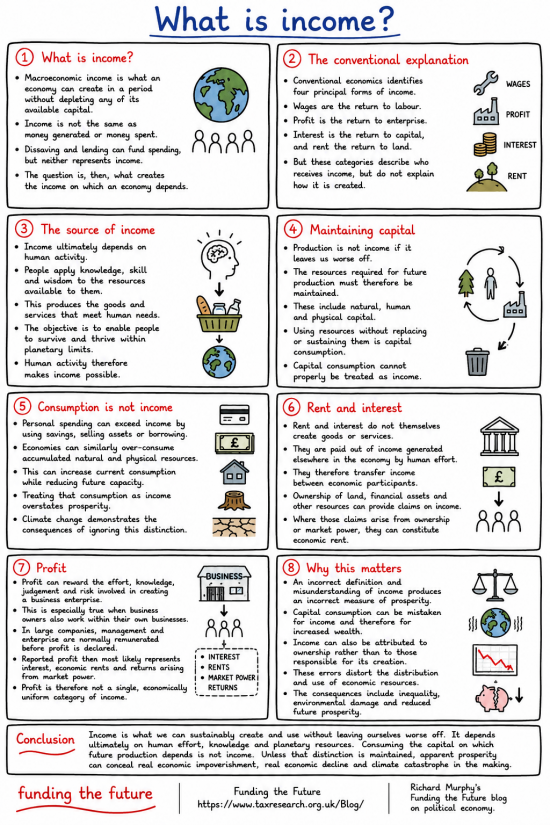
This is the transcript:
Hello, I'm Richard Murphy, and this is Understanding Economics. That's the series I'm creating, which is looking at the key questions in economics as I see it. At the moment we're still working through some of the mega questions in economics, and this video is another one that does that. I'm asking the question: what is income? That is one of the questions that is at the very core of macroeconomics, the economics of a country as a whole.
So, what do we mean by income? Let me be clear. I am talking here about the economy as a whole. I am not talking about the money in your pocket, and they are very different things. I am talking about how we recognise income within the society in which we live. And income is something that we can easily misunderstand. I'll suggest to you during the course of this video that most of conventional economics does, and that is why this video is so important.
Income is what we can use as a society without becoming worse off.
That's it. It's so important. I'm going to say it again.
Income is what we can use as a society without becoming worse off.
Now notice something about that. I'm talking about what we can use. I'm not talking about money here. I'm talking about the resources that are available to us to live on. And economics often confuses that idea of income with money spent, but they are not the same thing.
You can spend savings or borrow money as an individual, but that is not a recognition of income. That is a recognition of a capacity to spend, and they are not the same thing.
Income is real value added by work done in a period.
Again, that's a restatement of that opening phrase I made at the start of this part of the video, but I'm going to say it again because it is so important.
Income is real value added by work done in a period.
So what creates this income we all depend upon? Conventional economics usually describes four types of income.
Wages are said to be paid to people for their labour.
Profit is said to be the reward for enterprise when running a business.
Interest is said to be the reward for the use of capital, and rent is paid for the use of land.
But I'll suggest to you that these labels are deeply misleading. Just because conventional economics calls something income does not mean that it is. That's the whole point of this series about understanding economics. I am reframing economics in a way that makes sense for the 21st century.
So where does income, this capacity to create those things we need to live on, really come from? It comes from us, of course; it comes from people; that is its only source. People use their knowledge, their skill, their wisdom, to make use of naturally available resources to create income. It is that combination that we create that means that we can survive and then thrive within the limits of our planet.
We make income possible. Nobody else can.
But what I stress is that we cannot describe everything we can do and everything we can make or produce as income. That's because it is not income if producing it uses up resources that we will need again, and we either do not replace them or they are, in fact, irreplaceable.
We only create income if, at the same time, we maintain the capital on which its production depended. That means we must ensure that nature, human capital, and physical capital, such as buildings and machines, are preserved as we create what we can describe as income.
Consuming capital is not the same as creating income. If we use up more capital resources than we replace or maintain during a period, then we are consuming that capital, and we can consume more capital than we create for a while. Personally, we can spend more than our income by using savings, selling assets, or borrowing.
At a macroeconomic level, we can do the same thing. We can eat up inherited capital resources we've got from a previous generation, or just last year, and we can deplete the planet's resources available to future generations. But we cannot call that excess consumption income because it is not. If we consume more than we make, we can create a false picture of prosperity, and climate change makes this very clear.
If we consume our planet beyond its ability to replenish itself, we are not creating income at all. We are destroying the host that provides us with the opportunity to live here. That is the contradiction that I am highlighting here. It is the contradiction that nothing in conventional economics talks about.
So are there other contradictions inside conventional economics? Yes, there are.
Let's talk about interest and rent. They create another contradiction. That's because rent and interest do not, of themselves, represent income. They can't because neither represents the creation of new goods or services, but income is only recognised when those things happen. Instead, they represent transfers of income created by people. They transfer income from those who created it to those who own land, financial assets and other resources. In that case, rent and interest are what economists call economic rent. That means they are an extraction of value; they are not a creation of value.
The recognition of the income created by some people as a result of their economic activity, as the income of those who are claiming they have earned rent and interest, is a recognition that we have economic rents within our economy. It is not a recognition that rent and interest are actually a contribution to income at all. The income is created by human endeavour, but those who undertake that endeavour are not enjoying the benefit.
So what about profit? Is that really income? The answer in this case is yes, and no. Profit can exist. It exists in smaller businesses in most cases. It reflects the return to some people who combine their effort, knowledge, wisdom, and the risks they take to create businesses. They create a surplus value as a consequence over and above what they could earn as labour, and that combination is called enterprise, and profit is the return to the people in question. I do not dispute that this exists.
But when we come to larger companies, things are very different. Any enterprise here belongs to employees, and they are paid for it, admittedly, often excessively because they are the directors and senior employees of these companies who earn very high rewards for the enterprise that they might bring to the activities of larger companies. But the cost of employing them is treated as a business cost before the profit of these companies is declared. And so large company profits, in that case, almost always actually represent economic rents instead of the profits seen in smaller companies.
Some of the profits of larger companies does, of course, come from rents. The business of some larger companies is letting out property.
And some more of the profit of larger companies can represent interest earned, especially in banks and finance companies.
But another rent comes from exploiting market power. Companies like Amazon, for example, can earn returns above those which we would normally expect because they control much of their market. Banks and supermarkets in the UK can do much the same thing. They earn what economists call supernormal profits because they lack effective competition.
And they also profit by not paying the people they employ the full value of what they create. Those profits which are extracted from employees are another form of economic rent.
So why does all this matter? We have to get our concept of income right if our economics is to work. We can mistake consumption for income. The conventional economics that most people have been taught does do exactly that. It says we can consume our capital and think that we are getting richer as a result, but that's a massive mistake that we've been making.
We have been getting poorer as a result of consuming capital rather than richer, and we have been fooling ourselves. This is why we need to understand what income is, while recognising the constraints upon it, which require us to make the economic choices that characterise the whole discipline we're discussing.
In addition, by misunderstanding income, we can misdescribe it, and we can also underpay it to those who really created it, who are human beings going out to work. As a consequence of underpaying them, we misrecognise it when we describe rent and interest as income, and we often do so as well in the case of profit. The result can be poor resource management, environmental damage, and greater inequality. And none of those are doing us any benefits at all.
So what should we remember?
First, we should recall that income is what we can sustainably create and use without destroying the resources we will need in the future to recreate that income stream when we come to need it again.
Second, income ultimately depends on human effort, knowledge, and the resources of the planet.
And if we get confused about these things, we fool ourselves into thinking we're becoming richer when we are actually becoming poorer.
Conventional economics has confused these issues. That is why we have crises like that on climate change. We have to understand income. Doing so means rethinking everything we know about economics, and that is what this series called Understanding Economics is all about.
All the videos in this series are linked below this one. You can find a playlist there, and the videos are produced in broadly the order in which you need to understand things, so I suggest starting with the first and working your way through.
If you do, and if you stick with us, and there are going to be a lot of videos in this series, you will begin to understand economics in an entirely new way. A way which can guarantee that we can survive, our planet can survive, but more than we can survive; that we can thrive. That is the goal that I am aiming for. I want people to do well in this world when so many at present do not. That is a possibility that we can create, but only if we understand economics in a new and better way.
Poll
Previous posts in this series
- Understanding economics: Introduction Article
- What is economics? Article. Video. Infographic.
- What is the economy for? Article. Video. Infographic.
- What is microeconomics? Article. Video. Infographic.
- What is macroeconomics? Article. Video. Infographic.
Thanks for reading this post.
You can share this post on social media of your choice by clicking these icons:
There are links to this blog's glossary in the above post that explain technical terms used in it. Follow them for more explanations.
You can subscribe to this blog's daily email here.
And if you would like to support this blog you can, here:

 Buy me a coffee!


This feels like a very important distinction – value v. money. I am totally in agreement with your approach but this does have some wide ranging consequences.
I take it that there is a difference between the vernacular definition of ‘income’ and the economist’s one. If income is value increase then there is a need to quantify that and popularly that would be money. How else would we measure that? Perhaps in those wellbeing economy terms, the reduction of poverty, those meaningfully engaged in work.
The other part of the definition requires there to be no reduction in resources or at least that those resources can be replaced. This would appear to be more problematic as the only replaceable resource is something that grows. We cannot but use up resources without borrowing from elsewhere to maintain a stock and in this case we borrow from the sun and the residual heat of the earth’s core.
Strictly that would mean only production of food and use of materials that grow should form part an economy. This is not impossible and has been the way of many indigenous tribes. It is, though, an unlikely scenario for the forseeable future.
Should we then include other inorganic materials that have already been produced and re-use them as per the ‘circular economy’? Power would similarly need to come from natural sources but of course the means of securing that requires the use of inorganic materials which by definition would become fewer as recycling is never 100%.
I don’t see how we can return to an even balance sheet for many decades without a large drop in production and people but I do appreciate you probing these questions.
As you say, these are difficult questions, but we have to recognise their relevance.
As you say Richard – it is all created by people – ‘human activity’ its the Labour theory of Value – as Marx put it.<p>
As the comment above mentions- ‘vernacular’ definitions of income can muddy the water.<p>
‘Income’ can imply a flow – rather than a store? <p>
The requirement for not using up of resources – would suggest a ‘net increase in value’?<p>
Am not feeling very bright today.
On this Marx was essentially right
Income can only be a flow
Capital is a store.
Not using up resources is steady state.
In box 7 of the infographic (profit), I’m struggling a little to understand how the 4th bullet point follows as a logical consequence of the 3rd.
Would you mind elaborating on this, or pointing me in the direction of somewhere else where you’ve explained it in more detail?
I confess I struggle to see how it does not follow.
If the profit these companies declare is not profit as properly defined and cannot be a return to labour, it must be a rent.
Are these valid definitions?
(1) profit = revenue – costs
(2) revenue = returns to enterprise + rent + interest + returns to market power
And if we then further assume that:
(3) the wages componenet of costs >= returns to enterprise (i.e. workers in aggregate are paid at least according to the value they add to the existing stock of capital?)
then it follows that:
(4) profit = rent + interest + returns to market power
(i.e. returns to enterprise disappeared from declared profits as we assumed in (3) these were all accounted to wage costs)
But then my question is, why assume that wages >= returns to enterprise? Marx (for example) assumed that wages < returns to enterprise (i.e. capitalist exploitation of labour, with capitalists paying workers less than the value their labour adds to the stock of capital). If that is the case then profits declared necessairily include return to enterprise again, don’t they? I’m not saying I think Marx was right (or wrong) here, just that your conclusion about profit seems to depend on some extra assumptions about how labour costs are handled that aren’t self-evident to me.
Apologies if I’ve missed something obvious here. I’m just trying to understand what you’ve written. If I’m still confused about the foundational definitions then other things wont make sense to me either.
I think you are making this more complicated than I intended, because I would not accept equation (2).
Accounting profit is certainly:
profit = revenue − costs
However, revenue is a broad brush covering income a business receives from supplying goods and services, plus other sources as well as realised and unrealised gains. It is not as such an accounting sum of returns to enterprise, rent, interest and market power. Those things are, however, possible explanations of how the resulting income can be described in economics, which is a very different discipline. You need too understand that I am working on the boundary between the two.
That is also important when it comes to wages. I am not assuming that wages are equal to, greater than, or less than the value created by labour. I am saying that labour in accounting is a cost, and not a part of profit. But, profit can include value extracted from that labour. There I agree with Marx.
My argument is that human beings, using their knowledge, skills and wisdom, organise resources to create goods and services. That is where new economic value ultimately comes from.
Profit can reward the genuine contribution of an entrepreneur who works, organises, innovates and takes risk. I explicitly acknowledge that.
But recorded profit outside small enterprises usually comprises returns arising from ownership, interest, economic rent, monopoly or other market power, and it can be overstated if the business fails properly to account for the natural, human or other capital it has consumed in producing it.
So I am not claiming:
profit = rent + interest + market power.
I am saying that the accounting number called profit does not tell us why that profit exists or who actually created the value from which it arose.
Thanks for taking the time to reply in such detail. It seems I simply misunderstood what you were claiming about profits. Now I am not worried about it.
I think I’ll spend some more time reading about how business accounting works. I’m pretty ignorant about that. I’ll also look into your Sustainable Cost Accounting framework 🙂
It’s a massive issue