
Most people think economics is about money.
It isn't.
Economics begins with something much more fundamental: resources. Every society has limited resources and must decide how best to use them. Those decisions shape our lives, our prosperity and our future.
In this episode of Understanding Economics, I explain what economists should really mean when they talk about resources. Human labour, knowledge, wisdom, natural resources, energy, capital, education and institutions all make up the wealth on which every economy depends.
Money, by contrast, is not itself a resource. It is simply a claim on resources. Understanding that distinction changes the way we think about economic policy, government, markets and inequality.
I also explain why capital maintenance matters. If we consume resources without replacing or renewing them, future generations become poorer than we are. Economics should therefore be about stewardship as much as production, ensuring that we preserve, develop and improve the resources we inherit.
This video is part of my ongoing Understanding Economics series, which starts with first principles and builds towards explaining how modern economies really work.
If you'd like a clearer understanding of economics without unnecessary jargon, this series is designed for you.
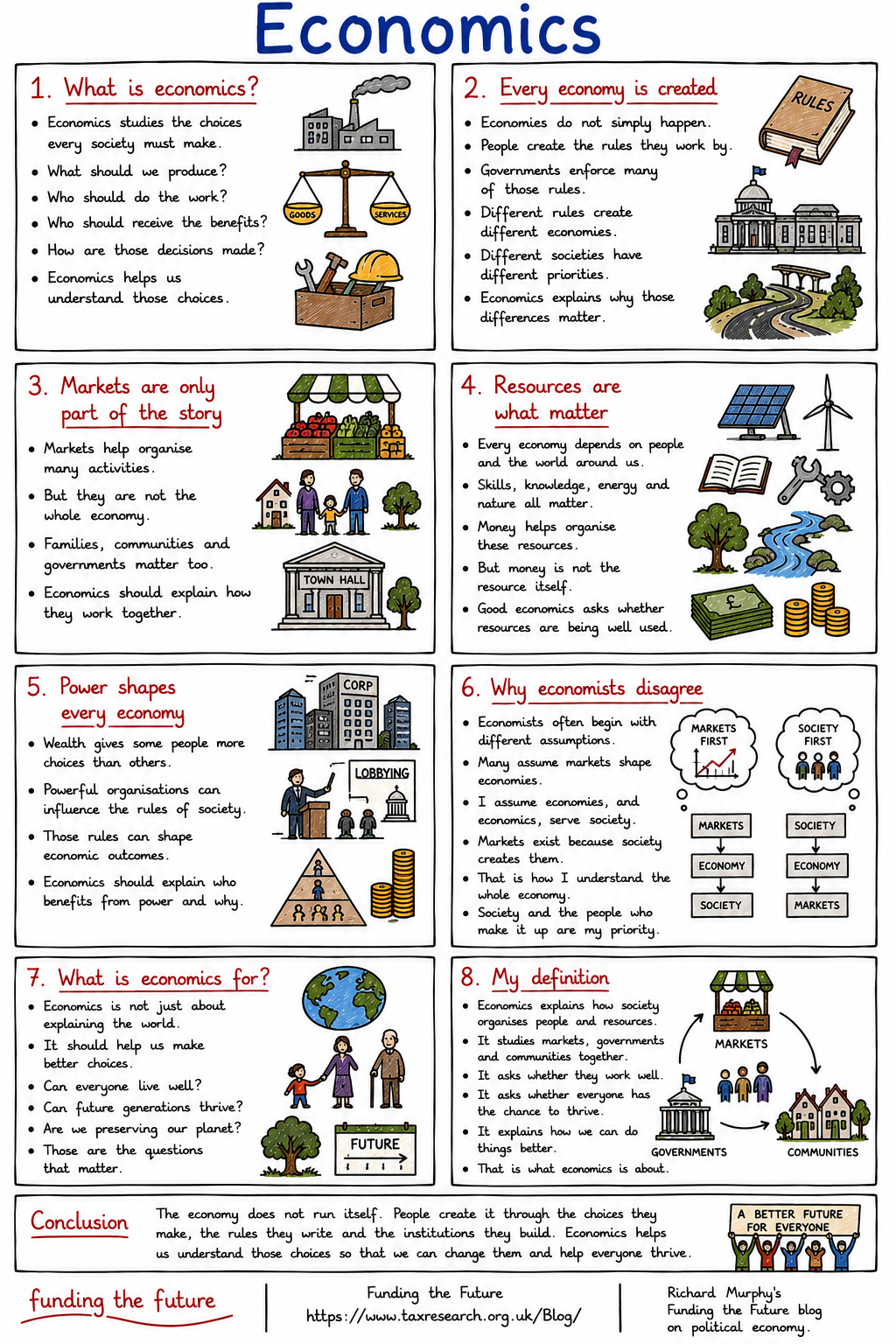
This infographic supports this video:

This is the audio version:
The Debate Ammunition for this video is available here.
This is the transcript:
Hello, I'm Richard Murphy, and this is Understanding Economics, my series that is designed to help you understand this complex subject, which does, however, touch every aspect of our lives.
In previous videos in this series, I have talked about what the economy is and that we need to make economic decisions, but why is that? It is because every economy throughout history, and now, has finite resources available to it. That is why we must make choices.
Those choices should reflect what the economy is trying to achieve, but all of economics begins with scarcity as a result, and not with money. The question is: what are those resources about which we have to make decisions? That is the subject of this video.
And the first of those resources is the greatest of all. It's us. It's human labour. It's you, and it's me, and it's everybody else on this planet. The economy exists to meet our needs. That is something we should never forget, and it can only do that because our work creates value. We are the greatest creators of all. And some work is paid, and some is not, and that matters. Care and voluntary activity are real economic activities, and we should take note that they exist. The point about work is that we do it for each other, and whether we're paid or not does not matter. We create value as a result, and it would be a very small economy if we did not.
And saying all that, I must mention that our work is informed by something else, which is our intelligence, and that provides us with two essential capabilities. Knowledge lets us know how to do things. Wisdom helps us to decide whether we should do them. Economics needs both these qualities, but too often it only values knowledge. We should never forget wisdom because how we make decisions is as important as what we do once we've made the decision, and both are wrapped up inside our intelligence.
And what do we do with our intelligence? Well, we use the Earth's resources. That's what we always do. Everything we use begins in nature. Minerals, metals, timber and fuels all come from our planet. So do food, clean water and clean air, and we cannot do without them. We depend entirely upon natural systems. Without them, we would simply not be here. But we need to remember that some natural resources can be renewed by nature itself. They are by their very nature renewable. And so long as we steward them well, they will replenish themselves, and that means that we get the chance to use them again.
But that is not true of everything that we use. Some resources that we use can be used once, and then they're gone forever. The transformation is final. That is why we must look after our resources and steward them for future generations.
This stewardship is vital. It is what creates the shared inheritance that we received and that which we will pass on. And this is something that is called capital maintenance. And we should remember that when we're talking about the management of our resources. Capital maintenance is what guarantees that we leave the world in as good a place when we depart it as we inherited when we arrived.
And looking at all of this, there is one other essential ingredient, and that is energy. Ultimately, all our energy comes from the sun. But, and this point is absolutely vital: we know from physics that energy cannot be destroyed, but every use of it makes it less useful to us by increasing what is called entropy, which is the state of chaos within our planet. Essentially, once we use energy, we release heat, and as our planet heats, it becomes more unbearable to live upon. And so we have to use energy efficiently and keep the entropy we create as low as possible. That is essential if our planet is to sustain future generations, and we have a duty to them to make sure that it can.
In the shorter term, we put together a lot of these resources into something that we call capital. Now, capital exists at a point of time. It is a human construct, but it is one of the resources that we manage nonetheless. Capital is the benefit of past work saved for future use. That is the simplest definition that I can find or create, because I think I made that one up.
It includes machines, buildings, infrastructure, and stored goods. Every form of capital, however, eventually wears out. It is our job to maintain, renew, and develop it. Capital maintenance is then an essential feature here as well if future generations are to benefit from what we create.
We have a duty to pass on as much capital to the people who come after us as we inherited from the people who came before us. In fact, if they are to live better, and that is very often our aspiration, we should pass on more rather than less capital, and that means that we should be measuring the capital that we have.
And let's not forget that capital involves more than mere physical products like computers, cameras, microphones, and other such things. Capital involves education as well. Knowledge does not appear by accident. Education turns one generation's discoveries into the next one's starting point. It does therefore become capital in its own right. But learning never stops and helps us use every other resource better. So investing in education creates a form of capital in itself: human capital. Education maintains, renews and develops that human capital for the benefit of generations to come. Capital maintenance appears here as well, then.
And institutions are part of capital too. Governments, communities and families sustain our society. Markets exist because institutions are created that provide the rules of their operation. Public services are part of institutional capital. Democracy lets us decide how these shared assets should serve us. If we are to live together, we need to maintain this form of capital as well. We must maintain it. We must renew it, and we must develop it. We cannot take it for granted. Government and all the institutions of our society matter. We must care for them.
And where does money come into all of this? Well, money is not in itself a resource. It's incredibly important to point that out. All the things I've talked about so far are resources; money is not. Money represents a claim on those resources. The ownership of money changes who has the power to make decisions as a result. If you can claim more resources as being under your control, you have more power to decide. Economics must therefore ask the question: who does control resources, and not just who owns money, because the two are intimately related, but it is the control aspect that is the more important one that we should be considering.
And we must also ask the question: how can we give a voice to everyone so that everyone has a chance to participate in this control over the decisions that manage the resources available to us in this world? It is resources, and not money, that matter most in our world, and that is why we must consider how the decision-making processes around both are managed within our economy.
So, resources matter. Our responsibility is to preserve, renew, and develop every one of the resources we inherit, and to improve them for generations to come. That is what capital maintenance involves. We cannot have an income until we have ensured that we have preserved what we have for the benefit of those to come in the future, ourselves included, of course. If we fail to do that, future generations cannot become better off than we are. We cannot be sure we'll survive the next year.
And so these ideas about resources are in themselves constrained, and we come back to that point. We have to make decisions because we cannot do everything. Resources are finite. This planet is finite. We are finite, and therefore we must make decisions. Economics is about how we make better decisions, but we have to establish the framework within which we do that. That is why considering the management of resources is so important in any economics that is really about human well-being and how we thrive.
Down below, you will find a list of the other videos in this series. Please take a look. They all hang together. They come out in order. If you haven't seen any earlier ones, have a look, because they will help you understand the way in which this series is progressing, and it's going to be long. There could be 50 or more videos in this series eventually. So take a look now and prepare yourself for what's to come. We are on a journey which we'll take together, and this could become something really important as a resource so that you can better understand the world that we live in and how we can all contribute to it, manage it, and survive it.
Poll
Previous posts in this series
- Understanding economics: Introduction Article
- What is economics? Article. Video. Infographic.
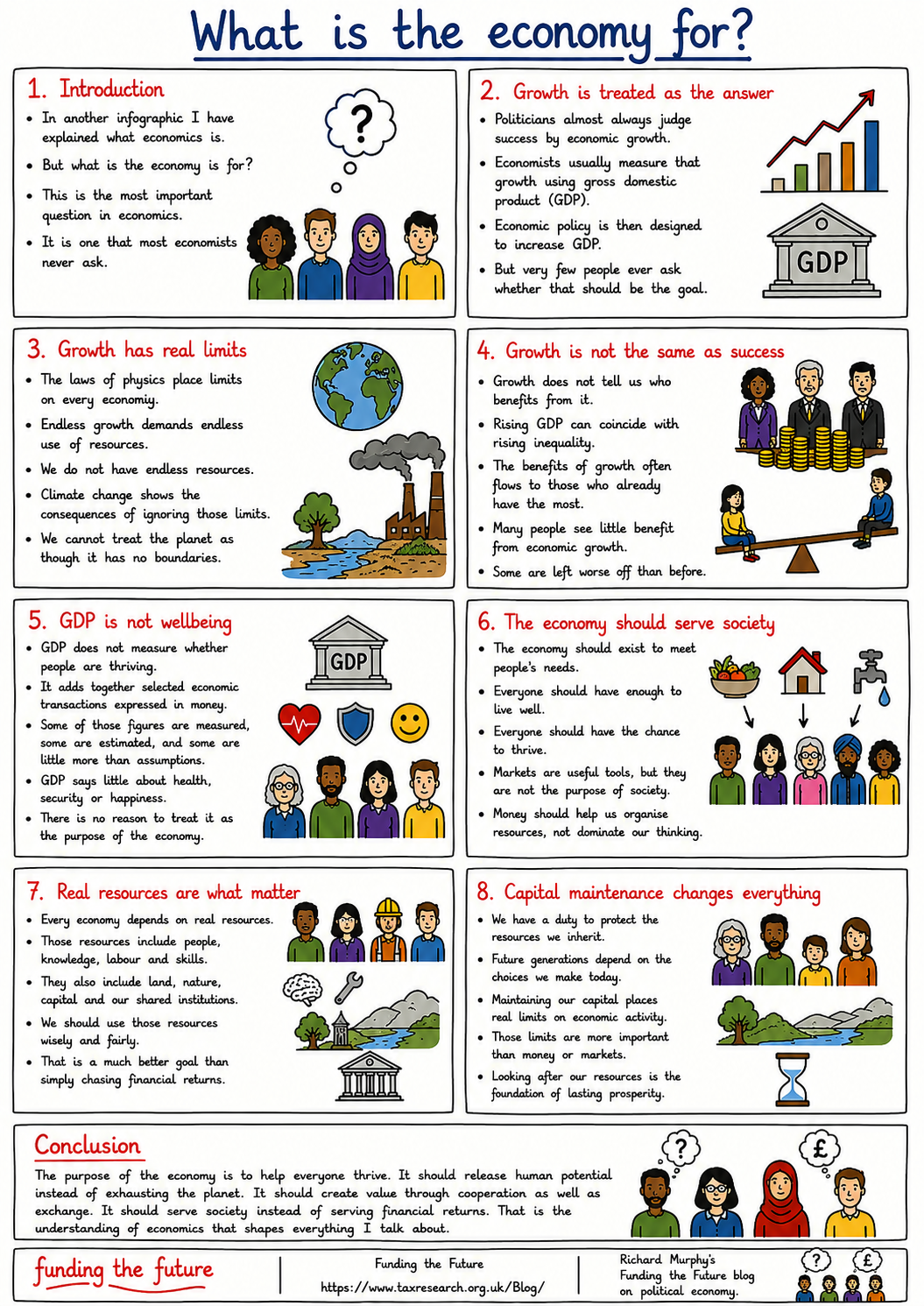
- What is the economy for? Article. Video. Infographic.
- What is microeconomics? Article. Video. Infographic.
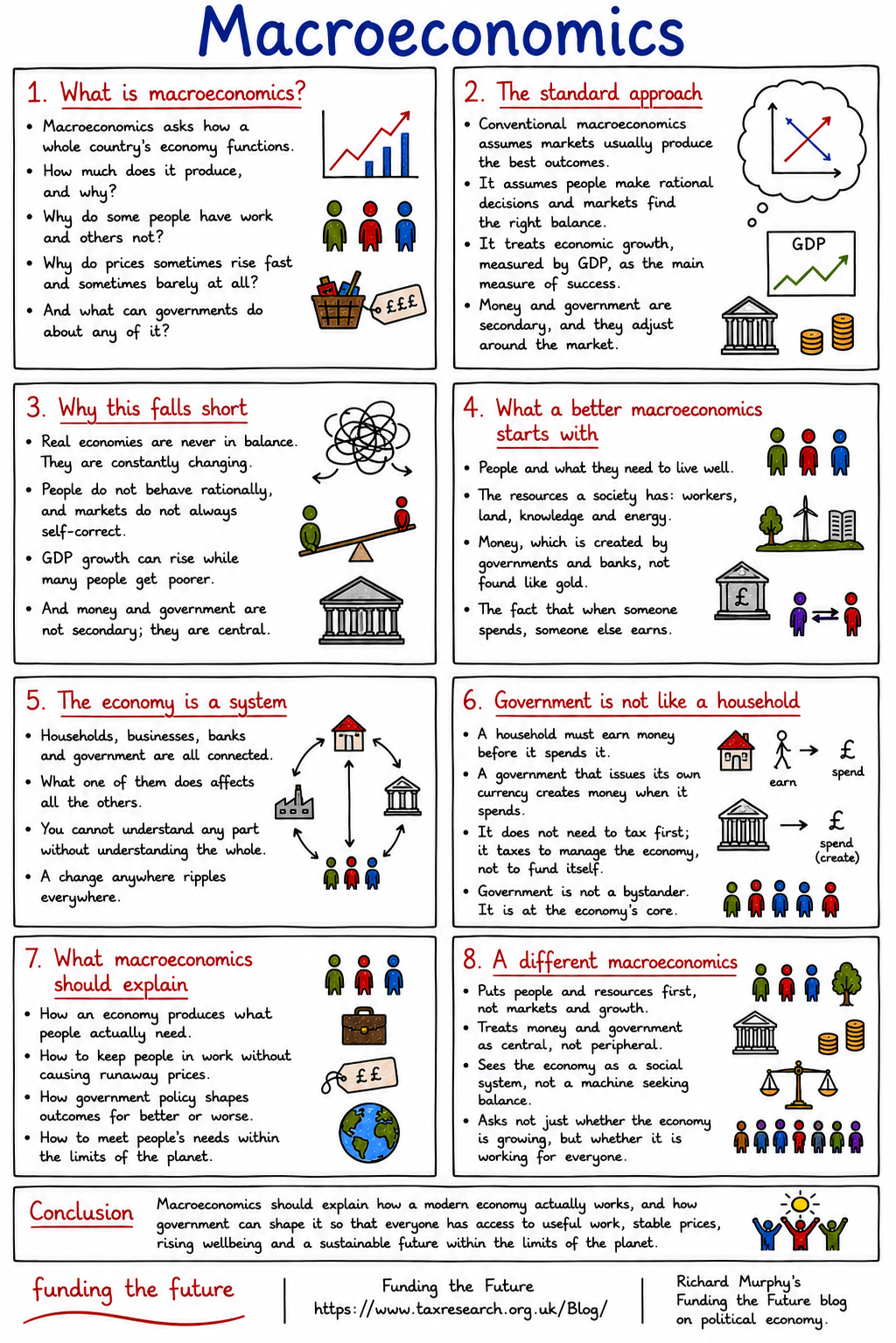
- What is macroeconomics? Article. Video. Infographic.
Thanks for reading this post.
You can share this post on social media of your choice by clicking these icons:
There are links to this blog's glossary in the above post that explain technical terms used in it. Follow them for more explanations.
You can subscribe to this blog's daily email here.
And if you would like to support this blog you can, here:
 Buy me a coffee!



Thanks to all for the economical power if this piece.
Might the money-wealth polatisation of Austerity/Neoliberalism have the submerged intention and the increasingly visible results of the polarisation of socio- economic contexts and largely one way political communication?
Prior to their revolutions, might the then govermments of France and Russia have been operating “avant la lettre” forms of Neoliberalism?
Might the proponents of Neoliberalism have no grandchildren?
Probably the best infographic so far of an excellent series for me. This one really clarifies the overall aims and objectives, present and future. This one is the overall grand plan with all the others being details of the various mechanisms that attempt to implement that plan with varying degrees of success, the pieces fell into place reading this one. Box 3 is particularly telling.
This one was very challenging to write for all the reasons you note.
My conclusion then from your infographic is that we do not really have an economy at all – modern capitalism is a monopoly model of resource allocation to the few, abusing money power by making everything into some sort of market commodity – sold to us under the guise of ‘choice’. Our ‘choice’ is just an opportunity to the rich to exercise their choice for having more and more.
Therefore even this market is not really a market, it’s just a place for capital, the already rich – a shop window – to acquire and monopolise other people’s assets and further enrich themselves and reduce the wide distribution of assets and benefits which a real economy is actually about.
There is more to come on this….
Richard, I think you have touched upon it here, but along with the laws of thermodynamics and the conservation of energy, is capital similar to energy? We can neither create or destroy capital, only transform it from other forms of capital? Can we assume we have finite capital except for that energy flowing in from the sun, so while some people may accumulate financial capital, and produce physical capital, it may only be at the expense of natural and human capital, and this may impact social capital. So while me may have a multiplier effect, we may also have a divisor effect, or entropy where we negatively impact capital, resulting in a massive liquidation of foundational capital stock, leading to an irreversible “Entropy Tax” and a net deflation of systemic planetary wealth? I am not sure I have fleshed this idea out properly, but it might help inform people that you cannot necessarily accumulate capital, with subtracting capital elsewhere, giving more reason for your care economy and restoring capital stocks, and managing resources very carefully, especially natural capital which is so much harder to restore.
Capital is not conserved in the way that energy is. We can create and restore capital. If we educate someone, develop knowledge, build a railway or restore degraded land, we can increase human, intellectual, physical or natural capital.
Equally, capital can be destroyed.
But I think your more important point is right. We frequently claim that we are creating capital when we are actually converting one form of capital into another, whilst ignoring what has been lost in the process.
Cutting down a forest might create financial profits and physical assets, for example, whilst destroying natural capital.
Overworking people might increase measured output whilst degrading human and social capital. GDP and conventional accounting can record the supposed gain whilst largely ignoring the loss.
That is precisely why capital maintenance matters. Before we claim to have created income, we have to ask whether we have maintained the stocks of natural, human, social and physical capital upon which future wellbeing depends.
See the video coming on Monday on this.
I am less convinced by the term “Entropy Tax”, because it risks making an economic argument sound like a claimed law of physics. But the underlying insight is important: apparent economic gain can actually represent the liquidation of the capital on which our future depends.
And when natural capital is irreversibly destroyed, no amount of additional financial capital can necessarily replace it. That is the fundamental problem conventional economic accounting so often ignores.
This is so good. It is my favourite in this poster series. Thank you.
It was one of the hardest to write, but not as much as tomorrow’s.