
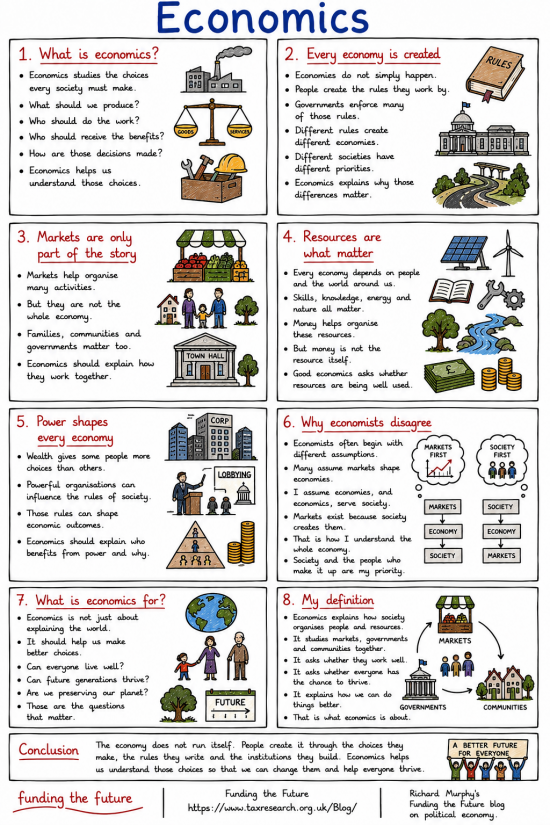
This is the first in a series of infographics which will continue with:
- Microecnomics
- Macroeconomics
- Political economy
- The household analogy
- And more.
How to expand this image
If you press CTRL or Command and Plus (+) on your keyboard, your browser should increase the size of your page every time you do this. Press CTRL or Command and the Minus (-) key together to restore the screen to normal. I can get to at least 2 times the normal size by doing this.
How to download this image.
If you right-click the image, you should be given the option to download it to your computer. So long as you do so without a view to making a profit, you may do so without further permission. Commercial use requires consent. But if you just want to share it, do so with whoever and wherever you want. That is the purpose of these infographics.
The image library
We are planning a library of these images. It will be available soon.
AI use.
In some way or other, I used AI in the creation of this post. I disclose how I use that technology here.
Thanks for reading this post.
You can share this post on social media of your choice by clicking these icons:
There are links to this blog's glossary in the above post that explain technical terms used in it. Follow them for more explanations.
You can subscribe to this blog's daily email here.
And if you would like to support this blog you can, here:

 Buy me a coffee!

I believe Jeremy Corbyn suggested that there should be a QE for the people and then I began to wonder how that would work. Then I realised I am not that clear on the mechanism of any QE.
Would you perhaps consider an infographic to explain this?
I wrote that version of QE.
There is an infographic on QE coming, and QT and People’s QE – the Jeremy version.
So I guess you know more than me!!!!!!
On this one, maybe
Very helpful. It seems to me that economics is rather like the law. Both cannot be described as a science. They are, at best, an art form. However both are used as a means of legitimising the existing power structures within society. They are used to stifle debate and to undermine alternative viewpoints. The adherents to the prevailing orthodox ideology that underpins current thinking like to argue that their thinking is nothing less than a self-evident “truth”. But we know that economic and jurisprudential orthodoxy can change over time. I am old enough to remember when the views of Hayek and Friedman et al were seen as eccentric to say the least. Now Keynesian economists are viewed in that same light.
Much to agree with.
Thank you for continuing to provide these very helpful and highly valuable infographics. The following is meant as constructive comment. I see that you sometimes use the first person, as you do in the Economics infographic here. To me, this slightly lowers the impact. In Box 6, the essential statement (bullet point 4) is that markets exist because society creates them. Bullet points 3 and 5, expressed in terms of your assumption and your understanding, detracts from that paramount fact, in my view.
Economics is all about opinions. To pretend otherwise is to mislead.
Under MMT is the idea of a Government deficit and Government debt illusory?
Under MMT does the State continue to pay the money markets for the money it creates through the issue of Government bonds? If not, what is the status of existing Government bonds?
These points have been addressed here many times.
`
Government deficits are not illusory, but they are often misunderstood\. A government deficit is simply the amount by which government spending exceeds taxation in a period\. That deficit is matched by a surplus somewhere else in the economy, either in the domestic private sector or overseas\. In other words, the government’s deficit is the source of someone else’s financial surplus\.
The same is true of government debt\. It is not an illusion\. It exists\. But what is called the national debt is, in reality, the total stock of government liabilities that the private sector chooses to hold as part of its savings\. Looking at it from only one side of the balance sheet has led to endless confusion\.
As for government bonds, MMT does not require them to finance government spending\. A currency\-issuing government creates the money it spends first\. Bond issuance is a separate operation\. Today, governments continue to issue bonds because that is how the present monetary system has been designed to operate\. Bonds provide a safe savings asset for pension funds, insurance companies and others, and they also help central banks manage interest rates\.
Existing government bonds remain legal obligations of the government\. They are honoured as they fall due, with interest paid according to their terms\. The point MMT makes is not that bonds are meaningless, but that they are a policy choice\. A government that issues its own currency does not need to borrow before it can spend\. It issues bonds because it has chosen to organise its monetary system in that way, not because it has no alternative\.
Regarding the information on how to magnify the image. CRTL and minus (-) keys reduces the size in the same way as CTRL and plus (+) increase it.
CTRL and zero (0) resets the image back to its original size in one step.
Thanks
[…] first, on economics, has been […]
[…] first, on economics, has been published, as has that on […]
[…] Economics […]
[…] Economics […]