
In this latest video in my Understanding Economics series, I look at an idea economics has been missing for the last forty years, and it is one of the ideas that matters most: resilience. The big deal is not growth, nor efficiency. It is, instead, the ability to withstand shocks and adapt when things change.
Resilience means preparing for hard times while things are still going well.
It means knowing what to do when circumstances change, and having the resources ready when you need them.
Without it, income and wealth are temporary: they can evaporate within a day or two.
For individuals and companies, resilience is largely about money or savings, and access to borrowing. But for a country like the UK, which issues its own currency, money is not the problem. The government can always create it. The real constraint is physical, and is whether we actually have the resources, the spare capacity and the backup systems to solve a crisis when it arrives.
That is what "redundancy" means: the spare tyre in the boot, the generator in the hospital, the second water supply. It is keeping extra capacity available even when it feels wasteful in the good times, because that is what keeps things running when something goes wrong. And it is exactly what neoliberal “just-in-time" thinking destroys. Just-in-time is a trick to minimise cost, and it delivers systems that are completely unsustainable.
The US has just proved it. It burnt through vast stockpiles of missiles in its fight against Iran, and discovered the lead time for replacement is too long to sustain a war.
Governments have to invest in infrastructure, energy, skills and public services, and build in spare capacity before a crisis strikes. Without resilience, an unexpected problem becomes a full-blown crisis: supplies run out, systems fail, companies collapse, and people suffer. Resilience is not a luxury. It is the difference between weathering the storm and being destroyed by it.
This is the audio version:
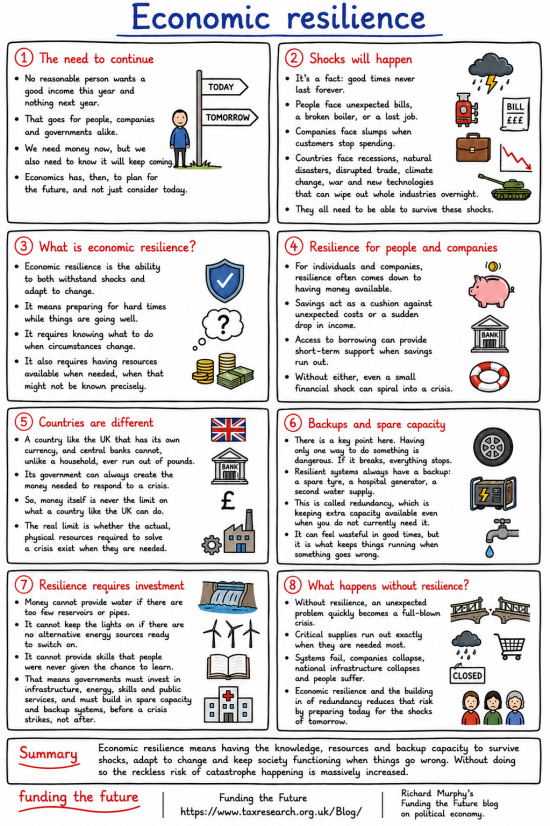
There is no Debate Ammunition for this video, but there is this infographic:
This is the transcript:
Hello, I'm Richard Murphy, and this is Understanding Economics, the series that I'm making that asks fundamental questions about the way in which our economy is managed and seeks to provide better answers to the questions I suspect you have on how the economy should work.
In this video, I want to talk about economic resilience. That's really important. Why? Because we can talk about income and we can talk about wealth, but unless we have economic resilience, neither of those things will last, and that's what resilience is all about.
No reasonable person wants a good income this year and nothing next year. No one wants to think themselves wealthy now and that it will all vaporise within a day or two.
That's true for people. It's also true for companies, and it's true for governments as well. We might need money and things now, but we also need to know that our incomes will continue into the future. Economics has, then, to plan for that future and not just consider outcomes today. But conventional economics has focused on today and ignored the future, and that is why we need to consider this issue and the impact that it has on the way in which we think about economics.
Let's be clear, good times will never last forever. We know that. People will face unexpected bills, a broken boiler or a lost job. Companies face slumps when customers stop spending, and countries face recessions, natural disasters, disrupted trade, climate change, war, and new technologies that can wipe out whole industries overnight. AI is the potential great example of that.
All of these things create situations that we need to be able to survive if we are to be resilient and face the future with confidence. And economic resilience is the ability to both withstand shocks and adapt to change. It means preparing for hard times while things are going well. It requires knowing what to do when circumstances change, and it also requires having resources available when needed, when that might not be known precisely.
For individuals and companies, resilience often comes down to having money available. Savings act as a cushion against unexpected costs or a sudden drop in income. Access to borrowing can provide short-term support when savings run out. Without either, even a small financial shock can spiral into a crisis.
But for countries, things are different. A country like the UK that has its own currency and its own central bank cannot ever run out of money, unlike a household. Its government can always create the money that is needed to respond to a crisis, so that will never become a constraint upon handling any such situation. The real issue that a country has when it is facing a crisis is whether the actual physical resources required to solve the problem that it is facing exist when they are needed.
And there is a key point here. Having only one way to do something is dangerous. If it breaks, everything stops. Resilient systems, and that's what we're talking about, always have a backup. A spare tyre, a hospital generator, a second water supply. This, in technical terms, is called redundancy, which doesn't mean these things are useless. It means that we're keeping extra capacity available for when we need it, but we don't necessarily know when.
This can feel wasteful in good times, but it is what keeps things running when something goes wrong, and that is the vital relevance of building redundancy into any system.
Money cannot provide water if there are too few reservoirs or pipes.
Money cannot keep the lights on if there are no alternative energy sources ready to switch on.
It cannot provide the skills that people need in a time of crisis, but were never given the chance to learn.
That means that governments must invest in infrastructure, energy, skills, and public services, and must build in spare capacity and backup systems before a crisis strikes, and not after it.
Without resilience, an unexpected problem quickly becomes a full-blown crisis. And we've seen examples of this all over the world now. Critical supplies can run out exactly when they're needed. Systems can fail. So can companies. National infrastructure can collapse, and people can suffer.
Economic resilience and the building in of redundancy reduce that risk by preparing today for the shocks of tomorrow. This idea rejects just-in-time thinking. Just-in-time thinking is the neoliberal way of approaching ideas to minimise cost, and it does deliver outcomes which are completely unsustainable.
The US government has provided one of the best examples of that. It has burnt through vast stockpiles of missiles in its fight against Iran. It has now discovered that the lead time for their replacement is so long that it cannot maintain a war. This is the failure of just-in-time thinking. Economic resilience would've meant that the US Navy, Army, and Air Force would've had the armaments they needed for any situation that they might have anticipated, but they haven't.
Economic resilience means having the knowledge, resources, and backup capacity to survive shocks and any situation that a government might face, as well as having the ability to adapt, to change, and keep society functioning when things go wrong. Without economic resilience, there is a risk of catastrophe happening, and that is massively increased as a consequence of failure to plan and a belief in just-in-time supply chains.
Economic resilience is then key to our economic survival, and economic survival is what the Understanding Economics series is all about. What I'm creating is a new economic narrative, one that I hope you can understand and follow, and we're creating these videos in a specific order to assist that process.
You will find down below a playlist of all the videos that we have created in this series. I suggest you start at the beginning because that, as somebody once said, is a very good place to start, and if you do, you will begin to understand economics in a different way. Please do watch those videos, and please do subscribe to this channel. There will be more videos in the Understanding Economics series in general on Saturdays and Mondays in each week, and they will build up a library of information to help you understand the economy you live in and the world as it exists now, and more importantly, the world as it might be.
Poll
Previous posts in this series
- Understanding economics: Introduction Article
- What is economics? Article. Video. Infographic.
- What is the economy for? Article. Video. Infographic.
- What is microeconomics? Article. Video. Infographic.
- What is macroeconomics? Article. Video. Infographic.
- What are economic resources? Article. Video. Infographic.
- What is income? Article. Video. Infographic.
- What is rent? Article. Video. Infographic.
Thanks for reading this post.
You can share this post on social media of your choice by clicking these icons:
There are links to this blog's glossary in the above post that explain technical terms used in it. Follow them for more explanations.
You can subscribe to this blog's daily email here.
And if you would like to support this blog you can, here:

 Buy me a coffee!


Thanks again to all for such a pressingly important article!
Might “attitude” also be a relevant addition to “knowledge, resources and back up capacity”?
Interesting
Attitude, or attention? Jacqueline and I are debating that word right now
You mention “spare tyre in the boot” as an example of resilience.
It’s a good example, but only available on older cars. First, they substituted low profile poorly ventilated emergency tyres, which set your brakes smoking if you drive above about 15mph (as on my 2012 Nissan). Then more recently, I hear you get NO spare tyre, just a can of emergency foam to spray into your tyre as long as it just has a “slow puncture,” not a blowout. So you have to pay rent to join a recovery service – lovely jubbly.
The car manufacturers & insurance industry have deliberately removed puncture resilience.
Agreed. I hate those tyres….
Richard
You mentioned your fathers work constructing and operating the National Grid and the fact that in his day ‘keeping the lights on’ was number 1 priority, so there was always back up available.
We need that mentality back in utilities and public services and the appropriate level of resources.
He reckoned there was no emergency he did not have capacity to cover. ANd the rest of the year the people maintained the system. It worked.
I just wanted to say something on the use of the word “efficiency” in economics. Mainstream economists seem to get away with implicitly defining efficiency as something like “the maximization of short term production for profit”. My question is, should they be allowed to get away with that? To me, efficiency just means achieving a desired goal with the least amount of irrelevant activity. If the goal is to have a system that functions well during both good times and bad then including redundancy is not irrelevant and therefore not inefficient. Hence there is no “trade-off” to make between efficiency and resiliency, provided efficiency gets defined in a suitable way. I think that whenever we hear that something is “efficient” we should always ask ourselves “at what?” (and then go on to ask ourselves to what extent that thing is desirable).
Yet another reason, if one were needed, for not allowing essential services to be owned by greedy profit seekers. It’s hard to extract quick profits from resilience
All essential infrastructure should be provided on a not for profit basis, preferably by national or local government