
Today is Budget Day in the UK, and Chancellor John Healey is preparing to deliver his first Budget for Andy Burnham's Labour government. But while politicians and economists focus on government debt, fiscal headroom, and economic growth, I believe they are ignoring the most important question, which is can ordinary people actually afford to live?
In this video, I examine evidence showing just how financially insecure millions of British households have become.
Using household income data produced by the Centre for Economics and Business Research for ASDA, I explain why Britain's cost of living crisis is far worse than headline economic statistics suggest.
The figures reveal extraordinary inequality. The poorest 20% of UK households have an average gross income of just £229 a week, compared with £2,715 for the wealthiest 20%.
But the real problem becomes clear when we examine discretionary income: the money households have left after paying taxes and meeting essential costs such as food, housing, energy and transport.
The poorest fifth of households have an average discretionary income of minus £75 a week. They cannot even afford their basic necessities. They must go without.
The next 20% have just £11 a week remaining after essential expenditure. That leaves almost nothing for holidays, Christmas presents, leisure activities or unexpected costs.
Even households in the middle of the income distribution have relatively little financial security, with average discretionary income of just £92 a week.
I argue that these figures demonstrate why so many people feel abandoned by Britain's political and economic system.
Around 60% of households have limited financial flexibility, and the poorest 20% cannot cover their essential costs. Meanwhile, the wealthiest households have many hundreds of pounds available every week after meeting their basic needs.
This is the reality that John Healey must confront in today's Budget.
I am not interested in whether he meets arbitrary fiscal rules or produces optimistic economic forecasts. I want to know what he will do to protect people who are struggling to survive.
Britain's economic problems cannot be solved by reassuring financial markets while millions of households remain financially insecure.
A successful Budget should be judged by whether it improves people's lives, reduces poverty and provides greater economic security.
That is the standard I will use when analysing John Healey's Budget later today.
This is the audio version:
This is the transcript:
Today is Budget Day in the UK. John Healey, our Chancellor of the Exchequer, will be at the Dispatch Box in the House of Commons at around 12:30, and an hour later I will be on BBC Radio 2 in London talking about what he's had to say. I'll be discussing it with Jeremy Vine, the presenter of that programme on BBC Radio 2, and I suspect I will also be with Mark Littlewood, who was at one time the director of the Institute of Economic Affairs in London. We've done this budget commentary for 15 years now. We've never agreed on anything.
But the point is, I want to provide some background at this moment as to what John Healey has to do in this budget. And my background appraisal is based upon the fact that I'm not interested in debt ratios. I'm not interested in what he's going to say about growth. I'm not interested in his fiscal headroom because all of those numbers are made up and all of them will be wrong. What I'm really interested in is what he's going to do for ordinary people because it is my concern for people's well-being that motivates me to make videos on this channel.
And the data that I want to show you comes from an unusual source. It comes from the supermarket Asda, and they have worked with the Centre for Economic and Business Research to produce data for some time on trends in UK household income.
This first chart shows gross income per week of households in the UK, as if they are split into five groups of equal size called quintiles.
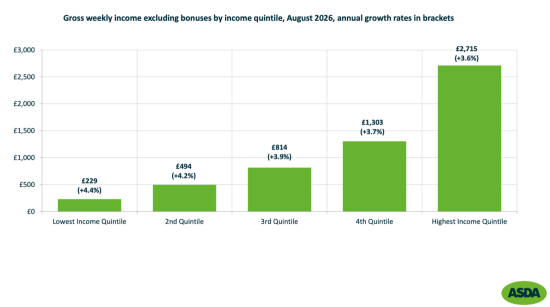
The bottom group has the lowest average income, and the top group has the highest average weekly income. And you'll see the difference.
The bottom group is on £229 of weekly income. The top group is on a weekly income of £2,715.
That means the average income of that top quintile, the top 20% of households in the UK, is heading for something over £130,000 a year. Now, there are probably two incomes in that household, but they are still very well off.
And you will see that there's a rising gradient as we go across the chart. Things do not go up in a straight line. They are very definitely skewed towards the wealthiest being best off compared to everybody else.
But that's the starting point for inequality in the UK because the critical chart is the next one. Look at this chart.
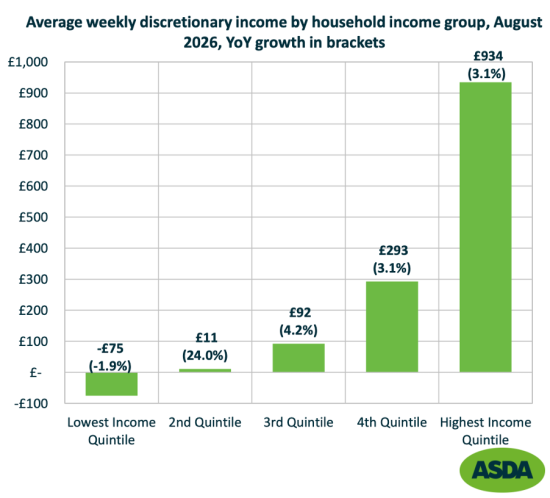
It's called the chart of discretionary income, as the Centre for Economics and Business Research define it for Asda, and this chart is really telling.
Let's just turn the data from those two charts into a table, and we get this.
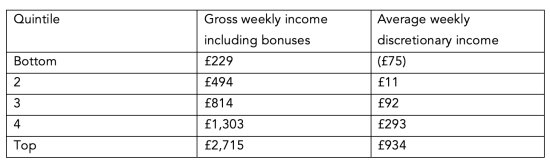
The bottom quintile has gross weekly income of £229, or around £12,000 a year. This is the state pension, near enough. The average weekly discretionary income that they have available to spend, you will note, is negative. It's negative £75 a week.
Now, to understand that, we need to understand what discretionary income is, so let me do a quick diversion into that. Discretionary income is the gross household income- that's the £229 a week, in their case, less taxes. There isn't a lot of tax to pay on that £229, you might think, but there is. They'll be paying for a BBC TV licence. They'll be paying council taxes, they'll be paying VAT, they'll be paying duties, and all of those things do come into the calculation.
And what is then deducted is essential household expenditure. That includes groceries and other essential food purchases, electricity and gas, transport costs, rent or mortgage interest payments, and other essential goods and services. Things like mobile phones these days, because you cannot survive without one. And Asda has been developing this model since 2008 and has, as a consequence, built this idea of what essential expenditure is, and they've come up with this chart.
Now, the chart shows just how different these outcomes are in terms of discretionary income available to households after they have taken off this essential expenditure.
The bottom 20% of households cannot cover their essential costs. They are in real poverty, and there should be nothing that surprises us about this. We know from data produced by the Joseph Rowntree Charitable Trust that around one in five households in the UK is in real poverty in this country. That's 14 million people, and that coincides with this data.
Real poverty in this country means you cannot cover your essential costs, and there is no discretion left for having any of the nice things in life.
But the critical point is, look at the next group as well. The next group up from the bottom has just £11 of discretionary income available to it a week. That is £500 a year. What has that got to cover? Holidays? Well, you can't have a holiday on £11 a week. Christmas presents, birthday presents. Any form of going out, any form of leisure activity. The essentials are covered, but these forms of discretion are simply not there for most of those households.
And even if we go up to the next group, the discretionary income available to them a week is only £92. Now look at the cost of a holiday for a family of four, and that is going to run to thousands of pounds. How many weeks is that going to require, then? Well, maybe a quarter of your year is going to have to be saved to put aside to pay for even a modest family holiday.
My point is this. These households are living on the edge. That's the purpose, on my part, of showing you this data. If John Healey is going to have an impact today, he doesn't have to worry about those who've got £934 a week to decide what to do with. The wealthy are doing all right. He doesn't need to worry about them. In fact, he should be taxing them more, as I have said time and time again.
The problem that he's got to address is the fact that 60% of households in this country are not doing all right. Some have just enough to afford a few luxuries. Many have no margin for error at all. 20% are not able to meet their basic needs.
So if John Healey is going to achieve anything today, these are the people he's got to persuade because they can vote, and they're not going to vote for Labour if it doesn't do anything for them.
You can see why so many people vote for Reform. They're angry with the political system that has failed them. It's very clear that they're looking for alternatives, and why wouldn't you when the system has so badly failed you, as it has for around 30% to 40% of households in the UK? They simply are just about getting by, if that. And that is why people won't vote Labour. It is why they will vote for alternatives. It is why they are angry.
So my focus today when I look at what John Healey is going to say is not what he does about debt-to-GDP ratios. It is not about his fiscal headroom. It is not about some marginal issues that he's going to make policy announcements on. It is not about his growth forecast because they are total rubbish, because the whole economy is going to fall apart in 2027. It is: what is he going to do to protect the most vulnerable people in our society? That is the measure I'm going to be applying. That is what I will talk about later today when I try to analyse what he's had to say.
Too many people in this country can't get by because the system is designed to ensure they are unable to do so, including as a consequence of the pay made by companies like Asda, because many of the people they employ will be on Universal Credit. This is the crisis in the UK, and that is why this is what matters in this budget.
You may disagree. There is a poll down below, of course. Let us have your opinions. Please do like and share this video. Please do subscribe. Please hit that bell button so we tell you about when we make new videos. And if you'd like to support our work, which is focused upon the well-being of ordinary people in the UK who do need a better economic system to serve them, please do buy us a coffee. There's a button down below.
Poll
Thanks for reading this post.
You can share this post on social media of your choice by clicking these icons:
There are links to this blog's glossary in the above post that explain technical terms used in it. Follow them for more explanations.
You can subscribe to this blog's daily email here.
And if you would like to support this blog you can, here:

 Buy me a coffee!


Richard
My suggestion for what its worth if you want to do something
A short term Council Tax Reform pending its replacement
Do what happens in most ‘property tax’ systems and make the owner not the tenant the liable party which will amongst other things result in a massive administration and recovery saving
This will have to include a reform of Local Housing Allowance levels
And for the remaining low income owner occupiers a National Council Tax benefit Scheme as existed ;prior to 2013 and still does for pensioners.
Thank you
I can’t vote in your poll because the first three options all go together, and should all be addressed by the government, not only in today’s budget but in all their continuing policies. They must invest in the the economy, in social need, not leave all that to a private sector that has been so taken over by the money men that it cannot invest for improvement. Any profits the private sector may make seem to go to highly paid top staff, to shareholders, to the multinational corporations that have taken them over.
Noted.
I agonised over that one… sometimes writing polls is not easy.
[…] fact that, as I demonstrate in this morning's video using data from the supermarket chain Asda and the Centre for Economics and Business Research, 20% […]