
I posted polls posing the question in the title of this post, both on this blog and on YouTube, yesterday.
I provided the right answer in my video.
This was the YouTube response:

The result here (which followed my discussion on our so-called national debt) was a little different, as was the number of votes:
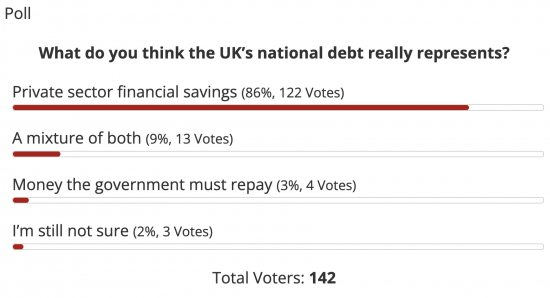
The scale of the response on YouTube makes clear why I engage there.
This misunderstanding in the response there is a clear indication that there is more work to do.
I then asked ChatGPT to analyse the comments. It is a large language model, after all. There were 116 of those comments - more than on the blog yesterday. This was its analysis. I stress that I did not write this, but I thought it might be of interest, and if you have no time, jump to the last paragraph:
The comments reveal a striking degree of disagreement about what the UK national debt actually is. Rather than a shared understanding with disagreements about policy, there are several fundamentally different models of the monetary system operating simultaneously.
I would summarise the comments into seven broad groups.
1. National debt is private-sector savings
A minority clearly understands the interpretation you were trying to convey. Examples include:
- “The government's red ink is our black ink.”
- “It is PRIVATE SECTOR SAVINGS!!!”
- “National debts with fiat currency is money that the nation owes to itself.”
- Government should not need to “owe its own currency” because it can create it.
- One commenter goes further, arguing that the debt reflects resources that were actually available and used, rather than unpaid bills.
These comments are closest to your argument that government liabilities are simultaneously financial assets belonging to somebody else.
This view is present, but it certainly does not dominate the discussion.
2. National debt is money taxpayers must eventually repay
A substantial group retains the conventional household analogy very strongly. They describe the debt as:
- “Money taxpayers must repay.”
- Future government income already spent.
- A “tax on the future”.
- A burden passed to children and grandchildren.
- The equivalent of credit-card debt.
- Spending beyond the country's means.
This is probably the most important finding from the comments. The household-budget model remains extraordinarily powerful.
Several commenters explicitly say that there is “no fundamental difference” between government finances and household or organisational finances.
That suggests that merely explaining bonds differently may not be enough. The prior belief that government must first obtain money before it can spend has to be addressed directly.
3. National debt is a transfer of wealth to the rich
Another substantial strand partly accepts your monetary argument but interprets the debt principally through distribution and class.
The argument is essentially:
Government does not tax wealthy people sufficiently → wealthy people accumulate money → government issues bonds → wealthy people buy them → government pays them interest.
Hence comments describing debt as:
- “Foregone taxes on the wealthy.”
- Money accumulated by the super-rich.
- “The interest is tax we pay to the rich.”
- “Socialize the debt, privatize the earnings.”
- A mechanism through which corporations and wealthy people receive interest rather than paying tax.
This group is interesting because it is much closer to your analysis of government money than the household-budget group, while drawing a very different conclusion from it.
For them, the problem isn't necessarily the existence of national debt; it is who owns the corresponding financial wealth and therefore receives the income from it.
4. National debt represents corruption, waste or political failure
A large number interpret the number not in monetary terms at all, but as evidence of wrongdoing or incompetence.
They attribute it variously to:
- corruption;
- military spending;
- bank rescues;
- Covid spending or fraud;
- corporate subsidies;
- private healthcare and pharmaceuticals;
- Brexit;
- politicians;
- the monarchy;
- tax avoidance;
- neoliberalism;
- government incompetence.
Some describe the entire system as money laundering or a “bankers reward system”.
These comments are really answering a different question:
“What caused government spending or deficits that I disapprove of?”
rather than:
“What is the national debt?”
That distinction looks important for any follow-up material.
5. National debt is a product of banks and central banking
There is also a distinct monetary-conspiracy/hard-money strand.
These comments blame:
- the Bank of England;
- central banking;
- financiers;
- the creation of the Bank of England in 1694;
- private banks;
- fiat currency;
- abandoning gold and silver;
- governments supposedly borrowing money that they could instead create themselves.
There is some overlap here with your argument that currency-issuing governments need not finance themselves like households, but it becomes mixed with historically and institutionally questionable claims about the Bank of England, gold-backed money and private control of currency.
6. “Printing money” means inflation or currency collapse
This is probably the most important substantive objection to your argument.
Several commenters essentially concede:
Yes, the government can create pounds.
But they then say:
Doing so will destroy the pound.
Japan is mentioned. So are hyperinflation, international markets, currency depreciation and creditors losing confidence.
This is materially different from the household analogy. These people are not necessarily saying the government cannot create the money needed to meet sterling obligations. They are saying that there are economic consequences to doing so.
That means an infographic simply saying “the government cannot run out of pounds” probably won't persuade them. Their next question is:
“What stops unlimited money creation causing inflation?”
That deserves a response in its own right.
7. National debt is politically meaningless, irrelevant or deliberately weaponised
Finally, some commenters reject the importance of the number itself.
They describe it as:
- “Austerity nonsense.”
- A construct used to justify austerity.
- Something that could simply be wiped out.
- Part of a dying economic system.
- Something without a meaningful repayment deadline.
There is also one relatively sophisticated argument that what matters is not the nominal amount of debt but its relationship to GDP, investment and productive capacity.
The overall picture
What stands out most is not hostility to your argument but conceptual fragmentation.
People are using “national debt” to mean completely different things:
- government borrowing;
- unpaid bills;
- future taxation;
- private savings;
- wealth inequality;
- corruption; accumulated deficits; bank power; wasted expenditure; deferred taxation; intergenerational burdens; or simply a political excuse for austerity.
That explains Linda Shepperd's comment that it is surprisingly difficult to communicate what appears to be a simple point.
The comments also suggest that there are three misconceptions or objections that particularly need answering.
First is the household analogy: “Government debt is like my credit-card debt.”
Second is the funding assumption: “Taxes and borrowing provide the money government spends.”
Third, and probably the strongest objection once the first two have been dealt with, is: “Fine, government can create pounds, but won't doing that cause inflation and destroy the currency?”
There is also a fourth issue that could make especially interesting follow-up material because some commenters are already halfway towards it:
If the national debt represents financial assets held outside government, who owns those assets?
That moves the discussion from “Is £3 trillion frightening?” to the considerably more interesting questions of whose £3 trillion it is, why they hold it, what form those savings take, and who receives the interest.
The comments therefore suggest that the biggest educational problem is not explaining the number £3 trillion. It is explaining the balance-sheet relationship between government and everyone else. Until people grasp that one person's financial liability is another person's financial asset, “national debt” will continue to sound intuitively like a gigantic unpaid bill.
Thanks for reading this post.
You can share this post on social media of your choice by clicking these icons:
There are links to this blog's glossary in the above post that explain technical terms used in it. Follow them for more explanations.
You can subscribe to this blog's daily email here.
And if you would like to support this blog you can, here:

 Buy me a coffee!

Who/which groups or organisations might be responsible for the misconceptions about our “National Debt” at the centre of our national Overton Window?
Might the inclusion of Socio-Economics as a discrete, prominent subject in the/a National Curriculum make our society more transpatent and equitable?
Yes
The devil would be in the detail of what is on the syllabus and how it is taught!
It feels like we are mixing up maths and logic with dreams and nightmares. The latter are unfortunately easier for many to identify with. Moreover, things like double entry book keeping are beyond many people’s ability to get their heads round. I was one of them. Arguably, this is also about poor teaching but the fact remains that this is an area that a lot of people want to avoid as it feels incomprehensible and makes them feel stupid when someone tries to explain it to them.
Stories, rather than simple mathematically precise examples, are the way to communicate these ideas. Simon’s example of the apple seller (in your previous post) is precise but still involves figures that require calculating. No matter that they are simple – you are asking someone to go where they don’t want to. You could explain inflation as the orchard owner who started out when not many knew about them. His apples were good but the market was flooded so his apples weren’t worth much. Then came the apple blight and most apples succumbed but his were resistant. There weren’t enough apples to go round. Suddenly, his apples were really popular and worth 5 times as much. Substitute cars, phones or whatever.
The problem I have with the apple seller story, is that it really suggests the apple seller is greedy. So they have blight free apples, but it didn’t cost any more to produce these blight free apples. Yes there is more demand than supply, but it is the seller’s choice to increase the price charged, rather than just selling at the same price and then saying “sorry, no more apples left” (note that they will have to say that anyway).
Now the argument is that with the extra income, the apple seller could invest some of their greater profit into producing more apples to improve supply, although that doesn’t obviously lead to lower prices if people are still desperate enough for an apple to pay the inflated price.
I think this is a different sort of inflation (raising prices just because the seller has cornered more of the market), to the inflation from, say fossil fuels, as the Overton Window moves for enough people to understand that they will run out (or rather be too expensive to extract), and consequently what is left is worth way more than the current price for a litre of petrol for your giant chelsea tractor to pop to the local corner shop.
The former apple inflation is, IMO, a choice by the seller to ration by price, the latter is forced by reality.
You really are massively overthinking this
It is a simple metaphor.
As such, it works.
Why mot recognise that?
Well yes probably pushing apples a little too far.
However, don’t you think there is a qualitative difference between inflation caused by opportunism because the queue outside the shop is longer, vs inflation caused by real resource constraints leading to a realisation that what is left should be used more productively than frivolously? One reflects human nature and choice, the other is externally imposed because we live on a finite planet.
I have made that point many times on this blog. It was not necessary fur the metaphor to work.
People are really invested in the idea that government debt exists as it would for a household, and that failure to cut spending will cause hyper inflation. I admit that I too have likely held both of these views as recently as a decade ago. It is a view constantly reinforced by the culture, both inadvertently, and no doubt with intent in many instances.
I recall discussing MMT with a long-time who is otherwise open to broad discussions on a range of interesting topics. The arguments I put forward are shut down with little real consideration, and the assumption implicit is that I must be an idiot who never heard of Zimbabwe, Argentina or the Weimar Republic. I should feel insulted by this clear implication that I must simply be an unthinking moron, but I understand how deeply held the view is.
My conclusion is that only by repeatedly making this argument, in as many different ways as we can, and by engaging the most aggressive proponents of the conventional wisdom can we begin to crack the facade. It means more and more of the type of feedback you describe elsewhere on the site, but it is essential work. For my part, I won’t stop trying new ways to show people that what they believe so implicitly, is false. There is a better way. Good luck all!
Now I know why you use AI (in the rigorous, engaged, trained, critical way you use it). That’s a VERY helpful analysis, from a well trained LLM!
I also wonder (partly because of that analysis) how successful we can ever be with a mass audience, using intellectual arguments – or to be fairer, at exactly whom we should be directing them?
I commend Team Murphy for being your own most rigorous critics, for constantly questionong your own effectiveness, for constantly revising, not your principles,but your strategies.
Do you have any means of analysing of the relationship between your infographics and your YouTube audience? Because the infographics are IMHO, a very significant tool, but are they reaching the right audience, are they demonstrably effective? Do we have any non-anecdotal evidence of their penetration, or success? How could we get it? (I’m non-YouTuber)
Quick answer is no, but we can see they are driving major new traffic flows on Substack, Facebook and LinkedIn – but not here, where traffic is still down from previous years, and the infographics seem to have little impact. They may be improving traffic on Twitter and Bluesky – but the latter is hard to measure.
If I hold a gilt to maturity, on redemption I will find myself in possession of a credit in my bank account equivalent to the monetary value of the gilt. I could convert this credit into a stack of banknotes, but that will just swap one promise from the state (the gilt) for another (the banknotes). In a fiat currency, neither is convertible to a physical asset. With a non-government party, in the event of non-payment, I could obtain a judgement and send in the bailiffs to seize actual physical assets. I cannot do this with the state. Hence, a government with a fiat currency issuing bonds in that currency has a liability in the accounting sense, but that liability is not enforceable in the way that non-government debts are. Unlike the household analogy, with the government it’s promises all the way down. This gets to the core of what is meant by “money”, which is so simple and yet so slippery and I suspect sits at the root of much of the confusion. Correct me if I am wrong.
Thank you
Is it possible that some of the trolling comments are bot generated, or do you already have a way of eliminating those? If a substantial number are bot generated it would still be useful to analyse the content in order to rebut and explain, but could the relative numbers of bot trolling remarks distort the actual and real opposition?
I think they are real in this case.
On LinkedIn, a lot of people who think they know finance are very angry with me. That’s not the first time this has happened in my life.
I find that v encouraging news indeed. When your opponents take the trouble to angrily oppose you, you know you are cutting through.
🙂
Hello Richard.
I don’t know if this is useful, or should be discarded. Up to you.
As part of the national debt is Bank of England bank notes, then theoretically all of government money creation could be in notes. No bond market, no electronic money. Obviously the functioning of a modern, real world economy would not be possible this way.
However, could the explanation of national debt be explained as if every pound created by government was in the form of notes? The total could still be £3 trillion and it would still be national debt, but maybe it would take away the fear of the government going bust because no one feels that the notes in their pocket/purse/wallet are anything but a good thing. Would it make it any easier for people to understand?
there is still the problem of the mad printing press nonsense.
The other thing I sometimes think is that the economy is like a sponge. Adding more water to the sponge is like adding extra productive money to the economy. Squeezing water out of the sponge is a deliberate act, so is like tax. Water in the bucket that’s not in the sponge is just dead money in the economy. If the bucket runs over that’s inflation
Maybe neither idea works, and that’s ok. Just a thought.
One other thing. For the non-troll, ordinary members of the public, who have an open mind to learning, I wonder who they think all the national debt is payable to? China? That was my original lead-in to trying to find out more about economics. My naive thought was, if every country seems to be in debt then who is it owed to? It didn’t make sense, and annoyed me.
Regards
It’s a fun idea.
No interest would be paid as well. Another fun idea.
Currently, UK borrowing costs are heavily dictated by unelected government bond traders. Operating with zero democratic accountability, they trade second-hand IOUs in a financialised echo chamber. When they panic, yields spike, and ordinary families suffer through skyrocketing mortgages and increased car payments. Market speed is mistaken for economic wisdom, but algorithmic sell-offs merely reflect the self-fulfilling panic of speculators.
To fix this disconnect, I suggest we look to traders who deal with loans in the productive economy: second-hand car dealers.
Unlike a City bond trader, a used car dealer has their ear to the ground, meeting a daily societal need for affordable transport. When arranging finance, they perform a delicate balancing act, securing a profit while ensuring monthly payments are genuinely affordable. They see when household budgets buckle long before the data reaches an academic spreadsheet.
So why don’t we bridge the gap by replacing abstract central banking models with real-time, real-world financial data? By using data pipelines and AI analysis, point-of-sale finance data from thousands of dealerships could stream directly to the Bank of England. Policymakers would gain an instant dashboard of consumer affordability, matching the speed of the bond market with real-world reality.
Technology can provide speed, but humans must retain judgment. So let’s reform the Monetary Policy Committee to include seats for consumer lending experts and implement an interest rate system that guarantees low, stable rates for everyday essentials like mortgages and transport. Let’s insulate families from the financialised circus and build a system that serves the public good.
When I wrote this yesterday, it was intended to be ironic. Reading it through again this morning, now I’m not so sure!
Truth be told, the greatest Neo-liberal achievement – that of project fear MK I – the threat of debt or serfdom – is obviously very effective and has a very secure foothold in any debate.
These concepts resonate at a personal level with people because they too are under threat of debt and serfdom – it is personally real to them, so it it must be possible that it can happen to anything else including the country they live in. The bogeyman is the debt collector. His accomplice is shame.
We can call this bullshit, or a curse, or just a fear, but what it really is, is ignorance that’s all – a lack of knowledge, a lack of awareness. What worries me is that the more we see of retrenchment in the public sector, the greater this ignorance will be seen as a reality and just accepted – state withdrawal will underline it. The longer we have un-courageous politicians the more the ignorance is made stronger too
The other issue is that I think people know that problems have stacked up all over the place but also know that some one or something has to pay to sort things out. The prospect of having to help sort it out by paying for it also overwhelms them in an exploitative economy where even owning a pet can put you deep into debt though vet bills.
We are stymied by fear born of ignorance. In short, if I were to write an essay on this subject, the title would be ‘We are ALL Americans Now’. Yes I’m afraid, many of us are. There is no other way that capitalism could have conquered a country where it resides except by such foul means.
Jacqueline and I call this internalised neoliberalism.