
The national debt is nearing £3 trillion, and almost everything said about that claim is wrong. It is not a debt in the way a household mortgage or a credit card is a debt. It is just the nation's savings.
Here is what that £3 trillion is actually made of: around £2.2 to £2.3 trillion of government bonds held by pension funds, banks and insurance companies; over £200 billion in National Savings; the physical cash in your pocket; and more than half a trillion pounds sitting in the reserve accounts commercial banks hold at the Bank of England. None of it is money the government "owes" in the sense of being unable to pay. The government creates sterling, so it cannot run out of it, and it cannot go bankrupt.
So why do we panic about the interest bill? The government can always pay the interest, because it can always create the money to do so. The cost is a policy choice, not a fact of nature.
The Bank of England sets the rates that drive that £100 billion-a-year bill, and by cutting them, it could save at least £20 billion a year.
Meanwhile, over £20 billion a year is paid to commercial banks on their reserves, a subsidy to bank profits that other central banks have already largely abandoned.
The real danger runs the other way. Trying to "reduce the debt" means higher taxes or deep spending cuts. These could create a recession, falling private wealth, and a poorer economy, with no improvement in the government's financial position.
The national debt is not our burden. It is the savings facility that lets pension funds, insurers and savers hold their money safely, and without it we would all be much poorer. The lie that this debt is a burden is the excuse used to justify austerity, and it is time we stopped believing it.
This is the audio version:
There is no Debate Ammunition for this video, but there is this infographic:
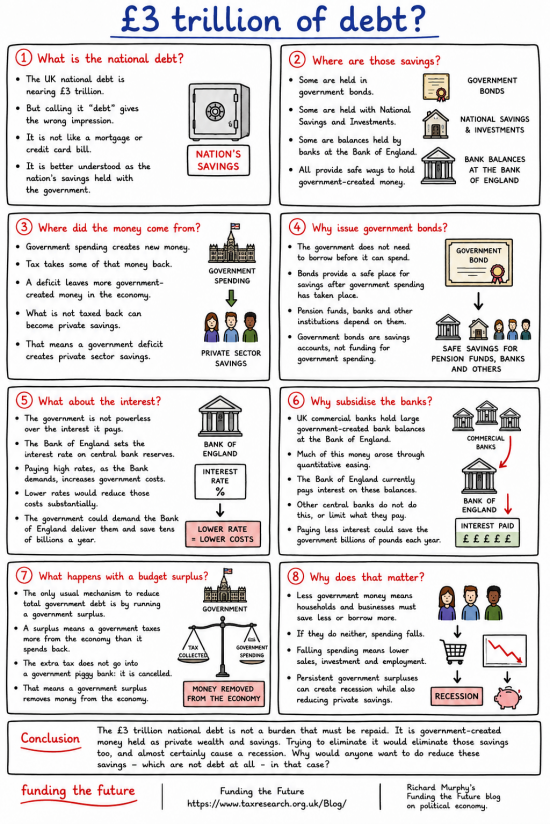
This is the transcript:
We're told that the UK's national debt is now nearing £3 trillion. But calling this a national debt creates entirely the wrong impression. This country is not in debt. This country creates all the money that we use. It can never be in debt because it can always repay the money at a moment's notice if it wished to. So this is all about a savings facility.
To think of the national debt like a household mortgage or a credit card bill is just wrong, even though that's what all our politicians do all the time, and that's what our financial journalists do all the time. But they are wrong. This so-called national debt is better understood as the nation's financial savings held with the government, and that's what I'm talking about in this video.
How are these savings held with the government? Well, there are a variety of ways. Some are held as government bonds or gilts. That's the biggest part of the money. That amount is issued by the government to the commercial financial markets, made up of banks, pension funds, life insurance companies, and so on. And that figure comes to around two point three trillion pounds or so at present.
Some of the money is held through National Savings and Investments. That's over £200 billion of the national debt, or £0.2 trillion, and that money is provided by individuals. You may have a National Savings account. So might somebody you know who has a Premium Bond, because Premium Bonds are part of the national debt.
You might also hold some of the national debt because you hold it in cash. You literally have notes, and that is part of the national debt as well.
And some of this money is held as central bank reserve account balances held by our commercial banks with the Bank of England, and they make up over half a trillion pounds at present.
These are all ways of holding government-created money as savings. Without exception, every one of these things is a savings account balance. Just as you can have a deposit account with a bank or a bond with a building society, these are savings accounts with the government, only they're much more valuable to large organisations than deposit accounts with banks. Why is that? Because the government only guarantees the repayment of £120,000 in any deposit account. And if you're putting on a couple of billion pounds in your savings account with a bank, you don't want to do that because you might lose it if the bank goes bust. So you buy government bonds instead. That's why government bonds exist. That's absolutely essential to understand.
The government spends the money that we use into existence. That's how we get our money supply. That is how the pound is created. The government creates it when it spends. The Bank of England effectively creates it on the government's instruction because the Bank of England is a part of the government. And then the government takes some of that money back out of the economy through taxation.
But when government spending exceeds tax collected, and it does most years for a very good reason, and that is because we need a growing money supply to deal with the fact that we do have continual inflation in our economy - which most economists agree is a good thing - some of that money that the government has spent is then left in the economy for it to use.
But eventually that money is saved. Let's be clear, somebody eventually doesn't spend it. Somebody saves it, and they've got to put it somewhere, and that is why the government provides this secure savings facility for pension funds, life insurance companies, banks in particular, but also overseas governments and people who want to trade with the UK from outside this country who need a place to deposit the money that they too have earned in sterling.
And let's be clear, the government does not need to issue these bonds. It does it as a favour to savers. And I'm going to make that point more than once in this video, but I'll start off making it here. Why does the government not need to issue the bonds? Well, that's because the government does not need to borrow money to be able to spend. It does not, in fact, ever borrow money to be able to spend, and that's because the government creates money when it spends.
So bonds do not then provide the government with a way to fund its spending. Instead, they provide people and financial institutions with a safe place to save the money they've got as a consequence of government spending. The government actually creates the money that is then deposited with it. We have to get this circle the right way round. It's not borrowing that funds spending. It's spending that funds the borrowing, or as we should properly call it, the saving. And that's how the money that comes to be deposited by pension funds and others with the government comes to exist. The government doesn't borrow it to spend. It provides a safe place for people to save. I can't say that often enough because people don't seem to understand it.
So what about the interest bill on this supposed borrowing that the government undertakes, but which is actually interest paid on savings accounts?
First of all, let's make it clear: the government will never have a problem paying this interest. Why is that? Because it can create the money to make the payment whenever it likes. That is a facility within its power to do. The government can't go bust because of its interest costs. Let's understand that straight away.
And let's also understand, as a result, that having to pay interest does not limit the capacity of the government to do anything else. There is no finite sum of money available to the government, and it must not spend any more. That is complete nonsense. It's a fiction made up by right-wing economists who want to shrink the size of the government. But if the government wants to pay nurses or teachers or build something to manage climate change as well as pay interest on these deposits, it can.
The limitation on whether it can pay nurses, teachers, and fund climate change is not the cost of borrowing because that's just money. The limitation on those other activities is: are their teachers available? Are there nurses available? Have we got the engineers to build the facility to manage climate change? The constraints are entirely different and wholly unrelated to each other. So let's be clear. This interest rate bill does not stop the government from doing anything at all.
But let's just discuss the size of that bill. Who sets the rate on the bill? Essentially, the Bank of England does. It sets the bank base rate for this country, and all other interest rates are related to that. Let's not pretend otherwise. People say the market sets rates and the government doesn't and the Bank of England doesn't, but that's not true. Look at the link between market interest rates and the Bank of England's base rate, and you will find that market rates always follow what the Bank of England offers.
Now, there might be a difference, and there might be moments when the Bank of England will be offering a rate higher than the market, although that's rare. And there might be different times when the difference between the Bank of England rate and the market rate is quite big. But again, that's also quite unusual. In essence, the Bank of England influences the interest rate paid on government debt more than anything else.
And the Bank of England is a government agency. So if we are paying a lot of interest at this moment on government debt or on these savings accounts, which is what we should properly call it, that's because the Bank of England has chosen to set interest rates in this country very high, and it's a signal that, in fact, we should be cutting interest rates. If they're too expensive for the government, they're too expensive for everyone else as well.
Let's understand that essential fact, and let's have the government tell the Bank of England, “Cut the interest rate.” It's got the power to do so. It can intervene under the terms of the Bank of England Act 1998, and say there is, for example, at this moment, a cost-of-living crisis and demand that the interest rate be cut as a result, and the Bank of England basically has to agree, although eventually Parliament would also have to back up the government, but you can guarantee that it would.
In other words, the government could cut the cost of the interest paid at this moment, which is in excess of a hundred billion pounds a year, and it could save tens of billions of pounds a year as a result. How many tens of billions? At least £20 billion a year, maybe more. The point is the government is unnecessarily paying high interest at this moment as a consequence of a policy choice by the Bank of England, but which it has endorsed, and that is not an unavoidable consequence of the debt. It is an unavoidable consequence of bad policy.
There is another issue to consider here with regard to the cost of interest as well. I've already mentioned that half a trillion pounds, or £500 billion, in other words, of the money that makes up our national debt, the savings that are deposited with the government, comes from our large commercial banks. You know, their names: Barclays, Lloyds, HSBC, all the others that occupy our high street. They deposit money with the Bank of England so that they can pay each other. But the deposits in question were created, in effect for them, by the government after 2008 as part of the bailout process that took place at that time because the banking system nearly fell over, and they were created again after 2020 when we were at the same risk as a consequence of COVID.
Now, this money does, however, have interest paid on it by the government, at a cost of over £20 billion a year. Now, what could you do with £20 billion a year? I think you would rather it was used on something useful for society, but at present it's used to subsidise the profits of our big commercial banks. I think that's wrong.
I think the government should be doing something which is done by the European Central Bank and by the Bank of Japan, and that is only paying an interest rate on part of these balances, with most of it having little or no interest paid at all. They could achieve their policy objectives for having interest paid on these accounts with only part being subject to payment, and the rest could be virtually interest-free to the government. The consequence would be a saving of well over £10 billion a year again.
So the fetish about the cost of this interest is actually misplaced. We could bring down the rate on all the cost of government deposits, that is what is commonly called government debt, if we wanted to, by the Bank of England cutting their rate. And we could cut the cost of that money which is deposited by commercial banks with the government, by reducing the rate on the central bank reserve accounts.
But we are not doing that, and instead, people are getting very upset about the fact that we appear to have £3 trillion of debt, and they're demanding it be repaid. They're making stupid claims like if we have another credit crisis, the government will run out of money, when that is technically impossible.
I did an interview recently where the other guest was the Institute for Fiscal Studies, and they made that suggestion, and if I'm honest with you, they made themselves look very stupid as a result because the government can never run out of money. It's the only agency that's allowed to create the stuff. We are dependent upon it. It is not dependent upon us.
But people do still say they want to cut the amount of debt, but I don't think they understand what they're talking about, because if you want to cut the size of government debt, you have to withdraw money from the economy. There is only one way for the government to withdraw that money from the economy, and that is to increase the amount of tax we pay.
Now, those who demand that the debt be reduced are also those who are demanding that the amount of tax we pay be cut. So, in fact, what they're saying is that, to achieve the outcome they want, not only should tax be cut, but the level of government spending should be cut even more so that we run what is called a government surplus. That means the government takes more in tax out of the economy than it spends into it to provide us with education, with health and all the other things on which we rely. That is what they're asking for.
But this has one almost inevitable consequence. It would create a recession. It could create deflation. It could force households and businesses to save less and borrow more to maintain their spending, and that would reduce our economic resilience. We would, if people did not borrow more, see demand fall. We would then see lower sales, less investment and fewer jobs, and we would then see us moving towards a recession.
At the same time, because government-created money is private wealth, we would see a reduction in private wealth, and we would not see any real change in the financial situation of the government because the government doesn't rely on this money to fund its activities. I've already pointed that out. It takes deposits. It doesn't use them to fund what it does.
So we would create an absolute financial nightmare for the economy, all for the sake of reducing the debt when there is no reason to reduce the debt, and its cost is entirely manageable if we want.
So why are people obsessing about the fact that the debt is now £3 trillion? Because they don't understand what it is. They don't understand it is savings balances. They don't understand it does not fund the government. They do not understand that its cost is within the government's control. They do not understand that the cost does not constrain other government activity. We are not facing an either/or: we do this, or we can't do that, with regard to payment of interest. Payment of interest does not stop us having the NHS we want. We just have a lot of people who don't understand that all that the so-called government debt is, is organisations which they support, like pension funds, life insurance companies, private banks, and foreign governments who save here to facilitate trade, saving with the government to make all those things possible.
Take the government debt away, and those things aren't possible. We would have a much poorer, much more limited economy. We would all be worse off. Is that what you want? Well, I don't, but what do you think?
There is a poll down below, as ever. Please do let us have your views. Please do like and share this video. Please do subscribe to the channel and hit that bell button so you're told when we make another video, and if you'd like to buy Tom and me a coffee so we can keep making these, that would be great.
Poll
Thanks for reading this post.
You can share this post on social media of your choice by clicking these icons:
There are links to this blog's glossary in the above post that explain technical terms used in it. Follow them for more explanations.
You can subscribe to this blog's daily email here.
And if you would like to support this blog you can, here:
-
Richard Murphy
-
Support This Site
If you like what I do please support me on Ko-fi using credit or debit card or PayPal
-

-
Follow me

 Buy me a coffee!
“So why are people obsessing about the fact that the debt is now £3 trillion?” – which people? why?
Perhaps this can be seen as narrative development by the UK finance sector that would very much like to keep things as they are (interest on reserve accounts = “nice little earner”).
It also shows who has power in the UK, it ain’t the politicos.
Yes of course the Govt can technically print money to replay its debt but the more sterling that is printed the more the effect is felt in inflation and weakness in Sterling. Both are akin to a “default in kind” as purchasing power is reduced. So yes you are technically correct but disingenuous also as there are significant negative effects which you fail to highlight.
Your claims are not in any way substantiated by the evidence.
Assertions do not supply evidence. Do you have any at all?
I think this is an important statement, because it’s what the majority of people, especially on the right, argue with “printing” money is bad and will lead to negative XYZ.
I think if a clear explanation of why it wouldn’t, then it would be easier to counter the ingrained belief of, just “printing” more money will make the situation worse not better.
Thank you for your comment.
You highlight one of the most important misunderstandings to address.
Creating money does not, by itself, cause inflation. If it did, every act of government spending would be inflationary because all government spending creates new money.
Bank lending would also necessarily cause inflation because commercial banks create new money when they lend.
Neither claim is true.
Inflation of the sort money creation can induce occurs when the ruling attempts at additional spending create demand that the economy cannot meet at existing prices.
That might happen because the economy is already operating at full capacity, because essential resources are scarce, or because supply cannot expand sufficiently quickly.
In those circumstances, creating still more demand can certainly be inflationary.
But suppose the government creates money to employ people who would otherwise be unemployed, build houses when construction capacity is available, invest in renewable energy, improve transport or increase productive capacity. The additional spending is matched by additional economic activity. In those cases, there is no reason why that spending, which creates new money, produces inflation.
In fact, investment that increases productive capacity can reduce inflationary pressure in the longer term.
The same applies to sterling. There is no mechanical relationship whereby creating another £1 billion causes sterling to fall by some corresponding amount. Exchange rates reflect productivity, trade performance, relative inflation, interest rates, expectations, political stability and international demand for currencies and assets.
So the constraint on government spending is real, but it is not money. It is the availability of people, skills, energy, materials, technology and productive capacity.
That is the crucial distinction. “Printing money causes inflation” is the wrong rule. Spending beyond the economy’s capacity to respond can cause inflation. Those are different propositions.
Does that help?
Richard has provided a perfect answer, but I thought I’d add my own dumbed down version I have used myself.
Imagine the uk economy consists of an apple seller. He has 10 apples to sell (resources available). There are 10 potential consumers. The government provides £8 to 8 of them to work at apple collection. The Apple seller sells them for £1 each to 8 of them leaving him with 2 spare with 2 consumer unable to buy them because they lack currency.
the government spends an additional £2 on putting these 2 to work. Now the seller sells all 10 at £1 each. Money supply expanded and prices remain stable.
If the Apple supply fell to 9 available because of a poor harvest, the price would likely rise as the consumers bid against each other for the limited supply. If the government tried to correct this supply problem by putting more money into the system all it would do is drive prices higher, unless the money was aimed at increasing Apple supply.
Increasing money supply when there are adequate resources is not inherently inflationary. The inflation issues faced by us now are supply issues around food and energy. Investing in green tech is like investing in apple production. Not inflationary, and likely to insulate us against future supply disruptions. There are plenty of other ways for us to spend as well which would expand the economy without adding to inflation.
i hope my simple example is generally accurate!
Very good
I have added this to my post
Great question Yessss and a great answer from Richard.
I’d even suggest making your answer a blog post.
I know that you have, in a way, already written it in e.g. “My View On … Inflation”.
But this reply is much more compactly on the point.
So it should be easier to find I think. 🙂
Done, at your request
As I commented a few days ago, those at the BoE who decide the interest rate should be required to declare their own holdings and therefore the likely personal bias that affects their decisions. Politicians are required to declare their interests, we must remember that Nigel is not in trouble for accepting a 5M quid donation but for failing to declare it, but how many constituents or even journalists bother to look into those revelations and then assess their MPs decisions for evidence of bias resulting from the obvious desire not to compromise their future payments? A national campaign asking “who pays your MP, ‘cos it sure aint YOU?”, or something slightly more acceptably grammatical (or should that be ‘grammatically acceptable’?) for a British audience, might have legs.
“A national campaign asking ‘who pays your MP…'”
Something like this? https://theyworkforwho.com/
Yes, exactly like that, but with more publicity.
Might the creation of concern/hysteria about the “National Finance Support System” be but one facet of a huge financial-socio-economic deception of thr British public by politicians and the mainstream media, including the B. B. C.?
Thanks, Richard. This is indeed the hardest thing to understand. I get that money is created and not limited, but not how the national deficit can be allowed to grow forever (and at any interest cost), without any negative effects whatsoever, and in fact must do so to keep our societies healthy. I think I get it when you are describing it, but afterwards I still feel unable to argue the case with someone else. Add in the relationship with the bond market and who is in control there, along with the views the ratings agencies would take if your views became policy, and I become very incapable of answering questions and therefore promoting this narrative in the face of the common objections the mainstream would make. Very frustrating. If we who are positively disposed to these views can’t engage and defend them, change will never occur.
You have identified why I need to keep explaining this.
I would make one correction. I am not saying that the deficit can grow forever, at any interest cost, with no consequences. I am saying that there is no predetermined financial limit to it. The limits are the productive capacity of the economy and inflation.
A government deficit simply means that the government has put more money into the economy than it has taken back in tax. That money has to be somewhere. It becomes part of the financial wealth of the private sector or overseas sector.
That is why deficits are normally necessary in a growing economy. People want to save, businesses want financial assets, and we need a growing money supply. If government continually tried to take back through tax everything it spent, those needs could not be met without increasing private debt.
Bonds do not alter this fundamental reality. They provide somewhere for accumulated money to be saved. The government does not need bondholders’ money before it can spend.
Interest matters, but again not because the government might run out of pounds. Excessive interest payments can increase inequality and potentially inflation, which is precisely why I argue that the government and Bank of England should control interest rates rather than pretend that financial markets must dictate them.
Ratings agencies cannot make the UK unable to pay sterling debts either. They can express opinions, and markets can react, but they cannot remove the government’s ability to create pounds.
Perhaps the simplest defence is therefore this: never ask whether the government can afford the money. Ask whether the economy has the resources to deliver what the government wants to buy without creating unacceptable inflation.
Once that distinction becomes intuitive, the other pieces begin to fall into place.
I wish more people understood this!
The way most people think about national debt, even on the left, is a massive shared delusion that causes terrible political choices downstream. You’re doing very important work, Richard. Great video.
Thank you
People put money in bank savings accounts. Increased savings with a bank are thought to make it stronger. They don’t lead to hysteria about the bank’s debts. People buy gilts. That becomes part of the National Debt, and many get hysterical about this. From an individual’s point of view, there is no real difference, but they have different mental slots for the 2 sorts of savings.
Agreed
I don’t know if they still do it but my building society used to make announcements about the ever increasing value of the money deposited with them and what they would be able to do with it.
The government should be doing the same
Some people are agonising that the debt to GDP ratio goes above 100%. This is neoliberal scare mongering. No explanation of this fear. Japan has a ratio of 250% but the sky over there hasn’t fallen in yet. England has had a National debt since the Bank of England established circa 1694. It has never been “paid back” and never will be. Imagine 3 trillion going into the economy in a relatively short time – it would be financial/inflation chaos!
Well done Richard – we likes it, we wants it!
The back story of this for me is how much of that money has been generated by trying to rectify the effects of stupid callous austerity or badly managed ex-public services. Talk about peeing into the wind!
As it happens I read my The Conversation daily email before FF (unusually), and there is an article by a professor of economics at the University of Leeds in which he bemoans the $40 trillion size of the US national debt.
https://theconversation.com/40-trillion-debt-balloon-is-a-warning-sign-for-us-economy-and-the-world-290277
It makes me pleased I did not exercise my right to convert my Diploma from Leeds College of Further Education to a BA from the university.
BTW, I appreciate that space and time are limited, but unless I missed it you didn’t say how the national debt comes about in the first place. Which is because the Treasury, by convention, issues bonds to cover its expected expenditure in excess of taxation. That harks back to the days of the gold standard and is entirely unnecessary in these days of fully floating fiat currency.
Thank you
Please don’t take this as being anything other than a hopefully constructive comment. My husband has just watched this video about “the debt” (with me). He is not an economist any more than I am but he fully understood your early point about this value being savings to organisations (mainly) and (some) individuals. However, he became confused as the video progressed because you kept calling it “the debt” – which to him undermined your point that it is savings. In the end I had to agree with him that a more consistent terminology would be helpful. I’ve read enough of your work on this site now to know what you meant despite the terminology – my point is that someone less exposed to your ideas got a bit waylaid by this video.
Fair comment….
Accepted
[…] This comment was made on this blog by someone whom I presume is a right-wing troll in response to my suggestion that we should not worry about £3 trillion in national debt. There were many fairly similar comments. They felt coordinated. That happens: […]
Richard, is there a model that shows say what would happen if say the government spent an extra £20 billion putting more doctors and nurses to work, at least in flows of money, taxation, economic stimulus etc. while probably leaving aside other benefits such as increased productivity, wellbeing etc. specific to a scenario.
And adjustable say for interest/taxation rates, ‘fiscal rules’ etc.
People like the NHS Alliance and many others argue that the economic multiplier effect for spending on the NHS is between 3.6 to 4.0, meaning that every £1 invested in the health service generates roughly £3.60 to £4.00 in wider economic activity and Gross Value Added (GVA). The overall tax rate is about 35%. The spending is more than fully recovered then.
I find it impossible to believe that the BBC, official and semi official economic spokespersons – everyone from Amol Rajan, Paul Johnson Jim O’Neill, Rachel reeves, John Healey etc doesn’t understand the BoE quarterly’s ,own explanation of how government creates its own money.<p>
Their incessant use of the household analogy, must be because they are aware that their jobs and salaries depend on them asserting it<p>
Richard – and Keynes ( ‘anything we can actually do we can afford’ – focusing on real resources, and real goods and services and people, – which are limited – and not starting with ‘money’ as the constraint makes the whole thing more understandable to the pubic at large.<p>
And that is why BBC and the powers that be always start with money as limited – ideological hegemony.
I do not believe they think the BoE is right.
Its Governor does not.
He thinks that the paper was the error, I am sure. So do they.
I saw a video by Robert Reich and he said that the interest paid on US national debt is a transfer of wealth to bond holders from US tax payers. Do you agree with this. And does the UK Government need to keep issuing bonds if the national debt is rising and interest payments are also rising due to high base rates?
Yes
That is why I say the interest rate should be cut.
Watch the video. Read the transcript.
Today I was trying to understand Bank of England resistance to a tiered reserve system. Their objections seem to be that it would 1) potentially weaken their control over interest rates and 2) blur lines between monetary and fiscal policy / result in the central bank operating outside of its current remit (their governor also apparently describes the partial removal of a massive unearned subsidy delivered by interest on central bank reserves as a “stealth tax on banks”, which I find weird).
MMT, as I understand it so far, would dismiss both these objections as irrelevant. It would point out that 1) tight control over interest rates by central banks is unnecessary, as inflation is anyway better managed through fiscal policy (and credit controls?) and 2) central bank independence / a “firewall” between monetary and fiscal policy is not realistic or desirable anyway – central bank and treasury operations need to be closely coordinated.
Broadly speaking, I think you have understood my position.
The Bank of England’s objections are revealing. It argues that paying Bank Rate on reserves is important because it anchors short-term market rates, and that tiering could weaken that control. It also argues that imposing unremunerated reserves for revenue-raising purposes would amount to fiscal policy and should therefore be a decision for government and Parliament.
My response is that neither argument justifies the present system.
First, I do not accept that manipulating interest rates should be our principal means of controlling inflation. Interest rates are an extraordinarily crude instrument. They redistribute income upwards, penalise borrowers, discourage investment and deliberately create unemployment. Fiscal policy, including taxation, together with appropriate credit controls, offers much more targeted ways of managing inflation.
Second, the supposed firewall between fiscal and monetary policy is largely fictional. The Treasury owns the Bank of England. The Bank is the government’s banker. Their balance sheets and operations necessarily interact. QE demonstrated that beyond reasonable doubt.
And I find the description of tiering as a “tax on banks” particularly revealing. Bailey has indeed said that removing reserve remuneration would effectively tax banks and should therefore be decided democratically. Fine: let Parliament decide.
What I cannot accept is that paying billions of pounds of public money to commercial banks simply because the Bank created reserves through QE should be treated as some natural and inviolable feature of monetary policy.
It isn’t. It is a policy choice. And it can be changed.
Thanks Richard. I agree with everything you wrote.
The The Gower Initiative for Modern Money Studies (GIMMS) has a useful diagram explainging money flows between the government and the economy. It may help some.
https://gimms.org.uk/2022/11/26/spending-chains-sankey-diagrams/
[…] result here (which followed my discussion on our so-called national debt) was a little different, as was the […]
[…] have already noted one response to my video about £3 trillion of national debt, posted yesterday. That was on YouTube […]
[…] strongest opposition that I received on LinkedIn, and elsewhere, to my suggestion that we need not worry about the UK's national debt as it approaches £3 trillion, which I noted […]
I wonder if there is a concerted push from somewhere to bring these national debts in the news at this time, right at the start of new political year. Here in Belgium, we also suddenly got a bunch of articles in the national news about both the US and Belgian national debt growing to new heights, and the associated doomsday messaging.