
Andy Burnham has finally become prime minister, but his timing could hardly be worse. On his first day in Downing Street, he faces at least six interconnected crises:
- war,
- inflation,
- recession,
- bond-market speculation,
- political grievance, and
- climate change.
None of these crises was created by Burnham. But every one makes the others more difficult to solve, and conventional Labour politics offers no convincing answer to any of them.
The war in the Gulf is disrupting energy supplies and driving inflation.
GDP per person is falling, investment is weak, and austerity has hollowed out public services.
Hedge funds are testing the government in the bond market, while the Treasury's fiscal rules prevent the investment Britain desperately needs.
Burnham therefore faces a fundamental choice. Will he serve financial markets or voters?
This video argues that Britain's problems cannot be solved within the neoliberal economic framework that created them. A currency-issuing government is not like a household. Money is not the real constraint: productive capacity, labour, skills, energy and natural resources are.
Fiscal rules must be replaced by investment rules. Wealth and land must be taxed more effectively. Public services must be rebuilt, monetary policy must serve the country and the transition away from fossil fuels must become Britain's industrial strategy.
Unless Burnham changes Britain's economic model, he will fail, and the resulting political grievance could threaten Labour and democracy itself.
This is the audio version:
The Debate Ammunition for this video is available here.
This is the transcript:
Andy Burnham has always wanted to be prime minister. He tried in 2010; he tried in 2015. Now he's got the job, but his timing is terrible. Ignore all the choreography, the tittle-tattle, and the gossip of the next few days, and let's look at the reality.
He's inherited at least six massive crises on his first day in office. None of these crises was created by him. Each crisis does, however, make every other crisis harder to manage. And together, they define the problems that our economy is facing. And the simple fact is that conventional politics and conventional economics offer no obvious solutions to any of these crises. The question is whether a different framework exists to manage them. And is Andy Burnham willing to look at it? That is what this video is about.
Back for a moment. Forget the number 10 photos. Look behind that front door as Andy Burnham begins in a world already in turmoil. War, recession and climate risk are all arriving together, and the UK is already febrile. Economically and politically, stress is to be seen everywhere. And markets are watching every political decision, and public confidence in government has already collapsed. Andy Burnham is not going to change that for very long.
Fiscal rules are severely restricting government action. Andy Burnham's room for manoeuvre looks to be extraordinarily limited unless he rewrites the rules. So what is he up against, and what can be done about it?
Let's look at the first crisis. This is the war in the Gulf. That war has already disrupted global supply chains. The Strait of Hormuz is now shut again at the time of making this video, and we know that this is likely to remain the case for some time to come. Trump seems delighted to be at war with Iran again. And there is no end in sight to that war, so oil and gas prices, which have already risen sharply again, are going to continue to do so.
Britain is most especially exposed to imported energy costs these days. High energy costs feed into inflation across the economy, and that inflation is the second crisis that Andy Burnham has got to face. He's got to resolve the stresses of the conflict and the domestic consequences. And that domestic consequence arises because of our fossil fuel dependence in the UK.
There is no Green New Deal in this country because Labour abandoned it before it even got into office. So, we have a crisis of war and defence issues, and we have a crisis of fuel and economic issues. Anyone pretending otherwise is kidding themselves. And there is little we can do about either in existing frameworks, so what will Burnham do? I'll come back to that later.
But let's talk about the next issue he has to face. And that is that the UK is already facing a weak economy. In fact, GDP per person in this country is already falling. This chart shows that.

Look at that downward turn on the right-hand side, and you'll see that this figure, which is the UK's gross domestic product, our national total income, when divided by the number of people, is falling. And in fact, we are not doing very much better now than we were almost a decade ago.
We are not growing in individual terms. We are seeing our incomes fall, and unsurprisingly, people aren't happy. Productivity and investment remain chronically weak. Industry continues to decline across the UK. Inflation is rising while confidence is falling. Austerity has already weakened the UK, and more of it can only make things worse. And we have chronic over-speculation and chronic underinvestment in the City of London. We are reaping what we have sown. And if growth was the goal, it has not happened. Burnham says he wants growth now, but we have an economy utterly incapable of delivering it as it stands.
At the same time, he will have to face what the markets are calling a bond market crisis. Now, there isn't a bond market crisis, but as a matter of fact, markets are looking to test Andy Burnham's credibility. There's around £100 billion of UK bonds, which are owned by hedge funds now, and they do like to speculate. They do like market turbulence, and they're going to create it now Andy Burnham is in office. And they're going to test his resolve with regard to interest rates.
And they can do that because Andy Burnham, like all his predecessors, is constrained by the fact that he believes he is dependent upon the funds that the Treasury can borrow from the City of London. As a consequence, and because the markets know that they can play games with that belief, interest rates in the UK are now approaching 6% in some cases on government bonds, which is a ludicrously high cost and quite unjustified.
But that speculation in bond markets is going to eventually tip into extra costs for the government. It's already spending £100 billion a year on interest, quite unnecessarily, because that cost could be reduced by reducing the base rate of interest if the government instructed the Bank of England to do that and by reducing interest payments on central bank reserve accounts. But the government isn't willing to do that. And so this fight between the bond markets and the government is going to continue quite unnecessarily.
And that is fuelled by the fact that fiscal rules were created to reassure investors, but they're not, as is obvious, and if Andy Burnham maintains his commitment to fiscal rules and strict spending limits, they are simply going to exploit that for their advantage by pushing up interest rates whilst he is going to pay the cost, as will we, because the government will not undertake the actions that are required on our behalf.
He should be declaring a national emergency to deal with this. We have got a national emergency. The City of London is at war with the government. It's time that we said so. It's time that action was taken to stop this. Quantitative tightening run by the Bank of England has to end because that forces up interest rates, and denies bonds to the market which they need, and makes them more illiquid. And as a consequence, there's less money for investment.
But Burnham is trapped between markets and voters. He has to decide who he's going to serve. And there is only one group, at the end of the day, who he must keep happy: that is voters. Will he? I don't know. That's the problem we face there.
And political grievance is continuing. And this has real economic causes, and this is the next crisis he faces. The consequence of the fiscal rules and austerity is that voters have lost confidence in mainstream politics. Living standards have stagnated. Public services have deteriorated. We see it everywhere. Inequality is growing, and that's true long before taxes and benefits are taken into consideration. Wages are stagnant. The data shows that there's a real spread of issues around this.
Look at this chart.
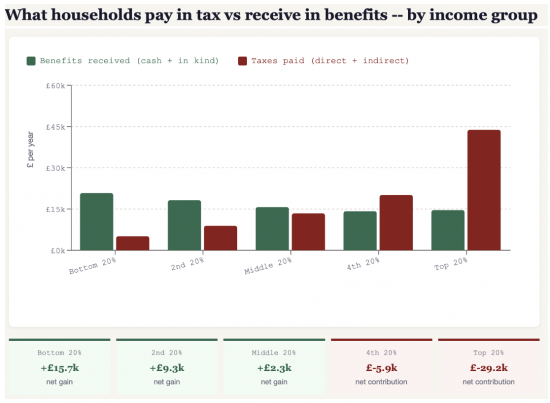
It shows the difference between the amount of benefit a person receives from the government and the amount they pay in tax. Benefits are in green. These include the value of benefits like the NHS and education, and subsidies for transport by way of the roads, for example, and everything else that a person might receive, as well as direct benefit payments, and the amount of tax they pay.
Households in the UK are split into five equal groups for the purposes of estimating this figure. So, on the left, we have the households with the lowest income. On the right, we have the households with the highest income. And as you'll see, the first three groups, moving from the left, all receive higher benefits from the state than they pay in tax.
The next group pays a bit more. These are the people earning around £50,000 a year in a household. And the highest group pay a lot more in tax than they do receive in benefits. In fact , they don't receive as much in benefits as some of the other groups, and that's not just because they don't get direct payments. They also tend to opt out of things like education and health as well.
But the point is, everywhere, this imbalance, which is not explained and which is not justified by government, is giving rise to grievance. And misunderstanding is making the situation worse. Everywhere, Labour is speaking one language of neoliberalism but not talking about what is actually needed, which is a greater degree of redistribution than we've already got, because need is not being met. So, grievance exists across the spectrum.
And now let's talk about the last major crisis that I've chosen to highlight. That is climate change. At the same time as everything else is going on, we know climate change is intensifying. We only have to live through this summer to realise that. And energy security in the UK now depends on decarbonisation, but we are not seeing that happening.
We're having more nuclear power; we're having more energy being extracted from the North Sea under policies being promoted by Keir Starmer, so we end up with a crisis. We've got extreme weather. We've got risk of flooding. We've got risk to crops. We've got risk to animals. We've got risk to health. None of these is being addressed because current fiscal rules are blocking essential investment to deal with this crisis in a way that is absolutely essential if we are to have a functioning country, a functioning population, a functioning economy into the future. We've got no strategy, no policy, and no defences as a consequence of this with regard to climate change, and all of that implies one thing.
All of these crises, war and defence, inflation, recession, bond markets, grievances, and trust and climate change. All of these, and the other crises that Andy Burnham also has, which I haven't mentioned, are currently analysed through one framework. That is the neoliberal economic framework. And in that, the government is always treated like a household subject to swings of fortune, which are beyond its control. Well, that's not true. The government is in control of a great deal in this economy, and it's not like a household because households can't create their own money, and the government can.
The government can create money to fund its own spending. Debt is not a constraint on central government in the way that it is portrayed to be by the media and by government itself. And when world events happen, we are assumed to have no role, as we are US poodles. That is an extension of this household analogy. And fiscal rules are presumed to be politically untouchable because the household analogy requires that to be the case.
And so every major problem that we have appears insoluble as a result. They're insoluble because we've chosen to make them so. We chose to create the crises. Now we are choosing not to address them because we tell ourselves it's impossible to do so. But in this impossible situation, something has to break.
We have crises. We cannot solve them using the policies that created them. A different understanding of government finance is required. We have to recognise that a currency-issuing government can create the money it spends. It can tax to manage inflation and reduce inequality as a consequence of that spending, and borrowing is not an issue of concern. It is a matter of supplying savings products to an economy that wants them.
Therefore, we should be talking about a very different economic framework, which starts by abandoning fiscal rules and saying, "Money is not our constraint. Real resources and productive capacity are." The debate we need has to start with different assumptions. We can't solve the problems we have by using the old failed assumptions, which created it.
If that's the case, we have to also make clear that we must address the underlying assumptions that have given rise to Britain's economic failure.
We have to end the wealth extraction from most people in this country, which has been going on for decades. The rent that is extracted literally through payments for property, and the rent that is extracted through excessive interest rates.
We have to end the curse of financialisation that has weakened productive investment.
We have to end the property and finance domination of the economy.
We must end the fact that too much tax is borne by those who are in work and on consumption. Tax must now be paid by those who control land and wealth.
We must tackle weak productive capacity by creating permanent new ways in which money can be found to fund investment.
And we must fund public services that end grievance.
All of that requires massive structural economic reform.
Investment rules should replace fiscal rules.
Wealth and land should be taxed more effectively.
The state must direct productive investment via ISA savings and pension savings.
The energy transition must become our industrial strategy.
And tax should reduce inequality rather than exacerbate it, which, too often, at present, it is doing.
Services must be improved.
And monetary policy must serve the country rather than fight it, which is what is happening at present.
Burnham has to understand these challenges. Whether he does is open to question. The Treasury orthodoxy remains deeply entrenched inside the current Labour government. Has he managed to avoid that? I don't think so because he once served as a Treasury minister. I suspect he's drunk the Kool-Aid. I suspect he believes in what the Treasury thinks.
But we need to hope that he can change, and we need the media to change its attitude as well. We need to talk about the fact that we have to change our society if we are going to live better. And if we are going to manage the global crises that are not going to wait for our politics to have an impact upon us, if we don't do anything.
Our success, Andy Burnham's success, and the country's success depend upon changing our economic model, and unless Burnham does that, he will fail.
He's taken a long time to get to Downing Street, but his prospects aren't good unless he's going to use the chance he's being given to fundamentally change the way in which we are governed.
If he doesn't, it will be another nail in the coffin for Labour, the people of this country, this country as a whole, and maybe our democracy, which will be under threat from the far-right as a consequence. That's how important this is.
That's what I think. What do you think? There's a poll down below. Let us have your comments, and please like this video if that's what you do. Share it, and if you'd like to buy Tom and me a coffee, that would be great.
Poll
Thanks for reading this post.
You can share this post on social media of your choice by clicking these icons:
There are links to this blog's glossary in the above post that explain technical terms used in it. Follow them for more explanations.
You can subscribe to this blog's daily email here.
And if you would like to support this blog you can, here:

 Buy me a coffee!

[…] The video this Debate Ammunition supports is available here. […]
The argument made seems to be that Andy Burnham should change Britain’s economic policy to one that it already has. MMT is a description not a theory, there’s close to £1bn of QE money in the economy since 2008 and government is taxing at post war record levels while inflation is above target.
The Green New Deal is just a label. There is literally billions being spent on tackling and regulating climate from carbon capture projects, fermented palm in petrol to solar mandates on new housing all of which employ hundreds of thousands in the green economy.
It’s going to be an absolute circus.
And your point is? I am not sure what you are saying.
I think Colin mean almost £1 *trillion*. QE topped out at around £900 billion. After years of QT it is still around £500 billion. In effect, huge amounts of money was created. But it was not delivered evenly.
More money chasing the same assets leads to asset price inflation. Cui bono?
What would happen if the Government were to significantly reduce bond sales?
The markets would squeal. The central bank reserve accounts would increase.
Let’s hope he does it then!
In the context of what passes for the UK’s “financial system” and the City of London, this is worth looking at:
https://www.youtube.com/watch?v=pXo6VMvajCg
The backstory to the French revolution. A group which resisted every single change (wrt to tax), & a nation that was in debt up to its necks.
The banksters/hedge fund/etc do not want change. They are quite happy with the way things are. LINO/Burnt-ham cannot make the changes needed. They are part of the system, they were chosen by the system. If there is no change, then a 21st century version of tumbrils will come as sure as eggs are eggs. Stupidity, short sightedness, I’m alright jack, selfishnees on & on it goes – until it doesn’t.
Richard – you outline Burnham’s choices in painful detail – but it is really difficult to see him rising to the occasion – firstly because he seems to have been gifted his Makerfield seat and his premiership by the Labour Together faction (Josh Simons) which engineered the MacSweeney/Mandleson/Starmer coup (Paul Holden’s book) – using illegal funds and possibly with security services input. <p>
Their donors, (their members no longer matter) many of whom are linked to big business, the City, foreign states interests etc etc – will not accept Burnham ditching fiscal rules, or ‘interfering’ with BoE , bond markets etc<p>
So deeply embedded is the neoliberal narrative – that the BBC Today programme in its business slot this morning asked one of its business guests if the Burnham’s wanting more public control over utilities ‘sends a shudder down his spine’?
Worrying to see Josh Simons in Downing Street getting hugs at lunchtime today
Sadly, I do not believe that Burnham would be the Labour leader if he truly intended to move away from neoliberalism. He will merely open the door to a hard right government, as Starmer was also doing. We seem to be trotting along to a greater script written by others.
The government hold a considerable amount of government bonds which are included in the debt figures. They should cancel these and then announce that they have reduced the Debt/GDP ratio and therefore can abolish the fiscal rules. The city of London needs fixing by a transaction tax that depends on how long an asset has been held.
In the Whole of Government Accounts they are shown as cancelled. In accounting terms they are.
There’s an awful lot that Burnham needs to do. I agree with your strategic analysis. I differ in the timing.
The UK and other governments do need to realise that they need to run a permadeficit. They need to understand MMT. They need to create or print money. But they don’t need to tear up those (nonsensical ) fiscal rules now. Indeed, I think it would be a mistake to tear them up now (though they must eventually go).
Creating money is similar to quantitative easing. That allows increased spending which is most welcome. But it also massively increases Bank of England reserves. Put aside the interest currently paid on reserves – I agree with you that should not be happening (a change Burnham should make now). But that money finds it’s way to the already wealthy, increasing inequality. That is bad. Inequality inhibits the economy. Wealthy hording slows the circulation of money, which reduces growth.
The important thing is increased government spending to make use of available real resources. Where the money comes from is much less important. And money needs to come from the wealthy to reduce inequality. So the government should use that first, i.e. increase the tax take from the wealthy (who would not spend that money themselves).
Taxing wealth, as in your report, is sufficient for the next couple of years, until the next election. And it is consistent with the Labour manifesto. Furthermore it would minimise criticism from the press.
Burnham doesn’t have to, and cannot in practice, do everything at once. He urgently needs to reduce inequality through tax. He needs to increase spending to start to reduce the damage from austerity. He needs to start moving in the right direct. That is enough.
To avoid watching any tedious news about today’s changeover of tenant in the publicly-owned housing in Downing St, I did a little research to see who the new tenant at number 10 will be serving, and if he has to make any binding commitments before taking office.
https://commonslibrary.parliament.uk/research-briefings/cbp-10840/
https://www.hansardsociety.org.uk/blog/mps-oath-of-allegiance
Nope. You might have thought he would have to promise to serve the people of the UK, or the common good, or even to promise to obey the law, but he formally promises and pledges NOTHING. (Downing St. podium pitches don’t count!)
When he became an MP, he took an oath/affirmation to be faithful to our unelected head of state (currently Andrew Mountbatten-Windsor’s elder brother Charles). As PM he doesn’t AFAICS, promise anything extra, and at no point, whether on becoming an MP, Privy Councillor or Prime Minister does he nor do any of his Cabinet colleagues, pledge to serve “we, the people”. I’m quite peeved about that.
The whole process of appointing the head of the UK government, is ruled, not by law, but by “convention”, and “royal prerogative”. The King could, if he saw fit, appont ME as PM. (I’d refuse.)
The corollary to all this mediaeval flummery, is that, contrary to what those in power tell us, ANYTHING is possible, if we have the will and stamina to make it happen. But a lot of powerful people have a vested interest in the status quo.
[…] I just posted an infographic and noted that James and Sam, who is doing an internship with us, have been iterating ideas on infographics. I have already shared one from James. This one is from Sam, based on this morning's video: […]
I voted “climate change”, though a new economic model is a prerequisite. All around the globe, we can see the evidence that we have reached the point where continuing to expect unlimited material growth and ever-increasing consumption is impossible to justify. Climate change demands profound changes in how our society operates. This must now be the top priority, but it can only happen with a new economic model and a new relationship between the public and private sectors.
Thanks
[…] last line is the killer. As I said in this morning's video, to succeed, Burnham has to break the fiscal rules. He has chosen a Chancellor who is very unlikely […]
Why is the Guardian headlining, “Burnham team keenly aware of fiscal tightrope”? I thought uk was in top ten world economies by ‘GDP’ with fiat currency. The stream of ‘there’s no money’ is relentless. Sorry if these questions sound like I’m way behind! Am wondering how to start some kind of rehearsal group to discuss and practice rebuttals to all the neoliberal framings out there.
Positive note i heard a caller on LBC denounce the household analogy. About time! Next day a rep of the ‘IEA’ was on as a talking head so then a big negative. I think the presenter may have challenged him a bit, but my signal cut out.
Why is the Guardian headlining, “Burnham team keenly aware of fiscal tightrope”? I thought uk was in top ten world economies by ‘GDP’ with fiat currency. The stream of ‘there’s no money’ is relentless. Sorry if these questions sound like I’m way behind! Am wondering how to start some kind of rehearsal group to discuss and practice rebuttals to all the neoliberal framings out there.
Positive note i heard a caller on LBC denounce the household analogy. About time! Next day a rep of the ‘IEA’ was on as a talking head so then a big negative. I think the presenter may have challenged him a bit, but my signal cut out.
Yes indeed I encourage you to use AI to augment your thinking?
– Use AI to *interrogate* your ideas, not just to generate content. Ask it to find blind spots, assumptions and alternate interpretations in your reasoning.
– Keep yourself in the driver’s seat: have AI refine, challenge and scaffold your thinking, but make final judgments yourself so you don’t offload too much cognition.
Agreed
Thank you Richard and Tom. Your poll is a lottery- a type of sortition. Prior to this current so called democratic rule we had sortition! 6th century Athenians cooperated using sortition (lottery) so as to head off oligarchy that thrives when using only voting as we all know! In your poll the threat from far right and climate change are the same threat as the same funders converge. Beyond Elections by New Democracy Foundation is a public education video explaining that actual democracy includes sortition https://youtu.be/lOsbww9-Q6s?si=VHGRkVWwb-cDWaKK
[…] Burnham will fail unless he breaks the economic rules […]