
What is fiscal policy, and why does it matter?
Fiscal policy is one of the government's most powerful economic tools, yet it is also one of the least understood. Fiscal policy is the process of managing the difference between government spending and its tax revenue for the benefit of society. That means that every debate about taxation, public spending, inflation, public services and economic growth is really a debate about fiscal policy, but few people ever explain what it actually is.
In this video, I explain fiscal policy from first principles. I show what fiscal policy is, how government spending is authorised, why taxation plays a very different role from the one most people imagine, and how fiscal policy shapes employment, inflation, inequality, investment and economic well-being.
I also explain why fiscal policy is about far more than balancing budgets. Good fiscal policy is about using the government's financial powers to mobilise the real people, skills, and resources available within the economy to achieve the best benefit for society. That means fiscal policy should support full employment, strong public services, economic security, environmental sustainability and rising living standards while keeping inflation under control.
This is the first video in a short series. The next will explain monetary policy before examining how fiscal policy and monetary policy should work together instead of frequently pulling in opposite directions.
If you want to understand how fiscal policy really works, and why it should be at the centre of economic debate, this video is for you.
This is the audio version:
The Debate Ammunition for this video is available here.
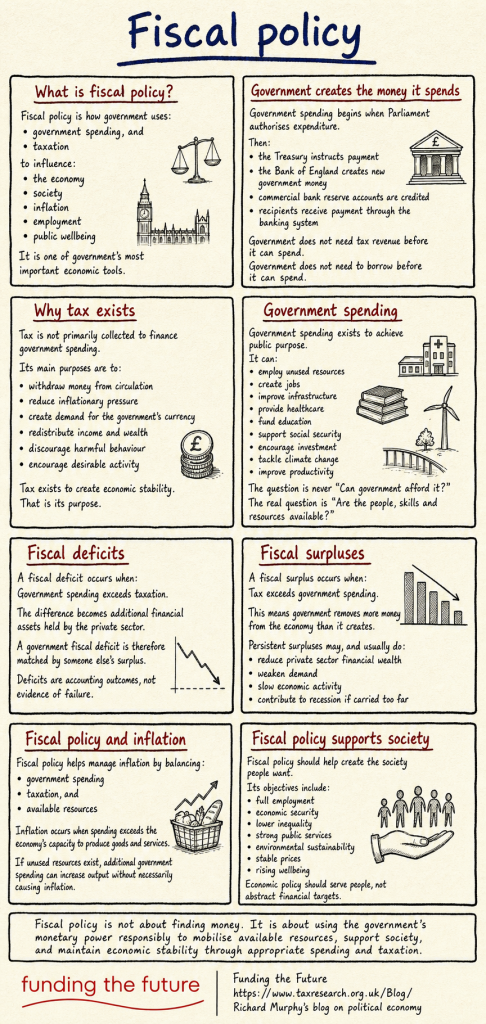
The infographic on which this video is based is here:
This is the transcript:
When we talk about economic policy in the UK, the issue is usually split in two. We talk about fiscal policy, and we talk about monetary policy, and I have a feeling that most people don't know what they are. So, in this video, I want to talk about what fiscal policy is. And in another video that will be coming soon, I'll talk about monetary policy. Then I might talk about how we join them together, because that is what we need to do.
We need to talk about both these things and then realise that at present, they normally run in opposition to each other and we'll only succeed in this country when we get them to work together.
But what is fiscal policy, first of all? Fiscal policy is simply how the government uses the mix between its spending and tax to influence the size of the economy, the shape of society, the rate of inflation, the level of employment inside the economy and public well-being generally. It is one of the government's most important economic tools.
Government spending begins when Parliament authorises expenditure. It sets a budget, in other words. We all think that the budget is setting rates of tax and all that sort of stuff, but it isn't. Its most important job is to authorise the government's expenditure for a year. Well over £1 trillion worth of it.
And then when it has a legal budget, government departments are authorised to spend. They do so by asking the Treasury to instruct a payment to be made. The Bank of England, as a consequence of being given that instruction to make a payment, creates new government money. This is done by marking up the government's bank account. That's all that happens. Some numbers are typed into a computer. New money is created.
That is a process with which you should be familiar. Every time you tap your credit card on a card machine, you create new money between you and your bank. The Treasury can do the same by instructing the Bank of England to mark up its bank account.
But as a consequence of that new money being created, commercial banks have their reserve accounts held with the Bank of England increased. And then they use that money to make a payment to the recipient that the government intended.
The government doesn't need tax revenue before it can spend in that case. The government doesn't need to borrow before it spends, in that case. It simply creates new money.
So, tax has a fundamentally different role inside fiscal policy than that which most people imagine, but it remains fundamentally important within this government spending cycle despite that fact. Its main purpose inside the fiscal cycle is to withdraw money from circulation, or there would simply be too much of it in circulation, and we'd get inflation. And therefore, its role is to reduce inflationary pressure.
At the same time, its job is to create demand for the government's currency because the government insists that we pay our taxes using pounds. And if we have to pay using pounds, we use pounds for everything else that we undertake inside the UK economy. And as a consequence, the government gains control of that economy because its currency is the one in use. That's a key role for taxation as far as the government is concerned.
And at the same time, some social policy can be delivered via taxation. For example, tax can be used to redistribute income and wealth. It could be used to discourage harmful behaviour like consuming harmful products: alcohol, tobacco, and so on. And it can also encourage desirable activity like investment or things that we need, like education and health. Tax exists then to create a stable economy in a way that suits the needs of society. That is the role of tax. I once called this The Joy of Tax, and I wrote a whole book about it.
Government spending exists to achieve public purpose as well. It can employ unused resources in the economy, create jobs, improve infrastructure, provide healthcare, fund education, support social security, encourage investment, tackle climate change, and improve productivity throughout our economy by making careful investment.
The real question is: “Are the people, skills, and resources available when it comes to spending, because the money always is if those people, skills and resources are available?” That is a simple, straightforward fact denied by many economists, but actually fundamentally true.
A fiscal deficit, and we hear a lot about these things, arises when government spending exceeds tax revenue. The difference becomes additional financial assets held by the private sector. And let's just be clear about this. If the government spends more into the private sector than it takes back by way of tax, somebody in the private sector is better off as a result.
The government actually creates private wealth by running a deficit. It's one of those weird reasons that I don't understand why the wealthy keep on demanding that the government get rid of deficits, because in fact, they're better off because of deficits. A government's fiscal deficit is always matched by somebody else's fiscal surplus. The government makes people richer. Deficits are accounting outcomes and not evidence of failure, then.
And a fiscal surplus is the exact opposite of a fiscal deficit. When there is a fiscal surplus, the government taxes more out of the economy than the government spends. This means the government removes more money from the economy than it creates, and persistent surpluses have serious, damaging effects. They reduce private sector financial wealth. They weaken demand as a consequence. They slow economic activity by reducing the rate of investment within the economy, and they can contribute to recession if carried too far.
That is why all of those who call for the removal of public debt don't understand economics, and don't understand the basis of their wealth. There is, then, a problem with the misunderstanding of the difference between fiscal deficits and the benefits they bring, and fiscal surpluses and the harm they create.
But a balance has to be found, and that's because of inflation. Fiscal policy helps manage inflation by balancing government spending and taxation and the available resources within the economy. And it's that last one that most people forget. Inflation only happens when more spending power is injected into the economy than the economy has capacity to consume because there aren't enough goods and services for that money to buy.
If there isn't enough for that money to be spent upon, we will get inflation. But if we keep this balance between government spending and taxation and the available resources that the government has available to it to buy, we don't get inflation.
And critically, if unused resources exist within the economy, best measured by the rate of unemployment, additional government spending can happen without necessarily causing inflation by putting those resources to use. That is a vital understanding that is missing from most people's understanding about fiscal policy at present.
So, fiscal policy can support society. Fiscal policy can help create the society that people want. Its objectives include full employment, economic security, lower inequality, strong public services, environmental sustainability, stable prices, and rising well-being. Economic policy should serve people and not abstract financial targets, and fiscal policy helps to achieve that goal.
The key takeaway from all of this is that fiscal policy is not about finding money for the government to spend because the government can always create the money it needs. It is instead about using the government's monetary power responsibly to mobilise the available resources within our economy, our society, and throughout the country, to maintain economic stability through appropriate spending and taxation, which can in turn deliver well-being for everyone.
That's what fiscal policy is about. That's how it should be used. We now need, in another video, to discuss monetary policy and how these two are so often in conflict because monetary policy presumes that money is dominant, and fiscal policy should look at real resources, and it's the conflict between the two that has led to the economic problems that the UK has.
That's what I think. What do you think? There's a poll down below asking you to give your opinion on the importance of fiscal policy. And please let us have your comments.
Poll
Thanks for reading this post.
You can share this post on social media of your choice by clicking these icons:
There are links to this blog's glossary in the above post that explain technical terms used in it. Follow them for more explanations.
You can subscribe to this blog's daily email here.
And if you would like to support this blog you can, here:

 Buy me a coffee!

[…] video that this Debate Ammunition supports is available […]
Thanks again for a fundamentally important article!
Might it also, if indirectly, raise questions as to why regular citizens are actively ill informed about this matter by the main stream media, politicians etc and passively by its not being visibly included in most, if not all, forms of institutional education?
I second your motion!
I can only say that having this properly explained for once makes you see exactly how much current governments favour the private sector so much and even the exploitation that enables.
There is also a rich democratic element to fiscal policy. James Buchanan’s ‘Public Choice Theory’ even mentions this but pours scorn on it – that politicians meeting the needs of voters is some how unwholesome or corrupt and not ‘objective’. So what are voters supposed to vote for then – people who make their lives worse? No – even better – make them fall out with each other and fight for the scraps whilst the rich gorge themselves at the Treasury.
What would Buchanan make therefore of the private funding of politics we see too much of today, and more recent changes to political funding in his own country, the USA? He would probably say it was justified because of democracy wouldn’t he? What else could he say? Yet private funding of political parties and campaigns has essentially purchased state fiscal policy for the rich. How is that not subjective or self interested? How typically Fascist to accuse someone else of your crimes.
What times we live in.
Thanks
@PSR
A few weeks ago someone here (was it you?) recommended the book Democracy In Chains by Nancy MacLean. It’s a chilling read and explains that much of the modern move to right wing politics and economics is encouraged by think tanks around the world founded and funded to deliberately promulgate the thinking of Buchanan and his like. They see democracy as system in which the ‘individual’ (their class of wealthy white male) is besieged and oppressed by the power given to the great unwashed mass of undeserving non-property-owning serfs.
I too am reading it, in small doses. Chilling as you say. This post is coalescing thoughts about how the neolib lobby captures government, the source of wealth, then messes up the ‘real’ economy and public services & infrastructure, in pursuit of the their agenda, whilst crypto coins are sold to extract fiat currency from people. I don’t think they have any love for any ‘serfs’ who own their own house either; more and more mortgage and rent payments go to big corporations. Expanding wealth will logically mean they need to own all the houses as they need investments. Small landlords will also be on the menu.