
THE RICHARD J MURPHY YOUTUBE CHANNEL
DEBATE AMMUNITION
What Is Fiscal Policy?
Funding the Future | July 2026
Topic
How government uses the mix between spending and taxation to manage the economy, and why most people misunderstand what tax is actually for.
The video that this Debate Ammunition supports is available here.
The Core Argument
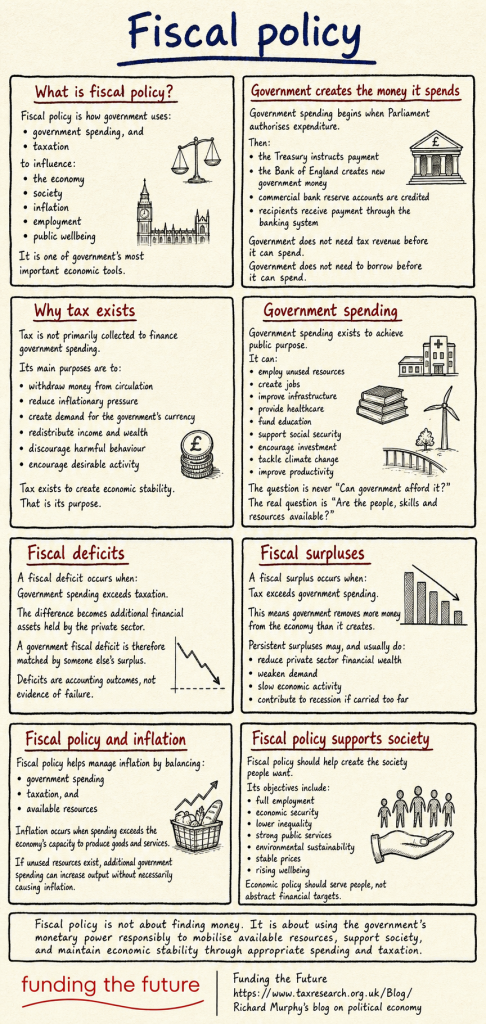
Fiscal policy is the government's use of spending and taxation to shape the size of the economy, the rate of inflation, employment levels and public well-being. It is not, as most people assume, about finding money for the government to spend, because the government can always create the money it needs.
Government spending creates new money: when Parliament authorises expenditure, the Bank of England marks up the government's bank account. Tax then withdraws money from circulation. Its primary purpose within fiscal policy is to control inflation and create demand for sterling, not to fund the spending that has already happened.
A fiscal deficit means the government has spent more into the private sector than it has taxed back. Somebody in the private sector is therefore richer as a result. Deficits create private wealth.
A fiscal surplus does the opposite: it removes more money than it injects, weakening demand and, if sustained, pushing the economy towards recession.
The real constraint on government spending is not money but real resources: the people, skills, materials and productive capacity available in the economy. If those resources are unused, measurable by unemployment, additional spending can happen without causing inflation. Inflation only arises when spending power exceeds the economy's capacity to supply goods and services.
The Argument Structure
Step 1 — Government spending creates money, not the reverse:
Every time Parliament authorises expenditure, the Bank of England marks up the government's bank account, just as a bank marks up your account when you use a credit card. New money is created. The government does not need tax revenue or borrowing before it can spend. This is how the UK system already works.
Step 2 — Tax controls inflation, it does not fund spending:
Tax withdraws money from circulation after it has been created by spending. Without that withdrawal there would be too much money chasing too few goods and inflation would result. Tax is, in that case, the primary tool to control inflation within an economy like that of the UK.
Tax also creates demand for sterling by requiring taxes to be paid in pounds This is the mechanism by which the government gains monetary sovereignty.
These roles are fundamentally different roles from those described by the household analogy most politicians use.
Step 3 — Deficits create private wealth, surpluses destroy it:
A fiscal deficit is simply the accounting mirror of a private-sector surplus. If the government injects more money than it withdraws, someone in the private sector holds more financial assets. Persistent surpluses do the reverse: they reduce private wealth, weaken demand, slow investment and risk recession. Demanding zero public debt is, paradoxically, a demand to reduce private wealth.
Step 4 — Real resources, not money, are the true constraint:
Inflation happens only when spending power exceeds the economy's productive capacity. If workers, factories and skills are idle, government can spend to employ them without causing inflation. The test is unemployment and spare capacity, not an arbitrary fiscal rule or a target for the national debt.
Their Argument → Your Rebuttal
|
They Say |
Your Response |
|---|---|
|
The government has to balance the books — you cannot just spend money you do not have. |
A currency-issuing government is not a household. When the Bank of England marks up the government's account, new money is created. The government always has the money it needs. The real question is whether the real resources exist in the economy to absorb the spending without causing inflation. Balancing the books by creating a government surplus, as some demand, removes more money from the private sector than the government put in. That weakens demand, cuts private wealth and slows growth. It is austerity by accounting. |
|
If government just creates money, we will get runaway inflation like Zimbabwe or Weimar Germany. |
Inflation arises when spending exceeds the economy's productive capacity — when there is more money than goods and services to buy. If there are unused workers, idle factories and spare capacity, new spending fills that gap without causing price rises. Zimbabwe and Weimar experienced supply collapses resulting from the destruction of productive capacity and not simply the act of money creation. The UK has substantial unused capacity, measurable in its unemployment rate. |
|
Fiscal deficits leave a debt burden on our children and grandchildren. |
A government deficit is, pound for pound, a private-sector surplus. When the government runs a deficit, it is creating financial assets held by the private sector in the form of savings, pension funds, and corporate reserves. The 'burden on future generations' framing treats government accounts in isolation. Future generations inherit both the liability on the government's books and the corresponding financial assets held by the private sector. Calling only one side of that a burden is selective arithmetic. |
|
Surely there must be some limit on what government can spend? Fiscal rules exist for good reason. |
Yes, there is a limit: it is the limit of real resources available to the government to buy within the economy. The economy's productive capacity in the form of its workers, skills, energy, infrastructure, and materials, sets the ceiling. Government should spend up to the point where those resources are fully employed and stop there, because that is where inflationary pressure begins. That is a harder, more meaningful constraint than an arbitrary debt-to-GDP target that ignores whether workers are in jobs or sitting idle. |
The infographic that supports this video
The One-Liners
“Tax does not fund government spending: it controls inflation and creates demand for sterling.”
“A government deficit is not a failure; it is the accounting record of government-promoted private-sector wealth creation.”
“The government can always create the money. The real question about any planned spending is always whether the real resources exist.”
“Demanding zero public debt is demanding lower private wealth.”
“Inflation is a real-resource problem, not a money-printing problem, and the two are not the same thing.”
Questions to Ask
If the government has to create our money, how did the government collect the very first pound of tax revenue without spending it into existence first of all?
If fiscal surpluses are prudent, can you name a period when sustained surpluses did not precede a recession?
Which specific real resources such as skills, workers, materials, and capacity, are actually in short supply right now, and which are merely assumed to be?
If the national debt is a burden on future generations, who exactly holds the other side of that liability as a financial asset?
Further Reading
|
Post |
Date |
What it covers |
|---|---|---|
|
2 Mar 2026 |
Sets out the operational reality that government spending creates money first, with tax withdrawing it afterwards — the core mechanism explained in this video. |
|
|
6 Mar 2026 |
Explains why a fiscal deficit is an accounting outcome and the mirror of a private-sector surplus, not evidence of mismanagement. |
|
|
4 Aug 2024 |
Demonstrates pound-for-pound how a government deficit translates directly into financial assets held by households and businesses. |
|
|
7 Jan 2026 |
Explains the accounting framework behind the claim that one sector's deficit is always another sector's surplus — the foundation of the deficit-as-wealth argument. |
|
|
Where does the money go when the government spends — and when it taxes? |
30 Oct 2025 |
Traces the money flows through the Bank of England, commercial banks and the private sector when the government spends and taxes, showing the operational reality described in this video. |
Thanks for reading this post.
You can share this post on social media of your choice by clicking these icons:
There are links to this blog's glossary in the above post that explain technical terms used in it. Follow them for more explanations.
You can subscribe to this blog's daily email here.
And if you would like to support this blog you can, here:

 Buy me a coffee!

[…] The Debate Ammunition for this video is available here. […]
The wording in the first ‘Questions to Ask’ seems to imply governments don’t create our money.
Should it read ‘If the government has to collect our money…’?
I don’t think it my best, but I think it works.
[…] Debate Ammunition: Fiscal policy […]