
One of my recurring themes on this blog lately has been the failure of neoliberalism to find any use for the money saved in our economies.
I am not alone in noticing this theme. Martin Wolf in the Financial Times has, for example, written for several years about the problem of a global savings glut. He has been right to do so.
As I have noted, this has been created by gross wealth inequality, delivering rewards to some way in excess of their needs, meaning that they have saved in the style that Martin Wolf has described, coupled with the failure of financial markets to find any use for that money.
At the same time, the neoliberal dogma that has simultaneously created that inequality and excess reward, and so a savings glut, has also created the idea that wealth can be created by financialisation alone, rather than through the creation of actual value by production, which has, as a result, created significant financial fragility in the balance sheets of many of the world's largest companies
Simultaneously, neoliberalism has promoted the dogmatic belief that government must withdraw from active involvement in the economy, meaning it must take no part in putting people's savings to constructive use, an issue I have addressed many times.
In a nutshell, it is this combination of circumstances that has created much of the crisis we now live in.
I was reminded of this by an article in the Financial Times this weekend. The article in question was about the last quarter's results for Berkshire Hathaway, the company that was, until very recently, headed by the supposedly legendary investor Warren Buffett, but which now has a new CEO. It noted that he has not changed the company strategy that he inherited from Buffett, which has over the last three or more years been based on the idea of selling out of investments in stock exchange companies and building ever greater cash piles, or their equivalent in the form of savings in US Treasuries, and maybe other government bonds.
This chart revealed the trend:
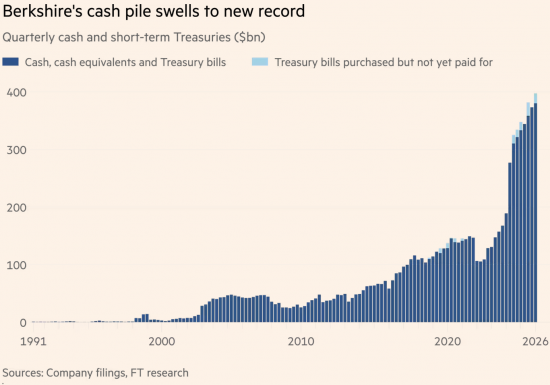
You will note that Berkshire Hathaway now has a cash pile totalling $380 billion. In that case, those buying its shares do not only now buy a stake in the remaining investments in a diversified range of companies that Berkshire Hathaway holds, but they also use their money to buy into a company that quite literally holds money because it can, just like the saver buying its shares, find nothing better to do with it.
That is, quite literally, the meaningless point which modern capitalism has reached, and please do not offer investment in AI as a counter-narrative to this. The current wave of investment in AI, large as it is, proves my point precisely because it indicates how desperate people are to find any form of new economic activity that might generate an economic return, when the fact is that AI not only cannot be guaranteed to do that, but might, in fact, be wholly destructive, both of our climate and of our economy, by destroying employment within it, alongside the whole structure of our society as a consequence.
Having reflected on this, I then came across this issue of capitalism running out of road in a different way. Since we started our YouTube channel, I have watched videos on cameras, video equipment, lenses, microphones, and all the things I had to learn about to reach an acceptable level of production quality. During that process, I came across the YouTube channel of a chap known as Gerald Undone. His videos were probably the most sophisticated analysis of camera equipment available on YouTube, and he was widely followed because he was just so good at spotting which products were good, explaining why, and what should, alternatively, be avoided.
And now he is giving up doing that. Why? That is because he says that all the fun has gone out of his job. His argument is that, whoever you now buy a camera from, whether it be Sony, Canon, Nikon, Leica, Panasonic, or anyone else, most probably including your phone, you will get a piece of equipment that is near enough perfect, and capable of delivering a photograph so far beyond the limits of your imagination that preparing technical analysis of them any more is becoming a waste of time.
As he has said, talking about the creative process, which is something he has never really done, remains relevant. Talking about the kit is not. It has reached the point where every reasonable demand that a human photographer can make of any such kit not only can be, but will always be, delivered. The rate of return on further investment in developing such equipment is now so small that it is hardly worthwhile to make it.
That summarises the neoliberal problem in a nutshell. We have reached the point where, when it comes to “stuff” of this sort, there is little further progress to be had, and any claims of difference will now come down to marketing spiel, and not to reality. What matters now is the capability of people, which is the very thing that neoliberalism wants to destroy.
Neoliberalism does not want to create people who can take photographs, because if people can think well enough to be really creative, they will question the neoliberal system, and the photos they create might challenge it. When they could complain about their kit for not producing the photos they required, they might have been put off creating the content that asked the questions that are necessary in life. Now there is no point in complaining about the kit; the only questions left are the meaningful ones.
No doubt, in due course, neoliberalism will find another way to suppress people from asking the questions it thinks undesirable. That is its chosen way, although it has yet to find an answer to the problem neurodivergent people pose to it, among whom willing compliance is rare, which is why all our leading neoliberal political parties and think tanks are turning so heavily against people with those conditions.
To further contextualise this, I published a video yesterday asking a rhetorical question about why I do this, by which I meant why I write blog posts every day and post a video every day. In summary, as I explained, that is because I want to find the answer to the question, what is our economy now all about?
What is now clear is that it is not about creating further technologies that will forever be beyond human capacity to use. Instead, it has to be about how we advance human capability. It is only by investing in people, meeting their needs, and providing them with the freedom from fear that they need to explore their own capacity to live well that we can now see a rate of return on the resources available in this world. The amazing and useful coincidence is that by doing so, we can also avert the major consequences of climate change.
Once we have our basic needs met, and I stress that point, most of us do not need more stuff. What we need is more understanding, which will, in turn, deliver a more level playing field, because when all is said and done, all of us are finite in what we can achieve, whilst massively diverse in how we achieve that goal, and it is by achieving satisfaction for everyone that we can now produce the returns that society requires.
There is, then, a requirement for a massive change in mindset. Markets have supposedly created untold wealth, but it is deeply concentrated and now unable to generate any further returns beyond rent extraction. In contrast, the scope for non-market-based activity by government and others to build capability and produce well-being remains enormous, massively underexploited, and with real potential to deliver returns far beyond anything that investments in market capital, technology, or rent extraction can produce at this point in time.
In this context, I am thinking a lot about how we need to reconsider GDP and related macroeconomic goals. There is nothing to publish yet, but what I am finding, as a consequence of that thinking, is a whole new range of economic indicators on what is really happening in the world around us, which can provide better indications of how we can allocate the world's resources, which, in economics, is the ultimate answer to the ultimate question. There will be more on this in due course.
Thanks for reading this post.
You can share this post on social media of your choice by clicking these icons:
There are links to this blog's glossary in the above post that explain technical terms used in it. Follow them for more explanations.
You can subscribe to this blog's daily email here.
And if you would like to support this blog you can, here:

 Buy me a coffee!

Neoliberals have exacerbated the self destruction of deregulated capitalism. It is now, as long predicted by economic philosophers, collapsing under its own contradictions. I fail to see how tech bro monarch Musk’s desire to create new virtual corporate city states run by the an Ellison designed Panopticon or their mass colonisation and exploitation of another planet will offer any solutions to this crisis.
I look forward to your thoughts on a truly shared and culturally creative future economy.
The UK is not short of projects that need investment, from pot-holes to new roads and houses.
Invest in people to do the work. It will add value by way of improvements.
Here comes another investment boom and bust………….
Probably on Laughing Boy on the 3.30 at Catford or other worthy project
( Dog Race)
At least I hope changes to the law will mean we dont get money poured into Buy to Lets
Again putting my MMT head on it indicates the need for higher and more effective taxation so we dont get these massive amounts of money sloshing around in the system like a draught in a colander looking for somewhere to go.
But we are going to end up again with a Jane Austen style aristocracy living off the interest
We have spent the last few hundred years investing in extracting raw materials from the earth and turning them into ‘things’ we use. We’ve invested in some of the people, but in no way have we invested in everyone. But industry now seems to be excluding the majority of the earth’s inhabitants.
My answer is therefore that we should be investing in people. The earth has to support us all and we should all recognise that all having their needs met should be our prime purpose.
Robots as carers? What’s wrong with people paid a decent wage for that job?
Financial markets, and Berkshire Hathaway, cannot find anything to invest their money in that satisfies their excessive, immoral, greed.
gibberish nonsense
This, folks, is what passes for intelligent comment from a troll.
Yesterday I took a train to of all places Cleethorpes. The weather was crap of course but I got a good deal for the ticket.
From my train window I got a good idea of the state of the country. As a boy out trainspotting I remembered the line up to Grimsby used to have freight yards in it and factories nearby. They seem to have all gone. I saw stations that could employ people turned into houses; rubbish and poor maintenance everywhere that could keep people employed if addressed. Grimsby looked like a bomb had hit it around what was left of its docks, crumbling buildings and many boarded up (but there was a decent mariner for yacht owners to park their boats of course). And then Cleethorpes itself with its rather senseless over-provision of fish and chip shops on the sea front – it seemed to be holding its own in the town centre, and I found the Humberside folk to be friendly.
But that is why I’m commenting on Richard’s post because essentially he is right and from what I saw from my train window as it does on most journeys these days is prove that all Thatcher’s capitalism ever did was suck out money from areas of the country and create huge more centralised piles of cash for the sake of having huge piles of cash and nothing else (well except to ‘invest’ and suck out more cash).
This is not capitalism is my view. This has been and remains daylight robbery. And we my friends have been had, hook, line and sinker.
Much to agree with. I have not been to Cleethorpes for many years.
British Rail used to run a Merrymaker Excursion from Bristol to Cleethorpes in the late 70’s………
Sadly it wasnt well timed to get in a trip on the Humber Ferry
🙂
Make the most of it, as Cleethorpes is one of those places under threat from rising sea levels in the next 10-20 years, thanks to climate change.
At the moment it is a Labour FPTP seat, but it is in an area very popular with the fossil fuel fanatics of Reform close by. Farage in Clacton (occasionally) and Tice MP for Dubai, Boston and Skegness.
Many of those Humberside folk are, I’m afraid, now seeing Reform as their saviour. They will face a very wet future if they vote for Reform.
As a kid, I occasionally went to Skegness. Really liked it back then, but I think today they would have to pay me to go there.
(Posting as Victor Meldrew)
The hardware & software may be at a peak, but the manuals and documentation are unutterably awful, and I suspect AI will make them worse.
I’ve switched to Linux Mint, LibreOffice, Thunderbird, Handbrake, Firefox and OpenMediaVault since retiring, and rebuilt my desktop PC, and a home server, with a near vertical learning cliff face, but I don’t think I’ve ever solved a problem by “reading the ******* manual (RTFM)” or clicking Help. The good news is that the support communities for FOSS (Free Open Source Software) usually provide answers within 12 hours especially if you post in the evening ready for North America to wake up.
There’s a huge gap out there for someone to write instruction manuals, for everything from flatpack furniture, Microwaves, TVs, PVRs, and of course DECT & Mobile phones. Not to mention software.
Then some of us “out of support”, sorely in need of a hardware & software upgrade, geriatrics might be able to actually USE this amazing near-near-perfect hardware.
Now, how do I switch this thing on….? I DON’T BELIEVE IT!!
(Technical query for Tom, Samsung Android, Firefox, NoScript, – the GUI formatting shows in my posts during composition but never on publication so I’ve stopped using it. Does it depend on any particular scripts that firefox blocks?)
This could be a use for AI
I tried it and it always a) misses key steeps out or b) refers to the wrong version
RobertJ, I have observed that Instruction Information leaflets are of ever smaller fonts. Even as a short sighted person I have found it increasongly difficult to read these, to the point I can’t read this info any longer, perhaps due to older age and inability to focus on font size 6.
This does not seem accidental to me, suppliers do not want an understanding of their product as you may want to repair it – God forbid you don’t buy new again, again and again.
I bought a new printer recently, chosen in part because reviews said it’s simple and quick to set up. Quite frankly, it would have been easier to open the Strait of Hormuz.
This is very interesting, Richard. In my work, words I frequently use with clients, old and new, are “adequate”, “sufficient”, and “enough”. What I’m referring to is often the level of income (and, sometimes, capital assets) that the individual has in ‘retirement’ (however one defines that – who wants to be entirely idle in their 60s & 70s?). Most people confuse really big numbers as far as so-called “net worth” (my house value, my investment value, my pension fund value) is concerned with what I believe are their real needs in later years – primarily ‘retirement’ income, however that is generated (interest, dividends, annuities). Net worth is an entirely useless measure until HMRC come calling for Inheritance Tax, if you are lucky enough to have such a liability – most are not.
These assets – savings/investments – mean nothing at all to most people unless they are used to provide one with an income to spend on bread & cheese, pay your bills and taxes, and have a bit of fun. After all, when you hit your 60s onwards, most capital expenditure is on what I call ‘maintenance’ – helping younger family members, charities, buying a new vacuum cleaner or coffee pot – rather than on discretionary items, and this is because most people of that age have all the “stuff” they are ever going to need (but don’t ask my family about my buying far too many old used CDs! I often reflect on the fact that the original owner of these artefacts are long dead, just as I will be one day).
Agreed. Enough is a powerful word.
It’s something a lot of people have that, say, Elon Musk will never have…….enough.
This What an empty car park says about one of the UK’s poorest areas – BBC News
Grim reading
Its difficult in coastal areas and worse being an Island
A topic of conversion i had in the weekend was about the divergence of the S&P500 and the NYSE. People aren’t investing in the large multinational corporates found on the big name Wall street type stock index. They want something more diversified like what the S&P500 provides. They want mutual funds where people can put their money away in a relative safe place and forget about the worry of trading. People don’t want financial markets. But our governments keep on regulating finance markets as if 24/7 financial markets is what we want.
I was reading this morning of the history of the sell-off, and right to buy, of council houses in the UK. Over two million have been sold since the 1980s.
And during that time, affordable rents have all but disappeared, and fewer council properties are being built. In 2024–25, just 2260 council homes were built, while 13,966 were sold off, under Right to Buy.
And today, of the two million or so council properties that have been sold, approximately 40% are now owned by private landlords, who, of course, want market rents.
https://neweconomics.org/2024/05/more-than-4-in-10-council-homes-sold-under-right-to-buy-now-owned-by-private-landlords
It’s a vicious circle, and like the Tories before them, Labour are failing to deliver on their housing policies. No surprise there, as the private market is only interested in more profit.
Meanwhile, we go from housing crisis to housing crisis.
Those that have seen success under neoliberalism are killing off the life chances of many.
And I watched a video at the weekend of falling birth rates and the fertility crisis the developed world is now facing.
Housing insecurity is a big part of that.
Look no further than neoliberal rent extraction for the answer.
Nothing to disagree with here.
It is also worth noting that those new 2260 homes will be let at 80% of market rents – council tenants now have to have to be checked to see if they can afford these rents and some can’t. These higher rents make up for the lack of bricks and mortar funding from government – if you want cheap housing, you have to pay higher rents than the target/social rent previously charged. And the housing portion of universal credit is not guaranteed to cover the whole cost.
The Homes and Community Agency are also happy to give council landlords higher grant rates to buy existing homes from the housing market than pay a decent grant rate for brand new, low carbon homes. I should know ‘cos I’ve claimed such grants. It is tantamount to subsidising the private sector and hobbling the public sector. It’s a con.
Thank you
Much to agree with
Sobering article in today’s i paper about what is happening in rental market https://inews.co.uk/opinion/uk-rental-scandal-no-ones-talking-about-4377924
I believe that the economy should exist to provide people with the goods and services required for a dignified life across all stage of that that life in a sustainable way. So your blog comment this morning that ” the scope for non-market-based activity by government and others to build capability and produce well-being remains enormous, massively under-exploited, and with real potential to deliver returns far beyond anything that investments in market capital, technology, or rent extraction can produce at this point in time ” gives me cause for hope. I look forward to reading more as you define how the value of this economic activity may be demonstrated.
Good article and thought provoking as always.
The paragraph regarding those who are neurodivergent really made think. It’s an excellent point and something that I hadn’t considered before. As I have previously mentioned both of my sons are neurodivergent and my eldest in particular does question things and is quite perceptive.
Craig
Thank you
I guess in answer to your question, that is why western governments are investing all they can in fomenting war.
Superb article Richard, a little bit disturbing too.
‘They’ have nothing ‘new’ to sell us. There is only so far a camera phone, PC tech, cars etc can go.
To broaden this slightly, I read a theory recently that the Billionaires… Would like to leave behind the rest of us and create their own civilisation. Sounds crazy…but…
Currently reading a fascinating book on how Gawker was taken down, ten years ago… The MO of the person that took them down, is actually terrifying, how he did it and won.
Your article shows clearly that capitalism has run out of road. The money is available, there are unused resources and unsatisfied basic needs. The system was supposed to solve these problems, but cannot because there is not enough surplus created for entrepreneurs to engage in the process of satisfying the demand created by basic needs. Instead, the capital that would have been employed is now hoarded, earning low rates of interest.
Only a gov has the economic power to change this. I suggest increasing taxes on unearned income (interest) while supporting any activity directed towards satisfying unmet basic needs. At the same time, welfare payments to enable poorer citizens to pay for basic needs must be upgraded.
I’m sure you’ve covered much of this in your Taxing Wealth Report, which I need to read again.
Seems to me like the whole system needs redesigning. Economics has trapped itself in being the science of the monetary transactions system, government trapped itself into making sure the system is “working” and the whole caboodle – the theorists, the institutions in their design and the people running and managing have forgotten what it actually is to be human with basic needs and a need to give and get care. This means if we turn to economists for a redesign we won’t get what humans need.
Maybe that change can come from introduction of hard constraints: stop blanketing the earth in CO2, stop making people’s lives miserable, and stop extracting materials from the lithosphere only to throw them, unrecoverable, away?
And stop people using money to influence democracy.
Laws and tax. Hard but fair.
You may be aware of this quote from Abe Lincoln:
“Money is the creature of law and creation of the original issue of money should be maintained as an exclusive monopoly of national government.
Money possesses no value to the State other than that given to it by circulation.
The privilege of creating and issuing of money is not only the supreme prerogative of government, but it is the government’s greatest creative opportunity.
The financing of all public enterprises, the maintenance of stable government and ordered progress, and the conduct of the Treasury will become matters of practical administration.
The people can and will be furnished with a currency as safe as their own government. Money will cease to be the master and become the servant of humanity.
Democracy will rise superior to the money power.
-Abraham Lincoln (Attributed)
quoted by Gerald Grattan McGeer
The Conquest of Poverty or Money, Humanity and Christianity (1935)
Thanks
‘…over the last three or more years been based on the idea of selling out of investments in stock exchange companies and building ever greater cash piles, or their equivalent in the form of savings in US Treasuries, and maybe other government bonds.’
Presumable if the USA and other Government stop issuing Bonds (as some neoliberals pretend they want to happen) these hoarders of cash would run crying to Governments saying ‘ but we need somewhere safe to store our cash – please issue more Bonds’.
They would
Ideally we would not be greedy, and with an appreciation that we are just one species on this planet, albeit the custodian of it for all others, we would allocate a fair proportion of the world’s resources to all other life and ecosystems. We would change our mindsets to appreciate how our basics (eg a hot water in a brick home, food of all descriptions everywhere you look, life-saving medicine etc) would throughout most of history be considered a great luxury or a hopelessly optimistic dream, even for the very highest echelons of society (kings, emperors etc). Measurement of society’s success would not be via how much stuff was bought and sold but of the state of people’s lives and wellbeing. We have everything we need, technology has improved and more or less solved all the major issues that previous generations had to contend with. To the extent that most forms of human progress have mostly been regressive for other life I think its perhaps time we stopped trying to progress (from a technology and financial wealth perspective) and start trying to settle with what we have and focus our efforts on ensuring that the enormous knowledge, skills and capabilities of our modern world is as evenly distributed and accessible as possible.
I think you should update your advice to Starmer.
For me he should :
1) bring the BOE back under control . Replace its objectives beyond its current narrow remit. Replace the current governor , senior executives and non executive directors.
2) sack the chancellor of the exchequer and the top team at the treasury.
3) change the economic rules of the game.
Most government spending should be payments for performance. Incentives and flexibility should replace the stick and the cash limit.
the test discount rate for strategic government investment should be -2%.
Day to day government spending should not pay for strategic investment in public infrastructure.
The state should seek to directly fund investment in housing , infrastructure , public transport, water supply, agricultural resilience, modernisation of the NHS, investment in provision of adequate social care and hospice care.
4. work with european and other countries to influence the emergence of a new framework for progressive economic management.
If starmer can start doing this he has a chance. But to improve his chances he should change the electoral rules making funding of political parties freer from undue influences , use of social media manipulation illegal, make voting compulsory and proportional representation mandatory.