
What happens when the government spends money? Most politicians talk about public spending as though it is simply a cost. But government spending does something much more important: it creates income, supports jobs and generates additional economic activity.
In this Understanding Economics video, I explain the multiplier effect, one of the most important concepts in economics, and why understanding it fundamentally changes how we should think about government spending, taxation and austerity.
The multiplier effect describes how an initial amount of spending generates additional income as money circulates through the economy.
Imagine the government pays a builder £100. The builder pays £30 in tax and spends the remaining £70 in local shops. Those shops now have additional income, which they can use to pay employees, purchase supplies and pay their own taxes.
The money continues circulating, creating further income and economic activity.
If the government's original £100 of spending generates £200 of additional income, the multiplier is two. If it generates £300, the multiplier is three.
And here's the important point: government spending can generate enough additional tax revenue to recover its original cost.
I explain why some forms of government expenditure have much greater multiplier effects than others.
Spending on the NHS, public services and productive investment can generate substantial additional economic activity. Defence spending, by contrast, may have a much smaller multiplier effect.
This means that government spending decisions should be judged by the economic and social benefits they create, not simply by their initial cost.
I also examine what happens when governments cut spending. The multiplier effect works in reverse. Cutting public expenditure reduces someone's income, which reduces their spending, which then reduces income elsewhere in the economy.
This helps explain why austerity can damage economic growth, destroy jobs and reduce government tax revenue.
But the multiplier effect has limits.
Saving money rather than spending it can reduce the multiplier effect. Spending on imports can also reduce the amount of money circulating domestically.
And when the economy reaches the limits of its productive capacity, additional spending may create inflation rather than additional output.
Understanding these relationships is essential to understanding how the economy really works.
I argue that politicians must stop treating government spending as money disappearing into a black hole.
Public spending creates income. That income supports businesses, employment and tax revenues. And in many circumstances, the economic benefits can be significantly greater than the government's original expenditure.
The question should not simply be how much government spending costs. It should be what that spending achieves.
That is why the multiplier effect matters, and why it is central to understanding economics.
This is the audio version:
This infographic supports this video:
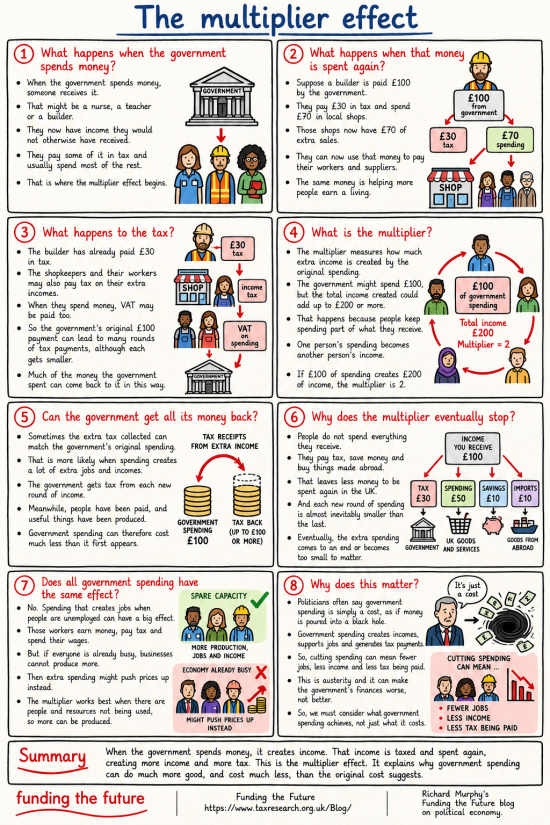
This is the transcript:
Hello, I'm Richard Murphy, and this is Understanding Economics. That's the series of videos that I'm making, which explains economics in the way that I see it. Now, I stress, I do not see economics in the way that every economist does. I'm a heterodox economist. That means I see things from outside the mainstream, but that's because I don't believe that mainstream economics tells us anything that is of use. So in this series, I look at the world afresh and ask questions about how it really works.
And in this video I want to talk about something called ‘the multiplier effect'. Now that sounds pretty technical, but it actually isn't very much to do with arithmetic. What this is all about is the way in which government spending impacts the economy, of which we are all a part.
And let's be clear: when the government spends money, someone receives it. So when the government pays my pension, because I am an old-age pensioner, my bank account goes up. They might also pay a nurse, a teacher, or a contractor, a builder, for example. All of those people now have income they would not otherwise have received. They then might pay some tax on it, and the rest will very often be spent. This is where the multiplier effect begins.
When a person has more money in their pocket because they're being paid by the government, they can then spend the money that they receive after tax. Suppose a builder is paid £100 by the government. They pay £30 in taxes and spend £70 in local shops. Those shops now have £70 of extra sales income. They can use that. They can use it to pay their workers and their suppliers. They can also pay their own taxes because there might be VAT on their receipt. The point is, the same money that was paid to the builder is now helping somebody else earn a living as well.
And the builder has already paid £30 in tax, and the shopkeeper and their workers might also pay tax on their extra income. And when they spend money, more VAT might be paid too, and the recipient might pay tax again.
So the government's original £100 payment can lead to many rounds of additional income and many rounds of extra tax payment as well, although each round gets smaller over time, of course. But as a consequence, much of the money the government spent in the first place can come back to it in this way, and in fact, that is what the multiplier effect is.
The multiplier measures how much extra income is created by the additional spending, and then we can work out as a consequence whether the government might recover the total amount it spent in the first place by way of additional tax revenue.
So let's just look at this in detail. If the government spent £100, but the total income created added up to £200, then the multiplier effect is two. That means that we have created double the amount of income in the economy as a consequence of the government spending £100. One person's spending becomes another person's income, and the multiplier effect works in this way.
Now, I stress this can work in the private sector as well. It can also work in reverse. That's particularly important. If the government cuts spending, the multiplier effect isn't that there is a one-off cut. There's a cut that compounds because spending that did happen no longer does, and people lose out as a result, and tax is not paid as a result.
So the multiplier effect is a very valuable tool for understanding the way in which the economy works. And there's one particular point to pick up on, again, which is that sometimes the extra tax collected can more than match the government's original spending.
If the tax rate is overall around 33% and the additional income created by government spending is £300, then tax due at 33% on £300 is £100, which is what the government spent in the first place, and that is a ratio that happens in many cases inside the UK economy. We see multiplier effects of more than three on spending in the NHS. We do the same when we see that it is spent on investment inside the economy. We see very low multiplier effects, however, on things like defence spending.
So we do see that what government spends its money on can have an impact on how much benefit it creates within the economy. Make people better, and the world is a better place. Spend money on weapons and the world's not looking so good. The rules can sometimes be reduced to something as simple as that, but they can also be translated into economic reality in terms of money recovered by the government.
We cannot treat all government expenditure as being the same in that case, and we do have to remember, and I will repeat the point, cuts have to be chosen with the same point in mind. Cutting spending on the NHS to fund defence does not make economic sense, and the cost is much higher than the simple reallocation of spending between the two budgets because the onward benefits from the multiplier effects have to be taken into account.
So why does the multiplier effect eventually stop? Well, one reason is because it becomes incredibly small; it becomes too remote from the original government spending. There is too little left to have any significant impact. That's, of course, entirely true. But there's another reason why it can stop; in fact, there are two.
One, people can save money, and that, of course, stops the spending cycle. The money gets diverted into a bank account and sits there and does nothing, or is used to buy a government bond. And do remember government bonds do not fund government spending. And as a consequence, the money stops flowing. So the multiplier effect does, as a consequence, cease to flow. And that's important. We have to understand that when it comes to savings. Savings slow down the economy. That's what we must learn from the multiplier effect.
And the second reason why the multiplier effect might stop working is because we buy things from abroad. That leaves less money to be spent inside the UK. But of course, that also works in reverse. If we export things, there is more money to spend inside the UK, and that is why trying to increase exports does make economic sense.
But at some point, for one of these reasons, the multiplier effect will end, and that is why the government does, of course, need to keep on spending. It needs to keep the economy going. Government spending is the most powerful single instrument to inject new economic activity into the UK economy because, quite simply, it's the biggest spender we've got. It controls 46% of GDP in the UK. In other words, its spending matters more than anyone else's.
Is there a limit to the amount that governments can spend? Well, yes, we know there is. We do know that the multiplier effect does not work if there's nothing for people to buy. So if the government spends and people get additional money, but there's a shortage of goods and services available in the marketplace, that isn't a multiplier effect at all. We get inflation instead.
So we have a choice. The government can spend up to the point where there are useful things for people to buy or resources to be put into use. But when that point has been reached, the multiplier effect stops. We get inflation instead. We have to find the right balance. All of these things are related. You can never think about economics in isolation. Each topic is related to another. The multiplier effect and inflation are intimately related characteristics within an economy.
And why does all this matter? Well, apart from the links that I've already explained and the choices that are implicit within them, many politicians know nothing about multiplier effects. They talk about government spending as if it is simply a cost and is money poured into a black hole.
They would suggest, for example, that spending on social security provides no benefit to anyone. The fact that the recipient needs the money to live is something that seems to have passed most politicians by. The fact that they spend what they get and that keeps the local economy going in very many cases is something that most politicians don't seem to understand.
The fact is, government spending, whether it is directly or indirectly, creates income, supports jobs and generates tax payments. So cutting spending can mean fewer jobs, less income, and less tax paid, which is precisely why austerity makes so little sense.
So we must always consider what government spending achieves, what its multiplier effect might be, and not just what it costs. When the government spends money, it creates income. That is the essential message from this video. That income is then taxed, and then it is spent again, creating more income and more tax. This is how the government recovers from the economy the money that it is spent into it, which is what modern monetary theory explains it does. And it also explains why government spending can do much more good and cost much less than the original cost implies. And that is something that you need to understand and which you need to remind our politicians of because they need to know it too.
That's what I think. You can let me know what you think in the comments down below or by taking part in our poll. But more importantly, look down below at the playlist that is down there, which lists all the Understanding Economics videos. There are well over 20 of them now. Each of them explains a particular topic around Understanding Economics. If you get your head around them, you will understand the world around you better, and that is my goal in creating this series. Good luck. This is an exercise worth undertaking. You will be better equipped to manage the world around you if you understand economics.
Poll
Thanks for reading this post.
You can share this post on social media of your choice by clicking these icons:
There are links to this blog's glossary in the above post that explain technical terms used in it. Follow them for more explanations.
You can subscribe to this blog's daily email here.
And if you would like to support this blog you can, here:

 Buy me a coffee!


Back in the Mid 80’s when I started working in Housing Benefits our manager who had come up through the ranks was quite clear about the benefits to the local economy from the work we did and in particular what happened when we improved take up.
It seems that Politicians and Civil Servants are incapable of grasping the lessons that Council Rent Collectors who in those days had left school before the age of 16 – like most of our management he had been one once, learnt rapidly ‘on the job’
Thank you
Thanks Richard, I really enjoyed this blog and infographic. It’s not that the multiplier effect is misunderstood by politicians and the general public – it seems to me it’s unknown to virtually everyone. I have never heard it discussed anywhere but here. I suspect it’s conveniently unknown to the political class as it fits nicely into the household analogy model of government finance. It’s a critically unknown / misunderstood concept – yet it’s perfectly logical. You don’t need a PhD for it to make sense.
Thank you
Obvious, innit? Why do so many politicians not see it?