
What happens when the government spends money? Most politicians talk about public spending as though it is simply a cost. But government spending does something much more important: it creates income, supports jobs and generates additional economic activity.
In this Understanding Economics video, I explain the multiplier effect, one of the most important concepts in economics, and why understanding it fundamentally changes how we should think about government spending, taxation and austerity.
The multiplier effect describes how an initial amount of spending generates additional income as money circulates through the economy.
Imagine the government pays a builder £100. The builder pays £30 in tax and spends the remaining £70 in local shops. Those shops now have additional income, which they can use to pay employees, purchase supplies and pay their own taxes.
The money continues circulating, creating further income and economic activity.
If the government's original £100 of spending generates £200 of additional income, the multiplier is two. If it generates £300, the multiplier is three.
And here's the important point: government spending can generate enough additional tax revenue to recover its original cost.
I explain why some forms of government expenditure have much greater multiplier effects than others.
Spending on the NHS, public services and productive investment can generate substantial additional economic activity. Defence spending, by contrast, may have a much smaller multiplier effect.
This means that government spending decisions should be judged by the economic and social benefits they create, not simply by their initial cost.
I also examine what happens when governments cut spending. The multiplier effect works in reverse. Cutting public expenditure reduces someone's income, which reduces their spending, which then reduces income elsewhere in the economy.
This helps explain why austerity can damage economic growth, destroy jobs and reduce government tax revenue.
But the multiplier effect has limits.
Saving money rather than spending it can reduce the multiplier effect. Spending on imports can also reduce the amount of money circulating domestically.
And when the economy reaches the limits of its productive capacity, additional spending may create inflation rather than additional output.
Understanding these relationships is essential to understanding how the economy really works.
I argue that politicians must stop treating government spending as money disappearing into a black hole.
Public spending creates income. That income supports businesses, employment and tax revenues. And in many circumstances, the economic benefits can be significantly greater than the government's original expenditure.
The question should not simply be how much government spending costs. It should be what that spending achieves.
That is why the multiplier effect matters, and why it is central to understanding economics.
This is the audio version:
This infographic supports this video:
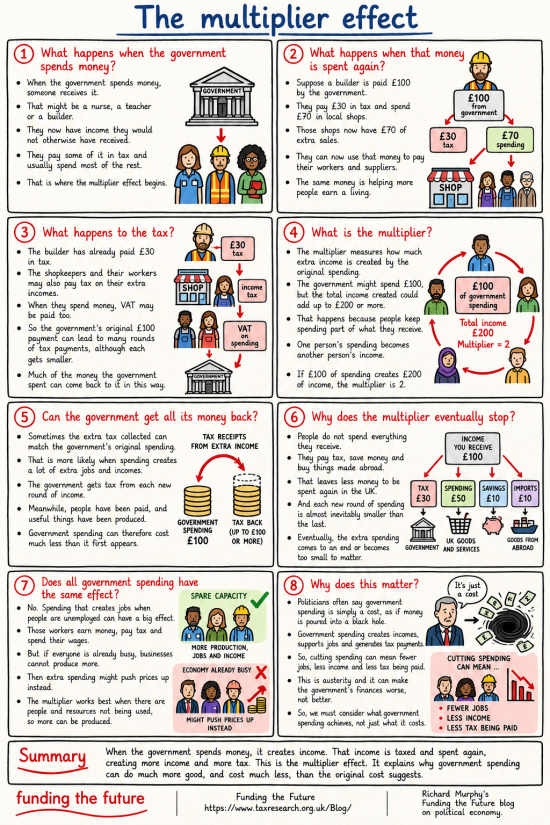
This is the transcript:
Hello, I'm Richard Murphy, and this is Understanding Economics. That's the series of videos that I'm making, which explains economics in the way that I see it. Now, I stress, I do not see economics in the way that every economist does. I'm a heterodox economist. That means I see things from outside the mainstream, but that's because I don't believe that mainstream economics tells us anything that is of use. So in this series, I look at the world afresh and ask questions about how it really works.
And in this video I want to talk about something called ‘the multiplier effect'. Now that sounds pretty technical, but it actually isn't very much to do with arithmetic. What this is all about is the way in which government spending impacts the economy, of which we are all a part.
And let's be clear: when the government spends money, someone receives it. So when the government pays my pension, because I am an old-age pensioner, my bank account goes up. They might also pay a nurse, a teacher, or a contractor, a builder, for example. All of those people now have income they would not otherwise have received. They then might pay some tax on it, and the rest will very often be spent. This is where the multiplier effect begins.
When a person has more money in their pocket because they're being paid by the government, they can then spend the money that they receive after tax. Suppose a builder is paid £100 by the government. They pay £30 in taxes and spend £70 in local shops. Those shops now have £70 of extra sales income. They can use that. They can use it to pay their workers and their suppliers. They can also pay their own taxes because there might be VAT on their receipt. The point is, the same money that was paid to the builder is now helping somebody else earn a living as well.
And the builder has already paid £30 in tax, and the shopkeeper and their workers might also pay tax on their extra income. And when they spend money, more VAT might be paid too, and the recipient might pay tax again.
So the government's original £100 payment can lead to many rounds of additional income and many rounds of extra tax payment as well, although each round gets smaller over time, of course. But as a consequence, much of the money the government spent in the first place can come back to it in this way, and in fact, that is what the multiplier effect is.
The multiplier measures how much extra income is created by the additional spending, and then we can work out as a consequence whether the government might recover the total amount it spent in the first place by way of additional tax revenue.
So let's just look at this in detail. If the government spent £100, but the total income created added up to £200, then the multiplier effect is two. That means that we have created double the amount of income in the economy as a consequence of the government spending £100. One person's spending becomes another person's income, and the multiplier effect works in this way.
Now, I stress this can work in the private sector as well. It can also work in reverse. That's particularly important. If the government cuts spending, the multiplier effect isn't that there is a one-off cut. There's a cut that compounds because spending that did happen no longer does, and people lose out as a result, and tax is not paid as a result.
So the multiplier effect is a very valuable tool for understanding the way in which the economy works. And there's one particular point to pick up on, again, which is that sometimes the extra tax collected can more than match the government's original spending.
If the tax rate is overall around 33% and the additional income created by government spending is £300, then tax due at 33% on £300 is £100, which is what the government spent in the first place, and that is a ratio that happens in many cases inside the UK economy. We see multiplier effects of more than three on spending in the NHS. We do the same when we see that it is spent on investment inside the economy. We see very low multiplier effects, however, on things like defence spending.
So we do see that what government spends its money on can have an impact on how much benefit it creates within the economy. Make people better, and the world is a better place. Spend money on weapons and the world's not looking so good. The rules can sometimes be reduced to something as simple as that, but they can also be translated into economic reality in terms of money recovered by the government.
We cannot treat all government expenditure as being the same in that case, and we do have to remember, and I will repeat the point, cuts have to be chosen with the same point in mind. Cutting spending on the NHS to fund defence does not make economic sense, and the cost is much higher than the simple reallocation of spending between the two budgets because the onward benefits from the multiplier effects have to be taken into account.
So why does the multiplier effect eventually stop? Well, one reason is because it becomes incredibly small; it becomes too remote from the original government spending. There is too little left to have any significant impact. That's, of course, entirely true. But there's another reason why it can stop; in fact, there are two.
One, people can save money, and that, of course, stops the spending cycle. The money gets diverted into a bank account and sits there and does nothing, or is used to buy a government bond. And do remember government bonds do not fund government spending. And as a consequence, the money stops flowing. So the multiplier effect does, as a consequence, cease to flow. And that's important. We have to understand that when it comes to savings. Savings slow down the economy. That's what we must learn from the multiplier effect.
And the second reason why the multiplier effect might stop working is because we buy things from abroad. That leaves less money to be spent inside the UK. But of course, that also works in reverse. If we export things, there is more money to spend inside the UK, and that is why trying to increase exports does make economic sense.
But at some point, for one of these reasons, the multiplier effect will end, and that is why the government does, of course, need to keep on spending. It needs to keep the economy going. Government spending is the most powerful single instrument to inject new economic activity into the UK economy because, quite simply, it's the biggest spender we've got. It controls 46% of GDP in the UK. In other words, its spending matters more than anyone else's.
Is there a limit to the amount that governments can spend? Well, yes, we know there is. We do know that the multiplier effect does not work if there's nothing for people to buy. So if the government spends and people get additional money, but there's a shortage of goods and services available in the marketplace, that isn't a multiplier effect at all. We get inflation instead.
So we have a choice. The government can spend up to the point where there are useful things for people to buy or resources to be put into use. But when that point has been reached, the multiplier effect stops. We get inflation instead. We have to find the right balance. All of these things are related. You can never think about economics in isolation. Each topic is related to another. The multiplier effect and inflation are intimately related characteristics within an economy.
And why does all this matter? Well, apart from the links that I've already explained and the choices that are implicit within them, many politicians know nothing about multiplier effects. They talk about government spending as if it is simply a cost and is money poured into a black hole.
They would suggest, for example, that spending on social security provides no benefit to anyone. The fact that the recipient needs the money to live is something that seems to have passed most politicians by. The fact that they spend what they get and that keeps the local economy going in very many cases is something that most politicians don't seem to understand.
The fact is, government spending, whether it is directly or indirectly, creates income, supports jobs and generates tax payments. So cutting spending can mean fewer jobs, less income, and less tax paid, which is precisely why austerity makes so little sense.
So we must always consider what government spending achieves, what its multiplier effect might be, and not just what it costs. When the government spends money, it creates income. That is the essential message from this video. That income is then taxed, and then it is spent again, creating more income and more tax. This is how the government recovers from the economy the money that it is spent into it, which is what modern monetary theory explains it does. And it also explains why government spending can do much more good and cost much less than the original cost implies. And that is something that you need to understand and which you need to remind our politicians of because they need to know it too.
That's what I think. You can let me know what you think in the comments down below or by taking part in our poll. But more importantly, look down below at the playlist that is down there, which lists all the Understanding Economics videos. There are well over 20 of them now. Each of them explains a particular topic around Understanding Economics. If you get your head around them, you will understand the world around you better, and that is my goal in creating this series. Good luck. This is an exercise worth undertaking. You will be better equipped to manage the world around you if you understand economics.
Poll
Thanks for reading this post.
You can share this post on social media of your choice by clicking these icons:
There are links to this blog's glossary in the above post that explain technical terms used in it. Follow them for more explanations.
You can subscribe to this blog's daily email here.
And if you would like to support this blog you can, here:

 Buy me a coffee!


Back in the Mid 80’s when I started working in Housing Benefits our manager who had come up through the ranks was quite clear about the benefits to the local economy from the work we did and in particular what happened when we improved take up.
It seems that Politicians and Civil Servants are incapable of grasping the lessons that Council Rent Collectors who in those days had left school before the age of 16 – like most of our management he had been one once, learnt rapidly ‘on the job’
Thank you
Richard,
Your video confuses spending money with creating wealth. A multiplier only measures money changing hands. What decides whether spending pays for itself is productivity, and your video barely mentions it.
Look at the NHS, your flagship example. Funding and staffing have risen sharply since 2019, yet the ONS estimates healthcare productivity was still 5.8% below its pre-pandemic 2019 level in 2025, with public services overall 2.5% lower. More pounds have gone in and less has come out per pound. A multiplier of “more than three” on that spending has no source. The “£4 back per £1” claims you may have in mind measure health and productivity value, which is not a demand multiplier. ons
Your own arithmetic doesn’t hold either. If £70 of every £100 is spent and £30 taxed, the multiplier cannot exceed about 3.3, and that assumes nobody saves and nothing is imported. Britain imports around a third of what it consumes. The OBR puts welfare at 0.60 and public services at 0.45, both fading to zero within five years. Even critics who think the OBR is too pessimistic estimate that about 54p of each extra £1 comes back to the Exchequer.
Your “inflation limit” is set by productivity. An economy that isn’t producing more per hour hits that limit quickly, and 2022 showed it, with inflation at 11% and debt near 100% of GDP. The Bank of England then raised rates to offset the extra spending.
The question that matters is not how many times a pound circulates. It is whether the spending leaves Britain able to produce more. Spending that raises productivity can pay for itself. Spending that doesn’t is debt, whatever the multiplier.
You are confusing several different economic concepts.
A multiplier does not simply measure money changing hands. It measures the additional income and output generated by an initial injection of spending. That is a standard macroeconomic concept, not something I have invented.
Nor is productivity the sole determinant of whether spending is worthwhile. Healthcare, education and social care create enormous economic and social value, including by enabling people to work, even when that value is inadequately captured by conventional productivity measures.
Your arithmetic is also misleading. The multiplier depends on the marginal propensity to consume, taxation, saving and imports. You cannot establish its value simply by assuming that 30% of each transaction is taxed. Nor does the UK’s aggregate import share tell us the import content of every particular spending programme.
You also confuse the fiscal multiplier with the proportion of spending recovered through taxation. They are not the same thing.
I have never suggested that all government spending has the same multiplier, or that spending can continue without regard to productive capacity. Indeed, I repeatedly emphasise that real resources and inflation are the constraints on government spending.
Finally, the inflation of 2022 was substantially driven by energy, food and other supply shocks. It is not evidence that public spending multipliers cease to exist.
Productivity matters. So do employment, unused capacity, the composition of spending and the needs that economic activity meets.
An economist should recognise that these are distinct questions rather than treating productivity as an answer to all of them. You are no economist.
An Economist said:
“The OBR puts welfare at 0.60 and public services at 0.45, both fading to zero within five years.”
The figure is taken from their 2015 report and compares the effect of a 1% reduction in GDP. Multipliers don’t work the same when reversed.
Full quote from the OBR:
“In June 2010, the interim OBR estimated the impact that the additional fiscal tightening announced in the Coalition’s first Budget would have on growth through the use of ‘fiscal multipliers’. These implied that a discretionary tightening of 1 per cent of GDP would, in the first instance, reduce output by 1 per cent in the case of investment cuts; 0.6 per cent in the case of cuts to day to day public services and welfare spending; 0.35 for VAT increases; and 0.3 per cent for income tax and NICs increases. The multiplier was assumed to diminish or taper over five years, as the initial effect was offset by changes in monetary policy, the exchange rate and real wage adjustments.”
https://obr.uk/box/fiscal-multipliers/
You ignore the fact that the OBR has always, and politically, seriously underestimated multipliers, which is why, to use a technical term, its forecasts are always shite.
Thanks Richard, I really enjoyed this blog and infographic. It’s not that the multiplier effect is misunderstood by politicians and the general public – it seems to me it’s unknown to virtually everyone. I have never heard it discussed anywhere but here. I suspect it’s conveniently unknown to the political class as it fits nicely into the household analogy model of government finance. It’s a critically unknown / misunderstood concept – yet it’s perfectly logical. You don’t need a PhD for it to make sense.
Thank you
I used it in a letter to the paper, urging govt to pour more money into the NHS. Not much room to explain it if you want the letter published. I will give your video ‘hype’ points on YouTube, I have 3 to bestow this week. I spend nearly all on FTF videos. Looking at top hyped videos, one on the chocolate recipe of a well-known brand was top. Readers, if you use YouTube, it takes seconds to hype a video, please let us do it, it will help push back against algorithm changes. No need to watch it.
Many thanks. And they do help, a lot.
[A long, long time ago, before AI] two young Cambridge mathematicians (latterly economists) discovered and developed the Multiplier Effect – RF Kahn and JM Keynes. It was an idea ridiculed by economists such as Hayek, and others notably right wing libertarians.
The Royal Haymarket theatre has an excellent production this month – “Th£ standard of living” on the life and work of John Maynard Keynes. I watched it this Saturday, from the gods, and it lifted my heart and soul. Ranging from Keynes’ early gay lifestyle and love of art to his struggles to convince the Govt of its economic purposes. It was his intellect, physical presence (6’5”) and sheer persistence that won the post WWII battle to fund the Beveridge welfare state. It felt akin to today’s economic arguments where austerity, wrapped up as prudence, is argued over targeted spending that will drive growth.
Remind you of your battles Richard?
Yes, in a word.
But I do not claim to be a new Keynes.
@RM We could see from the gods and the sound was perfect. It was a fast paced play and enjoyable. [My arthritic pain was the only problem]. The unsold tockets are closer to £250 now.
I know, I checked
I should have booked earlier
I also saw the play and thoroughly enjoyed it.
What I particularly took away, summarised in the dialogues between Keynes and Hayek, was their profoundly different underlying moralities. The wider social interests and concerns of Keynes, contrasted with the amorality of the Hayekian view. Keynesian economics enabled the Beveridge reforms. The Hayekians and neoliberals have spent the decades trying to undermine and destroy the legacies of Beveridge.
I am not sure I can justify the ticket price…
So, thank you
Yes, tickets are currenrly crazy prices. We booked early at £31 each. My hip paid the extra price of sitting up the gods on hard seats.
Could you see?
Fortunately I’d booked relatively early at prices that were about normal for London theatre. Or most other gigs come to that.
I know other late bookers were paying 190 plus. Just hope they video it
I have only seen the very high prices
Obvious, innit? Why do so many politicians not see it?
Puh,…. that somehow is a quite tough one for me.
I’ve watched the video now 3 times and I still have 2, I hope not too silly, questions:
So if I get this right, a government can get all its spent money back but in order to keep the economic activity of 300 pounds up it then needs to again invest 100 pounds as otherwise the money would be missing for any multiplier effect, right?
Also, why is the multiplier effect for defence spending lower than for health spending?
I mean, a nurse in a hospital gets paid the same way a worker in a factory is, they both then spend this money in the economy.
This looks quite the same for me, both are also having a lot of only one-time use products.
What’s the difference?
Neither question is silly. They get to the heart of how the multiplier works.
First, the government does not necessarily get all its spending back in tax. Some money is saved, some is spent on imports, and some returns as tax. These are different things.
Nor does the government have to spend another £100 to keep the original £300 of economic activity going. The multiplier describes the additional economic activity generated by an initial injection of spending. Whether that activity continues depends on what households and businesses subsequently do. Further spending may be needed if demand falls, but not automatically.
Second, you are right that nurses and defence workers both spend their wages. The difference is what happens as a result of the spending.
Healthcare is generally labour-intensive, with much of its expenditure supporting employment and activity within the domestic economy. It also creates the opportunity for significantly more employment – making people better off.
Defence spending can involve expensive imported equipment, meaning more of the money leaves the country rather than circulating domestically. And defence spending has few additional knock-on effects.
So, the multiplier is about the whole chain of spending, not just the wages paid initially.
The question of how much defence spending goes overseas is a live one. Historically we’ve run our own industry down and relied on overseas companies to supply almost our every need. That doesn’t work when other nations prioritise their own needs and since 2022, they are. Who can blame them? That the market can’t respond to meet needs if the productive base isn’t there is a theme familiar to readers of this blog.
Defence seems to me akin to academia, S&T and even NASA’s APOLLO in that they’re all speculative investments in an uncertain future, but in the moment the money isn’t wasted as it is spent into the economy. The government’s task is to optimise that spending alongside health, education, utilities etc. within the constraints of available resources and inflation. Political choices all, which you make crystal clear. At the moment our government is failing all sectors and all people – except the already rich.
Can you tell I’m a scientist with an interest in defence who is just as frustrated and even angry as you? Not to mention inspired by your dedication to a cause well described by ‘the politics of care’.
KUTGW
I can’t.
Good article, thanks. This is another reason why it’s important to demolish the household analogy. If you hold the ‘tax first then spend’ belief, it’s hard to understand that how much tax you need doesn’t depend only on how much you spend; it actually depends hugely on what you spend it on.
Under Margaret Thatcher, public spending grew by around 1% a year on average in real terms. Between now and the latest possible date of the next general election, it is forecast to grow at roughly the same rate (OBR, 2026). By this measure, Andy Burnham’s spending plans look remarkably similar to those of the Thatcher era.
John, I agree.
My wife told me just before the pandemic, the staff at a hospital ( I think Croydon but not sure) got all the departments together to work out what their plan would be. It seems there were dramatic improvements.
I was 20 + years ago the Rep for the Association of Teachers and Lecturers (now merged into the National Education Union) which published documents on aspects of education for members. They were greatly superior to most of the stuff coming out of Whitehall.
The point is services can be well run by the people working in the system using common sense and experience. The task of those at the top is to supply the means and tools IMHO
Fine post on a subject our elected imbeciles never discuss.
For those that would like to read more (it is a free download) & it covers a couple of sectors, not just health – put the following into a search engine and you will get the paper:
Does investment in the health sector promote or inhibit economic growth?
Aaron Reeves1*, Sanjay Basu2,3, Martin McKee3, Christopher Meissner4 and David Stuckler
It seems to me that the multiplier effect needs much more publicity. Just as the expenditure incurred by businesses in developing their people, products and services, is viewed, at least by enlightened employers as an investment, so should public expenditure, where investment in people and infrastructure is vital. Yet the media, notably economics commentators, persist in detailing only the headline costs with no reference to any return on expenditure. This was particularly apparent during the recent doctors strikes when no reference was even made to the tax that would be paid on any salary increases, let alone any reference to the potential multiplier effect in such a vast organisation as the NHS. In fact I don’t think I’ve heard the multiplier effect discussed ever on mainstream TV or the newspapers.
Incidentally I thought your research piece ‘The crisis of care in this country is nothing like that which neoliberal politicians describe’ was terrific and recommended it to my MP.
Thank you and much to agree with
Hi Richard…. excellent….a very apposite post.
I feel that maybe under ‘why it stops’ savings could be emphasised as National Debt to further illuminate the nonsense of calling it debt in the first place?
Excellent piece Richard. Multipliers should be part of every economic discussion. Only, they aren’t, are they. Why? Maybe cos it blows the whole welfare/public spending myth out of the water.
Much to agree with
Would I be right in assuming the incoming AI era reducing people in employment will cause considerable consequences to the multiplier effect?
It would mean that any additional spending by the government would have a big multiplier effect.
Thanks for the excellent article Richard.
I’d like you to expand and unpack the assumption you made express that taxes paid to a national government are so-called “revenue” (income/inflow), and a way to recover the “cost” of so-called “spending”.
Below is a quotation from your article that exemplifies your assumption that taxes paid to a national government are “revenue” (income/inflow):
“And here’s the important point: government spending can generate enough additional tax revenue to recover its original cost.”
This assumption that taxes paid are revenue is not settled, not self-evident. National governments like the UK, Canada, USA, China, Japan, as you know, create their monetary units internally via their monetary systems. How are taxes paid categorized as “revenue” or “income” or “inflow” or a way to “recover its original cost” when that act of creating dollars or pounds is done by entering the numbers of monetary units into the accounts designated by decision of the national government?
MMT documents that taxes paid to national governments drain dollars and pounds from circulation.
Yes, taxes paid to sub-national governments are revenue (income/inflow) if they are not fully funded by the national government. Yes, taxes paid to national governments can have many productive purposes and outcomes.
Why does the internal creation of dollars or pounds necessitate more dollars or pounds from outside of the governments as taxes as “revenue” (or “borrowing”) that creates them internally in technically unlimited amounts digitally for free?
I think you are reading rather more into the word revenue than it actually means.
The word revenue derives from the French revenir, meaning to come back or return. Income is even more straightforward. It means money coming in. Neither word tells us where the money originated or whether it was necessary to fund spending in the first place.
That is the distinction you are missing.
Tax revenue is money coming back to the government. That is precisely what happens when taxation withdraws money that government spending has put into circulation.
Calling it revenue does not imply that the government needed to receive it before it could spend. Nor does saying that taxation recovers the cost of spending imply that taxation financed that spending.
The word recover is important here. The government creates money when it spends and can subsequently recover some of that money through taxation. That is entirely consistent with MMT.
You are confusing the description of an accounting flow with an explanation of how government spending is financed.
There is no contradiction in my terminology.
Dear Richard,
Thank you for taking the time to reply and share your perspective on the terminology. I appreciate the exchange and your ongoing work with the Understanding Economics series,”
Kelly
Thank you
[…] By Richard Murphy, Emeritus Professor of Accounting Practice at Sheffield University Management School and a director of Tax Research LLP. Originally published at Funding the Future […]
Is the velocity of circulation an equally important concept here? The multiplier can quantify how much economic activity ultimately takes place due to the initial round of spending, but isn’t the (average) velocity of circulation concept needed to quantify the timeframe this activity takes place during?
I do not think so. One relates to money – the velocity of circulation. The other relates to the real economy – the multiplier.