
Andrew Bailey, the Governor of the Bank of England, gave a speech yesterday about the state of the world's financial markets and the threats that they now face. Much of what he said was entirely orthodox and predictable. His conclusions about government spending were, however, deeply troubling.
Bailey began by acknowledging that the world economy is facing an extraordinary combination of threats. These include the war in the Middle East, repeated supply shocks, weak economic growth, the risks associated with artificial intelligence and increasing instability in government bond markets. He and I are on the same hymn sheet when it comes to these issues.
He also acknowledged that the financial system has, so far, coped reasonably well with these pressures. Banks remain adequately capitalised, and financial markets have continued to function despite significant increases in government bond yields. But Bailey was then very clear that this resilience cannot be taken for granted. I would again agree. If markets crash, as I think they will, resilience cannot be assumed.
His particular concern was, however, that governments might find it increasingly difficult to respond to economic crises because of the consequences of weak growth, higher borrowing costs and repeated demands for government intervention. He said:
Lower growth and repeated supply shocks weaken the public finances while increasing pressure on governments to provide support.
He then added:
If markets begin to doubt the fiscal trajectory, bond yields can rise further, tightening monetary and financial conditions.
What Bailey is very clearly suggesting in that case is that financial markets can, might, and maybe should, constrain the ability of governments to respond to crises, even when that response is necessary to protect the wellbeing of the people for whom those governments are responsible. That is an extraordinary admission from the Governor of the Bank of England, revealing a complete lack of understanding of the nature of government finances in a country like the UK, and an embedded view on his part of where power should lie in this country that is deeply troubling
That said, I note that Bailey acknowledged that governments have a responsibility to intervene when economic crises occur. He said:
Governments can ordinarily use their balance sheets to cushion a severe downturn and rebuild fiscal space when conditions improve.
That is, of course, entirely correct. Governments exist, in part, to provide the economic stability that markets cannot deliver. But Bailey immediately qualified his statement, saying:
But when shocks become more frequent, underlying growth is weaker, and the succession of shocks leads to a higher level of government debt, this becomes much harder to sustain.
His very clear conclusion was that governments must maintain the confidence of financial markets in preference to serving the interests of the people of the country they govern. He said:
Fiscal policy must ... be directed towards stability and be seen by markets as credible. Clear frameworks, including fiscal rules, can help contain risk premia when shocks occur.
This is where Bailey's argument falls apart. He is effectively saying that governments must be prepared to respond to crises, but only if financial markets approve of what they are doing. The implication is that the needs of financial markets must take precedence over the needs of people. That, of course, is an idea implicit in the corporatism of fascism. That is not a principle that I can accept.
There is another problem with Bailey's argument, and it is one that he himself identifies. He acknowledges that government bond markets have changed fundamentally. They are increasingly dominated by leveraged investors rather than institutions seeking long-term, relatively secure investments.
These investors borrow to speculate. Their positions can be unwound rapidly. When markets move against them, margin calls and other contractual obligations can force them to sell assets, whether they wish to do so or not. Bailey explicitly acknowledges that these processes can amplify market instability. I noted all of these issues yesterday.
In other words, and let me be quite clear about this, Bailey recognises that financial markets are not necessarily rational mechanisms for determining the appropriate price of government debt. He also recognises that, as far as many market operators are concerned, they no longer exist to fund the government, as conventional thinking suggests. Instead, leverage, automated trading, contractual obligations, and the need to cover losses elsewhere can drive their behaviour. These are precisely the mechanisms that can create financial crises, again as I pointed out yesterday.
And yet Bailey's answer is that governments must organise their fiscal policies to maintain the confidence of those same markets. There is a fundamental contradiction here.
If financial markets are increasingly unstable, why should governments be required to submit their economic policies to their judgement? Why should the ability of a government to provide healthcare, education, housing, social security or the investment required to address climate change depend upon the behaviour of highly leveraged financial institutions? And why should the Bank of England accept that this is an appropriate constraint on democratic government? To that, Bailey provided no answer. He could not, within the constraints of his own thinking, which presumes the government is dependent on bonds to finance its activities.
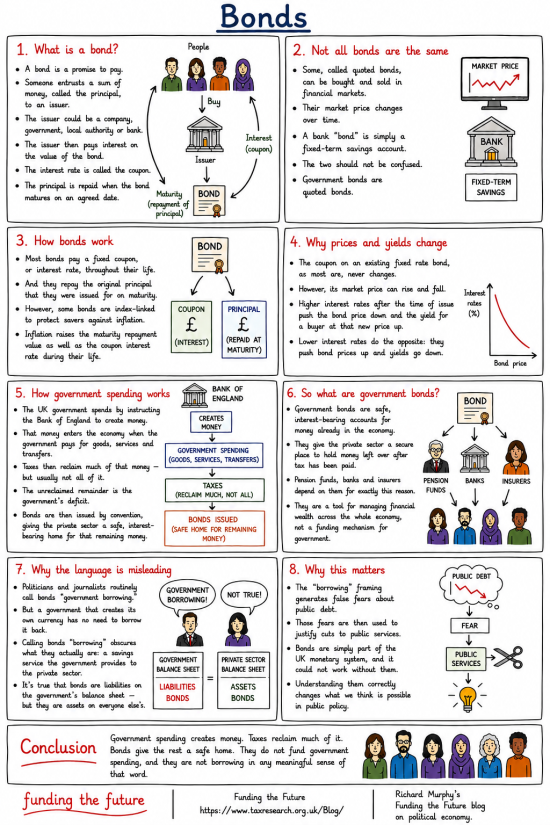
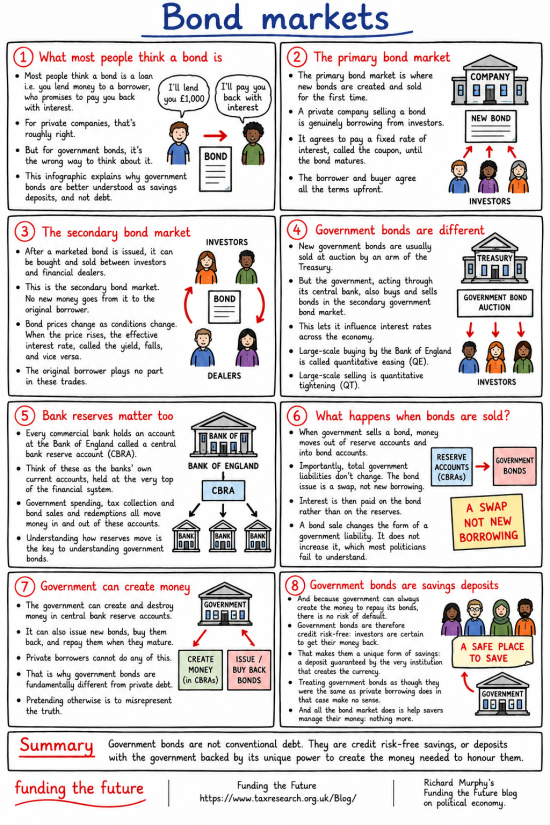
There is an alternative way of looking at this issue. The UK government is the issuer of sterling. It does not need to obtain sterling from financial markets before it can spend. It creates the money that it spends, with taxation subsequently withdrawing purchasing power from the economy. And bonds do not fund anything. They are safe places for financial institutions to save surplus funds.
That does not mean that government spending is without limits. Of course there are limits. Those limits are determined by the real resources available within the economy, the capacity to increase those resources, the risk of inflation and the consequences of government spending for economic and social wellbeing. They are not ultimately determined by the willingness of financial markets to purchase government bonds.
The Bank of England also has the capacity to intervene in government bond markets when financial stability requires it. It demonstrated that in 2022, when it intervened to prevent instability associated with liability-driven investment strategies in pension funds from becoming a wider financial crisis, created in no small part by its unprecedented and unexpected decision to commence active quantitative tightening
Bailey knows all this. He also knows that the Bank of England and the Treasury are parts of the same state, even if they have different responsibilities and operational arrangements. What is required is a coherent approach to monetary and fiscal policy that recognises these realities.
That would mean accepting that the government's first responsibility is to meet the needs of the population while maintaining price stability.
It would mean recognising that government bonds are a mechanism for providing secure savings opportunities, rather than an unavoidable means of financing government spending.
It would also mean accepting that the Bank of England has a responsibility to prevent financial market instability from undermining the capacity of the government to act in the public interest.
None of this requires unlimited government spending. It requires responsible economic management based upon the actual constraints that the economy faces.
Bailey is right that we face a world of repeated crises, weak growth and increasingly unstable financial markets. He is also right that governments must be able to respond to those crises. But his suggestion that governments must maintain fiscal rules designed to reassure financial markets, even when those markets are themselves a source of instability, is profoundly mistaken.
The purpose of economic policy is not to satisfy bond traders. It is to ensure that people can live securely, that public services can function, that the economy can prosper and that society can thrive.
If financial markets threaten those objectives, it is the financial markets that need to be managed. It is not the needs of the people that should be sacrificed.
That is the distinction Andrew Bailey appears unwilling to make. And it is one that matters enormously for the future of this country. It is a question of who rules, and why. Bailey seems to think financial markets rule because they might have the power to do so. I think people and democratic government must come what may. The difference of view is not theoretical. It may be at the epicentre of the coming crisis in this country.
How to expand these images
Press CTRL or Command and the Plus (+) key on your keyboard to zoom in. Press CTRL or Command and the 0 (zero) key together to restore the screen to normal.
How to download these images
Right-click the image to download it to your computer. So long as you do so without the intent to make a profit, you may do so without further permission. Commercial use requires consent. If you just want to share it, share it with whoever and wherever you want. That is the purpose of these infographics.
The image library
There is a library of these images. It is available here. All downloads are free, but donations help our work.
AI use
I wrote these infographics. I used AI to create the final image.
Thanks for reading this post.
You can share this post on social media of your choice by clicking these icons:
There are links to this blog's glossary in the above post that explain technical terms used in it. Follow them for more explanations.
You can subscribe to this blog's daily email here.
And if you would like to support this blog you can, here:

 Buy me a coffee!

We are “in hock to the bond market” because voters have chosen to be so. Your analysis is correct – it doesn’t need to be that way but it requires honesty about taxes with voters and every time there is an honest approach they vote against it.
It’s not about “balancing the books” it’s about recognising that persistent large budget deficits, particularly if “undrained” by bond issuance are inflationary….. and if the government is to deliver what we need without inflation then taxes must rise.
We agree
I think it’s a tad harsh the say that voters have chosen to be in hock to the bond markets.
Most voters are not as fascinated by economics as the readers of this blog. They have lives to lead, jobs to do, children and relatives to look after, they don’t want to, and maybe can’t, spend time in detailed economic analysis.
That’s the problem with democracy. For it to function optimally every voter needs to be engaged and do their own independent analysis. That’s a huge amount of aggregate effort. It’s unrealistic and unreasonable to expect this.
That’s why we have representative democracy. The representatives are supposed to spend time doing the analysis and acting in their constituents’ interests. But they don’t do this. They play politics. They pretend to perform a social service, “constituency business”, for which they have no powers. Either they don’t understand their job of analysis, or they are incapable, or perhaps just lazy. They don’t do it.
The electorate are relentlessly mislead, misinformed, or down right lied to, by lazy politicians and vested interests. It took me decades, and a lot of time, to realise this. The electorate can’t reasonably be expected to do this analysis.
Nevertheless, they are not stupid, they know something is wrong. They see the ongoing degradation and destruction of public services. They know it didn’t used to be like this. They know it’s broken. But snake oil salesmen offer them simple, surefire, nostrums to solve the problem. Of course they are confused, but who are they to believe?
In France they take to the streets.
So, no, voters don’t vote to be in hock to the bond markets.
Watch next Monday’s video, I suggest.
Hmmmm…………………….
I think that what the Neo-liberal Age has taught me is that if you want democracy you need to be constantly vigilant.
The age of innocence is over Tim.
The very concept of ‘innocence’ in political matters is a fascist concept anyway. It’s not just ‘We did not know’ or ‘I did not vote for that’. It’s also about negating our history – the bad (say, slavery) and the good (say, nationalization of the central bank, MMT). We have been made innocent of history. In addition it also about not wanting to know, and then moaning about it afterwards. It’s about not being curious as well as not being educated. It’s about choosing not to care and calling people who do ‘woke’ as if it were an affliction.
And it’s also about writing yourself off as I shamefully did and thinking that you were just not good enough and entrusting your life to others who were not worthy of that trust.
No I’m sorry Tim. The way society really works is that no one is innocent in such matters – except perhaps the young. And since when have we listened to them?
I think now is the time to engage with reality more than ever before. You can have solidarity watching a TV programme or solidarity about some good basic human ways to live in a society. I unreservedly commend the latter to everyone.
Maybe I was a little harsh on voters but they don’t have to understand the intricacies of bonds or MMT. Even in prehistoric “household finance” language they think that better services require higher taxes….. but still vote for same/ lower taxes in the secrecy of the polling booth.
Clive and PSR,
I agree with you Clive that you don’t have to know the intricacies of bonds or MMT to know that better services need higher taxes, and then to choose a party who will tax those who are best taxed. Sadly there are few parties who are truly progressive. For example Burnham has just announced a reduction on the triple lock. Whilst there are arguments for this, essentially it means reducing benefits for some poor members of society so that wealthier members can pass on their wealth as inheritance – hardly progressive. In the US people voted TWICE for the orange clown. Once, perhaps they might, just, have been excused. Twice, they are complicit in the horrors going on there.
PSR, all I’m really saying is that in the real world expecting people to undertake a lot of analysis is unrealistic. Many really can’t. You can blame them if you want, it doesn’t mean they can engage in, perhaps, the way you’d like. Of course you can expect people to take some interest and, if they don’t, I agree they are complicit. Some voting propositions are clearly appalling, people do have to take some responsibility for those type of votes. But, by and large, people are just confused, and can we really blame them when they have been misled and lied to?
I disagree that representatives are suppose to just know what we need? These are our literal representatives. It is the public who make the laws in democracies so it is up to us to stay connected with issues, with our not for profits that help is and with our representatives also. We can pick our fights? But we certainly do not see that our representatives are supposed to know and hand our democracy over? This public attitude is exactly the problem this public attitude? Democracy takes effort, one day, one week or one monthly action at a time. It is certainly not voting! Yes the French never forget their history.
See next Monday’s video
He’s a senior cleric. He has to follow scripture.
I agree with Cliff B.
Senior Cleric of Scripture.
Andrew Bailey starts with the correct letters but ends up with the wrong conclusion. Much like his speech.
It’s Senior Civil Servant, Andy.
Where might Mr. Bailey be appropriately placed on a spectrum between these contrasting poles?
1) Ignorance: Avoidance of Realities
2) Endorsing Plutocracy: Endorsing Democracy
3) Prioritisating Money: Prioritising Resources
4) Prioritising Capital: Prioritising Labour
5) ?
Rendered almost speechless by your blog on the ‘Full Funding Rule’, all I can say about Bailey is that his words condemn him as not even working for the government that employed him – he is working for the markets and nothing else. He’s the market’s man – paid for by the state – adding even more insult to injury.
Agreed
Thank you, Richard.
Yesterday morning, the governor of the Bank of France, a Macron crony, said similar. The former head of Lazard France, Matthieu Pigasse, hit back immediately along Richard’s lines.
This debate will be front and centre of the French presidential campaign. The Melenchon campaign will unveil its programme next month. Stay tuned.
Readers may not be aware: Bailey was the only doctoral student in his Bank intake. He was not expected to become governor or even chief economist. However, he’s a good politician and came into his own during the Tory and coalition years. Please read between my lines… I will inform Richard privately.
His doctorate is about the impact of the American civil war on Manchester and its textiles industry. He sought help from an American academic. She became his wife and teaches here. They own a house in the Rockies, so ideal for the annual Jackson Hole central bank pow wow.
What is interesting is Bailey does not appear to understand supply shocks or has forgotten.
I met Bailey few times between 2008 – 19 and was underwhelmed. I’m not the only one.
Thanks, Colonel.
The obvious suggestion is that Governments need to control markets in particular ‘speculative’ transactions by Banks and other regulated organisations
Agreed
Everyone agrees that growth is key and that we don’t have enough of it. (Let’s put aside arguments about what type of growth; I mean growth of wellbeing not GDP).
Conventional economists say that businesses create growth, that Government both inhibits growth through regulation and crowds out commercial investment by taxing too much. Therefore we need smaller government, less tax and less spending. Simples!
Successive governments have tried this, notably George Osborne with his “expansionary austerity” (a term used mockingly by the Financial Times). Every time it has quashed growth and ratcheted the decline of public services. Nevertheless successive governments, of all flavours, have continued to believe that if only they could cut enough and reduce expenditure the economy would magically blossom into life. But no government has ever made expansionary austerity work!
They have it completely the wrong way round. For an economy to expand it needs more money. Government cuts reduce that money and push the economy towards deflation, a persistent problem in the gold standard era. Only the government can create the money needed by an expanding economy through spending. And, unless already at capacity (spoiler alert we’re not!), that spending will grow the economy by more than was spent (reducing deficit as a percentage of GDP).
Growth is the key. To achieve it the government must spend more!
Very reasoned analysis of Bailey’s speech – and perfect take-down.
I wonder in my naivety – could a way be designed to restrict bond sales to bona fide savers over speculators?
In retrospect this of course does nothing to correct the perspective that government is ‘borrowing’ from savers but would merely make the status quo more stable.
Maybe, but until very recently I hadn’t thought about it. The answer would have to involve making certain forms of contract unenforceable. That is possible as a form of capital control.
Thank you, I actually understand this as a non financial person, pity AB doesn’t or won’t despite his so called expertise.
It does make sense that a large complex system would need a backstop mechanism otherwise the whole system would struggle to function without belief, confidence and trust that the system can ultimately sustain itself, heal, and repair as needed.
Thank you
I.am currently reading Karen Ho’s book Liquidated. One of her arguments is that Wall Street destroyed corporate America by its relentless focus on shareholder value, not for the sake of the underlying businesses or shareholders, who lost out in the long run, but to increase deal flow and maintain their bonuses. It feels like the UK and EU bond markets are acting in the same way.
We will hit 2C global heating within 10 years. Of course, I’m not suggesting it is anything the govt or BoE needs to be worried about.
They say they do….which is perverse.
Austerity makes the economy worse, bond sales do not fund spending, its all do to the human fear of loss bias that makes treating government finance like household or company finance as sensible when it isn’t