
Much of the time, I suspect the mainstream media, including its supposedly more serious elements, fails to give us the whole truth on significant issues. I have had a nagging doubt about this with regard to the supposed bond crisis that is engulfing the governments of many Western countries at present.
Every instinct I have tells me that the bond sales that are going on make very little sense because, although there are undoubted concerns about world events and additional government spending resulting from events like Donald Trump's war on Iran, the AI boom and disrupted supply chains for climate reasons, these narratives are insufficient to explain the continual bond selling that must inevitably involve the recognition of losses that traders must feel uncomfortable with. There must, then, be another reason why this trend is continuing.
Having recently read an FT article, linked below, that suggested all is not what it seems, I decided to investigate this issue further, using AI to assist my search. I found at least three patterns of automated or contractually based reasons for bond markets to enter what is, in effect, a doom-loop spiral of bond sales once sentiment creates an initial shift in perceived value.
Having found this, I decided, quite unusually for me, to ask ChatGPT, on which I did this research, to draft an article on this issue, and I then decided to use it here with minor edits. Before doing so, I tested the hypothesis by repeating searches, and I think the explanations offered are entirely plausible. They are referenced.
In 2022, the UK had a bond crisis after Liz Truss's government made what were undoubtedly unwise claims about its intentions. What they inadvertently triggered was a structured response from within the UK pension industry that had used government bonds, and the presumption of continuing quantitative easing, to underpin a particular form of funding. Kwasi Kwarteng's budget, combined with the announcement that the Bank of England would end QE and replace it with quantitative tightening, undermined this funding arrangement, creating a major structural funding shortfall that had to be addressed with a further round of QE.
When I began this approach, I suspected something similar might be happening now. I now suspect this is the case. I am not sure how significant this is, but the FT has noted it, and the trend in US mortgage markets does appear significant.
The consequence is very real. Yet again, it seems that we are being punished by financial markets for their own failings. Even if this is only a partial explanation for what is happening, it is another sign of the considerable stress that supposed financial engineering is creating within our society. Supposedly clever people creating structures with bond instruments for purposes they were not intended to fulfil can produce unexpected outcomes, and in this case that might be an accidentally engineered doom-loop downward spiral in bond prices, which creates the corollary of an upward spiral in supposed government borrowing costs.
I put this forward as a hypothesis worth exploring further, at the very least, given the scale of the issue that we face and the total nonsense that has been talked about it in the mainstream media.
Much of the commentary on the current government bond sell-off rests on a dangerous assumption. It is that investors are selling because they have become pessimistic, and that once their mood improves, the selling will stop. But some of this selling may have very little to do with sentiment. Instead, it may be driven by contractual obligations and automatic risk controls, which means falling prices can create the conditions for further falls.
That distinction matters. An investor who thinks a bond has become cheap might decide to buy it. An investor facing a contractual demand for cash might have to sell it, however cheap they think it has become. The second investor does not necessarily have the freedom to wait for the market to recover.
One mechanism producing this pressure is a margin call. Investors who borrow to finance their holdings, or use derivatives, can be required to provide additional cash or collateral when market prices move against them. If they do not have enough cash available, they have to raise it by selling assets. Government bonds, precisely because they are normally readily saleable, can be among the assets they sell.
The problem is that those sales can push bond prices down further. As prices fall, yields rise. Other investors then suffer losses or face additional collateral demands, and they too may have to sell. The Bank for International Settlements has documented this interaction between leverage, margin calls and forced selling in government bond markets. What begins as a price movement can become a process that feeds on itself.
A related mechanism operates through the repo market, where investors borrow cash against bonds offered as security. If lenders demand additional collateral, increase the protection they require against losses, or decline to renew financing, the borrower may have to reduce its bond holdings. Once again, the sale need not express a view about inflation, government borrowing or the competence of a chancellor. It may simply be necessary to meet the terms on which the investor obtained its finance.
Alongside these contractual pressures are stop-loss instructions and portfolio risk limits. These can require positions to be reduced when losses or measured risks cross specified thresholds. The Bank of England explicitly identifies margin and collateral calls, withdrawals of repo funding, and breaches of stop-loss or risk limits as potential triggers for disorderly selling in the gilt market. This is a recognised vulnerability within the financial system.
There is another mechanism particularly relevant to the United States. When mortgage rates rise, fewer homeowners refinance their mortgages. Investments backed by those mortgages are then expected to remain outstanding for longer, increasing their holders' exposure to interest-rate changes. Those investors may respond by selling US government bonds, or using derivatives to achieve a similar reduction in exposure.
This is called mortgage convexity hedging. The terminology is obscure, but the consequence is straightforward: rising yields can prompt transactions that push yields higher still. The Financial Times has identified this mechanism as a contributor to the current Treasury market sell-off. It is another reason why selling can continue without every seller making a fresh decision that the economic outlook has deteriorated.
None of this means that every bond sale is forced, or that concerns about inflation and government policy are irrelevant. Nor do we have enough public information to say precisely how much of the current selling each mechanism explains. But it does mean that interpreting every rise in yields as a considered verdict on a government is deeply misleading. Some of what is described as the judgement of the markets may actually be the enforcement of financing contracts and trading rules.
There will still be a buyer for every completed sale. The difficulty is the price at which that buyer is willing to transact. If sellers must obtain cash urgently, while buyers can wait, prices can fall sharply before a trade takes place. The existence of buyers does not prevent the downward spiral.
This is why there is no clear end in sight. That does not mean the selling must continue indefinitely. It means there is no basis for assuming that a change in mood will bring it to an end, because further price falls can themselves generate further obligations to sell.
A financial system organised in this way can amplify the pressures it is supposedly there to manage. The resulting higher yields then become the justification for more expensive mortgages, pressure on public spending and demands for austerity. Ordinary people are asked to bear the consequences of mechanisms over which they have no control. Before treating those consequences as unavoidable economic discipline, we should recognise how much of that discipline may be imposed by the financial system's own contracts.
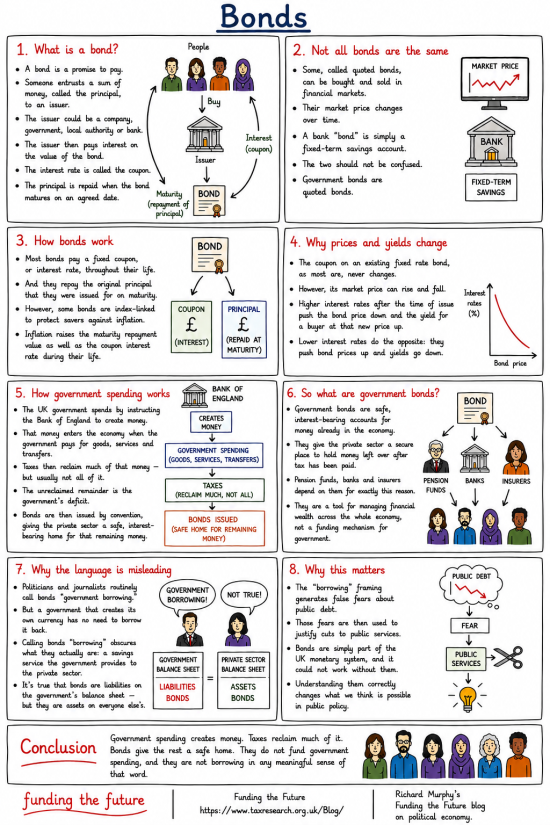
I think this is a moment to share my infographic on bonds. They are not meant to be toxic. It appears that in the hands of the wrong people, when used for an inappropriate purpose, they might be:
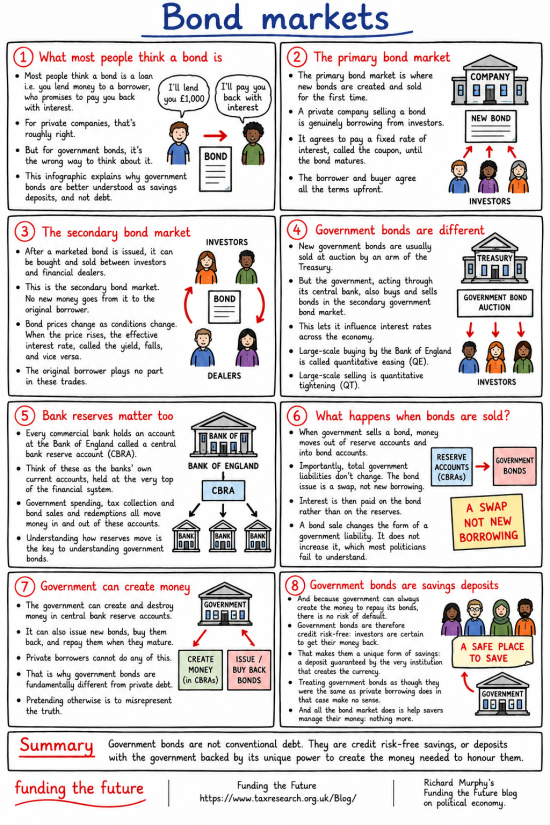
And this is the infographic on bond markets:
How to expand this image
Press CTRL or Command and the Plus (+) key on your keyboard to zoom in. Press CTRL or Command and the 0 (zero) key together to restore the screen to normal.
How to download this image
If you right-click the image, you should be given the option to download it to your computer. So long as you do so without the intent to make a profit, you may do so without further permission. Commercial use requires consent. But if you just want to share it, do so with whoever and wherever you want. That is the purpose of these infographics.
The image library
There is a library of these images. It is available here. All downloads are free, but donations help our work.
AI use
I wrote this infographic. I used AI to create the final image.
Thanks for reading this post.
You can share this post on social media of your choice by clicking these icons:
There are links to this blog's glossary in the above post that explain technical terms used in it. Follow them for more explanations.
You can subscribe to this blog's daily email here.
And if you would like to support this blog you can, here:

 Buy me a coffee!

Richard,
With respect, there is nothing new here. Margin calls, repo haircuts, risk limits and convexity hedging are not hidden mechanisms the FT has just uncovered. They are the ordinary plumbing of fixed income, and have been for decades. Mortgage convexity hedging drove the 1994 bond rout and the 2003 Treasury sell-off. The Bank of England has flagged leveraged and collateral-driven selling in every Financial Stability Report since the 2022 LDI episode. Every rates desk models these flows daily.
Your core analytical error is confusing amplifiers with causes. Forced selling needs an initial price shock to set it off. It speeds a move up; it does not start one. And the idea that holders are reluctant to “recognise losses” misunderstands the market. Leveraged positions are marked to market daily, so those losses are already booked.
The shock here is fundamental. UK CPI rose to 3.1% in August on energy prices. The Bank now expects inflation slightly above 4% in Q1 2027. In the US, strong business activity and concern about debt levels have produced the biggest Treasury sell-off since April 2025, with the 10-year near 5.25%, close to its highest since 2007.
When inflation is well above target, central banks are turning hawkish and governments still need to borrow heavily, investors demand a higher real yield and term premium. That is not a doom loop. It is pricing.
Finally, Japan, Germany, France, Britain and the US all sold off on the same days. A synchronised global move does not fit a story about contractual quirks. It fits a common macro shock: energy, inflation and supply.
The markets are not punishing anyone for their own failings. They are telling governments what lending to them now costs.
I think you are missing my point, and I hope not deliberately, but I cannot be sure.
I have never suggested that margin calls, repo haircuts, risk limits or convexity hedging are new, nor that they necessarily initiate a bond sell-off.
My point is precisely that they are amplifiers. Once bond prices begin to fall, contractual and risk-management mechanisms can require further selling irrespective of anyone’s changing view of inflation, government policy or creditworthiness. That additional selling can push prices lower, triggering still more forced selling. The fact that the initial shock might have been energy or inflation does not alter that argument. That is my whole point, that and the fact that it is not being talked about.
Nor does daily marking to market dispose of the issue. Recognising a loss in valuation terms is not the same thing as voluntarily realising that loss by disposing of the asset. Forced deleveraging can turn the former into the latter.
And your final sentence illustrates the wider problem. Markets are not simply “telling governments what lending to them now costs”. Market prices are being produced by all these interacting mechanisms, including forced sales, leverage, hedging, liquidity constraints and changing portfolio allocations.
You cannot acknowledge that these mechanisms amplify price movements and then treat the resulting yield as a pristine market judgement about what governments should pay. That is precisely the assumption I am questioning. You do not seem to undertsand that. Why?
I read you as presenting these mechanisms as something new and peculiar to the Bank of England.
On marking to market, though, you are wrong. For a leveraged holder carried at fair value, the loss hits NAV, equity and collateral the day the price moves. Selling at that mark changes nothing on the balance sheet. Cash replaces bonds at the same value, and NAV is unchanged. Realisation is an accounting event, not an economic one. The only extra cost of a forced sale is any discount below the mark needed to shift size. Realisation only really bites for assets held at amortised cost, as SVB showed in 2023, and those are not the leveraged books doing the forced selling.
Amplification is real, but it limits itself. Sales pushed too far draw in unlevered, long-horizon buyers: insurers, pension funds and reserve managers. That is why the 2022 LDI spiral reversed within weeks of the Bank acting. A move that has built over months, across several countries at once, looks like repricing, not a fire sale. Forced selling also leaves fingerprints: collapsing liquidity, wide bid-offer spreads, cash–swap dislocations and emergency intervention. At this moment there is nothing particularly unusual about activity in the bond market.
And whatever produced the price, it is still the rate the Treasury actually refinances at.
Thank you for adding nothing except this gem:
“Realisation is an accounting event, not an economic one. ”
As a claim that indicates a loss of touch with reality, that really does take some beating.
No doubt you will claim to be an expert. I can tell you, you are not, because if that is the product of your expertise, it is valueless.
Excellent stuff.
Thus if you are a bond buyer the only question to answer is when? When will this bottom out, it always does. 6%+ yield on a 30 year Gilt looks pretty good to me (last week it was 5.8%). Nice thing is, what goes up must come down so nice yield and when things calm down (& yields decline) a useful capital gain. Note that 6% is better than what is offered as a dividend even by oil companies & if buying a gilt – at least the value is locked in (with poss of capital gain for the reasons given). This begs the question, will investors in stocks start to move to bonds?
Thanks to you and your team for drawing attention to a profound, deceitful flaw in our finance dominated “democracy”/subverted polyarchy.
Might it be that:
1) Bond holders are wealthy?
2) The main stream media, except for the B. B. C., are owned by the wealthy?
3) “The members of the BBC Board are overwhelmingly wealthy”? (AI Mode)
According to the Institute for Public Policy Research wealthy individuals have donated a total of£179 million to U K political parties since 2019. Why?
“Politicians use fear as a strategic tool to build and maintain power.” (AI Overview) Why not realities?
Clucking Bell Richard, no one can accuse you of being superficial – ever! I’m trying to process this so bear with me……………
My God – so the state is issuing bonds into a market who has a whole different outlook and motivation for holding them? These are simple long term deposit transactions (the money is being voluntarily put there with the state for safe keeping at an agreed rate of return and duration) being pushed into a short-term dominated markets.
Then, these ‘people’ are taking these ‘pieces of paper’ (the bonds) and then basically putting them to uses that they are ill fitted to in a Klondike style, under regulated financial sector.
They have created their own market for these, and seem to be imposing their market pricing on an pre-agreed redemption rate with the state? On the basis that ‘We own these bonds, they are ours to do what we like with’.
Therefore these simple financial instruments are being embroiled in all sorts of high risk, complicated financial shenanigans and it is these behaviours/churn in these markets that are also contributing to the so-called bond crisis? It is not just driven by concerns over ‘national debt’ but by market behaviour (greed, quick profits, panic).
Considering what a bond is, isn’t about time that there were some strict limitations put on bond ownership in terms of how they are traded/owned? Long-term SHOULD mean long term.
I mean as it is, this is just tolerated chaos Richard isn’t it? Who is in charge around here please? Honestly…………….that this should allowed to go on.
Much to agree with