
Andrew Bailey, the Governor of the Bank of England, gave a speech yesterday about the state of the world's financial markets and the threats that they now face. Much of what he said was entirely orthodox and predictable. His conclusions about government spending were, however, deeply troubling.
Bailey began by acknowledging that the world economy is facing an extraordinary combination of threats. These include the war in the Middle East, repeated supply shocks, weak economic growth, the risks associated with artificial intelligence and increasing instability in government bond markets. He and I are on the same hymn sheet when it comes to these issues.
He also acknowledged that the financial system has, so far, coped reasonably well with these pressures. Banks remain adequately capitalised, and financial markets have continued to function despite significant increases in government bond yields. But Bailey was then very clear that this resilience cannot be taken for granted. I would again agree. If markets crash, as I think they will, resilience cannot be assumed.
His particular concern was, however, that governments might find it increasingly difficult to respond to economic crises because of the consequences of weak growth, higher borrowing costs and repeated demands for government intervention. He said:
Lower growth and repeated supply shocks weaken the public finances while increasing pressure on governments to provide support.
He then added:
If markets begin to doubt the fiscal trajectory, bond yields can rise further, tightening monetary and financial conditions.
What Bailey is very clearly suggesting in that case is that financial markets can, might, and maybe should, constrain the ability of governments to respond to crises, even when that response is necessary to protect the wellbeing of the people for whom those governments are responsible. That is an extraordinary admission from the Governor of the Bank of England, revealing a complete lack of understanding of the nature of government finances in a country like the UK, and an embedded view on his part of where power should lie in this country that is deeply troubling
That said, I note that Bailey acknowledged that governments have a responsibility to intervene when economic crises occur. He said:
Governments can ordinarily use their balance sheets to cushion a severe downturn and rebuild fiscal space when conditions improve.
That is, of course, entirely correct. Governments exist, in part, to provide the economic stability that markets cannot deliver. But Bailey immediately qualified his statement, saying:
But when shocks become more frequent, underlying growth is weaker, and the succession of shocks leads to a higher level of government debt, this becomes much harder to sustain.
His very clear conclusion was that governments must maintain the confidence of financial markets in preference to serving the interests of the people of the country they govern. He said:
Fiscal policy must ... be directed towards stability and be seen by markets as credible. Clear frameworks, including fiscal rules, can help contain risk premia when shocks occur.
This is where Bailey's argument falls apart. He is effectively saying that governments must be prepared to respond to crises, but only if financial markets approve of what they are doing. The implication is that the needs of financial markets must take precedence over the needs of people. That, of course, is an idea implicit in the corporatism of fascism. That is not a principle that I can accept.
There is another problem with Bailey's argument, and it is one that he himself identifies. He acknowledges that government bond markets have changed fundamentally. They are increasingly dominated by leveraged investors rather than institutions seeking long-term, relatively secure investments.
These investors borrow to speculate. Their positions can be unwound rapidly. When markets move against them, margin calls and other contractual obligations can force them to sell assets, whether they wish to do so or not. Bailey explicitly acknowledges that these processes can amplify market instability. I noted all of these issues yesterday.
In other words, and let me be quite clear about this, Bailey recognises that financial markets are not necessarily rational mechanisms for determining the appropriate price of government debt. He also recognises that, as far as many market operators are concerned, they no longer exist to fund the government, as conventional thinking suggests. Instead, leverage, automated trading, contractual obligations, and the need to cover losses elsewhere can drive their behaviour. These are precisely the mechanisms that can create financial crises, again as I pointed out yesterday.
And yet Bailey's answer is that governments must organise their fiscal policies to maintain the confidence of those same markets. There is a fundamental contradiction here.
If financial markets are increasingly unstable, why should governments be required to submit their economic policies to their judgement? Why should the ability of a government to provide healthcare, education, housing, social security or the investment required to address climate change depend upon the behaviour of highly leveraged financial institutions? And why should the Bank of England accept that this is an appropriate constraint on democratic government? To that, Bailey provided no answer. He could not, within the constraints of his own thinking, which presumes the government is dependent on bonds to finance its activities.
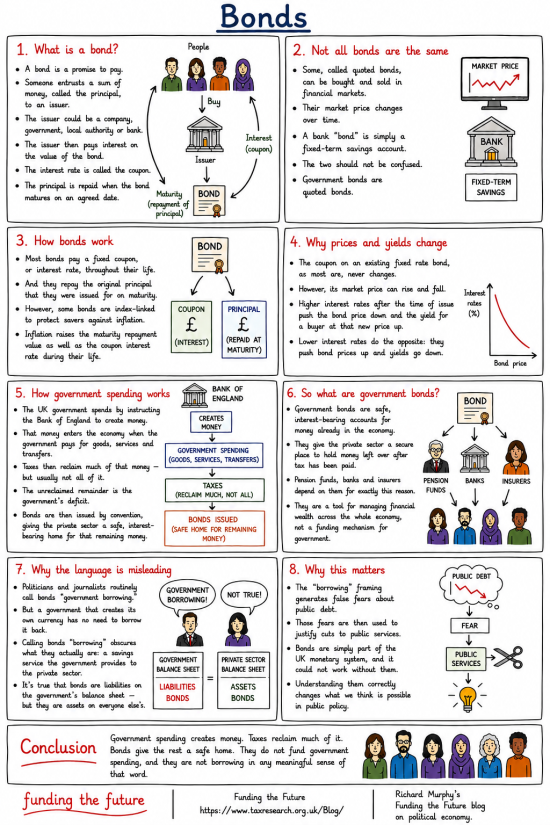
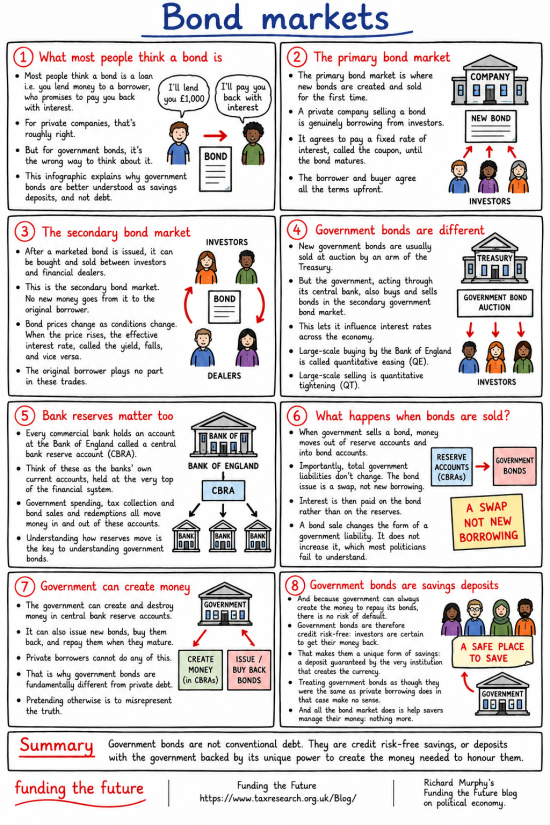
There is an alternative way of looking at this issue. The UK government is the issuer of sterling. It does not need to obtain sterling from financial markets before it can spend. It creates the money that it spends, with taxation subsequently withdrawing purchasing power from the economy. And bonds do not fund anything. They are safe places for financial institutions to save surplus funds.
That does not mean that government spending is without limits. Of course there are limits. Those limits are determined by the real resources available within the economy, the capacity to increase those resources, the risk of inflation and the consequences of government spending for economic and social wellbeing. They are not ultimately determined by the willingness of financial markets to purchase government bonds.
The Bank of England also has the capacity to intervene in government bond markets when financial stability requires it. It demonstrated that in 2022, when it intervened to prevent instability associated with liability-driven investment strategies in pension funds from becoming a wider financial crisis, created in no small part by its unprecedented and unexpected decision to commence active quantitative tightening
Bailey knows all this. He also knows that the Bank of England and the Treasury are parts of the same state, even if they have different responsibilities and operational arrangements. What is required is a coherent approach to monetary and fiscal policy that recognises these realities.
That would mean accepting that the government's first responsibility is to meet the needs of the population while maintaining price stability.
It would mean recognising that government bonds are a mechanism for providing secure savings opportunities, rather than an unavoidable means of financing government spending.
It would also mean accepting that the Bank of England has a responsibility to prevent financial market instability from undermining the capacity of the government to act in the public interest.
None of this requires unlimited government spending. It requires responsible economic management based upon the actual constraints that the economy faces.
Bailey is right that we face a world of repeated crises, weak growth and increasingly unstable financial markets. He is also right that governments must be able to respond to those crises. But his suggestion that governments must maintain fiscal rules designed to reassure financial markets, even when those markets are themselves a source of instability, is profoundly mistaken.
The purpose of economic policy is not to satisfy bond traders. It is to ensure that people can live securely, that public services can function, that the economy can prosper and that society can thrive.
If financial markets threaten those objectives, it is the financial markets that need to be managed. It is not the needs of the people that should be sacrificed.
That is the distinction Andrew Bailey appears unwilling to make. And it is one that matters enormously for the future of this country. It is a question of who rules, and why. Bailey seems to think financial markets rule because they might have the power to do so. I think people and democratic government must come what may. The difference of view is not theoretical. It may be at the epicentre of the coming crisis in this country.
How to expand these images
Press CTRL or Command and the Plus (+) key on your keyboard to zoom in. Press CTRL or Command and the 0 (zero) key together to restore the screen to normal.
How to download these images
Right-click the image to download it to your computer. So long as you do so without the intent to make a profit, you may do so without further permission. Commercial use requires consent. If you just want to share it, share it with whoever and wherever you want. That is the purpose of these infographics.
The image library
There is a library of these images. It is available here. All downloads are free, but donations help our work.
AI use
I wrote these infographics. I used AI to create the final image.
Thanks for reading this post.
You can share this post on social media of your choice by clicking these icons:
There are links to this blog's glossary in the above post that explain technical terms used in it. Follow them for more explanations.
You can subscribe to this blog's daily email here.
And if you would like to support this blog you can, here:

 Buy me a coffee!
