
The strongest opposition that I received on LinkedIn, and elsewhere, to my suggestion that we need not worry about the UK's national debt as it approaches £3 trillion, which I noted here yesterday, was that I had ignored the impact of my approach on international exchange rates.
The first thing to say is that my approach is that of modern monetary theory. What MMT describes is the way in which the monetary system of this country, and a great many others, actually works. There is nothing radical about it. It is just a straightforward explanation of what is happening, and is not a speculative suggestion as to what might happen. What is more, it is an explanation of what has been happening since the gold standard was finally abandoned in the 1970s, and so we can say that this system has been in use for a long period of time.
The second thing we can then do is look at why there have been major changes in the UK exchange rate this century to see if they are caused by the creation of additional money, or were instead better explained by other events. To do this, I got Claude AI to plot the sterling exchange rate with both the US dollar and the euro during the course of this century. This is the resulting chart.
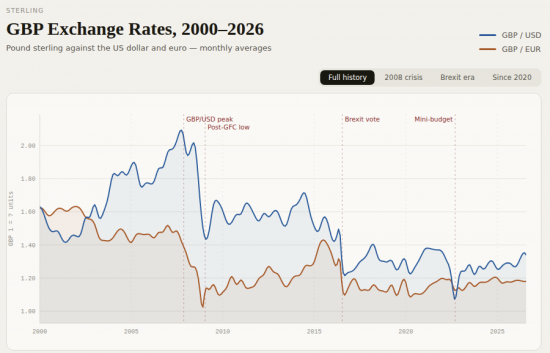
It is important to note that the patterns are broadly similar, although not identical, and that is because there is no reason why activity in the UK should necessarily impact the US dollar/euro exchange rate, and we would not, therefore, expect them to follow the same patterns. That said, trends are relatively clear and broadly similar.
Firstly, the value of the pound began to rise against the dollar after 2004, and that was because of the bubbling UK stock markets between 2004 and 2008, which attracted additional funds into the City of London. Gordon Brown created a boom. The exchange rate reflected that fact, without this influencing the rate with the euro, because they had more sense than to follow the hot money.
What then happened was the 2008 crash, and the myth of the City of London was burst, and the exchange rate collapsed against both the dollar and the euro, and for very good reason. This was not, however, because of quantitative easing, which only began in late 2009. It was because the City failed.
QE then stabilised the exchange rate, and even improved it against the euro over the period from 2010 to 2016. In other words, extensive money creation during that period, of more than £400 billion, did not cause the exchange rate to collapse. If anything, it strengthened it.
Then, Nigel Farage knocked the exchange rate to bits because of the fundamental changes in UK international competitiveness caused by Brexit, after which the permanent damage that he created settled matters at a lower level.
However, money creation from 2020 to 2021 boosted the exchange rate against the dollar, until Liz Truss created another sterling crisis from which we have slowly recovered ever since.
What is the point of noting this? There are four.
First, it was politics that created all the major changes in exchange rates.
Second, major money creation and quantitative easing stabilised exchange rates from 2010 to 2016 and again from 2020. It did not cause a crisis.
Thirdly, despite the current and ongoing supposed crises with the balance of payments and fiscal deficits, exchange rates are improving. Markets can easily accommodate them.
Fourthly, nothing I have said about the national debt will change any of this.
In other words, all this hyperbole about modern monetary theory, money creation, and collapse in the value of the pound is complete and utter nonsense. A calm appraisal of the facts suggests that money creation supports the pound, rather than harms it, and that money creation compensates for political errors of judgement, and does not create them.
I suggest that my critics go away and think again.
Thanks for reading this post.
You can share this post on social media of your choice by clicking these icons:
There are links to this blog's glossary in the above post that explain technical terms used in it. Follow them for more explanations.
You can subscribe to this blog's daily email here.
And if you would like to support this blog you can, here:

 Buy me a coffee!

Thanks again for yet another clear, thoughtful analysis.
Alas, might it be that many humans are more influenced/governed by emotions and attitudes than by analytical thought?
If so, the contributions of you and your team are invaluable as, particularly with the infographics, they will, over time, have effects on attitudes as well as thinking.
I can live in hope
Good piece, and definitely a canard worth debunking. Worth throwing in the Meese-Rogoff finding too. Since 1983 the literature has consistently shown that standard exchange rate models, including the monetary ones that say money supply differentials should move rates, cannot beat a random guess at forecasting even a year out. If the “printing money crashes the currency” story were as solid as critics claim, those models would have some predictive power by now. They dont, not reliably, over four decades of attempts to fix them.
That fits exactly with what you’re showing above. Politics and capital flows dominate: Brown’s boom, the 2008 crash, Brexit, Truss, QE stabilising things rather than wrecking them. The fundamentals based scare stories about deficits and exchange rates have never had strong empirical legs, which is presumably why the critics never bring up Meese-Rogoff themselves.
Thank you. Appreciated.
The “anti MMTers” always set up the strawman of Weimar or Zimbabwe. Of course, money creation in those situations created inflation…. but nobody is suggesting we follow Zimbabwean policy.
What I want is good policy….. which recognises that money creation at the right level is part of the policy. I don’t want a strong or weak currency – I want a level that balances the interests of importers, exporters and investors appropriately.
In fact, I want policy makers to forget about markets and manage for the real economy and wellbeing. Do that and markets take care of themselves.
Clive,
Anyone who bothers to spend a few minutes researching what happened in Zimbabwe in the 1980s will know that the hyperinflation started as a result of Mugabe’s destruction of the country’s farming infrastructure many months before. The majority of the money printing was actually a last desperate straw-clutching act of an already drowning economy. Clearly 5 minutes on Wikipedia is beyond the intellectual capacity of most LinkedIn subscribers. Perhaps I should delete my own entry there, I haven’t actually looked for a new job since 2013?
Regarding ‘good policy’ I have decided I am not any kind of an ‘ist’ (monetarist, communist, fascist, socialist etc.) except for pragmatist. Any policy that works in practice to further the current and long term welfare of the whole population is OKist with me. Richard appears to have the most OKist list of policies currently on offer but is sadly (unlike some more widely known names) not sufficiently prone to the Dunning-Kruger effect to push himself towards any position of real power.
I am not temperamentally suited to being an MP or minister.
Call it an inability to buillshit.
Not sure where to start with this one, except to say that you are wrong.
As comments go, that is staggeringly inadequate.
I present the evidence.
You say I am wrong. You give no evidence at all as to why that is the case.
I agree that money creation stabilises sterling rather than causing depreciation (despite what the BoE might say).
Why is that? First, let’s assume the economy is not at full capacity. With unemployment at 4.9% and wider underemployment at 7.3%, that’s a fair bet.
Next, assume that the government spends any money it creates in a sensible way, doing useful things, rather than as tax cuts for the already wealthy. With those assumptions, the fiscal multiplier, the amount the economy grows for every pound spent by the government, would be more than one. That is, government spending will actually grow the economy.
So what will be the affect of spending on the exchange rate? Well, the economy will have grown faster than the amount of money created. It can do this because money circulates faster. And money circulates faster if it is spent in the real economy, by people who need it, for people who need it, rather than to pad the bank balances of the wealthy.
If the economy has grown more than the money added then the pound will be MORE valuable rather than less valuable. That means that sterling is likely to appreciate rather than fall.
So Prof Murphy is right.
Thanks, Tim, and much to agree with.
One minor comment. Your last sentence about your critics going away and thinking again. This, however, presupposes that they gave it some thought in the first place as opposed to just swallowing (without questioning) hook, line and sinker the classical economics that they were indoctrinated in at university and elsewhere.
Agreed
What’s really scary is the notion that they did give it some thought and still came to the wrong conclusion.
Thanks for your explanation yesterday and this post today.
Especially for the time you’re taking to explain it well and in a wording that even, not very easily but easily enough, someone like me, a craftsman without an university degree, can understand.
I really have to say that I learned quite a lot of substantial things supporting MMT (mainly concerning inflation and exchange rates which I often couldn’t address well in arguments) the last days from you.
I may be wrong but in my opinion, most people that talk about MMT are only talking about the problems we face because of not having it.
They criticize the acting of governments, and justifiably so.
They seem to very, very often miss to address the “How” and “Why” of MMT at work for the alternative to take shape.
So, thanks for your time and effort to help us all understanding it better 🙂
Thank you
Brilliant thank you. This criticism is such a straw man argument. A hypothetical rebuttal without a shred of evidence. Discount the usual Weimar republic and Zimbabwe examples, where hyperinflation was not caused by money printing, but other serious fiscal problems. Desperate excessive money printing was a symptom not the cause.
There are also other historic examples of “overt monetisation” being used successfully;
The UK government issued the Bradbury pound at the start of WW1 to prevent a financial crisis.
US presidents Lincoln and Hoover. The former to fund the costs of the American Civil War, and the latter with the New Deal in the 1930s.
According to NEF the Canadian government successfully used this policy from 1944 to 1975, as well as New Zealand from 1935 to 1939.
Nazi Germany in the 1930s. This one is a moot topic of course. But technically it worked very well.Turning a basket case economy into a military – industrial giant. I personally like that example, as it counters the Weimar republic straw man argument. How do you stop rampant inflation and create a productive economy?The state intervenes and directs investment where it desires it. Though it can indeed be used for evil purposes.
Thank you
Vincent,
Nobody wants to say anything good about the Nazi government of the 1930s but you do make a good point. An authoritarian government was able to manage the economy in way that achieved it’s desired aims. Sadly those aims were not of long term benefit to the German population or anybody else.
More recently the government in Singapore has managed to propel that island country out of the 3rd world and firmly into the 1st in a single generation. It is nominally a Westminster democracy but one party has managed to get elected to almost every seat in the parliament for nearly 70 years with only 4 Prime Ministers since 1959 and it is considered an authoritarian regime. Richard balked at my describing this as a ‘benevolent dictatorship by consent’ but as I said previously I would rather live in a country that denies me the right to chew gum in public than one that allows me to carry a handgun and how is the UK to make any significant change in direction without a government made up of sterner stuff than the current house full of marsh-mallows?
It’s easy for me to criticise the UK from my comfortable retreat in rural Tasmania but I still have family back in dear old Blighty about whom I am very concerned.
Yes I kind of dread mentioning Nazis in connection with MMT. But the central Banker Hjalmar Schacht is an interesting figure. Not a Nazi per se, but he knew how to redirect a dysfunctional economy and turn it into a powerhouse.
He was put on trial at Nuremberg, for funding the regime,but he was found innocent. He didn’t actually like Hitler and thought him entirely ignorant of economic affairs, not unusual in a politician.
He went on to help the German central bank after the war such was his knowledge. I did read his autobiography, but he is a controversial character, having willingly aided a monster.
I am aware of this…
This is very good. I’m sure neo-liberals won’t let things like history and facts get in the way of their policy objectives, but for those of us who crave evidence-based policy options, this type of thing is very helpful.
It did bring to mind something I have been thinking, which is that while we worry about the uk debt position, the other currencies we are comparing the uk too also have extreme concern over their debt position. So the US debt to GDP is even higher than in the UK, yet we worry here about exchange rates with the US dollar? Surely all currencies can’t fall relative to each other at the same time. If every major currency issuing country is worried about their own currencies, who comes out on top? Does hyperinflation just hit every country at the same time?
I note from a simple google search that some of the lowest debt to GDP ratios are enjoyed by Afghanistan, Congo, Haiti and Albania. So I presume these will end up being some of the currencies which appreciate given their outstanding credit situation?
Anyone know how I can go long on the Congolese franc?
I think it’s very clear that overall “debt” plays very little role in exchange rates.
You raise a good point.
The US supposedly has a debt crisis.
So do many European countries – or, like Germany, they have shattered their economies and industries instead.
And you effectively pose good questions for those who claim to hate debt – most especially: would you rather live in a failed state instead?
Simon, yes a very good point. Then there is Japan with a debt to GDP of over 200%. Along with Singapore just under that figure.
So high government debt to GDP versus inflation or exchange rates is certainly not a clearly defined relationship in isolation of other mitigating circumstances.
In Japan it’s mainly down to the high level of demand for domestic savings that requires a higher amount of bank reserves.In Singapore, there are mandatory deductions from paychecks to go into savings funds.
What is done with all these savings is another important issue, one Richard has made good answers for.
I agree with you that money creation has only a marginal effect on the exchange rate.
However, the BoE disagree. 🙁 And this is problem as it risks undermining the credibility of your economic arguments (I wish that were not true).
According to Google (who may be wrong), “Based on foundational peer-reviewed studies published by the Bank of England, a newly announced monetary expansion of 1% of GDP (£30 billion) is estimated to reduce the sterling exchange rate by approximately 0.6% to 0.9% under normal, non-crisis economic conditions.” (IEO evaluation of the Bank of England’s approach to quantitative easing, https://www.bankofengland.co.uk/independent-evaluation-office/ieo-report-january-2021/ieo-evaluation-of-the-bank-of-englands-approach-to-quantitative-easing).
It may be that this analysis is wrong. But folks (and trolls) who would criticise you, might seize on this to discredit you. This is a problem when relatively few voices are pitted against the credibility of the BoE. Now, in my opinion, the Bank has limited credibility based on it’s absurd handling of base rates. So I’m inclined to believe you rather than the Bank. But this is still a problem in trying to convey a rational message about economics.
🙁 🙁
Thank you, but there is a problem with your summary. The Bank report you link to does not, as far as I can see, make the quoted claim that £30 billion of monetary expansion reduces sterling by 0.6% to 0.9%. What the report actually says is more interesting.
It says QE may put downward pressure on sterling because it lowers interest rates, not simply because more central bank money has been created. It also explicitly says the impact of QE is “state-contingent”, that there is still active debate about exactly how QE works, and that the macroeconomic effects are difficult to identify.
That distinction matters enormously.
I have never claimed that government action cannot affect exchange rates. Of course it can. My argument is that there is no simple quantity-of-money mechanism whereby creating more pounds automatically reduces their value.
Indeed, the Bank’s own discussion effectively concedes that point by describing multiple transmission mechanisms whose significance varies according to economic circumstances.
So I do not think this undermines my argument. If anything, the Bank’s own qualifications reinforce it.
Thanks Richard. Graphs like this are extremely helpful.
Steve Keen also has a really good one showing that private debt, rather than govt debt, is what leads to financial crises: https://profstevekeen.substack.com/p/gaslighting-us-on-private-debt (see “figure 4” and note in particular the unusual period of govt budget surplus during the 1920s and 1990s/2000s and what followed)
These two graphs alone ought to be enough to put a serious dent in somebody’s reflexive fear of govt. defecits.
I agree with Steve.
This piece mistakes narrative for proof. Four cherry-picked episodes are asked to carry a universal law — “money creation supports the pound” — that they cannot bear. Showing QE didn’t collapse sterling in one low-inflation decade doesn’t establish that money creation never matters; it establishes that it didn’t dominate in that specific window, where cheap global capital and eurozone weakness were plausibly doing the real work. The counterfactual is never addressed. Worse, the piece quietly elides the actual dispute: virtually no serious economist denies a currency-issuing government isn’t revenue-constrained like a household. The real argument is about inflation and confidence risk from sustained, large-scale deficit monetization outside a demand slump — precisely the scenario this chart doesn’t test. Concluding “nothing about the national debt changes any of this” is asserted, not shown. Strip the rhetorical flourishes (“utter nonsense,” “go away and think again”) and what’s left is a timeline dressed up as a refutation.
I think you have reversed the burden of proof.
I am not claiming that money creation can never contribute to inflation or currency depreciation. It can, if the resulting spending creates demand beyond the economy’s capacity to supply goods and services. I have said that repeatedly. It is what MMT says.
The claim I am challenging is that creating money, increasing government deficits or increasing the national debt necessarily debases the currency and causes inflation. Those making that claim need evidence for it.
The episodes I examined do not establish a universal law that “money creation supports the pound”. I have never suggested that. They test whether major episodes of UK money creation produced the currency consequences that critics predict. They did not.
Nor does calling them “cherry-picked” dispose of that evidence. They are what happened. If substantial money creation occurred without the predicted consequences, the supposed causal relationship needs more explaining and a lot more evidence.
Meanwhile saying that other factors overwhelmed the monetary effect supports my argument. Once you concede that trade, productivity, international conditions, interest-rate expectations and other factors can dominate money creation in determining sterling’s value, the simplistic claim has already failed.
The counterfactual argument does not rescue it either. Saying “sterling would have been higher without the money creation” is not evidence. It is an unobservable counterfactual requiring proof of its own.
Finally, deficit “monetisation” does not become inflationary simply because that label is attached to it. The question is whether the resulting spending creates excess demand relative to available productive capacity.
My conclusion is therefore straightforward: there is no simple empirical relationship showing that more government-created money, or a larger national debt, necessarily causes inflation or sterling depreciation. If someone claims otherwise, they need to provide the evidence.
Richard you actually read what you write (or which AI generates for you)?
You claim that:
”The episodes I examined do not establish a universal law that money creation supports the pound”. I have never suggested that. “
And yet the title for this blog is:
“Money creation supports the value of the pound, rather than harms it”
And where is the conflict between the two?
The second refers to the evidence. It supports what I said.
The problem is yours: I did not create a law from an observation.
I understand the categorical imperative. Do you?
Fair pushback on the “necessarily” framing — no one should claim mechanical inevitability. But absence of a universal law isn’t absence of a mechanism: money creation shifts probability distributions, not certainties. UK episodes without crisis don’t disprove the channel — they show other factors (credibility, growth, real yields) can offset it.
The relationship is threshold-dependent, not lawless: small or well-anchored money creation gets absorbed harmlessly because credibility, spare capacity and demand for the currency act as buffers, while creation that outpaces those buffers — or coincides with a collapse in institutional trust, as in Turkey or 1976 Britain — tips into depreciation and inflation. That’s not a fixed law triggering at a precise number, but nor is it random: it’s a function of scale relative to capacity, and of how markets price the credibility of the institution issuing the money. Your evidence shows the buffers held in the cases you picked; it doesn’t show they always will.
I think you are moving the argument rather than answering it.
Once you accept that money creation does not mechanically cause depreciation – which you now concede – you need to demonstrate the mechanism you now propose. Saying that it “shifts probability distributions” sounds sophisticated, but unless you can show how much, under what conditions, and with what evidence, it risks becoming impossible to falsify.
If sterling falls after money creation, the theory is said to be confirmed. If sterling does not fall, we are told that “credibility”, growth, spare capacity or real yields offset the effect. That makes the proposition capable of explaining every possible outcome after the event. Alternatively, it reveals prejudice rather than reasoned thinking.
Turkey does not solve this problem. Its experience involved chronic inflation, substantial foreign-currency liabilities, political interference in monetary policy and serious external imbalances. Nor is 1976 Britain a clean experiment in money creation: the UK was dealing with oil shocks, inflation, balance-of-payments pressures and profound structural weakness. In addition, the world was utetrly confused after the end of the gold standard.
I entirely agree that excessive spending relative to available real resources can cause inflation, and that loss of confidence can affect an exchange rate. But those are different propositions from saying that money creation itself creates some independently identifiable downward pressure on sterling.
The important variables are what the money finances, whether productive capacity exists, what happens to imports and exports, inflation, political stability and the demand for sterling assets.
If those factors explain the outcome, then invoking an additional quantity-of-money effect requires evidence. It cannot simply be assumed to exist whenever the observed facts fail to show it. You cannot show it. Why claim it?
It would be interesting to discuss this in detail (as i have with colleagues many times over the years ) but we don’t really have the time and the correct forum. Suffice to say the headline “Money creation supports the value of the pound rather than harms it” is disingenuous to say the least. I think previous statements that “deficits don’t matter” or “we don’t need a bond market” predicated on the fact a fiat currency can always replay its borrowings are technically correct but practically wrong. And it can go very wrong if deficit financing is undertaken or money creation is used to fulfill a populist political agenda. I could bombard you with recent examples Argentina, Lebanon, Bolivia and others. We might think we are miles away from these but they highlight the dangers of excessive money creation at the wrong time for the wrong reasons. Anyway that’s me finished on the matter. I dip in and out of your blog but rarely comment. I appreciate the dialogue.
Why not just admit: you proposed total nonsense and are still talking what might best be called total and utter drivel that makes precisely no economic sense. Go and learn why we are in nothing like the situations of Argentina, Lebanon md Bolivia are. It is really not very hard to work out. You really have made a complete fool of yourself, and I hope you are deeply embarrassed.
Concerning states like Lebanon, Argentinia and Bolivia:
I’m trying to get a picture about why they failed with their finances and you’re right that those facts aren’t that hard to find.
What I’m curious about is if there’s a way for them to get back on track again.
I refuse to think that this can’t be achieved as e.g. in Germany it seems to have worked twice already, also having been in serious trouble due to horrible political decisions before.
To be clear: I’m sure as heck not talking about these futile “attempts” by people like Milei, that seem to try to improve GDP by impoverishing everyone except themselves.
What could really help them?
Countries can recover from situations like those you describe. There is nothing inevitable about permanent economic failure.
The first requirement is to understand what has gone wrong. These countries have different histories, but they share some problems:
– dependence on foreign currency,
– weak export capacity,
– exchange-rate difficulties,
– loss of foreign-exchange reserves, and
– foreign-currency debt.
Lebanon has also suffered a banking crisis and occupation while Bolivia has suffered declining gas production and Argentina’s political history is not stable.
What that means is these countries cannot generate the foreign-currency they need to pay debts or purchase essential imports. So recovery has to start with rebuilding the real economy.
That means increasing domestic food and energy production where possible, developing industries capable of replacing unnecessary imports, investing in infrastructure and education, and, crucially, developing exports that earn the foreign currency needed for unavoidable imports.
Foreign-currency debts may also have to be restructured. Creditors may have to accept losses. Trying to extract foreign-currency payments from a damaged economy can destroy the very productive capacity required to repay anything.
Banking systems may need reconstruction as well. Lebanon is an extreme example of this.
How to achieve this? International funding in the local currency is essential to provide capital – and the IMF and World Bank could do this.
I would also reject the idea that recovery requires impoverishing the population. Their usual austerity demands always undermine recovery.
Germany recovered after the catastrophe of WW2 because productive capacity, institutions, investment and demand were rebuilt. That is ultimately what these countries need too.
The objective cannot be to make the government’s accounts look better. It has to be to rebuild the country’s capacity to provide for its own people and earn what it needs from the rest of the world.
Hi Richard, thanks as always. Great, clear explanation.
Is it possible to quantitively evaluate the levels of GBP currency creation (perhaps something like = govt spending – tax + new bank loans – bank loan repayments) if the data is available?
If so, this plotted against the two exchange rates you highlight would be a really interesting visualisation against the two exchange rate curves, and could then also be used calculate a correlation coefficient to assess the impact they have on each other.
No, in a word, it is not. Not in my budget, anyway.
According to the OBR, government policy is on track to be in surplus by 2030. So what exactly do the Hawks want? Even more surplus? It is not clear.
I recall that it was once thought the exchange rate fluctuated with interest rate differences between countries as money was moved to where it would get the highest return. If the US had higher interest rates than UK, traders would exchange sterling for dollars and invest those dollars in the US. The demand for dollars would increase and the dollar would strengthen against the pound, and so forth…
I read the Economist for many years and never saw much evidence of this happening despite the logic behind it.
When we left the EU, our interest rates increased and the exchange rates against other main currencies fell ( the pound weakened), the opposite of what I was expecting. I have been scratching my head ever since.
I correct myself. There was a considerable time lag after leaving the EU in 2016 before interest rates went up. In fact, the Bof E reduced interest rates immediately after the vote to defend a falling pound. My memory let me down.
Some things come to mind – irrespective of the technical aspects here.
Can someone tell me who is in charge of this place, the UK?
Everyone one ranting about how the markets will react etc., are ignoring this thing called sovereignty which as I understand it is to do with political order and self determination . This also means that money creation is also a function of a democracy. So do all these naysayers not believe in democracy, or our sovereignty? What do you believe in then, if not those? Markets are not ‘voted in’ are they? If you can’t pay or if your wad is not big enough for the market, how will you be heard or represented? Duh!
The other thing that comes to mind is how quickly heterodox thinking is closed down because of ‘the risks’ of MMT. Yet we have a Central Bank Reserve Account (+ interest) still at huge levels to support the risk being taken by private banks!! Well, if the private banks can have it, so can can a democratically appointed government and state owned bank if they want to try something new and a bit risky and behalf of us all! Is that too much to ask? Does that avoid double standards? Or do we want double standards? And, How many market created crashes have we had since 1979? Does this not tell some of these idiots that something is seriously wrong with the way in which we’ve been managing things and now we need a new direction and we need to be bold?
Honestly, looking at some of the reactions, I’m fucking sick and tired of living with turkeys voting for Christmas all of the time.
I get your frustration.
@Brendan https://www.taxresearch.org.uk/Blog/2026/08/28/money-creation-supports-the-value-of-pound-rather-than-harms-it/comment-page-1/#comment-1091321
I know a little about Lebanon, Brendan, and it is a country with totally unique political and economic circumstances, not least having an economy based on the “informally circulating” US dollar (including some I send there).
That you can use it as an example here, while still keeping a straight face, is mind-boggling. I do hope you don’t apply your “interesting” ideas on money to anything mission-critical anywhere that involves geopolitics or economics, or the lives of flesh and blood humans, because it would represent a serious threat to public safety.
Agreed.
I have been to Lebanon, to a supposedly secure UN compound, with armed guards everywhere.
I talked about economics.
And yes, I went out into a very troubled and divided Beirut, which is simultaneously beautiful.
It is nothing like the UK in so many ways.
It annoys me deeply to see anyone making such stupid comparisons. I agree with your conclusion.