
Ever since I wrote my book 'The Joy of Tax', I have argued that there are six reasons to tax, none of which have anything to do with raising revenue to fund central government in a country like the UK.
Getting this on an infographic took some work. I hope I have succeeded. Please let me know:
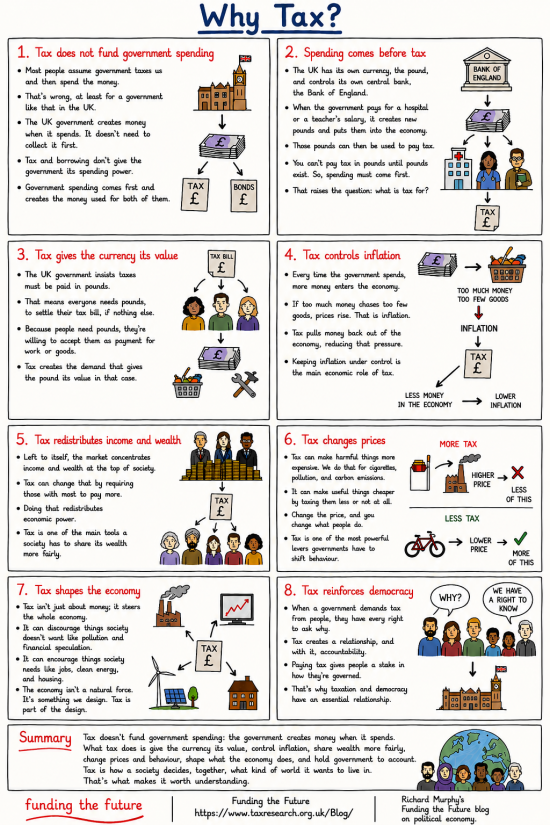
Note: Typos in boxes 1 and 4 have now been corrected.
How to expand this image
If you press CTRL or Command and Plus (+) on your keyboard, your browser should increase the size of your page every time you do this. Press CTRL or Command and the 0 (zero) key together to restore the screen to normal.
How to download this image.
If you right-click the image, you should be given the option to download it to your computer. It is much easier to download it from our image library.
The image library
We have a library of these images. It is available here. All downloads are free, but donations help our work.
AI use
I wrote this infographic. I used AI to draw it, under my direction, until I was satisfied with the result (which took many attempts). I explain how I use AI here.
Thanks for reading this post.
You can share this post on social media of your choice by clicking these icons:
There are links to this blog's glossary in the above post that explain technical terms used in it. Follow them for more explanations.
You can subscribe to this blog's daily email here.
And if you would like to support this blog you can, here:

 Buy me a coffee!

Editor’s note: You never apologised for calling Chris Packham a commie, and this is another AI-generated piece. You are blocked.
Very good
In block 8 I am not sure of the reasoning. It seems to me that tax was raised historically on people who had no say in the monarch’s or parliament’s policies. In a fair system one would expect these two things to go together but is there a causal link?
The evidence of research – admittedly in Africa, where at one time it was easier to find deeply contrasting states, is that this claim is true. It was done by Mick Moore at Sussex University. From observation, I think it also true.
It’s logical enough to me that if people are expected to participate in the government’s process to help manage the effects of its spending then they will also expect to have a say in what that spending is directed towards. If they aren’t given that say, they may feel aggrieved and push the system to make concessions and become more democratic (a sentiment historically captured in the slogan “no taxation without representation”?) That could be your causal link?
That will do nicely, Sir.
On issue 8, now that’s an interesting one………….there is a ‘social levelling’ element in taxation that also underlines that a democracy/form political order is in charge – that before the tax/law authority we are all equal concerning the principle of tax? Maybe Box 8 needs to quickly refer to previous boxes stating the benefits to be less ‘abstract’?
Just a thought or two.
How would you word it?
OK, let’s see……………I have responded very quickly, but my starting point was the problem of not paying tax and working from there – trying to keep to 4 bullet points only. I am not precious about it:
Tax a is mutually beneficial relationship between the citizen and the state – it makes all of us – the state included – accountable to each other. Accountability is a fundamental part of democracy
We all benefit from the things tax does for us above by taking part in the tax system.
Tax also creates equality as we all have to pay, and are we all equal before the principle of tax (law).
Tax legitimises those who pay and legitimises those who are paid. That is what makes a democracy, and democracy is what makes a country fit to live in.
Let me work on that for an update….
Box 4, second bullet point doesn’t quite parse: If too much money chases too few goods, and prices rise. That is inflation.
If you’re still making edits, I can suggest three alternatives:
If too much money chases too few goods, and prices rise, that is inflation.
If too much money chases too few goods, then prices rise. That is inflation.
If too much money chases too few goods, prices rise. That is inflation.
And I would say you’ve definitely succeeded here. I’ve often read (or skimmed through) your explanations of tax before, but it’s always felt a bit dry. Whereas this format, if not warm and cuddly, does make it relatable!
Thanks. I changed to option 3, and I admit I then saw you suggesting it.
I really should use AI more!
This is such a good summary of the reasons for central government taxation that I’ve been hesitating all day about whether to offer a few amendments but in the end I found I couldn’t let it go. There’s a couple of words or phrases that, though not actually implying anything incorrect, might easily lead some readers to infer something wrong.
In point 3 within box 4 you say “Tax pulls money back”. If I didn’t know any better, I might infer from that phrase that money is pulled back to the government which can then spend it. Perhaps you could say something like “Taxes are debts we incur in response to government legislation. As each tax is paid the relevant debt is cancelled and the amount of money concerned ceases to exist, reducing the inflationary pressure” Two sentences; so maybe two bullet points? (I expect that with or without AI, you’ll be able produce something more succinct than I have.)
Box 5 says Tax redistributes income and wealth. One might naively infer that the amount of tax paid by those who can pay more is money paid to the government and in effect distributed to the less well off. How about “evens out” in stead of “redistributes” in the heading and “helps to equalise” in point 3?
Redistributes is clear. Evens out is not. Sorry.
And I see your first point but the constraint is words. I used 4. That is the suave available. What are your 4. These things are hard, for precisely these reasons.
But thanks for caring.
I think it is a really good explanation that we can give to those who cannot see anything but the household purse in action. Very helpful.
PSR says ‘we all have to pay’ but clearly many do not pay.. I assume the consequences of these thieves are for another topic/day?
This is a very important subject because most people and possibly journalists and politicians think our national economy is like a household economy. Maybe there’s a bit more money down the back of the national sofa! You, Richard, are doing a good job educating people. But another point worth making is to answer rich people who ask why they should be taxed at an even higher rate.
Imagine a huge company that runs buses. They have an extra good year and there are a few more million Pounds available for staff pay. What to do with that money? Maybe the CEO gets a bigger bonus and can buy a bigger yacht and can hold his head high the next time he is chatting to another CEO. But if the millions are shared amongst the drivers and each one got a pay rise of say £15000 think how much (deserved) happiness each driver would get. So although I see pay levels as helpful incentives to encourage hard work, training for skilled work and just talented people to use their talents, more and more pay brings diminishing returns of ‘happiness’. Although not widely admitted what more and more pay brings is more and more power. The answer surely using tax bands to limit massive wealth.
Diminishing marginal returns from additional pay are real and provide the economic argument for progressive taxation at the same time.