
Why does the UK government sell bonds? Does it really need to borrow money before it can spend? And do government bonds actually increase the national debt?
In this episode of Understanding Economics, I explain why government bonds are not what most politicians and financial commentators claim them to be.
The UK government issues its own currency through the Bank of England. When it spends, money enters the economy, and when it taxes, money is removed.
When government spending exceeds taxation, the money left in the economy becomes available for households, businesses and financial institutions to save.
Government bonds, also known as gilts, are essentially government-backed savings accounts. They allow investors to exchange money they already hold for a financial asset that pays interest.
This is the crucial point: selling a government bond does not, by itself, create additional government financial liabilities. It exchanges one form of government debt for another.
So why does the government issue bonds?
I explain how bonds provide relatively safe savings opportunities for pension funds, banks and other investors, while also helping influence interest rates throughout the economy.
I also examine the role of the Bank of England, commercial bank reserves and the difference between variable interest rates and the fixed or inflation-linked returns offered by government bonds.
Most importantly, I challenge the assumption that the government must borrow from financial markets to fund its spending.
I argue that government bond issuance is an economic policy choice, not an unavoidable requirement for financing public expenditure.
The real limits on government spending are the availability of workers, materials and productive resources, alongside the need to manage inflation.
Understanding this changes how we think about government borrowing, the national debt and the supposed power of bond markets.
The government should be making economic decisions in the public interest, not simply to satisfy financial markets.
This is the audio version:
This infographic supports this video:
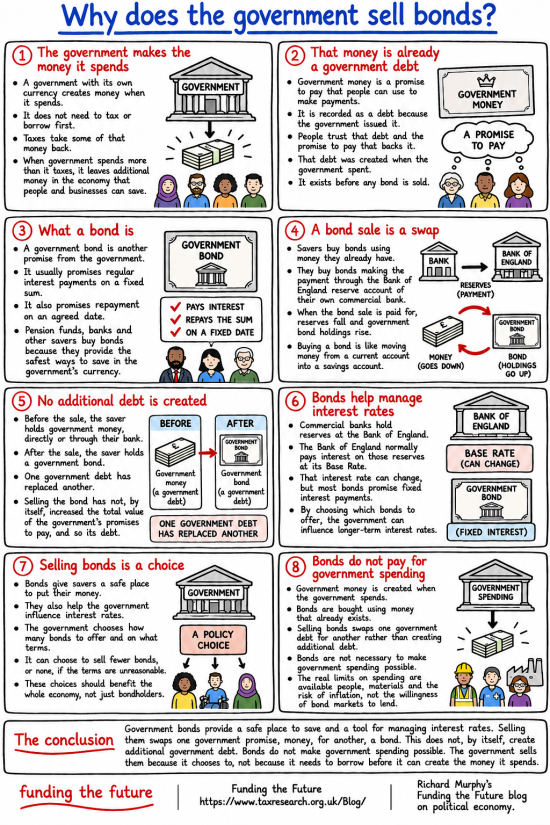 This is the transcript:
Hello, I'm Richard Murphy, and this is Understanding Economics. That's the series of videos that I'm making that explains how I think our economy really works, so that I hope you might do so as well.
And in this video, I want to explain why our government sells bonds. This seems to me one of the most difficult issues that people have with understanding the economy in which we live. They think that bonds are somehow deep and mysterious and beyond their comprehension. Well, let me tell you, they're not. They're easy to understand. And the reason why the government sells them is something I will explain in this video.
Let's start right at the very beginning, though. The government makes the money it spends. You have to understand that point. In an economy like that of the UK, where the government has its own currency, its own central bank, and all its borrowing is in that currency, it can never not pay its debts. And every time that the government tells the Bank of England to make a payment on its behalf, the Bank of England creates the money that the government uses to make that payment.
The government does not have to tax or borrow first to make a payment. It has its own bank. That bank creates money for it. Banks exist to create money. That is their function. They make money every time they lend money. And the Bank of England lends money to the government to let it make its payments. That is how government money gets into circulation in our economy, and you have to understand that, or you cannot understand bonds.
Now taxes take some of that money back out of the economy. That's deliberate. The government has to take most of the money that it creates back out of the economy, or we would have hyperinflation. And so it creates taxes to achieve that goal. That is the primary function of tax in our economy. Tax does not fund government spending. It's there to control inflation.
But when the government spends more than it taxes, and most of the time, and in every year during the course of this century, that has been the case, it leaves additional money in the economy that people and businesses can save. That is how the money that people save comes into existence.
The government is already in debt when people begin to save. Let's be clear about that. Government money is a promise to pay that people can use to make payments. We trust the government's promise, and so we use what evidences that promise, whether it's a balance in our bank account, or a note or a coin, to make payments. And the recipients also trust the government to make their payment. And that's how we end up with a monetary economy.
But that debt is a record that exists in the government's ledgers at the time that we use it. That money exists, therefore, before there is tax and before there is borrowing, and indeed, before there is saving. The government creates it. And that is key.
The debt that the government has is the difference between the total amount that it has spent and the total tax that it has taken back out of the economy. That is the debt, and the debt exists before any government bond is sold. That's the important point.
So what is a bond? A government bond is just another form of government promise to pay. But in this case, it's not like ordinary money. On ordinary money, the £20 note in your pocket, if you so happen to have one, you do not earn interest. But the government issues a bond, and it promises, in addition to the fact that it will repay it at a fixed point of time in the future, to pay interest on it in the meantime.
So this is a fixed-term savings account. That is all it is. You can get one of these from a building society. You can get one of these from a bank, but the government issues more of them than anyone else. But it is just a savings account. Don't complicate the issue. That's what we are talking about.
Pension funds, banks and other savers buy bonds because they provide the safest way to save in the government's currency.
Now, admittedly, you can buy and sell these savings accounts, and you can't do that with a building society account or a bank account, but that's the only difference between the two. There is a market in secondhand government savings accounts, which there isn't for a building society account. But don't let that confuse the issue. It's still just a savings account.
And savers buy bonds with the money that they already have. This is the critical point. If the government had not created money in the first place, and spent it into the economy, and then taken less back out of the economy by way of tax than they had spent, there would be no money to save.
But when people buy bonds, what they do is use the money that is held by them, or more likely by their commercial banks, acting on their behalf with the Bank of England, to buy a bond. Those accounts that the banks hold with the Bank of England are called reserve accounts. And when a bond is purchased, the bank's reserve accounts fall in value, and the value of government bonds rises.
Buying a bond is then like moving money from a current account on which no interest is paid into a savings account on which interest is paid.
Now, it's again slightly more complicated than that in this case. But the important point is that no additional debt is created by this transaction.
When the government issues a bond, and people buy it with money that the government has already spent into existence, no new debt is created at all. Before the bond was bought, the saver held government money. After the bond has been bought, the saver holds a government bond instead. But one government debt has been replaced by another government debt. There is, however, no more debt in total. The government still has the same total value of promises to pay in existence as it had before the bond was issued. So, this is key to understanding. Government bonds do not increase total government debt.
Let's just go back to the question of interest rates, though, because this is important. Commercial banks, when they hold money with the Bank of England, are paid interest on those balances at present. I argue that they shouldn't be, but they are as a matter of fact. And the point about issuing a bond is that the transfer of money out of the reserve accounts into a bond account does something quite distinct.
What it does is remove the variable rate of interest from the reserve account, which the bank is paid and produces a guaranteed rate of interest instead. The bond has a guaranteed interest rate. That might be a fixed rate over its life, or it might be one linked to the rate of inflation. But the point is, in either case, the payment will be made, whereas when there is a balance on a bank reserve account held with the Bank of England, there is no guarantee that interest will be paid. And we saw, between 2010 and 2020, almost no interest was paid on these accounts at all.
So why do people want to buy government bonds? Because they get a positive interest rate and it's guaranteed to be paid over a fixed period of time, which could be quite long. A bond can exist for up to 50 years. But if they hold their money on a bank reserve account, or their bank does for them, there is no guarantee of an interest rate. So by choosing which bonds to offer and over what periods of time, the government does deliberately influence the interest rates available in the UK economy.
What we have to understand about bonds is bond issues don't fund anything on the part of the government. They do provide an enormous favour to the financial services sector in this country, who wants to buy them to get a guaranteed rate of interest. But their primary purpose is actually to influence interest rates right across the economy. The government chooses how many bonds to offer, at what interest rate, for what duration to achieve this outcome.
And it can in fact choose to sell no bonds at all if it wants. It can borrow from the Bank of England if it wishes to. There is no legal reason not to. It is just custom dating from the early 1980s that the government always issues bonds to cover its deficits. There is no reason why it should.
Everything about bonds, then, is about choosing an economic policy and not a mechanism to fund government. And it's choosing an economic policy to influence interest rates for the benefit of the economy as a whole that is what the priority should be, and not just to keep City bondholders happy.
Let's summarise this. Government money is created when the government spends. Bonds are bought using money that already exists, and when the government sells bonds, one government debt is swapped for another debt, but no new additional debt is created.
So bonds cannot fund government spending because it's already been funded by the issue of money in the first place. Bonds are not related to the capacity of the government to meet its obligations to us, the people of the country. And the real limits on spending are available people, materials, and the risk of inflation, and not the willingness of bond markets to lend, whatever those bond markets might like to say.
Government bonds provide a safe place to save and a tool for managing interest rates for the government. Selling them swaps one government promise, money, for another, a bond. This does not by itself create additional government debt. Bonds do not make government spending possible. The government sells them because it chooses to, because it wants to help our financial markets, which cannot function without them, but not because it needs to borrow before it can create the money it spends.
Understanding this is essential if you're going to understand economics, if you're going to understand why we have bonds, and if you understand why the threat from bond markets is completely hollow, because all the power in this relationship rests with the government and not with the financiers.
That is a key message from this Understanding Economics series. If you want to learn more about the whole series, there is a playlist down below the video. Have a look at it. Please do watch those videos. You will understand economics better if you do, and that is my whole purpose in creating this whole series and, in due course, the book that will follow from it, because one will. That's my goal. I want you to understand this world better so you are better informed about the risks of living within it.
Poll
Thanks for reading this post.
You can share this post on social media of your choice by clicking these icons:
There are links to this blog's glossary in the above post that explain technical terms used in it. Follow them for more explanations.
You can subscribe to this blog's daily email here.
And if you would like to support this blog you can, here:

 Buy me a coffee!


I think you need to reframe the question in the poll. Maybe something like “Why do YOU think the UK government SHOULD sell bonds?” My answer to “why do you think the UK government sells bonds?” is “because they want us to think bonds pay for public spending” (and the banks want to keep it that way).
If I have £1000 in my bank account, does this add £1000 to the National Debt?
If I buy a £1000 Premium Bond, does the National Debt increase by another £1000?
That National Debt is often stated per capita (per person), and does not show that some people such as millionaires, contribute more to the National Debt than less wealthy people?
No, having £1,000 in your bank account does not automatically add £1,000 to the national debt. However, buying a Premim Bond does increase its notional value as I note below. A bank will have swapped central bank reserves for the bond for you.
There is an important, and confusing, distinction here. Commercial banks create deposits when they lend, but those deposits only function as money because banks have access to central bank reserve accounts. Those reserves are created by the Bank of England, which is part of the state.
Government spending also creates money that enters commercial bank accounts, with corresponding reserves created to settle the payments. So the government plays an essential role in creating and sustaining the money in your account, even when the deposit itself originated from commercial bank lending.
If you buy £1,000 of Premium Bonds, you exchange your bank deposit for a government-backed savings product. That £1,000 is then recorded as part of the national debt. You have changed the form in which you hold your savings, rather than created another £1,000 of money.
And you are right to question the presentation of national debt per person. It suggests that everyone owes an equal share, which is nonsense.
Government debt is also a financial asset held by savers, pension funds and other investors. Wealthier people generally own more of these assets than those with little or no savings.
The national debt is not a bill divided equally among the population. It is largely a record of financial claims on the government, and understanding who owns those claims matters much more than dividing their total by the population.
Thanks again to all for yet another illuminating article.
Might the following A I Mode comment be relevant?
”The presentation of sovereign government bonds as identical to standard household-style debt is another classic example of creating cognitive ease, and from certain economic perspectives, it is viewed as highly deceptive.”
I do not say they are the same. I made a comparison to ease some aspects of understanding always making it clear there other factors involved. You rely on AI too much.
Richard, you claim the government could sell no gilts at all and simply borrow from the Bank. But the deficit doesn’t disappear when you stop issuing bonds. It sits in the banking system as reserves, and that leaves you two options, both bad.
If you keep paying Bank Rate on those reserves, you haven’t escaped the market. You’ve moved the entire debt onto an overnight floating rate, repriced at every MPC meeting.
If you stop paying interest on reserves, as you want, the Bank loses control of short-term rates. A flood of reserves earning nothing pushes the overnight rate to zero, whatever inflation is doing. To get control back, you’d have to force banks to hold reserves at zero interest, which is a tax on the banking system that savers and borrowers would end up paying. And don’t wave Japan at me: even under negative rates, it split reserves into tiers earning a positive rate, a zero rate and a negative rate, so only a sliver was ever penalised. Today it pays 1.25% on all excess reserves, and that bill now exceeds its interest income from government bonds.
Either way, the bond market doesn’t go away. It moves into the currency market. Pension funds and savers who are denied a sterling asset that pays interest will buy foreign ones, so sterling falls and inflation comes in through import prices. You can stop selling gilts, but you can’t stop people selling pounds.
I find this a rather extraordinary comment because you are attempting to catch me out by explaining things I explicitly discussed in both the article and the video. Did you actually pay attention to either?
Of course, if the government stops issuing gilts, the resulting money remains in the banking system as reserves. That is precisely the point I made.
But your argument depends on an assumption that you never justify: that the Bank of England must pay Bank Rate on all those reserves.
It does not. Paying interest on reserves is a policy choice, not an economic necessity. The Bank could operate a tiered system, remunerate only some reserves, or adopt other arrangements for managing short-term interest rates. Indeed, your own reference to Japan demonstrates that alternative arrangements are possible.
Why do you refuse to recognise this?
Nor does the absence of gilt issuance mean that everyone must sell sterling. People still need sterling to transact, pay taxes and hold domestic assets. Exchange rates depend on many factors, not simply the availability of government bonds.
I have never suggested that changing these arrangements would have no consequences or require no policy decisions. I have explained what those choices are and why they matter.
You have simply restated parts of my argument as though they were objections to it, added some questionable assumptions, and presented the result as a devastating criticism.
It isn’t. It is an argument against a position I have not taken. Stop trolling.
You say…… “To get control back, you’d have to force banks to hold reserves at zero interest, which is a tax on the banking system that savers and borrowers would end up paying. ”
Yes, banks would have to hold a certain level of reserves at zero interest. What that level should be is unknown but it does not have to none (as it currently is). Is it a “tax on the banking system”? – yes, sort of but I think is a preferable system than we currently have where government takes a look at banks’ overall profits and then imposes an arbitrary extra tax. First, banks would know up front what the tax regime is; second, it would not “penalise” profit generation in overseas markets. I don’t know, but would HSBC prefer reduced remuneration of Reserves in exchange for lower tax on their profits which are largely generated overseas? Probably, yes.
Would savers and borrowers pay? Possibly… but it could also be paid by shareholder and executives with lower dividends/bonuses.
Agreed
I am beginning to understand how government money works thanks to your explanations Richard.
The question which arose for me today is about the money government creates to service the interest on bonds which it issues. As a simple example: I won £25 on Premium Bonds in the November draw. That means the government has created £25 to pay me over and above my investment. I take it that this money is part of government spending, but rather than, or in addition to, paying more for public services, it is paying me for saving its money with itself. Is this a valid interpretation?
Congrtaulations on your £25 win!
Premium Bonds are a way of saving with the government. Instead of paying conventional interest, the government offers prizes, which provide a return to savers.
Your £25 prize is government spending. The government creates the money to make that payment, just as it creates money when paying nurses, teachers or pensioners. Your original savings remain intact.
Crucially, the government does not need to collect taxes or borrow money before paying you that £25.
Nor is there a choice between paying you and funding public services. The government can create the money for both. The constraints on its spending are the real resources available and the risk of inflation, not a shortage of money.
Your example illustrates an important point: government spending includes payments to savers as well as payments for public services. Both are ways in which government-created money enters the economy.
And this is not how interest on private bank loans works: they transfer income.
This is helpful as I was seeking same clarification. Would it be correct to say that when exchanging normal money for bonds it’s not quite the case that the government is not increasing it’s obligations as the interest component is new money that will be spent into the economy. Or is there another factor at play?
Interest is paid anyway on the central bank reserve accounts. The marginal difference is not worth worrying about at a macro level at present.
So what we have is some sort of distorted view is that savings provide the investment funds for everything. This view is rhubarb because it treats the money supply as a closed system (all the money that exists already exists). We already know that the amount of savings cannot provide that investment. This also blind sides us about credit-debt cycles because the economy is set up to provide money making debt by the private sector which creates instability on a regular basis. It’s OK apparently for the private sector to create debt because it creates profit. Debt for a state is sin (even though to me state ‘debt’ is just a record of money out into the country).
Bottom line though, this ideology basically negates state sovereignty on these issues – it’s as though it is just not there. This is very convenient isn’t it for the financial sector. It’s akin to privatisation of the money supply.
The other issue that comes to mind is that investment is turned into a complete mess – a system of false constraints that is reduced to giving out not enough or ignoring need completely (Labour’s recent budget comes to mind). And we are left with the so-called U.S. style of ‘investment’ when there is a privatisation or an acquisition (which is just an entry fee to enable the incomer to acquire assets which are then sold off at the loss of jobs and competition).
It’s FUBAR really isn’t it?
I agree with much of this, but I think there is an important distinction worth making.
You are right that investment does not depend on a fixed pool of existing savings. Money can be created through commercial bank lending and government spending. The idea that we must first accumulate savings before we can invest is fundamentally misleading.
But savings do exist, and what we do with them matters enormously.
Savings can be directed towards creating productive capital: new housing, renewable energy, infrastructure, businesses and other assets that meet real needs. Alternatively, they can be used to speculate in existing financial assets, inflate asset prices and extract economic rents without necessarily creating anything new.
That distinction is crucial. We should not confuse the creation of money with the productive use of savings that already exist.
I also agree that treating private debt as economically virtuous while portraying government debt as inherently dangerous is deeply contradictory. It obscures the government’s monetary powers and privileges private finance.
My argument is that we need both public investment funded through government money creation and a savings system designed to support productive activity rather than speculation.
The real question is not simply where the money comes from. It is what we use it for, who benefits and whether it creates the capacity to meet society’s needs.
I fully accept your response but I am stating how the world is now – for example you have often called out the stupidity of ISA’s and how those savings accounts could be put to good use and are not. This area of the economy is very underdeveloped intentionally in my view to give the financial sector a free rein on wealth extraction labelled as investment.
I fully agree with what you suggest with regard to ISAs because it would increase investment funds and put money to work and re-balance private versus public investment (also I think very desirable from a democratic point of view). So no problem for me at all – but that is not what we have at the moment and don’t we know it.
I always talk possibilities.
You are correct – the government does not need to issue bonds. So, for me, the key take-away is that bond issuance and open market operations should all be focussed on delivering the appropriate interest rates (across all maturities) for the real economy. The idea that “as a borrower, the government has to issue bonds at whatever rate the market demands” is wrong. We know it is wrong because QE showed what is possible.
Sadly, knowing what is possible is not enough. We are reliant on the BoE to execute…. and their track record is pretty poor.
Agreed
Just for fun, if I may…
Consider this thought experiment (just in case anyone wishes to argue that taxes do fund expenditure):
1. Assume taxes did fund government expenditure, the money (tax income) would need to have been collected before expenditure could be allowed.
2. This would demand that the Treasury check before paying anything that they had collected enough from tax receipts.
3. If this happened the Treasury would need a department and checking mechanism to handle this function.
4. As far as I can determine, no such department, or even an individual checking on a computer, actually exists for this function.
5. CONCLUSION. This is not the way the system works, the government expenditure is as described above.
I think this explanation for bond issuance is incomplete.
Let’s take the two fundamental ideas of MMT to be: (1) Govts with fiat currencies can create money at will. (2) Taxation of a fiat currency destroys money.
When a govt issues debt, it functions like a temporary form of taxation. If the govt issues £1 billion in bonds, and investors buy them, then £1 billion is temporarily removed from the money supply. It is returned to the money supply when the bond is repaid. Of course, new debt can then be issued to replace old debt and so debt allows the money supply to be reduce indefinitely. But, unlike taxation, there is a cost to the govt in terms of interest rates for using debt rather than taxation to reduce money supply.
It is true that bond markets have an effect on long term interest rates and exchange rates. But that is because the amount of debt is so great.
Neither taxation nor govt issued debt pays for govt spending. That much is true. But in general, both are needed to prevent inflation. If the govt wishes to increase spending by X pounds and does not wish to increase the money supply, it must remove an equal quantity of money from supply. Taxation would permanently remove it. Issuing debt also removes it, for as long as you keep doing it. That is one of the primary reasons, if not the primary reason, why govts issue debt. It allows them to spend without raising taxes and without raising inflation.
I disagree with your argument because government debt does not function like taxation. They are quite different.
Taxation removes money from the economy. Bond issuance exchanges one form of financial asset for another. When someone buys a government bond, they exchange debt money for a bond. They still have an asset, and that asset can be sold, borrowed against or used as collateral.
Bond issuance can, I agree, reduce the amount of money immediately available for spending, but it does not have to do so. You have ignored what happens to the money involved.
Government bonds provide a savings facility, but they can also support investment by providing capital for investment. Their economic role cannot be understood simply by treating them as money withdrawn from circulation.
Your argument also assumes that every pound of additional government spending must be matched by a pound withdrawn from the economy to prevent inflation. That is wrong.
If there are unemployed people, unused resources and unmet needs, additional government spending can increase output without necessarily creating inflation. The constraint is the availability of real resources, not an arbitrary requirement to maintain a fixed money supply.
Nor does issuing bonds automatically prevent inflation. It changes the composition of financial assets held by the private sector. Whether that reduces demand depends on what people do as a consequence.
The fundamental mistake is treating the quantity of money as the determining factor while ignoring its use, the availability of resources and the productive capacity of the economy.
That is why I do not accept that controlling inflation is the primary reason for government bond issuance. Bonds are a savings instrument, a means of influencing interest rates and an important part of financial arrangements. They are not simply temporary taxation.
I think the strongest of your objections is that when the private sector buys a bond, they are simply exchanging money for a money-denominated asset of approximately equal value (at the time of purchase), so the total money supply remains the same (assuming that bonds are included in the definition of the money supply). That’s certainly true, so it seems I must change my mind. Issuing bonds does not directly reduce the money supply, not even temporarily.
If it doesn’t help constrain the money supply, then the rationale for issuing bonds is weaker than I thought!
(Note that my original argument does not assume that the govt must keep the money supply constant. I simply considered a scenario where it wished to do so.)
Thanks for tackling this issue of bond markets directly, it’s very helpful.
The asset swap is quite straightforward.
Suppose you have £1,000 in your bank account and use it to buy a government bond. Before the purchase, you own £1,000 as a bank deposit. Afterwards, you own a government bond worth £1,000.
You have exchanged one financial asset for another. You have not lost £1,000 of wealth, and the government has not taxed you.
The payment also changes the banking system’s balance sheet. Your bank deposit is reduced and central bank reserves are transferred to the government’s account. When the government spends, money and reserves return to the economy.
That is why bond issuance should not be confused with taxation. Taxation cancels a financial claim on the state. Bond issuance replaces one form of claim with another.
There is an important qualification: a bond is less immediately spendable than a bank deposit. So the swap can affect liquidity and spending behaviour. But the bond can also be sold, pledged as collateral or held as a secure savings asset.
The point is that issuing bonds changes the composition of financial assets, rather than simply removing wealth from the economy.
That is why I regard government bonds primarily as savings instruments and tools for managing interest rates, not as a necessary means of financing government spending.
Issuing bonds does have an impact on inflation and it is mainly felt through higher interest rates (that bond sales imply) than some idea of “temporary taxation”.
First, individuals with debt (a mortgage) will have their disposable income reduced so will stop buying stuff…. that will mean that the price of stuff comes down (or so the theory goes).
Second, companies might choose not to make new investment if finance is too costly. This reduces demand (and the price) of the stuff required to make the new project/investment happen.
Third, whatever happens with rates, the sale of bonds means there are a bunch of people with less cash in their pockets (but bonds in their safe)…. and we don’t know who their behaviour is modified. Clearly it is VERY different than tax but it is not zero.
Having said that, I think it is decisions about policy that swamp all these effects…. supporting my conjecture that issuance (or not) of bonds should always be about getting the interest rate levels across all maturities at the “correct” level.
Thanks, Clive. I agree, bond issuance is in no small part about interest rate control, rather crudely, and not always successfully.