
Why does the government keep telling us that it must balance its books? And what happens to the rest of the economy when it tries to eliminate its deficit?
The answer lies in something called the sectoral balances, one of the most important concepts in economics and a fundamental part of understanding Modern Monetary Theory (MMT).
In this Understanding Economics video, I explain why government deficits are not necessarily a problem, why the national debt represents financial savings held by others, and why balancing the government's budget can make households and businesses worse off.
The starting point is simple: every pound saved by one person must be matched by a financial liability somewhere else. This is not an economic theory. It is a fundamental principle of double-entry bookkeeping.
When we apply this principle to the economy as a whole, we can divide economic activity into four sectors: government, households, businesses and the rest of the world.
Each sector can run a financial surplus or deficit. But there is one rule that cannot be broken: the financial balances of all four sectors must add up to zero. This has enormous implications for how we understand government borrowing.
The UK normally imports more than it exports, meaning the overseas sector has a financial surplus in relation to Britain.
If households and businesses also want to save, the government must run a deficit to accommodate those financial balances. It has no option but to do so.
I explain why this means government deficits are often the consequence of decisions made elsewhere in the economy rather than simply the result of irresponsible government spending.
Using straightforward numerical examples, I demonstrate how the sectoral balances work.
Suppose the overseas sector has a surplus of £20, households save £15, and businesses borrow £5. The government must then run a deficit of £30 for the accounts to balance. That has to be the case.
But what happens if the government decides to eliminate its deficit?
If the overseas sector continues to run a surplus, households and businesses must collectively move into deficit instead. In that case, the government has not eliminated the need for borrowing. It has instead shifted the financial deficit onto the private sector.
That could mean households taking on more debt or businesses borrowing more, with the risk that economic activity contracts as people reduce spending to manage the situation.
This is why I argue that austerity and balanced-budget policies can be so damaging.
Politicians often present government borrowing as a burden on future generations. But the sectoral balances reveal that government financial liabilities are also financial assets held elsewhere in the economy.
In the UK's case, government bonds provide a way for households, pension funds, financial institutions and overseas investors to hold sterling-denominated, government-backed savings. The sectoral balances reveal that is all that bonds can be. No other description is possible.
As a result, I argue that the government's priority should not be eliminating its deficit or reducing the national debt for its own sake. Instead, it should focus on maintaining employment, supporting economic activity, investing in public services and ensuring that people's needs are met.
Understanding the sectoral balances changes how we think about public finances.
Not everyone can run a financial surplus at the same time. If one sector saves, another must be in deficit.
And in a country like the UK, where the government issues its own currency, I argue that government deficits are often preferable to forcing households into greater financial insecurity.
The real question is not whether the government can balance its books.
It is whether the economy is working for the people who live in it.
This is the audio version:
This infographic supports this video:
 This is the transcript:
Hello, I'm Richard Murphy, and this is Understanding Economics. That's the series of videos that I'm making about how I understand economics, and I hope it will help you do so as well.
In this video, I want to talk about something which is quite important, and that is called the sectoral balances. Now that sounds deeply technical, but stick with me because this explains why government deficits really don't matter in the way that our politicians like to claim. So, work your way through this video with me, and you will understand why clearing government debt is really not a good idea.
Let's start with something really basic. If you put £10 in a bank, the bank owes you £10. Every pound saved is matched by a pound someone else owes. So if one person saves, someone else must always owe. And this is an accounting fact and not an opinion, and it applies to the whole economy. In everything we do, this is true. Double-entry bookkeeping makes that the case, and remember that money only exists in double-entry ledgers.
So, if we apply this logic of savings being matched by borrowings, which is what I just said, although I've just explained it in an alternative way, we can apply it to the whole economy.
Let's presume that we can split the economy into four sectors because that is what economists do. Those sectors are the government, households, businesses, and the overseas sector, which means everyone who trades with or saves in the UK.
Each sector can have a surplus when it receives more money than it spends in a period, and it can have a deficit when it spends more than it receives. One sector's surplus must always be matched by deficits elsewhere. The money balances and the four balances in this case must always add up to zero.
Now, in the UK there is one fact that we have to deal with, and that is that we usually buy more from other countries than we sell to them. This has been a situation that has been going on for so long now that we can almost call it normal.
Including interest and profits, more money usually leaves the UK in each year than arrives. That means we have an external deficit. The consequence is that in sterling terms, the overseas sector within our economy is almost always in surplus. People from other countries save in the UK as a matter of routine.
That means something quite important, though. The government or households, and businesses must together then be in deficit by the same total amount that the overseas sector is in surplus by. The equation requires that to be the case. And we can look at this on the latest chart from the government for the sectoral balances.
This chart comes from the latest budget forecasts.
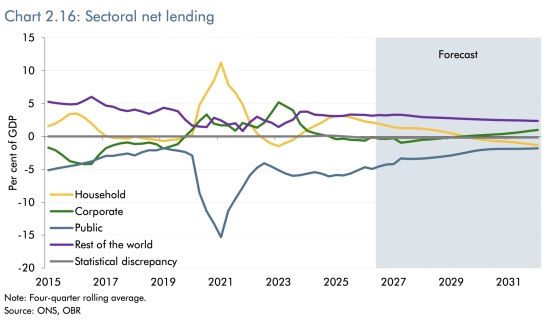
There are four lines on it, well, plus one tiny one, which is for differences, but we'll ignore that one. And what they show is that the figures above the horizontal axis, the x-axis, are equal to the figures below the horizontal axis, that x-axis, and that must always be the case.
Now, ignore the forecasts, which are the shaded area on here, and look at the figures to the left of the chart. They show history and just note how things move. The balances might move up and down, but they always add up to zero.
So what does this mean? It means that when government spends more than it collects in tax, it's in deficit. And as you will note from the chart we've just looked at, that is almost always the case in the UK. In fact, it has been almost always the case in the UK since the Second World War.
So what does this mean? Let's put this in context. When the government spends more than it collects in tax, it is in deficit. That means it adds money to the economy, and this is what it has done in almost every year since World War II, and it has done in every year this century.
Households and businesses can keep that money that the government spends in the bank or in government bonds, which work like a government savings account. They can save. The government is in deficit. And if households and businesses both save and sometimes they have, and the overseas sector saves, the government has absolutely no choice but to borrow as a result.
Let's be clear about that. The government has no choice but to borrow if everybody else decides to save. That is the way our financial system works, and the government, as the creator of our currency and what is called the borrower of last resort, has to run a deficit as a result.
Why is it a borrower of last resort? Because when we save, somebody borrows our money, and when everybody saves, automatically those funds end up in the government sector through deposits at the Bank of England, and the government runs a deficit.
This means that government deficits are very largely not under their control, nor are they automatically a problem. They are just the residual of other parts of the economy making totally rational decisions.
And this can be demonstrated with a few numbers. Suppose the overseas sector has a surplus of £20. Suppose households try to save and they have a surplus of £15. Suppose businesses borrow to invest, because that's what they do, and so they have a deficit of £5, and the government has a deficit of £ 30 as a result.
Add those numbers up: £20 plus £15 less, £5, less, £30, and the answer is £0.
Households are saving, and businesses are borrowing. The government is in deficit. The overseas sector is saving with us, and the economy is in balance.
When the government talks about balancing its books, it always does. This is a matter of fact, and that is what the sectoral balances show. The books are in balance.
If the government doesn't like that balance, it can try to change it. So let's look at another example. Suppose the government cuts its deficit to zero by spending less or raising more tax. This, of course, is the consequence of something called austerity, and I've talked about that many times on this channel.
The overseas surplus is still £20. We don't really control people from overseas and how much they choose to save here. But we can rearrange the other sectors in the economy as a result. So households and businesses must now be £20 in deficit because the government is neutral and the overseas sector has a surplus. Households and businesses therefore have no choice but to run a deficit. That is what the economy ordains that they will do.
Suppose that each of them has a deficit of £10. Now they are borrowing by that amount. So run through the figures again. The overseas sector is in surplus by £20, less a £10 deficit in the household sector and a £10 deficit in the private business sector. And a neutral outcome with the government and the figures overall balance. They add up to zero.
But households have moved from saving £15 to borrowing £10. The fact is, when the government decides to clear its deficit, it doesn't actually change the overall need for a deficit within the economy. If anybody is saving within the economy, somebody must, by definition, have a deficit. If the government decides it won't have one, and that is what neoliberal politicians claim they desire, somebody else must be in deficit instead.
A neutral government financial position, represented by having no borrowing, means that because we always have an overseas surplus in the UK, households or businesses must run deficits. And let's be honest, most of the time businesses have more control over their financing. And because the government having a neutral outcome will mean that more tax is paid, households will inevitably pay more by way of tax as a consequence, and will be in deficit as a result.
It will be very rare for any balanced budget in the UK to produce any other outcome than this. All that the government has done is something very straightforward. It has shifted its deficit onto households or businesses. It has reduced the well-being of both, and nobody is better off because, let's be honest, nobody gives a damn about whether the government balances its books or not, and the overseas sector won't react to that fact at all.
So all that will happen if the government tries to clear its deficit is that it will make everyone else in the UK worse off.
Every pound saved does then require someone else to borrow it. That is the fundamental lesson of the sectoral balances.
Not everybody can save at once. That is an impossibility.
Somebody must always be in deficit if somebody else is in surplus.
Double-entry accounting and the way in which our monetary system works absolutely requires that.
And in the UK, let's come to the obvious conclusion. If someone must be in deficit, the best person to be in deficit is the government. Why is that? Because they are then injecting new financial wealth into the economy, which will keep it functioning and indeed will make it grow, and at the same time, make people feel better off.
If it tries to remove its deficit, it will make people feel worse off. It will shrink the size of the economy because people will have less to spend. It might even reduce its tax take as well, making that objective harder to achieve.
The point is, when you understand the sectoral balances, you realise why the objective that so many politicians have created for the economy of a balanced budget is just about the worst thing that they can talk about.
We should stop obsessing about the so-called UK national debt, because as the sectoral balances prove, it's just other people's savings, and other people's savings are generally quite good things.
So let's move on. Let's stop this focus of attention. Let's understand that this is reality, and even necessary, and let's talk about what is important in our economy, which is meeting people's needs. That's what understanding the sectoral balances is all about.
That's what I think, though you may disagree. There is a poll down below, but there's something more important down below as well, which is a list of all the videos in the Understanding Economics series. And you might want to take a look at them. They will help you understand economics in a way that I think will be beneficial to you. You will see the world in a different way, and that will, I hope, improve your well-being.
Poll
Thanks for reading this post.
You can share this post on social media of your choice by clicking these icons:
There are links to this blog's glossary in the above post that explain technical terms used in it. Follow them for more explanations.
You can subscribe to this blog's daily email here.
And if you would like to support this blog you can, here:

 Buy me a coffee!

