
Why do we pay tax? Most people believe taxation exists to fund government spending. But what if that is not actually its primary purpose?
In this Understanding Economics video, I explain why tax plays a much more important role in our economy and society than simply raising money for the government.
As a heterodox economist who approaches economics through modern monetary theory, I argue that the UK government creates money when it spends. It does not need to collect taxes before making payments. This raises an important question: if tax does not fund government spending, why do we need it?
I explain the six reasons for taxation and why each matters.
First, tax gives money its value by creating demand for the currency that the government issues.
Second, taxation helps control inflation by withdrawing money from circulation.
Third, tax can reduce inequality by redistributing income and wealth, creating a fairer society and limiting the concentration of economic power.
Fourth, taxation can discourage harmful activities, including pollution and excessive alcohol consumption.
Fifth, tax reliefs and exemptions can encourage socially beneficial activities, including investment, education and charitable giving.
Finally, taxation helps manage the economy as a whole. Governments can adjust taxes to influence demand, support employment and respond to inflation or recession.
These six purposes show why taxation is one of the most powerful economic tools available to government.
Tax is not simply about collecting money. It is about shaping the society we live in, influencing economic behaviour and making our economy work for everyone.
That is the argument I developed in my book The Joy of Tax, and it remains central to how I believe we should understand economics.
This is the audio version:
This infographic supports this video:
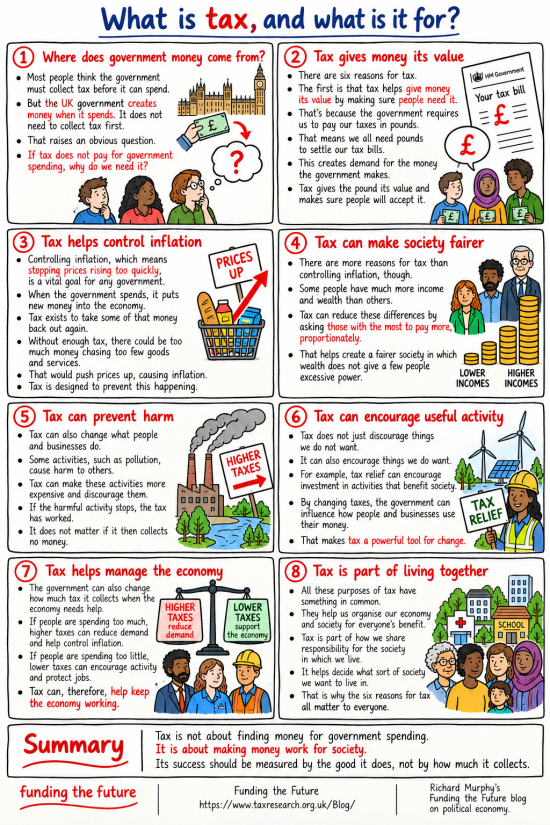
This is the transcript:
Hello, I'm Richard Murphy, and this is Understanding Economics. That is the series of videos that I'm making, which explains economics in the way that I see it. Now, this is a personal view, and I do not represent the mainstream of all economists. I'm called a heterodox economist. That means I'm outside that mainstream. I look at the world through the lens of modern monetary theory.
But I also look at it through another lens, and that is my lived experience: my work as a chartered accountant, my work as a campaigner, my work as a university professor, and none of that says that the explanations of economics that are supplied by textbooks, by most university professors, and by most commentators, do in any way represent the way in which the world really works.
So Understanding Economics tries to present an alternative view of how the world works.
And in this video, I want to talk about a subject which has been dear to me throughout my life because I want to talk about tax, and at one time, I specialised in tax as a chartered accountant.
Most people think the government must collect tax before it can spend, but the UK government creates money when it spends. It does not need to collect tax first. This raises an obvious question: if tax does not pay for government spending, why do we need it?
There are six reasons for tax inside the UK economy and inside most economies around the world. I'm stressing that point. I'm talking about the UK here, but the argument is one that travels around the globe.
The first reason for tax is that it helps give money its value by making sure that people need to use it. And that's because the government requires us to pay our taxes in pounds. That means we all need pounds to settle our tax bills. This creates demand for the money that the government makes and spends into the economy whenever it buys something from us or makes a payment to someone.
My pension payment becomes a pound inside the economy. That creates the money that is then used to pay tax bills. Tax then gives the pound its value and makes sure that people will accept it.
That is a key role for tax, and there is another key role for tax as well, because that is that tax helps control inflation.
Controlling inflation is a vital goal for any government. It means it tries to stop prices rising too quickly. A small amount of inflation does very little harm to an economy. Rapid inflation, where price rises create instability, are undoubtedly economically harmful.
And when the government spends, it puts new money into the economy. This is a matter of fact. There's no point debating it. It's what happens every day. And tax exists for a very particular reason. It creates a debt that is used to take some of that money that the government has created back out of the economy again.
Without enough tax, there could be too much money in the economy chasing too few goods and services. That would push up prices, and that would cause inflation and tax is designed to prevent this happening, and it works.
Let me give you an example. From 2010 to 2020, we had very, very low interest rates in the UK economy, so low that they could not influence the inflation rate and yet we also had stable inflation. That means that tax was doing the job that I'm talking about here. It took enough money out of the economy, that had been created by way of government spending, to ensure that prices remain stable. Tax does control inflation.
And tax can do something else. It can make our society fairer. Some people have much more income and wealth than others inside our society. Markets always deliver that outcome. And tax can reduce these differences by asking those with the most to pay more proportionately to what they own or what they earn. And this matters too.
Inequality creates stress in our society and injustice, and asking for more tax from those with the greatest ability to pay produces a fairer society with a more level playing field in which everyone can then partake in the world around us. That is what is essential to create justice, but it also prevents a few people gaining excessive power in this country.
Tax can also prevent harm. Tax can change what people and businesses do. Some activities, such as pollution, cause harm to others. Others that we can partake in, such as excess drinking of alcohol, can cause harm to ourselves. Tax can make these activities more expensive and discourage them.
If the harmful activity stops, the tax has worked. Raising money here is not the goal. The aim is to change behaviour, and that is something that is really important to understand about tax. The collection of money is not the sole purpose of tax. It is as much about how it changes the way the economy or our behaviour works. And that is why tax is so important.
Tax can also encourage useful activity. It doesn't just have a purpose to discourage things. We can encourage things we want people to do. There is no VAT, for example, on newspapers. There is no VAT on books. There is no VAT on healthcare. And all of these things are without tax charge because the government wants us to enjoy them.
And in addition, tax reliefs can be provided to encourage investment in activities that benefit society, or they can be given to encourage things like donations to charity. By changing taxes, the government can influence how people and businesses use their money. It can become a powerful tool for change, a tool for change for the better.
And tax can also help us manage the economy. Here I'm talking about the economy as a whole, rather than individual behaviours, which is what I've been talking about to date. The government can, by changing the overall level of tax that it charges within the economy, change the level of economic activity within it.
If people are spending too much within the economy, meaning the ‘animal spirits' are too high, as Lord Keynes once described them, then tax can be used to reduce demand and help control the inflation that will arise in this situation.
Alternatively, if people are spending too little and we are heading for recession, then lower taxes can encourage economic activity and protect jobs.
Tax can therefore help keep the economy working at times when it is overheating and times when it is under stress, and both matter.
So tax in all these six situations is something that helps us live together. Tax reminds us that we have something in common. It helps us to organise our economy and our society for everyone's benefit. Tax is part of how we share responsibility for the society in which we all live. It helps us decide what sort of society we do in fact want to live in. That is why the six reasons for tax all matter to everyone, and that is why I say that tax is the most powerful instrument available to our government to shape the society we live in. That is what I called the Joy of Tax, which was the title of a book I once wrote.
Tax is not about finding money for government spending. It is about making money work for society. Its success should be measured by the good it does and not by how much it collects. But that means we need to reappraise everything we think about tax from the moment that we start the whole process, and understand that tax does not fund government spending - the government does that itself - and tax has a very different role to play in the society and the economy of which we're a part, but where it can do powerful things for the common good.
That's what I think about tax. You may think something different. The point is, this is something we need to discuss and that's the purpose of this Understanding Economics series. Down below, there's a playlist with all the videos in this series, in it. Take a look, listen to some of the other videos. Try to understand economics. That's what this series is about. If you do, you'll be able to understand the world around you better, and that is my goal.
Poll
Thanks for reading this post.
You can share this post on social media of your choice by clicking these icons:
There are links to this blog's glossary in the above post that explain technical terms used in it. Follow them for more explanations.
You can subscribe to this blog's daily email here.
And if you would like to support this blog you can, here:

 Buy me a coffee!

