
Is France showing us that neoliberalism is beginning to fail? As protests against austerity grow, financial markets are demanding spending cuts while ordinary people are demanding better public services and greater economic security. I argue that this conflict could determine the future of European politics and economics.
In this video, I examine how neoliberalism became the dominant economic ideology of the past 45 years, why its influence is now being challenged, and what might replace it.
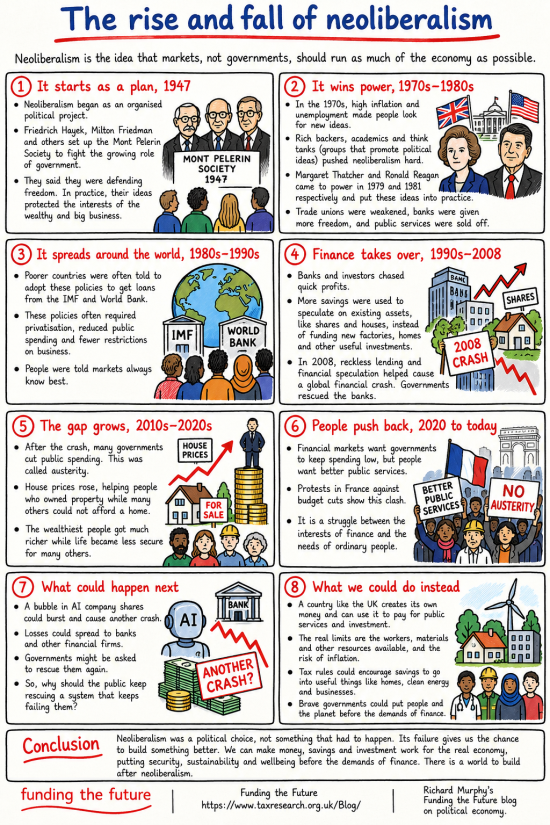
The story begins in 1947 with Friedrich Hayek, Milton Friedman and the Mont Pèlerin Society. Their ideas were subsequently promoted through think tanks, wealthy supporters and financial institutions before becoming central to the economic policies of Margaret Thatcher, Ronald Reagan and the Washington Consensus.
Neoliberalism promised that markets would allocate resources more efficiently than governments. But I argue that this ignored inequality, environmental damage and the unequal power of those participating in markets.
Instead of delivering prosperity for everyone, neoliberal policies have encouraged privatisation, deregulation, financial speculation and the concentration of wealth. Productive investment has increasingly been displaced by financial extraction, while wages have stagnated and economic insecurity has grown.
The protests in France, and growing discontent elsewhere in Europe, reveal the consequences of this system. Governments continue to prioritise the demands of financial markets while many citizens experience deteriorating public services and declining economic security.
I also examine Thames Water as an example of the conflict between financial interests and public need. Should the government prioritise the claims of creditors, or the essential services on which millions of people depend?
Looking ahead, I consider whether a future financial crisis, potentially triggered by an AI investment crash, could expose the weaknesses of the neoliberal economic model.
But there is an alternative.
Modern monetary theory helps explain why governments that issue their own currencies are not financially dependent on markets in the way politicians often suggest. Meanwhile, reforms to pensions and ISAs that I have proposed could redirect savings away from speculation and towards productive investment.
I argue that we could create an economy focused on public services, housing, infrastructure, economic security and environmental sustainability rather than financial extraction.
Neoliberalism is facing growing resistance. The question is whether governments have the courage to replace it with something better.
This is the audio version:
This infographic supports this video:
This is the transcript:
Is France now showing us that neoliberalism is failing? The French government is facing growing protests against austerity, and financial markets are demanding spending cuts from that government and debt stabilisation. The government meanwhile claims it cannot afford to meet the French people's demands of it, and this is creating a conflict between the interests of financial capital and ordinary people in France.
And it's not just in France. Let's be clear about that. There are protests in Italy, in Spain, in Tirana, in Albania and elsewhere. The fact is, there is a growing disquiet with neoliberalism, and this conflict could determine the future of our economies, politics, and even the EU if France is left with no choice but leave it because it needs control of its own currency.
So this matters, but the question is: how did neoliberalism become so powerful that this crisis has become the one that defines our moment in history?
Way back in 1947, Friedrich Hayek and Milton Friedman, plus others, around 20 in all, established what was called the Mont Pèlerin Society. Why was it called that? Because they met for the first time in that year in a lodge below the mountain in question in Switzerland. They wanted to challenge social democracy and defend the interests of capital.
Their big concern? That socialism was going to sweep away what they thought were the gains of World War II, and they wanted to restore the power of capital and defeat the rise of what they saw as socialism, and even communism, but which was, in fact, social democracy and the post-war settlement that brought riches to so many around the world.
Think tanks and wealthy supporters promoted their ideas internationally. Margaret Thatcher and Ronald Reagan brought neoliberalism into governments in 1979 and 1980, building on the groundwork laid in places like the UK by the Institute of Economic Affairs.
And the Washington Consensus was then created by the International Monetary Fund, the IMF and the World Bank to spread the ideas of neoliberalism around the world.
So what did neoliberalism actually change?
It claimed that markets allocated resources better than governments, and as a consequence, it said that markets should dominate our economies and government should basically butt out. The claim did, however, ignore some very significant issues.
One was that we need government to set the rules of the game to establish markets, to provide the money that is used to ensure that markets can operate and to deliver fair play through courts and other mechanisms.
It also ignored the fact that markets do not take into account what are called externalities in economics. That is, the costs that are not priced when you pay for something. Things like pollution, things like the health impacts of smoking.
And inequality was also ignored. What does that mean? It assumed that everybody had equal power in the marketplace, but very obviously they don't. Those with high incomes and wealth have many more votes in the marketplace than do those who are on low income because they have less to spend.
As a consequence, the so-called claimed optimal allocation of resources that neoliberalism promised was anything but that as a result, as should have been obvious to anyone with an open mind.
But even so, the demand was made that governments should get out of the way of markets. They should privatise industries. They should deregulate and reduce taxation, especially for the wealthy. And trade unions were most deliberately weakened, and manufacturing capacity was often destroyed in the process, whilst the postwar social safety net came under pressure. Social security costs were always one of the first things to be reduced whenever a neoliberal government came into power.
Financial capital was meanwhile granted greater freedom to pursue returns right across the world, and the tax haven world grew as a consequence. There was a direct link between the two. The interests of capital increasingly took priority over the needs of society.
So why did finance become more important than investment in that case, because that was one of the consequences of neoliberalism?
Financial markets increasingly prioritised short-term financial returns under neoliberal thinking. Speculation became more attractive than investment in productive activity because it could yield a return quicker than actually doing something. Savings were increasingly used to trade existing financial assets and property. And rising asset prices created the illusion of financial wealth without there being any equivalent new productive capacity within the economy that could deliver financial well-being to people who had to work for a living.
And this resulted in a disconnect between savings and investments in the real economy. Money that was saved in pension funds and elsewhere was not used, as it had been in previous generations, to actually provide the capital for productive capacity. It was instead used for financial speculation in the City of London, on Wall Street, and elsewhere, and financial extraction increasingly displaced the creation of genuine economic value.
For those who gained, the gains were really big, and they controlled the show so it continued despite the losses to others.
So who did benefit from neoliberalism, and who lost? Financial wealth became increasingly concentrated amongst relatively few people. This is a trend that we have seen over time. Rising property prices rewarded asset owners, but excluded many wage earners from ever getting near home ownership. Inadequate productive investment weakened the foundations of future prosperity. We are now seeing the consequences of that, and wages stagnated as a result.
The social safety net offered less protection against economic insecurity, as a matter of neoliberal policy, and that insecurity was increased because of reduced labour protections, for example, in regulation around the world.
There was, as a consequence, the rise of what Guy Standing calls the ‘precariat', people whose lives are on the financial edge at all times because they do not have the resources to ensure that security is within their reach. Society became divided between those with capital and those facing insecurity.
So, why is neoliberalism now facing growing resistance? I mean, this issue has been going on for decades, so what's the point at this moment? And that is that the inequalities and insecurity created by neoliberalism are becoming increasingly unsustainable. Financial markets are continuing to demand returns from economies they increasingly dominate. Governments are responding by trying to restrict public spending, and by imposing yet more austerity, as if that to date has not delivered when all it has created is misery. And people are increasingly rejecting the consequences for their lives and public services.
The protests in France reveal this conflict between people and capital. This is nothing less than class warfare as a result. Those who own capital won't call it this, but Warren Buffett once did, and he was, at the time, I think, the richest person in the world. He said there was class warfare going on in the world, and he said the class who was engaged in it was his: those who owned capital. That's still true, and people have now rumbled this. The political legitimacy of neoliberalism is increasingly being challenged. That's what's happening at this moment, and that's why we're getting rioting.
So who should control the services on which people depend? Thames Water in the UK provides an example of the conflict between finance and people. It's a failed privatisation that has left this company, which supplies water to around 10 million people in the UK, facing enormous financial problems. Creditors want to protect their financial claims on the business. Millions of people depend upon the water that it provides.
The UK government has a simple decision to make, and yet they are making it out to be very complicated. They must decide whether financial claims or public need, literally to the water that is necessary for survival, must take priority in this case. You wouldn't have thought it was a very difficult decision for any government to make, but ours has dithered. And Andy Burnham arrived in office saying he was going to deal with this issue, and so far we see no sign that he will.
The fact is that whatever the legal claims that exist around this company are, the government has to override them. Water comes first. People's needs have priority. The interests of financial capital very definitely come last in such a situation, whatever they might like to claim, and if the law does not say that, the law needs to be changed. A courageous government would see this, and it would put essential services first. But is that what we will get from Andy Burnham? I genuinely don't know.
But the bigger question is, does this then precipitate a new world that will come after neoliberalism? Is there a financial crisis to come, which is going to result in the change that 2008 did not deliver? Will Gramsci's promise that the new age will be born finally be realised?
Financial speculation has created enormous claims on future economic returns. An AI investment crash could expose the fragility of those claims. Losses could spread through hedge funds, private equity, secondary banking, and all of financial markets. And banks could then face another crisis as speculative investments fail. I don't think the crisis will start in the banking system this time. I think they will be the victims of it, and we will once again, through our governments, be the people who pick up the mess.
Governments should then expect to rescue the financial system again sometime soon, quite probably in 2027. And another bailout would rightly raise the question of why this system should survive. But the real question then is: does it need to do so? And the answer is, of course, it doesn't. If governments realise that they are not dependent upon financial markets for money, they could liberate themselves from the claims that those markets make upon them.
The reality is that governments issuing their own currencies have the power to create money, and as a matter of fact, that's what they do day in and day out. As a result, they do not need financial markets to provide the money that they spend. The real limits on government activity are labour, resources, productive capacity, and the environment, of course.
Inflation can arise when spending exceeds what the economy can supply. We have to take that into consideration in macroeconomic management. And any government that does not is reckless, and I will make that point loud and clear. But a government could manage these constraints rather than accept artificial financial limits, like fiscal rules, debt-to-GDP ratios and more, which have not delivered well-being, which is my critical point.
Understanding money makes a different relationship with financial markets possible. Dependency could be broken, and the money to create change is available. The government can fund its own spending, but what about investment? For decades, we have seen savings being directed into speculative behaviour in financial markets. But what would happen if those savings were redirected towards productive investment?
Tax incentives already influence where enormous amounts of savings are invested. Around 80% or maybe slightly more of all savings in the UK are in tax-incentivised arrangements like pension funds and ISAs. Those incentives could be changed to encourage socially useful investment. Saving could cease to be used for pointless speculation and could instead become the support for investment in housing, infrastructure and sustainable economic activity. Savings could, in other words, be reconnected to capital as economics once said they were, but which it has long forgotten to adhere to.
We could recreate a proper capital base for society organised socially so that your savings, my savings, could be used to fund the necessary investment mechanisms that could transform our societies simply by reorganising how ISAs and pensions work. This would reconnect savings with the creation of real economic wealth. You could be a part of this process of building our future. This, to me, is how we'd replace neoliberalism. The objective would be sustainable prosperity rather than speculative financial returns.
So could this replace neoliberalism? The answer is yes; I think it could. Neoliberalism has obviously failed. Governments with the power and understanding that they can create money can meet genuine economic needs. There is no constraint on them doing so once they realise they are free of the power of financial markets, while savings used as capital can create the investment that provides for lasting social value. Public services, economic security and environmental sustainability could then become our priorities. But achieving this requires a courageous government willing to challenge financial power.
The economy must serve the well-being of people and not the extraction of financial wealth, and that is the key point that I'm making. Neoliberalism has reached the point where the extraction of financial value is the only thing it knows how to do. But that is of no benefit to most people, and it is literally eating our economies. We are left in despair. Our politicians are, at the moment, walking around like headless chickens. We need a new system based upon the power of the government to use the money it can create and the power of our savings to become the capital for a better future, and if we had that, we could replace neoliberalism. We could have the future we need and deserve, and which, most especially, our young people are right to demand.
That's my opinion. What do you think? There is, of course, a poll down below. Let us have your comments. Please do like and share this video. Please do make a donation to our work if you think it's important. And please do have a look at the playlist down below because they will provide you with more information on what we are doing and the subjects that we tackle. You should find something there which is of real interest to you if you've got this far through this video.
Poll
Thanks for reading this post.
You can share this post on social media of your choice by clicking these icons:
There are links to this blog's glossary in the above post that explain technical terms used in it. Follow them for more explanations.
You can subscribe to this blog's daily email here.
And if you would like to support this blog you can, here:

 Buy me a coffee!

