
Britain is one of the wealthiest countries in the world, with more than £12 trillion in financial wealth. So why are wages stagnating, public services struggling, housing becoming increasingly unaffordable, and millions of people feeling poorer?
In this video, I argue that Britain's economic problems are not simply the result of recent crises. They are the consequence of decades of political and economic decisions that have prioritised financial extraction over productive investment.
Britain has consistently invested less than other major developed economies. In 2024, total investment amounted to just 17.9% of GDP, the lowest proportion in the G7. That means we have failed to invest adequately in the infrastructure, technology, skills, housing and public services needed to create lasting prosperity.
I examine the evidence showing how both business and government investment have fallen short, leaving Britain less productive and less economically resilient than it should be.
At the same time, our economy has increasingly rewarded financial extraction. Interest, rents, fees, dividends and speculation have generated financial returns without necessarily creating the productive assets or public benefits that society needs.
Privatisation has compounded these problems. Essential services such as water, energy and transport have been operated to generate private financial returns, often at the expense of investment, affordability and service quality.
Meanwhile, rising property prices and financial asset values have benefited those who already own wealth, while people dependent on wages have experienced much weaker improvements in their living standards.
I argue that these outcomes were not inevitable. They resulted from political choices that successive governments could have made differently.
Britain has the people, skills, knowledge and resources to achieve much more. But prosperity requires productive investment, fairer distribution of economic rewards and a government willing to challenge the interests benefiting from the current system.
This is the first of two videos examining Britain's economic problems. Today, I explain why we are poorer than we should be. In tomorrow's video, I will explain what we can do about it.
This is the audio version:
This is the transcript:
Why are we so much poorer than we should be? Britain is one of the world's wealthiest countries. It probably ranks around sixth in the world at present, and we have more than £12 trillion of financial wealth in the UK. And yet, wages have stagnated. Public services are struggling, and housing is increasingly unaffordable and of poor quality in far too many cases. Millions of people feel that their living standards are declining, and this is not simply the consequence of recent economic crises.
Something has gone fundamentally wrong with the way our economy works in the UK. What was that, and what can be done about it? This is the first of two videos on this theme. One is this one, and the other will be out tomorrow. I'm not going to set up a problem without an answer. This one is about the problem. Tomorrow's is about the answer.
And the fact is that Britain's economic problems have developed over decades. We've failed to invest enough in the foundations of prosperity in this country. That is the basis of the problem that we now have. And instead of investing, we have increasingly rewarded financial extraction rather than productive activity. Whilst privatisation has allowed private interests to profit from essential services.
Growing inequality has concentrated wealth while leaving many people struggling because there is insufficient good-quality work to do. And these are all connected problems and not separate economic accidents.
The reality is real productive investment is essential to creating a prosperous economy. And I stress that is true even if we are talking about a sustainable economy. You can't build a sustainable economy without building the infrastructure on which it depends. Now, businesses need modern equipment, technology, and skilled workers, and we also need public infrastructure from education to healthcare, to functioning legal systems, to transport systems, to energy transmission systems, and more.
But Britain has consistently invested less than comparable developed countries. In 2024, total investment in the UK was just 17.9% of GDP, the lowest proportion in the G7. What does that mean in real terms? It means that we only spent just over £1 in every £6 that we had available to us in our economy on investing in the resources that would build the foundations for our future prosperity. And that persistent weakness has undermined our economic performance.
Investment figures reveal a long-term economic failure in this country.

This chart shows investment in the UK by businesses - that's the red top line - and government - that's the dark bottom line. And the period covered by the chart is 1997, when Labour came into office, until now. And the fact is that, as you can see, business has, in general, reduced its level of investment over this period. For every incentive that they have demanded from government, for every tax change that they have said they need to encourage investment, nothing has happened. We haven't seen businesses investing in this country. And whilst the government has increased its investment overall during this period, one of the reasons why that looks to be improved is because GDP has flattened.
The consequence is we are heavily underinvested. Government investment provides infrastructure and essential public services, except it isn't. And business investment provides equipment, technology, and productive capacity, except again, it isn't. Because both are inadequate, we are not growing as politicians demand. We are not delivering the future that we need, and that is the problem.
And very clearly, our government has not responded as a consequence. The international comparison makes this clear.
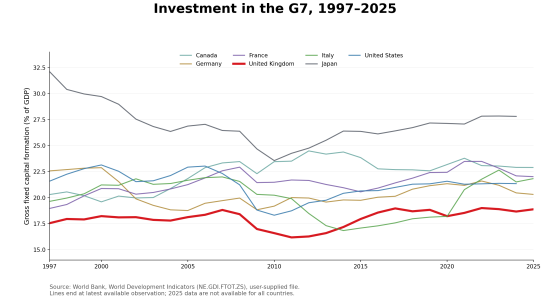
The data on this chart is for the same period of time, 1997 to essentially today, 2025 in reality. And we are that bold bottom red line on this chart. The other lines are for the other G7 countries, the leading economies in the world, and we're at the bottom and not by chance.
We underinvest. We've even been beaten by Italy in most years. That green line, which for a period dropped below us, between 2015 and 2020, is Italy. Otherwise, they've outperformed us, as has every other country. The top line is the USA. It invests so much more than we do. It's unsurprising that it has grown faster.
And there's no way we can keep up, and there's no way we can maintain our growth to match the performance of these countries if we do not invest. That is my simple message. The data shows we are poor, and we're poor as a consequence of our own choice.
And that's also because in the UK we have pursued a particular form of neoliberal thinking. Financial extraction has become a major feature of the UK's economy, as has a lack of real investment. The lack of real investment has been shown by the charts we've just looked at. But let's be clear, we have failed to create anything which matches that of other countries. But meanwhile, we've allowed existing assets to be churned, exploited, refinanced, and generally extrapolated from so that interest, rents, fees, and speculation have created the illusion of growth, but there hasn't been real wealth to back up that illusion.
That is what extraction is all about. It creates financial assets, but it doesn't create anything that produces real wealth. That is the problem of the British economy in a nutshell. We might have a rich financial sector, but we do not have a more prosperous society, and the stress is showing.
And privatisation is symptomatic of this. Privatisation was put in place by a government that believed that the creation of financial wealth was its priority. That is what Margaret Thatcher brought into the UK and spread around the world. And everyone thereafter has followed her pattern, every Labour government included.
Utilities, transport, and other essential services have all been transferred into the private sector, but that has allowed extraction to take place. Through excess profits, overpricing, high dividends, and other financial returns in the form of interest paid to overseas financiers in the majority of cases. And those demands have conflicted with affordability, service quality, and vitally, long-term investment. And we have seen the consequences.
Water demonstrates it. We have had no investment in the water infrastructure we need, and the consequence is all around us. Weak regulation has allowed monopoly power to increase the costs households face. And the reality is we've chosen profit over investment, the short term over the long term, and now we are poorer as a result.
And that has another consequence, and that is rising inequality, which compounds the consequences of these economic failures. Property and financial asset owners have benefited from rising asset values, but most people who are entirely dependent upon wages have experienced much weaker financial progress. And housing cost transfers have created substantial incomes for those who provide mortgages and landlords who provide properties to tenants. But at the same time, the value, the real value, of our housing has probably declined because its quality has fallen. We haven't even invested in what we need in this essential sector.
Economic growth means little to those who receive few of its benefits, and the reality is that in the UK, the benefits have gone to a few and the majority have missed out. And that is key to our understanding because it is government policy that has let this happen.
Let's be clear: none of this happened by chance. Successive governments have prioritised financial discipline over sustained public investment, and they have assumed that private ownership will make good for their own shortfalls in investment, but they haven't. They've treated financial market confidence as being their central economic objective. They haven't treated financial market substance in the form of additional investment as the thing that they must expect to get in exchange for the benefits that they have provided to markets. And these political choices have influenced how resources and rewards in the UK have been distributed.
But the resulting economic weaknesses were not inevitable. They were the result of our choice to follow an extractive form of neoliberalism, and we are now paying the price. And the important point is this: Britain could still choose a different economic strategy. The government could invest in housing, infrastructure, education, and healthcare. It could regulate finance to encourage productive investment and limit extraction. It could reform its taxation system to reduce inequality and discourage excessive concentrations of wealth. Public ownership and stronger regulation could still protect essential services.
The real challenge for government is in mobilising available resources while managing inflation, but the government has not chosen to accept that challenge. That's the basis of the crisis that we still face. And our further economic decline is not inevitable. I cannot stress that enough. We have the people, the knowledge, and the productive potential to achieve so much more in this country. We do not need to be poor, in other words.
But prosperity requires investment rather than continuing financial extraction. It also requires an economy that distributes its rewards more fairly. Government must be willing to challenge the economic interests benefiting from the status quo. We are poorer than we should be because of choices that we can change. That is the vital point.
So the question is, will they be changed? Will John Healey tackle this hierarchy of power that has created this outcome in his budget on October 28th? We do not need to be poor. We do not need to be as poor as we are, but will he do anything to change that?
That is my question. There's a poll down below. You might disagree with me. If you do, let us know. If you agree with me, let us also know, because we appreciate that. Please do like and share this video, and please do watch tomorrow's video, where I will explain what could be done about this.
In the meantime, subscribe to the channel, hit that bell button, and if you'd like to make a donation to support our work, please do, and please do something else as well. There are playlists down below this video. Have a look at them because they will provide you with more information and access to more videos on the topics we're talking about here.
Poll
Thanks for reading this post.
You can share this post on social media of your choice by clicking these icons:
There are links to this blog's glossary in the above post that explain technical terms used in it. Follow them for more explanations.
You can subscribe to this blog's daily email here.
And if you would like to support this blog you can, here:

 Buy me a coffee!


All net financial assets in the economy are created by government spending. We have designed an economy in which all of those net financial assets are funnelled directly to a very small group of people. This has been achieved in part by the government not creating enough money to fund the growth of the country over the last 4-5 decades, meaning much of it has been funded by bank money, issued with private liabilities + interest, to inevitably move more and more of that money in one direction.
Your article yesterday on Neoliberalism being the extreme ideology, along with Barry’s Economics latest video on the absurdity of “economics 101” have really provided clarity on the greatest trick of the mainstream economic thinking…to actually convince people that it was the moderate natural state and not a deliberate, extractive system designed purely for the benefit of wealth.
Thank you
Barry and I should interview each other…
Might a comparison with China, within an overall attitude/mindset of “optionality”, indicate ways to improve the socio-economic contexts of so many U.K. citizens?
Might such also bring the sustaining benefits of a more robust economy and, not least, a more valid democracy/polyarchy?
1) Most Chinese government spending is organised and spent at a local level
2) China welcomes local initiatives which “let a hundred flowers bloom”.
3) There is a firmly applied policy that homes are for living in, not for speculation.
4) In China money, credit and banking are a public utility.
5) “In the UK or the U. S., the banks tell the government what its going to be allowed to do. China does not do that. “You have a business, you run your business. We have the government. We run the government”. And they make sure to enforce that separation.” (From the current Michael Hudson blog which is well worth reading.)
6) China measures everything and so quickly identifies outperformance and underperformance.
7) It then uses the outprformers to raise the performances of the underperformers.
P. S Might the troubles in France indicate the dangers of unstated government policies of applying technical “Input Democracy” as a cover for Neoliberalism instead of a substantive “Outcomes Democracy”?
P. P. S. Estimated home ownership in China is some 96%: in the U.K. it is some 64/65%
P. P. S. China is far from faultless but might not accepting the “Iron Curtain” of the main stream media enable us to do better?
Vote? All the options are clearly true, but I have no idea how to rank them. Time to expel the money men – those who think accruing money is the point, rather than using it for public benefit.
We had years of Rachel Reeves, who was vastly under-qualified for the job,but now we have John Healey who seems totally unqualified.
I voted for privatisation, not because it is the most damaging, but wherever you look, private enterprise has a finger in the pie. Just yesterday, a damning report on supported housing run by private enterprise was published. That is beyond ridiculous.
Imagine a world where the only treatment available for ALL diseases, was bloodletting with leeches, repeated several times, if the patient didn’t get better, then followed by daily venesection for the really resistant cases.
That’s how government economics has worked since 1979. It’s literally lethal.
Agreed
From my viewpoint, I suggest the event, that eased the way for the rest, was privatisation. The rest then followed. But it is the correlation between energy use and gdp that shows where government policy let the privatised energy companies cemented the uk’s bottom position on your graph. Low cost and plentiful energy is the seedcorn for growth. High quality water is also essential.
I can find no fault with your assertions. Talk about ‘being had’. We’ve been had many times over.
What I find difficult to understand sometimes is how they got away with it? If the markets were truly magical and as beneficial as claimed, we would have seen some sort doubling of the benefits in terms of output would we not?. A proactive government plus a more liberated market? But what we’ve actually seen from what I can see is a just a sneaky straight forward change of who the data/economic output is attributed to. Who is generating the output has changed – not necessarily the output itself (initially anyway). And state input can be said to have shrunk or just used to prop up the facade. This change is nothing but….ideological. We were told that the state was a monopoly and it needed to be broken up. Now we have more monopolies than ever before – private ones. And now, there is not enough money in the economy for people to live as you point out.
There is one area that has grown exponentially as base or ‘real money’ has shrunk (as well as manufacturing). And that seems to me be to ‘debt’ – leverage for football teams, privatizations, mergers and nice fat fees This is something noted right back to Thatcher’s time in office. The public ‘debt’ (which is just money spent into the economy) is abhorred; but the debt and leverage from the City is celebrated. But like all real debt, it is less sustainable than real investment and manufacturing.
Going forward, we can only discover the joy of repetition and get the message over eventually by telling people this over and over and over again.
That is the rest of my life you just talked about.
But major media channels are calling today.
“Now this is not the end. It is not even the beginning of the end. But it is, perhaps, the end of the beginning” Nov 10th 1942, Mansion House, Churchill.
I like what you you do, thankyou. It’s fantastic. But I think your polls appear to be designed to encourage support for your beliefs, rather than providing a believable survey of others’ opinions. I think they could be designed to allow those that don’t agree with your position. It would involve being more aware of the arguments against your position. Thanks again, valuable work that we will all benefit from!
I try to always allow disagreement
I apologise if I fail.
I hadn’t realised how easy it is to get Google to generate graphs like this until I asked it for the Australian equivalent. Interestingly we have outshone even Japan for most of the period, but has this resulted in massive benefits for the general population?
The peak of over 32% was in the early 2000s when huge sums were invested in new mines and gas extraction infrastructure. The resulting iron ore is mostly sold to China, which we buy back for a much higher price as finished goods. Was there investment in steel processing and manufacturing at home. No.
Norway and Australia produce roughly the same quantity of natural gas but the Norwegian government owns a controlling share in their industry and collects around 20 times as much revenue as Australia does. Most of our gas revenue goes offshore instead.
For the rest of the period investment has been well above 26% for most of the time, but not in public housing, not in reducing hospital waiting times, not in improving the living standards of the unemployed and not in providing tertiary education, apprenticeships or university places that do not incur large debts. After a dip to 26% in 2021 the percentage has been over 27% yet in the same period the fastest growing cohort of homeless people has been single women over 50.
Government investment alone is not so easy to access but is given as between 3.5 – 6.5% over the period. Significantly above the UK figure, but not enough and/or not in the right places to make the differences that matter to the most needy of the population.
[…] watch my previous video on why Britain is poorer than it should be, and then watch this video for the answer. We could be richer. We just have to change our savings […]
Hi Richard,
Why are we poor? Because it seems we focus on the wrong thing, GDP and “growth”. There is too much focus on the distribution and movement of money – very convenient for the treasury which gets to tax transactions but tells us nothing about the wealth and financial health of the country. Recently there was talk about raising tax by increasing gambling taxes. All this will do is move money around, it doesn’t make the country more wealthy.
Our wealth comes from what we get out of the ground, the sea, the sun (or income from other countries) and how efficiently we do that. There are two elements; stocking the stores and then distributing the contents of the stores. There is too much emphasis on the distribution or at least no distinction between the two. If we want to be wealthier as a country then we need to focus on stocking the stores as efficiently as we can.
Where is “stocking the stores” covered? I realised this is our “industrial strategy” except we don’t actually have one, there is a document but it’s pathetic and there is no drive in this direction. This is what we urgently need to address.
What say you Richard? Am I on the money?
I think you are right to argue that we need an industrial strategy, but I would challenge your distinction between creating wealth and distributing it.
Wealth does not simply come from extracting resources from the ground or sea. It comes from human activity that transforms resources, provides services, develops knowledge and meets people’s needs. Education, healthcare and care services all create value, even though they do not produce physical goods.
Nor is distribution irrelevant. Who receives income and wealth determines what people can afford, what businesses can sell and where investment takes place.
I agree that GDP growth is an inadequate measure of economic success. We should be asking whether people are better off, whether our productive capacity is improving and whether we are creating a sustainable economy.
That requires investment in skills, infrastructure, technology, public services and the green transition.
So I agree with your conclusion. We desperately need a serious industrial strategy. But creating wealth and distributing it fairly are not competing objectives. They are essential parts of the same economic strategy.