
Austerity was never necessary. It was a political choice, and Britain is still paying the price.
In 2010, George Osborne told Britain that the government had run out of money. Public spending had to be cut, he claimed, because there was no alternative. But was any of that true?
In this episode of Understanding Economics, I explain why the economic arguments used to justify austerity were fundamentally flawed.
The UK government is not a household. It creates money when it spends and uses taxation to withdraw money from the economy. That means the real limits on government spending are the resources available to deliver what society needs, not an arbitrary shortage of pounds.
I explain why cutting government spending during an economic downturn makes matters worse. Lower spending means fewer jobs, reduced incomes, weaker businesses and falling tax revenues. Rather than solving the government's financial problems, austerity can make them worse.
I also examine the consequences of austerity for the NHS, local government, public services, investment and economic growth.
Above all, I explain why austerity was a political choice, not an economic necessity.
The lesson is straightforward: governments should stop asking whether they can afford to act and start asking whether the resources exist to do what needs to be done.
The message is simple: If we can do it, we can afford it.
This is the audio version:
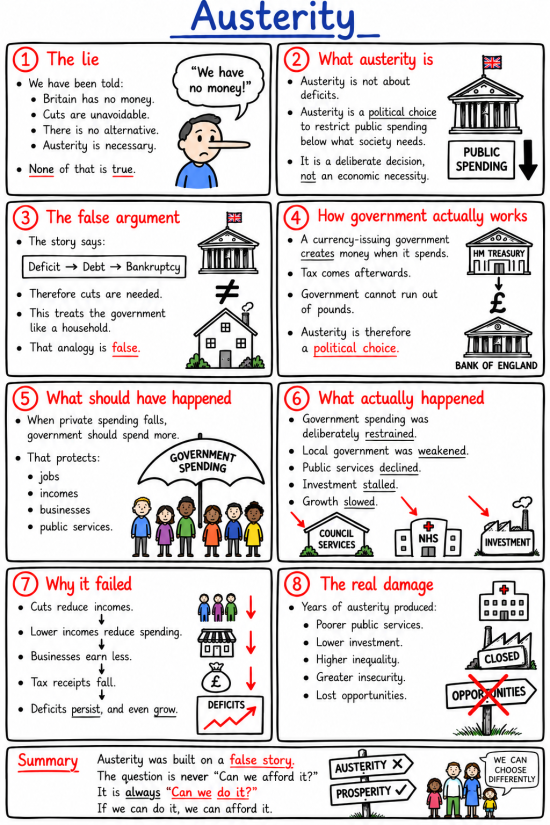
This infographic supports this video:
This is the transcript:
Hello, I'm Richard Murphy, and this is Understanding Economics. That is the series of videos that I'm making on how I understand economics, and I stress the I in that last sentence because I am a heterodox economist, and that means I do not see economics in the same way as the majority of economists do. I understand it through the lens of modern monetary theory, and this series is about how I explain economics in that light.
I believe the consequence is a form of economic understanding that is, well, simply better. One that is easier to understand, that matches what we see in the real world with the explanations that economics can supply. And that's why I think this series on understanding economics matters.
And in this video, I want to talk about something that really came to our attention from 2010 onwards. When George Osborne became the Chancellor of the Exchequer in the UK in 2010, when the Tories came into power with the Liberal Democrats in coalition government, he told us that Britain had no money and that public spending cuts were unavoidable.
He said there was no alternative to austerity. He quoted Margaret Thatcher when saying so, and he and his colleagues in government insisted that cuts were necessary to restore economic stability in the UK and the same arguments were used across Europe.
Portugal, Greece, Spain, and Ireland all saw these policies imposed by the European Union.
And the UK was not the only country where it was seen that had its own currency.
But was that claim that austerity was necessary simply untrue? Was it in fact the case that austerity was a political choice rather than an economic necessity? We need to understand austerity.
So what is it? Austerity is the deliberate policy of restricting public spending below what society needs. It is usually justified by claims about government deficits and debt. Politicians argue that governments must cut their spending because they say it cannot afford it. The government is heading into debt. The burden will fall upon our grandchildren. And austerity is then unavoidable if the government is to be responsible with regard to its finances. But, and I stress this point, austerity is a political decision about how society's resources should be used. And it is based upon a very particular and false interpretation of the way in which government finances work.
The argument used to justify austerity was fundamentally flawed. We are told that government deficits inevitably increase national debt, but that is not necessarily true, although it is in the very short term. And we were warned that rising debt could lead to national bankruptcy. But in the case of the UK, that is a technical impossibility and a practical one as well. And the supposed solution was to cut government spending.
The argument was that government finances work in the same way as household finances. But the government is not a household, and that comparison is false. The government can never manage its money in the same way as a household because a household must earn or borrow money before it can spend.
The UK government and those of many other countries, including, in effect, those inside the European Union, can spend money into existence when they undertake their planned activities. Whenever they make a payment, they create currency through their central banks.
Households cannot do that. They do not have their own banks to facilitate that operation. But a government like that in the UK, the USA, Canada, Australia, New Zealand, India, South Africa, and so many other countries does, and what that means is that the government is the creator of currency. Households and businesses never are.
But that also creates the need for taxation because taxation exists to withdraw the money that the government has created from circulation in an economy, and the purpose is to control inflation. It is not to fund government spending because that's already been paid for.
The consequence of this, though, is that no government in this situation can run out of pounds, dollars, yen, whatever else you wish to name as a currency, in the way that a household can. Its financial position is therefore fundamentally different from that of a person, a household, or a company, or even a subnational government like those in the UK, in our counties, and in Scotland, Wales, and Northern Ireland.
Understanding how government money works then blows the whole austerity narrative apart. Government spending is not dependent on first collecting sufficient taxes. A currency-issuing government can always make payments in its own currency, and that means that the government can always pay for its programmes if it so wishes, subject to one vital constraint, which is that there are resources available to fulfil the promise made.
You cannot promise more healthcare if you haven't got the doctors, nurses, hospital, porters, cleaners, and everybody else to deliver that service. But if you have, the government can always afford to put them to use. That understanding is critical. That is the actual essential economic point that we have to understand. Austerity and therefore the refusal to put resources to use, which is exactly what happened, was therefore a political choice and not an unavoidable financial necessity, nor was it economically rational.
So what should have happened when private spending fell after the global financial crisis in 2008, as it did because household confidence collapsed? When households and businesses reduced their spending, which is what happened, economic activity declines, of course. Businesses then faced falling sales, and many looked to reduce employment.
Now the government should have responded as the Labour government did in 2009. It increased spending, and it provided direct support to the economy. But when it lost the general election in 2010 and was replaced by a Tory government, that government claimed this was not affordable.
They drew a comparison with Greece, then in the European Union and in the Euro and in a dire situation, because it did not have its own currency. It could not create it because it was told by the European Central Bank that it could not. And the consequence was that Greece did face the threat of insolvency, but the UK was in nothing like that situation and could never be. And as a consequence, that analogy was completely false, and either George Osborne understood that he was lying to the country or he was incredibly stupid. Of course, both possibilities can exist together.
But the point was he should have been spending, and that spending would've protected jobs. It would've protected incomes. It would've protected businesses, many of which failed as a consequence of his failure to support them. And it would have protected public services. That spending would've been designed to prevent a temporary economic downturn from becoming a prolonged crisis. And we did actually get that prolonged crisis.
The government cut spending from 2010, and it continued to do so for years afterwards. Local government funding was cut most of all, weakening councils' ability to deliver services. The impact was seen most heavily in social services, support for vulnerable people, and the provision of social care. But we saw it elsewhere in education. We saw it in the provision of other types of public services, including those provided by councils: libraries, sports facilities, so much else, that built the relationship between people and government was abandoned.
And investment was reduced when the economy needed more of it. We gave up, for example, working on climate change when that was the time when we should have been doing it. Economic growth slowed, making recovery from the financial crisis harder. We had a decade of stagnation, not least because of low wage growth, and then COVID hit.
Austerity failed. And it failed because spending cuts damaged the economy. Cuts in government spending normally reduce most the incomes of those people who have the lowest income. And when they have lower income, and indeed, when everybody has lower income, households simply have less money to spend. That's a matter of fact, and it's obvious because households, unlike government, cannot create money out of thin air.
So when they have less to spend, businesses earn less. And, when businesses earn less, there is less economic activity in the economy, less employment and less investment. All of that means that we have lower economic activity, producing lower volumes of tax paid. And the government therefore cannot recover from its deficit position as a consequence of imposing austerity because the very act of cutting its spending reduces its income.
That is the difference between a microeconomic situation, which we as individuals live in, and companies as businesses live in, and a macroeconomic situation, which is what a government lives in. A government manages the economy as a whole. And if you reduce spending within the economy as a whole, that economy shrinks, and therefore the size of the tax take shrinks. And if you are trying to increase your tax revenues to reduce your overall deficit, you actually increase your spending.
That might be counterintuitive, but that is what you need to do. You need to put money into people's pockets to create an upward spiral in the level of activity in the economy, and it is that which reduces government deficits.
Everything in macroeconomics works the other way around from what most people think, and that is one of the key points in this Understanding Economics series.
So austerity created a self-defeating economic cycle. That is the issue with it. Because it cut incomes, it cut tax revenues. Deficits were not cleared. And in fact, in the decade after austerity began, the UK's overall level of national debt nearly doubled, from around £1 trillion to nearly £2 trillion, and by the way, it's now nearly £3 trillion. Austerity was therefore not just socially damaging, but economically flawed, and the consequence is more debt, the thing about which politicians were obsessed at the start of the day.
But the real damage caused by austerity went far beyond government finances. There is no problem with having debt of £3 trillion. It is just money deposited with the government by financial institutions who benefited from quantitative easing, quantitative tightening, and all the other processes that have gone on since the 2008 financial crisis.
The problem with austerity was the years of spending restraint that left public services poorer and less able to meet needs. And the impact was seen during COVID and since. The NHS was left vulnerable, and we saw the consequence. It did not have the PPE it needed. It did not have the intensive care facilities it needed. It didn't have the depth of resources that were required. It didn't have the resilience to manage a crisis.
And that was because lower public investment had weakened the NHS, as it had weakened so much else of the British economy. And greater insecurity affected people's ability to plan their lives as a consequence. Confidence has been lost. We have seen a rise in popularity amongst right-wing politicians as a result because people do not believe they have the resilience any more than they believe the government has, and all of this is a result of austerity.
Opportunities were lost because the government chose not to use available resources.
Austerity was then ultimately a choice about what sort of society successive Tory governments wanted, and Labour has done nothing to reverse the trend since 2024. They could have supported employment, incomes and public services. Instead, they chose to restrict spending despite the damage that followed.
That decision reflected political priorities rather than any financial necessity. I cannot stress it enough. There was no need for austerity throughout the period 2010 onwards. The consequences were experienced by people who depended, most of all, on public services, and those choices could have been made differently, and they still could be.
The lesson from austerity is that we must ask the right economic questions. The claim that Britain has no money was never a sound basis for economic policy, and it never will be. We have all the money we need if we have the resources to put to use in our society to meet people's needs. If those resources exist, government can put them to work. In that case, austerity makes no sense, and it never has.
The question should never simply be: can we afford it? Because we always can. The question is: can we do it? And the answer is: if we can do it, we can afford it. Those words were created originally by Lord Keynes, John Maynard Keynes, the greatest economist of the 20th century, but I will echo them now. Can we do it? If we can, we can afford it. That is what you need to know. And when it comes to austerity, that is the critical understanding that you need to have, which is why you will now understand economics.
If you want to understand more about economics and you've enjoyed this video, have a look at our playlist, which is down below this video, because there you will find around 20 other videos in this series. Do give them a watch. Do give them a watch in roughly the order in which they're in that playlist, because that will make the greatest sense. But please do like and share them because this series is designed to help you understand one of the most important issues, which very few people get their heads around, which is how our economy works and how it could work better for you.
Poll
Thanks for reading this post.
You can share this post on social media of your choice by clicking these icons:
There are links to this blog's glossary in the above post that explain technical terms used in it. Follow them for more explanations.
You can subscribe to this blog's daily email here.
And if you would like to support this blog you can, here:

 Buy me a coffee!


Well said Richard.
For all those misguided people out there who think that immigration is the problem and Farage is the answer then read this and wake up.
Don’t forget that we’ve had a number UN Rapporteurs over here since 2010 looking into the effects of our austerity polices, and one of those in 2018 was about extreme poverty and human rights.
And that is shameful.
I have read Philip Alston’s report and it was pretty damning: https://digitallibrary.un.org/record/3806308
Thanks again to you and your team.
Why did/does the main stream media, M Ps and orthodox economics education promote this demcracy damaging deceit of Austerity/Neoliberalism?
Because they win from it. That is it.
Thank you, both.
Around 2008, I was told and, a fortnight ago, reminded how often politicians and media types are from middle class backgrounds, and consider themselves better than their neighbours, fellow pupils etc., but at university, Oxbridge and the ones for sub-par poshos, Bristol, Exeter, Oxford Brooke’s, Edinburgh and St Andrew’s, these wannabes come across the Camerons and Osbornes and for the first time realise that there’s a class well above them. Most, but not all, also realise that they don’t have the connections to make it in the Tory Party*, so, like Balls and Bryant, join Labour. Clegg had the Tory connections, including, via his wife, with Franco and his successors, but felt he would be a bigger fish in the smaller Liberal pond.
They were already Thatcherites and see politics as a way of obtaining wealth and status, not for public service. They can’t afford to. They see the masses as an irrelevance, even an annoyance, and may not even live in constituencies and conduct surgeries.
I have come across and agree with that.
*Harman and Kitty Usher are cousins of Virginia Bottomley and Jeremy Hunt, so could have made it in the Tory party.
Kitty Usher was always a Tory.
Burnham was formerly mayor of Manchester
he cant be unaware that Local Government is close to collapse across the country – and where I live very close to collapse. In some areas it has already happened.
But he wont create the money to fix it
That is what austerity looks like.
It’s the denial of ability to do anything.
Unfortunately, Labour pushback against Osborne’s credit card lie was pathetic. First time I remember anything of note was when Ed Milliband said on QT during the 2015 GE campaign that the previous Labour government couldn’t possibly have been responsible for the sub prime debacle which caused the worldwide banking crash. Alas nobody ran with the ball. We know what the Tories are, we need to get progressive MP’s to buy into this.
Infographic Panel 1 – Pinnochio…
This is your best ever infographic panel. Absolutely brilliant!
Thank you
Discussing these issues with a friend, the sticking point for him is ‘the power of the markets’. They rule; they will force up our interest rates and the debt will spiral; then taxes will have to rise to pay the debt.
I have, perhaps inadequately, used the arguments above. I suspect that the problem is the behaviour of whoever the Governor of the Bank of England is and what he, and other BoE staff say, that he then believes. He sees that the Chancellor and BoE would be saying different, and incompatible policy statements as being untenable. He is also caught in the apparent essential need for Quantitative Tightening. “If they could avoid it, they wouldn’t do it” is his response.
Too many people are in positions in different official Government organisations where they are responsible for the public finances speak and act the Thatcher meme. And two organisations say it, one of which is not directly answerable to Parliament. In baby steps, perhaps, there could be change, but not when change in one Government Dept would be countermanded the actions and statements of another.
Then there would be the media, singing the Thatcher tune in support of neoliberalism. It seems incredible to me that so many across the country will change their political views, but fail to understand that neoliberalism is at the front and centre of our country’s problems.
Thank heavens Funding the Future exists.
My apologies for the delay in replying, and thank you for your comments on my work.
I think you have identified the fundamental problem. The supposed power of financial markets is reinforced by institutions that have accepted neoliberal assumptions about how the economy must be managed.
Markets can influence the price of government bonds, but they cannot dictate the interest rate that the Bank of England sets. Nor can they force a government that creates its own currency to run out of money.
Quantitative tightening is also a policy choice, not an economic necessity. The Bank of England could stop it. The fact that it continues does not prove that it must.
Your point about conflicting messages from the Treasury and Bank of England is particularly important. That is why I argue that monetary and fiscal policy must be coordinated under democratic control. An unelected central bank should not be able to frustrate the economic programme of an elected government.
The obstacle is not primarily economic. It is institutional, political and ideological.
And you are right that the media reinforce these misconceptions. Changing public understanding is therefore essential. That is precisely what I am trying to do.
Thank you and well said, Richard.
May I, please, add some personal history.
In the run-up to the 2010 election, the organisation I worked for held meetings with the main three parties, including working lunches with Cameron, Clarke and Osborne, Darling and Balls, and Clegg and Cable. We also held briefings for wannabe MPs like Jo Johnson and Rachel Reeves.
All were signed up to the austerity agenda, not just Osborne and his brains, Matt Hancock and Rupert Harrison. Darling promised to cut more than the Tories, egged on by the former Tories Balls and Bryant*. The public is not aware of how many current Labour and Liberal MPs are ex Tories. Same in Canada with Carnage’s Liberals.
At the same time as we hosted the politicians, the Bank of England did so, too, and hammered home that the UK needs to avoid being the next Greece. It was easy to intimidate the know nothings.
Osborne knows nothing about economics and hired Matt Hancock and Rupert Harrison, both PPE, to advise. He’s arrogant and worse, leading to some NDA departures at the Treasury, and insecure about his background. At the Bullingdon, he was nicknamed oik as his alma mater, St Paul’s in Barnes, the same school as Harman, was not in the same league as Eton. He changed his name from Gideon to George. His maternal grandmother is Jewish.
The Buller and Chipping Norton Set also sniggered about Hancock and had a nickname for him.
Some years later, Osborne addressed a town hall at the Treasury, an awful building compared to the palatial Foreign Office. One of the economists, apparently a Marxist, coughed “bs” like the Val Kilmer character in Top Gun. The guy standing next to him is a friend.
Thank you
I know many were competing on austerity at that time
The ghastly LibDem, Danny Alexander, who ended up at the Treasury, did.
Reeves was unambiguous.
Thank you, Richard.
Gosh! I had forgotten Danny Boy, former spokesman for the highlands national park. Last heard, spinning for the Asia Infrastructure Investment Bank (Asian monetary fund and world bank).
After we met him, then part of the quad (with Cameron, Osborne and Clegg), the head of government affairs said if Alexander could become a minister, anyone could.
There was some resistance to austerity. Chris Huhne took on Osborne in cabinet. The yellow Tories refused to back him.
With regard to Reeves, it was austerity for thee and abundance for me, as per her expenses.
Much to agree with
“All of that means that we have lower economic activity, producing lower volumes of tax paid. And the government therefore cannot recover from its deficit position as a consequence of imposing austerity because the very act of cutting its spending reduces its income.”
I’m not sure that the two sentences above help your case because to my mind they show that taxes paid equals government income – and the whole MMT shows this is not true. It’s very nit picky and probably just me in all honesty. To me the wording works better as “…. because the very act of cutting its spending widens the gap between expected and actual tax receipts so cannot cut the deficit.” But I do stress that I am no economist and maybe my own interpretation is very wrong. No need to publish this if I am indeed misunderstanding.
The comment is made within a neoliberal framework – which austerity always is. I am showing it is self defeating. I think you have missed the point.