
What is neoliberalism, and why has it had such a devastating impact on Britain's economy, public services and democracy?
Neoliberalism has dominated economic and political thinking for more than 45 years. But what does it actually mean, who benefits from it, and why have successive governments accepted its ideas?
In this episode of Understanding Economics, I explain how neoliberalism emerged, why economists such as Friedrich Hayek and Milton Friedman promoted it, and how it became the dominant economic ideology of our time.
I explore how neoliberalism has encouraged privatisation, deregulation, austerity and lower taxes on wealth, while transferring economic power away from democratically elected governments towards corporations, financial markets and the wealthy.
I also explain why neoliberalism's claims about government money are fundamentally misleading. Governments that issue their own currencies are not financially constrained in the way households are. Understanding that changes how we think about taxation, public spending and the possibilities for economic reform.
The consequences of neoliberalism are everywhere, from NHS waiting lists and privatised water companies to growing inequality and weakened democratic accountability.
But there is an alternative.
I argue that we need a caring state that puts people, public services, democracy and the environment before financial wealth.
The economy should serve people, not the other way around.
This is part of my Understanding Economics series, which explains how the economy really works and how we could make it work better.
This is the audio version:
This infographic supports this video:
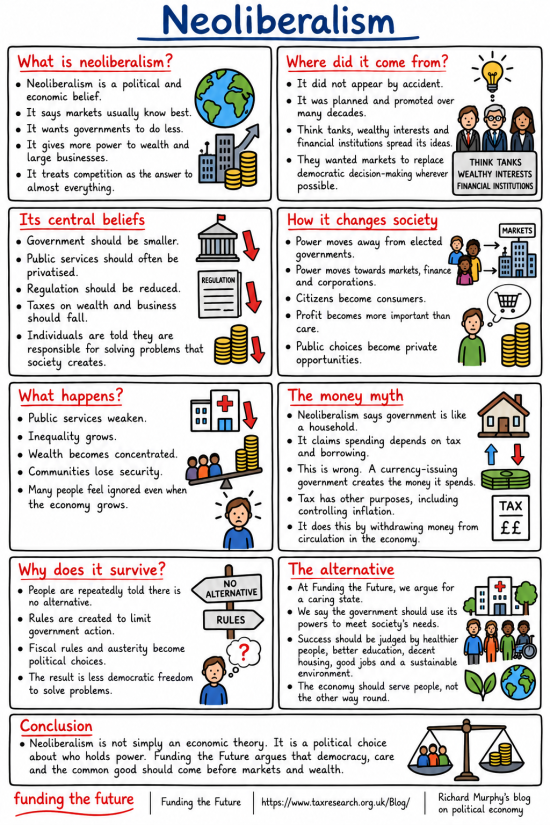
This is the transcript:
Hello, I'm Richard Murphy, and this is Understanding Economics. That is the series of videos that I'm making that explains economics in the way that I see it, and I stress that point. This is economics in the way that I see it, and I do not see it as most economists do, because I am what is called a heterodox economist.
There are about 8% of all economists in the world who stand outside the mainstream and who criticise mainstream economics because of its failure to supply answers which solve the problems that we face in the world, and I am pleased to be one of that 8%. So this is not standard economics. It is economics that answers the questions that you might have about our economy and why it isn't working.
One of the terms that I use quite often in my videos is neoliberalism, and yet I've never made a video which says what neoliberalism is, and it seems time to make one in this Understanding Economics series.
So, what is neoliberalism? Neoliberalism is a political and economic philosophy, and I stress the point. It is both, and it has transformed the way our economy and our societies work. It has shifted power away from government and towards markets and business. It has changed how we think about public services, taxation and responsibility. And it has also changed who benefits in our society from the economic activity that is undertaken in it.
But what exactly does it do, and why does it matter so much to all of us?
The point is, neoliberalism is this unusual combination of both being an economic theory and a political ideology. Now, it's not alone in being that. Marxism clearly does the same thing. And there are other forms of thinking that do have this overlap. But not every type of description of economics is deeply political at the same time. Neoliberalism is.
It assumes that markets usually make better decisions than governments. It argues as a result that governments should do less inside our economy and businesses should do more. It treats competition as the best way to organise almost everything in our society. And the result is an economic system that gives increasing power to those with wealth and to the businesses that they own.
But where did this ideology come from? Neoliberalism did not become influential by accident. Its ideas were deliberately developed and promoted over many decades. They began after World War II with Friedrich Hayek and Milton Friedman, and they created a society to promote this idea in 1947 called the Mont Pèlerin Society, named after the mountain in Switzerland, below which they held their first meeting.
After that, think tanks, wealthy individuals and financial institutions helped spread the word about neoliberalism. They argued that markets should replace many decisions made by governments, and they did so because that was in their own self-interest. Their aim was to change who exercised power over the economy. They resented the rise of social democracy in the aftermath of World War II and the Keynesian economics that went with it. They wanted to replace democratic decision-making wherever that was possible.
But what are the central beliefs of neoliberalism? Neoliberalism argues that government should be smaller and less influential inside our society. It favours privatisation of business, which transfers public services into private ownership, and that, of course, is done by direct sale of those businesses, but it is also achieved by outsourcing. We should never forget that the idea of outsourcing is a key component within the neoliberal framework.
Neoliberalism also supports deregulation, which reduces government controls over business, and it argues for lower taxes on business and wealth because they say that those taxes undermine entrepreneurial activity even though there is no evidence that they do. It also makes individuals responsible for solving problems that society creates.
So we, individually, become responsible for solving climate change. And we, individually, are deemed to be self-sufficient and therefore capable of looking after ourselves even though no evidence is necessarily available that everyone is capable of doing so. But as a consequence, we find the idea that neoliberalism promotes that we should, for example, be responsible for our own healthcare. And the idea that we might need to pay for education is also one implicit in neoliberalism. Millions of students now have neoliberal thinking to blame for the fact that they now have student debt.
But what does neoliberalism change within society apart from student debt?
Neoliberalism transfers economic power away from elected governments. It gives financial markets, corporations, and wealthy investors greater influence. That is what it is promoted to achieve.
People are increasingly treated as consumers within a neoliberal market rather than as citizens, and public services become opportunities for private businesses to make profits.
We have seen that, of course. Water is the worst example, but the railways were privatised for a long time. So has the post office been. So have electricity and gas and so many other businesses. Decisions about society's needs become increasingly dependent upon commercial interests.
So what happens to public services in a neoliberal state? Neoliberalism encourages governments to reduce their direct provision of services. We see the consequences. It is not by chance that we see long NHS waiting lists, whilst at the same time, if you can produce the necessary cash, someone will see you very quickly in the private sector. That stress is a deliberately created one within a neoliberal environment where money is able to talk louder than need.
Neoliberalism assumes that private businesses can provide services more efficiently than government. And as a result of the way in which the bias is created within the supply of government services, this often appears to be the case, whether true or not, and this puts financial returns and commercial priorities ahead of public need. Services that should provide security and care can consequently be weakened. The result is that access to essential services can depend increasingly on having access to money. Nowhere is that seen more obviously than in the provision of social care for the elderly.
What happens to inequality in that case? Neoliberalism gives greater economic power to those who already own wealth. Lower taxes and reduced regulation can increase the rewards available to them. Wealth and economic influence consequently become more concentrated because they can use their economic power to influence government. Meanwhile, many people experience growing insecurity in their daily lives. A neoliberal economy can grow while leaving large numbers of people feeling ignored.
So what is neoliberalism's money myth, because there is one? Neoliberalism deliberately treats government finances as if they were household finances. It claims governments must raise money through taxation or borrowing before spending, making government spending appear to be, as a consequence, dependent upon the activities of the wealthy and the companies that they own.
But a government that issues its own currency creates money when it spends, and taxation is not there to fund government activity. It is there to withdraw money from circulation and help control inflation. The neoliberal money myth of dependence, therefore, upon the wealthy and their companies is just a work of fiction. The real limits on government spending include available resources and inflation, but not money. Neoliberalism ignores this to create government dependency on private capital, banks, and wealth. And those three combine together to restrain government activity.
This is not by chance. This is by deliberate political choice. This is the way in which they exercise their control over government, and governments have, for 45 years in this country, and many others around the world, succumbed to that pressure.
So why has neoliberalism survived for so long? It survived mainly because people are told there is no alternative. Margaret Thatcher coined the phrase “TINA”, which did stand for “There Is No Alternative”, and so far social democratic parties right around the world have failed to create that alternative. Governments have created fiscal rules that restrict their own economic choices, succumbing to neoliberal power in the process, and they have given away control of their central banks, the consequence being that the wealth of the wealthy has been increased by those banks who have kept interest rates artificially high. And those who are economically vulnerable because they borrow or are in vulnerable employments have seen the consequence in a reduction in their well-being.
These rules are all intended to make austerity appear necessary rather than a political choice. They discourage governments from using their own powers to address social problems, and the result is a reduction in the choices that democratic governments are willing to make.
So when we talk about democracy, what does neoliberalism do for it? Democracy should allow people to decide how society's resources are used. Neoliberalism has increasingly transferred those decisions to markets and corporations. Those exercising economic power are not democratically accountable in many cases as a consequence. We see that most obviously in our central banks, but we see it too when major corporations make decisions that have a direct impact on our lives because they are in control of outsourced services.
Governments then claim that markets or fiscal rules prevent them from acting. And democracy is weakened as a consequence when elected governments surrender their power to make choices on our behalf. And we have seen that in water, the NHS, so many privatisations, and government outsourcing, all of which have left the government as a hollowed-out and hopelessly inefficient version of its former self.
So is there an alternative to neoliberalism? My argument is that there is. I argue for a caring state that puts people first. Government should use its powers to meet society's needs. Economic policy should be judged by its contribution to people's well-being and not by its financial outcomes. And success should mean better healthcare, education, housing, and employment, and not a growth in wealth without any real meaning as to what that represents. It should also mean greater security, less inequality, and a sustainable environment. Financial metrics do not matter if these things are achieved, but they are not the things that neoliberalism puts focus on.
So how could we make the economy serve everyone? We would start by asking what people need to live fulfilling lives. We would then identify the people, skills and resources available to meet those needs. And the government would then use its economic powers to put those resources to work in the interests of people and not finance.
Now, I'm not saying that markets and businesses have nothing to contribute to all of this. They would. But they should not determine society's priorities. Democratic choices should decide how the economy serves the common good.
So what should we conclude about neoliberalism? Neoliberalism is not simply an economic theory about how markets work. It is a political choice about who should exercise power in society. Its consequences include greater inequality, weaker public services, and reduced democratic control.
We can choose instead to put democracy, care and the common good first. The economy should serve people rather than requiring people to serve the economy. Money is not the purpose of life; living well is, and neoliberalism has got that wrong. It's time to change that. People must come before finance. That means we have to reject neoliberalism.
That's what I think. There is a poll down below for you to offer your opinion. Please let us have your comments.
Please also look down below because this is one of our videos in the Understanding Economics series. There are over 20 videos in this series now, I think. Have a look at the playlist we reproduce below. They show the videos in the sequence in which we made them, which is the order in which they are broadly appropriate. You could shuffle them in a few places, but that will help you understand economics, which is what this channel is seeking to achieve.
I want you to be empowered to understand the way in which the world around you works, and Understanding Economics enables you to do that.
Poll
Thanks for reading this post.
You can share this post on social media of your choice by clicking these icons:
There are links to this blog's glossary in the above post that explain technical terms used in it. Follow them for more explanations.
You can subscribe to this blog's daily email here.
And if you would like to support this blog you can, here:

 Buy me a coffee!


Some recommended viewing and reading on neoliberalism:
The Shock Doctrine: The Rise of Disaster Capitalism by Naomi Klein
https://amzn.eu/d/fAmspcx
The Racket: A Rogue Reporter vs The American Empire (2024) by Matt Kennard
https://amzn.eu/d/6KsBdEl
The Invisible Doctrine: The Secret History of Neoliberalism (& How It Came to Control Your Life) (2024) by George Monbiot and Peter Hutchison
https://amzn.eu/d/hWvMzE6
Videos
The secret history of Neoliberalism | The Invisible Doctrine
https://www.youtube.com/watch?v=gR4eSEetKP0&t=26s
A Rogue Reporter vs. The American Empire (w/ Matt Kennard) | The Chris Hedges Report
https://www.youtube.com/watch?v=V1raT5Gxk_M
The Shock Doctrine (ENGLISH) – FULL DOCUMENTARY : The Rise of Disaster Capitalism
https://www.youtube.com/watch?v=aL3XGZ5rreE
Thank you
“Neoliberalism assumes that private businesses can provide services more efficiently than government.”
The neoliberal side of the debate, in the early ’80s, said that private industries were so efficient, because of competition, that they could not only make a profit for shareholders, they could also provide services more cheaply than public utilities. They were, we were told, that good. Perhaps some proponents really believed it.
Water companies had zero debt when they were sold. The government wrote off £4.9 billion in accumulated public debt. It gave them £1.5 billion in public funds (the “green dowry”). But the first thing a private company does is load up with debt. It does this both to release funds to shareholders and to reduce it’s tax liability. So now the water companies have debts of at least £60billion. Since their sale they have returned about £70billion to shareholders.
Water companies policies of polluting rivers and dumping sewage are well known. Their failure to provide water this year, their core service, resulted in hosepipe bans. They expected them to save 5% of water use. Meanwhile their leaks were wasting 15% of water. They claim to be repairing leaks. Old water mains may last 50 to 70 years, many are at the end of life. Water companies replace 0.05% (sic) of their mains pipes every year. At that rate it will take two millennia to replace them all.
Privatisation has worked well – for shareholders. Not so well for the rest of us (or the environment).
Much to agree with
Yet again, thanks to all for another “X-Ray” article.
Might a significant factor in the power and longevity of Neoliberalism be that our democracy fronted form of subverted polyarchy governance has used its unstated manipulation powers to impose “Structural Ignorance” on our society?
Structural Ignorance/Imposed Ignorance is a state of deprivation whereby the regular citizenry is deliberately kept from knowing facts which could embarass/undermine the Society’s dominant groups. Structural Ignorance is effected by forms of authority, unquestioned social norms, fashion, inadequate education, main stream media bias/lack of objectivity, political distortions of soci-economic actualities, the connivance of “our” public service broadcaster etc. (From AI sources)
Very good of Ian Tresman to remind ourselves that there is an established alternative school of thought to neoliberalism – Richard is not a lone voice<p>
And that makes it even more shocking that BBC , despite its partiality for ‘balance’ when it is between two far – right views , somehow rarely if ever features Richard, Mazzucato, Kennard, Klein, Monbiot etc etc <p>
And now we have the ‘Growth Commission’s draft budget https://www.growth-commission.com/2026/10/01/the-growth-budget-2026/
Could you get anything more neoliberal?
Thank you
What a hateful document! I5 represents a twisted view of Britain enforcing the views and of the super-rich, banks, the markets and such “interested” parties. No mention of addressing the difference between taxation of work and investments. Truly it shows why we are in such a mess when such rubbish is listened to by politicians of a neoliberal bent.
I didn’t vote as the list of Neo-liberal crimes was incomplete (joke).
I actually heard/saw the word(s) ‘Neo-liberalism’ mentioned on the radio/publications recently and made a mental note. Let’s see what happens.
One thing is for sure, like much said here, it will need to be repeated over and over again until they get it and this will be helped by the more reality bites their lives because of the the big Neo-liberal con.
Much to agree with
I have noted before that I don’t watch your videos (because I prefer to read rather than listen where there is an argument to be made, so I’m always grateful for your transcripts) but I do like to read the BTL comments to see how people react to them
Today I am encouraged by the fact that so far the BTL commenters are. with very few exceptions, in agreement with you.
I wonder if I am seeing a trend, with Larry Elliot recently in The Guardian calling for a ‘return to New Deal principles’ originally (influenced I understand by Keynes) when discussing the IMF pronouncements and the Guardian interview with Isabelle Weber in which she says : make life’s necessities affordable. That is housing, transport, food, water, energy, healthcare: the stuff humanity depends on. “Fascism is rising from frustration, born out of a crisis of livelihoods,” says Weber. “So, we need to reclaim these essentials now” The unaffordability of these things being, of course, the consequence of neoliberal ‘economics’.
Of course, the Guardian is known for its occasional forays off piste while usually following the neoliberal line, but are more people listening now?
https://www.theguardian.com/commentisfree/2026/oct/15/global-economy-multilateral-cooperation-crisis-imf
https://www.theguardian.com/business/2026/oct/16/isabella-weber-anti-fascist-economics
I have to live in hope.
And thank you.
WE do analyse our YT responses. Most are very positive. Obvious trolls are deleted when we get time.
I’m coming into this a but late in the day because I’m recovering from eye surgery (not as unpleasant as anticipated). You are, Richard, quite correct to blame the Mont Pelerin Society for the root of neoliberalism. But I tend to regard the formation in 1955 by Anthony Fisher and Oliver Smedley of the Institute for Economic Affairs as being the real start of it. And, sadly, perpetuating it to this day.
In the uk you are right
Recover well
I still question whether the word “neoliberalism” communicates the argument to the people who most need to hear it. It may be familiar enough to Guardian readers, academics and readers of this blog, but not for those struggling with bills, housing costs and failing public services. I still think it is too abstract a word requiring an explanation before the conversation can even begin. I think it is time to describe the outcomes of neoliberalism more directly – That we now live in a predatory economy.
“Predatory” communicates a relationship that people immediately recognise because they are the “prey” – they know and feel that those with power use it to extract every last penny out of them. People need water, energy, housing, food and care and they know that those necessities have become opportunities to charge more
The public experiences this through mortgage increases they cannot escape, the essential bills they cannot afford and the deteriorating services for which they find increasingly difficult to access. They may never have heard of Hayek, but they know what it feels like to be treated as a source of income rather than a person – to be preyed upon.
The phrase also challenges the suggestion that these are merely unfortunate failures within an otherwise successful system. When wealth is repeatedly extracted while security, services and democratic control deteriorate, I think it is time to name it what it is.
“Neoliberalism” names the ideology. A “Predatory economy” describes the outcomes and the reality it has created. And “predatory economics” names the thinking and the policies used to justify and perpetuate it.
Your argument that people must come before finance deserves language that travels beyond those already persuaded. “Predatory economy” gives people words for something they already feel—and a clearer reason to demand change.
I agree. ‘Predatory economy’ describes very well what people experience: rising costs, deteriorating services and the extraction of wealth by those with economic power.
But people still need to understand what neoliberalism is, because it is the ideology that has justified and encouraged these outcomes.
Unless people understand that their problems arise from deliberate political choices, rather than economic inevitability, they will struggle to see how things could be different.
So we need both terms. ‘Predatory economy’ describes the consequences. ‘Neoliberalism’ explains why they have arisen.
Understanding both is essential if we are to make the case for change.