
Inflation means that prices are rising, but knowing the inflation rate does not tell us why prices are going up. In this Understanding Economics video, I argue that identifying the cause of inflation is essential if we are going to choose the right policy to tackle it.
Economists traditionally distinguish between demand-pull inflation and cost-push inflation. Demand-pull inflation happens when spending exceeds the economy's capacity to supply goods and services. Cost-push inflation happens when essential costs such as energy, food and materials rise because of supply shocks.
I also identify a third form: “greedflation”. This happens when companies use their market power to increase prices by more than their costs have risen, increasing their profit margins in the process.
These different causes require different responses. I argue that raising interest rates might suppress demand, but it cannot create more energy, food or other scarce resources. Higher rates also increase mortgages, rents and business costs while discouraging the investment that could increase productive capacity.
Instead, policy should match the cause. Excessive demand can be managed through taxation. Excess profits can be tackled through regulation and taxation. Energy shortages require investment in domestic energy, while other supply shortages require investment in the capacity needed to produce more.
Inflation policy is therefore about much more than changing interest rates. We need to ask what is causing prices to rise, who is gaining, who is losing and which policy actually addresses the underlying problem.
There is no single solution to inflation because there is no single cause. Understanding that is essential if we want economic policy that works. This is what Understanding Economics is all about.
This is the audio version:
This infographic supports this video:
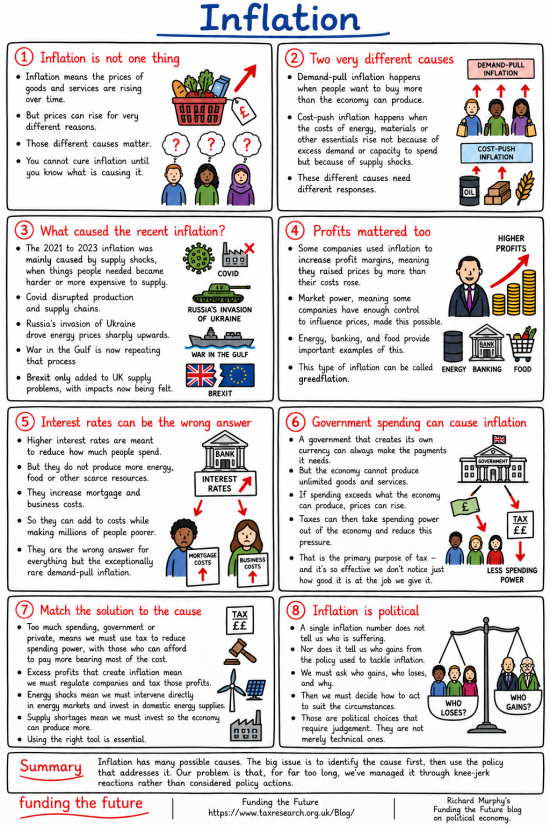
This is the transcript:
Hello, I'm Richard Murphy, and this is Understanding Economics, the series of videos that I'm creating to explain economics in the way that I see it. And I stress that point: this is about economics in the way that I see it, because I see it as what is called a heterodox economist. That means I am outside the mainstream. But given that mainstream economics has clearly failed us, or we would not be in the mess that we are in, heterodox economics matters, and that is why I'm making this series, which I hope will be of use to you.
In this video, I'm talking about inflation, and that is one of the most important economic concepts because people think, quite correctly, that it can affect their well-being and they don't like that.
Inflation means the prices of goods and services are rising over time. That's all it is about. The same goods and services that were available last year for £1 now cost £1.05, and that is inflation of 5%.
There is, by the way, an opposite to inflation, which is called deflation, but I am not discussing that here. If deflation happens, the goods that cost £1 last year cost, for example, 95p now, and that is when prices generally go down. But it is a phenomenon that we have not seen for a very long time, and so I'm going to discuss inflation instead.
But, and this is the key point, inflation can happen for very different reasons, and those different causes matter. You cannot cure inflation until you know what is causing it. And that is the key message of this video because our authorities, our central banks, which are being tasked with the job of controlling inflation, do not seem to understand that point.
The two major causes of inflation are described by economists as demand-pull inflation and cost-push inflation.
Demand-pull inflation happens when people want to buy more than the economy can produce. The economy is in the jargon term that is used: overheating. People have too much money in their pockets, and they're trying to buy more than is available. As a consequence, they go into the marketplace, can't find what they want, and they bid up prices. And people who have goods and services for sale know that they can get increased prices because people are willing to pay them. That is demand-pull inflation, and you have hardly seen it during the course of your lifetime.
The alternative is cost-push inflation. Cost-push inflation happens when the cost of energy, materials or other essential items like food rise, not because of excess demand, but instead because of what are called supply shocks. There have been many of these of late. I'll discuss them more in a minute, but the point is the price of things goes up because of a physical event.
People don't want to buy more of these things. They are essential items, and they need them. If they've got to buy them, they may well buy less of something else. But the fact that buying less of something else is not recorded within the measure of inflation, the fact they're buying more of the essential item is, and people feel they are worse off, and that is the consequence of inflation. But these different causes need different responses, and that is the key point of this video.
Those who are responsible for controlling inflation, whether they be in government, whether they be in central banks, in Treasuries, or anywhere else, do need to take causes into account.
Now, what has caused recent inflation in this country? From 2021 to 2023, inflation in this country was caused mainly by supply shocks. We had disruptions in global supply chains as a consequence of COVID. When we were let out of lockdowns and everything to do with that, there was a flood of money that came into the market, and I admit this doesn't make it look like demand-pull inflation, but the fact is that the flood of money was artificially created by COVID because people could not spend, and there were supply chain shocks.
People wanted to buy new cars. There were no new cars on their way from China because ships were not sailing.
People wanted to buy new kitchens, but there were no new kitchens available because people hadn't been going to work to make the units, the sinks, and everything else that they wanted to buy. The fact is, this created a supply chain cost-push inflationary shock.
That was exacerbated within months of it happening by Russia invading Ukraine in February 2022. That drove up energy prices for oil and gas and then for fertiliser, and also for some forms of foodstuffs like wheat, because Ukraine is a major exporter of wheat to the whole of Europe.
Now the fact is that actually there were no supply shocks in this particular case. There was enough energy, there was enough gas, there was enough fertiliser, and there was enough wheat. But the point was that financial markets and speculators within them thought there wouldn't be. They forced prices up, and the consequence was that we got inflation.
And the war in the Gulf started by Donald Trump and Benjamin Netanyahu is repeating that process all over again. Only this time there are real supply shocks. We are short of oil, we are short of gas, we are short of fertilisers, we are short of some of the materials required to undertake industrial processes. And the fact is that we do have a real supply shock, and people who have to pay more for their petrol, their diesel, their gas, their energy and their foodstuffs will not be able to buy other materials as a result. They will feel worse off, and they will feel that's the case because there have been very real price rises, and we know that is true.
So we have UK supply problems, and Brexit only made all of those worse. I think I should mention that along the way.
But profits matter too in these situations. Over the last few years, there has been ample evidence that some companies have exploited the situations that we have faced as a country to increase their profit margins, meaning they have increased prices by more than their costs have risen. And as a consequence, because of their market power, which means they can control prices that we have to pay, some companies have made excess profits as a result. Energy, banking and food all provide important examples of situations where this can happen. And I call this type of inflation ‘greedflation'. It is a third category of inflation, and we have to take it into account.
And now my point is that if we have three categories of inflation, having only one policy response can be wrong.
The government has given the task of managing inflation to the Bank of England through the use of interest rates to try to control the level of demand within our economy, but that will only work when we have demand-pull inflation, when there is too much money chasing too few goods in the economy, but that is not the situation we are in.
We are not at full employment. We have not got an overheated economy. We have economies that have been suffering successive supply shocks, and that is the inflation we're dealing with, essentially cost-push inflation. And in that situation, increasing interest rates does not produce more energy. It does not produce more food. It does not provide other scarce resources.
But despite the fact that there is no solution to the inflation problem and its causes by increasing interest rates, the government still lets the Bank of England increase those rates, and the result is increased mortgage costs, increased rents, increased business costs, and so more inflation, because if you put up the price of money, you increase the rate of inflation. That is something that most economists do not know, but as a matter of fact, it's true.
For example, if a business has to pay more interest, that interest becomes part of its costs. Of course, it will try to recover that by increasing its prices. And in some cases, for example, in car leasing, the interest rate is a major part of the cost that is passed onto the consumer, and the price is bound to rise.
The consequence is clear. Millions of people will be made poorer as a consequence of this policy, and that is not an accident. That is by design.
And in fact, there's another consequence that is created by design. This policy is intended to make people unemployed because that is the way in which the message that the Bank wants to impart, that we must suppress consumption, is delivered into the economy. There are fewer jobs. The pressure on wages goes down whilst the pressure on prices goes up. This is what the Bank of England is trying to do. It is not only trying to suppress the well-being of millions, but it is also trying to create greater inequality in the country.
And a government that creates its own currency does not face the type of problem that the Bank of England believes it does. The government in that situation can control inflation using taxation. But the government in that situation cannot produce unlimited goods and services. So what it has to do is balance demand with taxation. And the essential job of tax inside any economy is to achieve that outcome. We ignore this point.
We always say that interest rates are used to control inflation, but that is not true. The primary purpose of tax is to take money that the government has created as a consequence of its spending, as modern monetary theory explains, out of the economy so that it cannot cause inflation. And in fact, tax is so good at that job, and so effective at it, that we just don't notice it's doing it.
And the problem of not noticing that it's doing its job so well is that we use another tool which is wholly ineffective, which is interest rates.
And how do I know that tax is so good at this job? Well, look at periods when we don't have external supply shocks. For example, the whole of the 2010s. We had very little inflation indeed during that decade. Tax controlled the situation, and we had stable interest rates. Something did control inflation because the government spent trillions into the economy. What controlled inflation, as a consequence? Tax did. It does work.
And this is what we need to do. We need to match the solutions to inflation to the causes that we can see which are happening.
If there is too much spending in an economy, whether that is created by the government or by the private sector, we must use tax to reduce spending power, and those who can afford to pay should bear most of the cost. That is the way in which an effective inflation policy works 99% of the time. That is what the government does with regard to its own spending, and that is what should also happen if we have demand-pull inflation.
But we don't have demand-pull inflation most of the time. Sometimes we have ‘greedflation', which is created by companies exploiting their monopoly power, and in that case, we need to regulate markets, regulate companies, and tax those profits.
That is the right response to greedflation, but we are not seeing that. We are not seeing sufficient extra taxes on oil companies at present, although they are making exceptional profits, and banks are squealing for a reduction in their tax rate, even though high interest rates are heavily benefiting them.
At the same time, if we have an energy shock, the signal that we should respond to is the fact that we do not have enough domestic energy in our economy, and the answer to that is to invest domestically. What do we do? We increase our domestic energy supply. We have wind power. We have solar power. We could have tidal power. That is the answer to that type of inflation. That is tangential, but it's the right thing to do.
And at the same time, if we have supply shortages, for example, with regard to food, what should we do? We should invest in the capacity of our economy to produce more. If we could produce more, we would not have a supply shock. We would have sufficient. We would not then get inflation, and that is why investment is the right answer. But putting up interest rates makes that harder, which is why it is the wrong tool. We must, in that case, choose the right tool. That is essential when we're managing inflation.
And the point is this: a single inflation number does not tell us who is suffering, nor does it tell us who gains from the policy used to tackle inflation. We must ask who gains, who loses and why. Then we must decide how to act to suit the circumstances, and these, I stress, are political choices requiring judgement. They are not merely technical ones. And the knee-jerk reaction that we keep on getting from the Bank of England to put interest rates up every time there is a threat of inflation is a technical solution, but the wrong one in most circumstances. We need to get much more clever when it comes to inflation.
Inflation has, as I've said, many possible causes. The big issue is find the cause first and then use the policy that deals with it. Our problem is that for far too long we've managed it through those knee-jerk reactions I've described, and we have not considered the right policy options that are available to us or the right actions to take. If we did, we would have a better economy because we have understood it better, and that is the whole point of this series on understanding economics. It is about how we understand the situation that we are in and how we can manage our circumstances better.
There is a whole playlist that is listed below this video of other videos available in this series, and there are now around 20 of them. There's plenty for you to watch. Do start at the beginning. It is probably the best place to start in this case, but pick and choose if you wish. There are plenty of topics to address because economics is a massive subject, but understanding it really helps you manage the way in which you react to what is going on in the world around us.
Poll
Thanks for reading this post.
You can share this post on social media of your choice by clicking these icons:
There are links to this blog's glossary in the above post that explain technical terms used in it. Follow them for more explanations.
You can subscribe to this blog's daily email here.
And if you would like to support this blog you can, here:

 Buy me a coffee!

The obvious point is that raising interest rates simply moves money around the economy from borrowers to depositors so does nothing to supress demand – just look at what happened in the 80’s
Given the particular issues with Diesel what about going back to the 70’s and reducing speed limits (Yes I do go on!) this would have multiple benefits, not just reducing fuel consumption but accident rates as well.
Finally nothing about any improvements to domestic energy efficiency such as the requirement to implement energy efficency improvements when a house is bought instead of Stamp Duty?
It’s not obvious to me that raising interest rates does nothing to suppress demand. Surely it makes individuals and businesses more reluctant to take out new bank loans? Since new bank loans equals new deposits (as per double entry book-keeping) a reduction in new bank loans would mean suppressed demand. I expect that levels of aggregate private debt in the economy would also be a factor via-a-vis how influential interest rate changes would be on new borrower behavior. Maybe people were more willing to take on new debt in the 80s (even at high interest rates) as aggregate private debt had not risen to its pre 2008 financial crisis levels?
But yes, increasing interest rates will increase transfers from debtors to creditors. This has broader societal implications, as it will most likely further exacerbate wealth inequality. For this (and the other reasons Richard has mentioned in the post) it’s not appropriate for governments to use central bank interest rates as a universal response to inflation.
I agree with much of this, and I have never suggested that higher interest rates cannot suppress demand. Of course they can. The question is how effectively they do so, at what cost, and whether they are the appropriate response to the inflation we are experiencing.
You are right that higher rates can discourage new borrowing, which means less new bank money is created. But the strength of that effect depends on many things, including existing levels of private debt, expectations about the future, and whether businesses and households actually need to borrow.
There is also another effect. Higher interest rates increase the incomes of those who hold financial assets, whilst increasing costs for borrowers. Some of that additional income will be spent, potentially increasing demand elsewhere in the economy.
More importantly, higher rates can increase business costs, discourage productive investment and make housing more expensive. None of those things necessarily helps tackle the underlying causes of inflation.
Your point about private debt is particularly important. In a heavily indebted economy, interest rate increases can have severe consequences for households and businesses that have little capacity to adjust. That makes the policy both economically damaging and socially unfair.
My argument is not that interest rates have no effect. It is that they are a crude, unreliable and deeply unequal way of controlling inflation, particularly when inflation originates in shortages or other supply-side problems.
That is why I favour fiscal policy, credit controls, regulation and measures to increase productive capacity instead of relying overwhelmingly on interest rates.
I agree with you Richard. I was replying to John Boxall’s comment, which stated it was “obvious” that an interest rate increase “does nothing to suppress demand”.
I’ve been reading your blog for a while and understand why interest rates won’t curb external supply driven inflation, and also that with a sovereign currency spending in under utilised resources need not necessarily cause inflation but I’m stuck on a point, at the risk of exposing my ignorance, but it is this;
If, as the BoE incorrectly believes, higher interest rates reduced demand by reducing spending power, or, as above, taxation reduces spending power, why do price rises in themselves not reduce inflation by reducing spending power?
I can see intrinsically that we don’t want inflation but why, with the markets and supply/demand economics etc, does inflation, or price rises, not naturally curb itself?
That is a very good question, and there is no reason to apologise for asking it.
You are right that rising prices reduce people’s spending power. If incomes remain unchanged whilst food, energy and other essentials become more expensive, people have less to spend elsewhere. That reduces demand and can eventually bring inflation down.
So inflation can sometimes help bring itself under control.
But there are three problems.
First, people cannot stop buying essentials. They still need food, energy, housing and transport. Instead, they cut spending elsewhere, potentially causing businesses to fail and unemployment to rise.
Second, workers and businesses respond to inflation. Workers seek higher wages to recover lost purchasing power, whilst businesses raise prices to recover costs or protect profits. That can keep inflation going.
Third, if inflation results from shortages, reducing people’s spending power does nothing to increase supply. It simply means some people can no longer afford what they need.
There is also an important distinction between prices remaining high and inflation continuing. If prices rise by 10% and then stop rising, inflation falls to zero, but everything still costs 10% more.
So your argument is correct. Inflation can reduce demand and eventually bring itself under control. But the process can be slow, unfair and economically damaging.
That is why I object to relying on higher interest rates, which impose another squeeze on spending power.
We should tackle the causes of inflation rather than simply make people poorer until prices stop rising.
Wisely you deal with one subject at a time for this widely misunderstood matter. You have kept to the central issue but would our thinking benefit from a footnote?
Large parts of the world are suffering from harmful climate impacts. For instance, more than half of England is afflicted by drought. In section 7 of the infographic, you have written: ‘Energy shocks mean we must intervene directly in energy markets and invest in domestic energy supplies.’ This is sensible but could the political response to this particular cause of inflation also include policies to *reduce* energy usage and thus carbon dioxide emissions? Higher prices might help other measures such as lower speed limits and better insulated houses.
Yes, in a word.
I have noted over the years that companies will be eager to tell the populace that tax rises will be passed onto consumers when they are discussed, but not really at all when interest rates rise. So from that perspective – a small one – so your post rings true to me about the behaviours you talk of here.
It seems to me that the present situation is beyond a quick fix. Climate change and the many disruptions of world supply are beyond our present capabilities. However what we are not doing is taking immediate mitigating measures. Just one example would be to impose national speed limits.
You can think of solutions. The problems are not beyond our ability to solve then.
But apparently beyond the capacity of our government!
True
Do you think it would be worthwhile to add a blog about inflation measures, a personal bugbear of mine, and how they are used wrongly, for example to increase the benefit payments rates by CPI when those on benefits suffer an inflation rate that is very different?
Sorry to suggest adding to your workload.
Let me add that to my ideas list – there is one.
Let me add that to my ideas list – there is one.
Greedflation – love it
Raising interest rates makes the BoE’s mates in the city richer and so arguably a covert type of greedflation, self feeding too, as costs are passed on prices go up so more greedflation interest rate rises are naturally prescribed.
Thank you
A good post. It should be obvious to any intelligent person that you need different policy responses to different causes of the problem. I have thought for some time that using interest rates was a very blunt instrument and you would have thought that the govt and BoE would have come to the same conclusion. Its a sad reflection on the quality of policy makers.
If, as seems to be the case, commercial banks gain a considerable financial benefit from bank rate increases, are these unearned profits taxed accordingly?
They are taxed, not not sufficiently in my view