
When will modern monetary theory actually be put into practice? My answer is that politicians will adopt MMT when they desperately need an alternative to the economic ideas that have failed them.
History suggests that major changes in economic thinking happen during crises. Keynesian economics gained influence after the failures exposed by the Great Depression. The Beveridge Report helped prepare the foundations for the post-war settlement. Neoliberal thinkers were ready when the economic turmoil of the 1970s created their political opportunity.
The same happened after the 2008 financial crisis. Tax Justice campaigners had spent years developing arguments and practical reforms that suddenly became politically useful when governments needed answers.
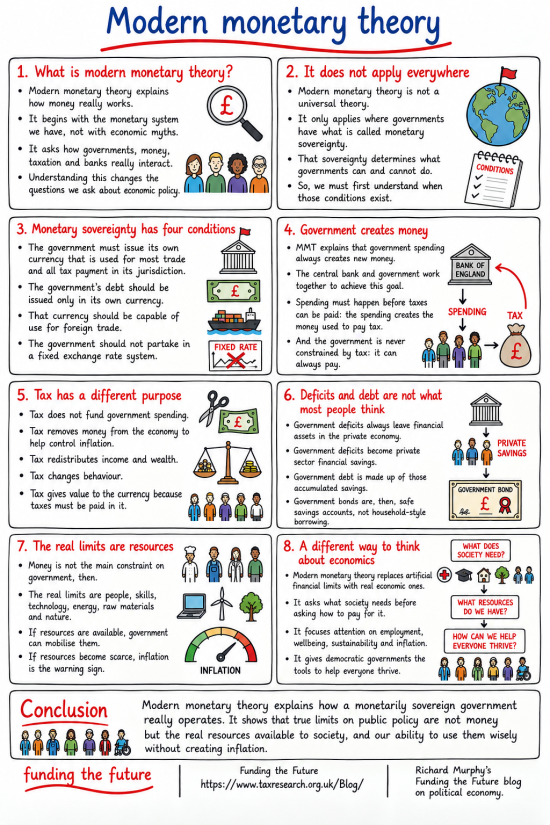
MMT needs to be equally prepared. Importantly, I argue that MMT does not require us to invent a new monetary system. It describes how the existing system already works: government spending creates money, taxation removes money from circulation, and government bonds provide a savings mechanism.
The real change is therefore in how politicians understand and manage the economy. Instead of asking whether government can afford something, MMT asks whether we have the real resources required to deliver it.
A new hospital, for example, requires land, materials, builders, doctors, nurses and other staff. Money itself cannot create those resources. The challenge for government is to mobilise available resources while managing genuine shortages and inflationary pressures.
I believe another major economic crisis could force politicians to reconsider the economic assumptions they currently rely upon. Financial instability, war, AI, climate change or recession could provide that catalyst.
We should not want such a crisis. But if one comes, an alternative must already be available. MMT needs a clear, practical political narrative explaining what governments can actually do. When politicians need an economic life belt, MMT must be ready.
This is the audio version:
This infographic supports this video:
This is the transcript:
When will we get modern monetary theory, or MMT for short, in practice? That's a question I'm always asked, and my answer is that politicians will adopt MMT when they realise it offers the answer they need.
That recognition is unlikely to come in normal political times. Politicians always remain within their comfort zones whenever they can. They are human beings who like the status quo, as we can all see. So the catalyst for change will then be a crisis, and that is why preparation now, before a crisis finally hits us, matters so much. If we are to get MMT, we have to be ready for the possibility that politicians will need it, and I think they will.
Crises change economic thinking when old answers stop working.
Neoclassical economics failed during the 1930s. Keynesianism offered politics an alternative at that time.
The Beveridge Report of 1942 provided a plan for the post-war settlement and the creation of the welfare state. It was opportunistic in 1942. In 1945, it was desperately needed.
And let's be honest, Margaret Thatcher seized her opportunity when 1970s inflation discredited the existing Keynesian consensus of that moment, and she too created change as a result.
History suggests that crisis creates the space for economic change, and the financial crisis proved that point again in 2008. Gordon Brown, Barack Obama and the G20 needed explanations for what had gone wrong. The tax haven story that I had helped promote became part of that explanation, which they latched onto with enthusiasm. Tax justice campaigners like me had already prepared the proposals for reform that they then used.
It was not by chance that I was at the London G20 Summit in April 2009 asking Gordon Brown a question in front of 4,000 journalists. I was opportune as to the moment, to the potential to create change. Ideas that had previously seemed unlikely suddenly became politically useful. Many of the reforms we tax justice campaigners had demanded were then adopted.
The key point is, though, that the alternative must exist before politicians have realised that they need it. Keynes, Beveridge and neoliberal thinkers had all prepared ideas in advance. Tax justice campaigners had done the same before 2008. John Christensen and I had written our manifesto, and we had done the donkey work to have the tools available that we thought politicians would need.
None of these people could know exactly when their opportunity would come. They created the foundations for change without certainty of success, or knowing that their plan might even ever be needed, and MMT now needs to undertake the same preparation. That is my point.
Planning for that change is, however, possible. MMT has the opportunity, and it will be easy to do.
Vitally, modern monetary theory describes how modern monetary systems already operate. It does not require us to reinvent those systems. The monetary plumbing already works in the way that MMT describes.
The system itself does operate. We do know that government spending does already create money. We do know that taxes do take it back out of the economy and do not fund the government spending. We do know that bonds are savings mechanisms, and they also do not fund the government's spending. The necessary change that we need now is not in the financial system as such, but in the understanding of how it works and how it is managed. That is where our economists and our politicians, as well as our commentators, are all in denial.
The fact that the system will not, as such, need to change will make the transition to MMT thinking much easier than most people imagine.
But that doesn't mean to say there isn't work to do. MMT needs to have what I call "a better song to sing" by the time neoliberalism fails, and that may be soon. It must have all the necessary explanations as to what it can do, ready in advance. That is what that song is. It's the narrative that hangs everything together to say there is an alternative.
Politicians in a crisis will need an understandable alternative. We must have it. They will need to know what an MMT-managed economy would actually mean, and elaborate forecasts will not provide them with that political narrative. A practical explanation of what government can do will meet that need. This is the application of MMT that we need to develop now.
So we need to be able to explain the difference between asking the question: 'Can we resource it?', instead of 'Can we afford it?', and what the consequences will look like in practice, because that is the key change that MMT will deliver in practice.
A new hospital provides the obvious example. To build a new hospital, we don't go and look at a bank account and say, have we got the money? Instead, we have to go and ask, do we have the land, the materials, the builders and the architects? And then can we provide the doctors, the nurses, and all the other staff down to the porters who are required to staff the place? Only if those resources exist can the hospital be created. Money is not the fundamental constraint; resources are. That is the difference that MMT makes. MMT requires that we ask better questions.
So in the midst of the coming financial crisis, we must be ready to explain that money is not the big issue, even if everyone else thinks that it is. Resources are what will matter. It is resources that the government will have to direct so that it can deliver outcomes to overcome the problems that the crisis will create.
Government can always create money through its spending. That is a matter of fact. But that spending can bring unused, and most especially underutilised, resources, and there will be a great deal of those in the coming crisis, into productive use without necessarily creating the risk of inflation, whilst the existence of scarce resources may create inflationary pressure, but not if the process of change is properly managed, and that inflationary pressure in some areas is anticipated and change is made to manage it.
The objective will be to manage resources in a way that ensures that need is met and scarce resources are well used. That is the process that MMT enables, and that is critical. MMT is a process that does require better decision-making by our politicians. And at the time of crisis, there can be no greater need than better decision-making.
Politicians can still have their ambitions. They will still be able to make plans. MMT would encourage them to do so, particularly in a time of crisis. But what MMT shows is how those plans can actually be delivered. Resource management and inflation control become explicit parts of that decision process in a way that they aren't at present because micro-thinking about bank balances is all that matters. Artificial constraints will no longer dominate the discussion. Economic policy will become focused on what is physically and socially possible. That fact will be critical if, and I think when, we have another crash.
So, what could trigger this crisis that I'm talking about? I think you know the answers to that question.
Neoliberalism is already under severe pressure. We've done a video about that already this week.
Trump's economic policies could bring the world to its knees. His war could do the same thing.
An AI-driven financial collapse could provide another trigger point.
And so could the climate crisis. We are facing enormous stresses in the next year or two from drought, from floods, from fires, from El Niño, and that, of course, rolls on into food supply chains and water issues and everything else.
And the consequence of all of these things is that markets, banks and credit systems could again require government intervention for any of these reasons, and maybe all of them at the same time.
Recession and unemployment could then make existing policy impossible to defend. Neoliberalism would have failed. And in that situation, politicians will need a lifebelt or even a lifeboat. And importantly, a drowning person does not study the theory of lifebelts before grabbing one. A government facing crisis will need something to grab onto immediately, and something which they can understand instinctively.
Beveridge, Keynes, and the tax justice movement all provided lifebelts. So could MMT. It could provide; it does provide, a coherent explanation of what a government can do in a crisis. Its practical narrative must therefore be ready before the emergency. Political necessity can then turn an alternative idea into government policy, and that's what we need to be ready for.
We should not want this crisis. I stress that. I do not because crises cause pain, and I hate that idea. But the fact that we are going to get a crisis, I think unavoidably, does make preparation for this transition necessary.
The 2008 financial crisis caused enormous and lasting damage. Another major economic breakdown could be even worse. Think of the 1930s if you want to get your head around this, on the basis that no action, or only neoliberal action, is taken in response to the crisis that might develop soon, and then realise why an alternative is necessary.
Neoliberalism is making crisis unavoidable. The responsible response is to prepare an MMT alternative beforehand. Otherwise, the opportunity for constructive change could be lost.
What all this means is that the transition to MMT could come much sooner than people expect. People talk about it to me as if it is something that will happen in the dim and distant future. I think it is going to happen soon, in a matter of, maybe not months, but years most likely.
And the next major crisis will force politicians to reconsider their basic economic policies, and there will be fundamental change. They will need an alternative that explains how government can respond. People will demand it from them, and they will not accept austerity this time. The people of France and the people of Spain are already showing that. People's anxiety in general, expressed in their alienation from government in this country and so many others, shows that the appetite for change is real.
MMT already describes the monetary system those politicians are trying to manage. The task is now to make the practical possibilities from truly understanding that system very clear. When crisis comes, MMT must be ready to become the alternative game in town. That's my message. I intend to be ready. I am writing a book as the foundation for what I think is necessary. I hope we will have further discussions here on this point.
That's my opinion, but what's yours? There is a poll down below. Please let us have your comments. We do appreciate them. We do analyse and look at them. We do want to understand what your position is because it might differ from ours.
If you do like this video, please say so. Please do share it. Please do subscribe to the channel. Please do hit that bell so you're told when we make another video.
And if you would like to support our work, because our work is going to be needed during the course of the coming crisis, then if you'd like to buy us a coffee, that would be great.
Poll
Thanks for reading this post.
You can share this post on social media of your choice by clicking these icons:
There are links to this blog's glossary in the above post that explain technical terms used in it. Follow them for more explanations.
You can subscribe to this blog's daily email here.
And if you would like to support this blog you can, here:

 Buy me a coffee!

I like your hospital building analogy, which is borne out by the wonderful (sic) Nightingale Hospitals, set up during Covid to care for thousands of patients. Some £500 million was wasted on them and they treated fewer than 1,000 patients, some treated none, because they did not have any staff. Staff in the original hospitals were under huge pressure and working additional hours so could not possibly be sent to the new hospitals. I believe there was also a lack of equipment.
Money is not the answer, resources are critical.
A great example.
I think Neoliberalism has already failed and the consequent crisis is unfolding right now. So it’s a question of how bad must things get before change comes. If we want to avert even more suffering, we must understand what is keeping Neoliberalism going. Your understanding of this, Richard, is far, far deeper than mine, but I think there are three main pillars of Neoliberalism that are holding it up. One is fear of change amongst politicians, civil servants and advisers. Another is the significant army of individuals engaged in the Neoliberalism industry – investors, many institutions, bond traders etc etc – who are doing well out of it and seem to have a quasi-religious belief in it. The third is the interconnected, international nature of Neoliberalism. It’s not just the UK. Neoliberalism exists across the World and is collapsing globally.
There needs to be a strategy, in my view, that tackles each of these pillars if we are to minimise the misery that Neoliberalism is causing. Politicians and their supporting organisations need to be filled with confidence that a new approach won’t break everything. Those engaged in delivering Neoliberalism need to be offered an alternative way to make returns that they can have faith in. And these things must be done globally.
Maybe the time has come for greater cooperation and a unified approach amongst all the organisations and individuals pushing for a MMT-based economy. That will mean compromise, and that can be hard. But a fractured approach is doomed to fail. I know little or nothing about the international scene, but in the UK there are a number of players – you of course, MMTUK, GIMMS, The 99% etc. Is now the time for you all to come together and issue a clear manifesto and delivery plan?
I think your identification of the three pillars sustaining neoliberalism is useful, although I would add a fourth: the extent to which neoliberal assumptions have become embedded in what passes for economic common sense. Many politicians, civil servants, journalists and economists cannot imagine an alternative because they have never seriously considered one.
That is why changing the economic narrative matters. Unless people understand that government is not financially constrained like a household, that markets are political creations, and that the economy should meet people’s needs, we risk reproducing neoliberalism under another name.
I agree that cooperation is needed. But I would distinguish between agreeing on how money works and agreeing on what we should do with that understanding.
MMT explains monetary operations. It is not a political programme. A credible alternative must go much further, addressing public services, inequality, housing, employment, climate change, democratic accountability and economic power.
I am willing to work with others who share those objectives. But I am less convinced that negotiating a single manifesto between existing organisations is the best starting point. We could spend considerable energy agreeing organisational positions rather than developing ideas and building public understanding.
Nor must we wait for international agreement. Change can begin nationally, with successful examples encouraging others.
What we need is a coherent, comprehensible and credible alternative that people can understand, believe in and campaign for. That requires cooperation, but also a movement much wider than existing MMT organisations.
I see my role as helping provide the ideas, explanations and arguments such a movement needs. Others must help turn them into political organisation and action.
The important thing is to start building that alternative now, before neoliberalism inflicts even more damage.
Another one to add to the list is covid. Businesses needed supporting and NHS ramped up. Johnson & Sunak didn’t think twice and just issued the money, an extra £250bn in 20/21. It’s a shame there wasn’t a debate about it at the time and the general public shown that there really is a magic money tree. Covid always my mic drop argument.
Agreed, Kevan
The ‘Finding the Money’ film featuring Stephanie Kelton is now freely available on YouTube as well as the MMTAction website.
I gather so.
At last.
I might post it here.
A brave, hopeful post, and rightly so.
My worry is that we are at the moment offered a blizzard of false alternatives to any oncoming crisis.
‘There is no money’ – leading to the empowerment of crypto (levering in privately owned money) and austerity.
‘Chuck them back into the sea/pull up the drawbridge’ – the response to immigration and the lie that we cannot afford services because of ‘incomers’.
‘Facism’ – that we need a strong, hard leadership style to essentially stop caring about others in order to survive.
‘False wars’ – where do you start? We ignore the war on want at home, assist other dodgy wars and seem prepared to sacrifice more to defend what – ‘our way of life’?!! I find our way of life indefensible at the moment.
‘Cultural Zionism’ – never mind ‘cultural Marxism’ (I wish – well parts of it!), we are encouraged to not question Israel too much because we will be called ‘anti-Semites’ if we do. Yet, looking back at history, Israel’s conduct in that region has not helped humanity at all.
One thing we know about Neo-liberalism – thank you Philip Mirowski – is how it never lets a crisis go to waste.
The challenge and of course real risk when a crisis comes isnt that things will change it is what the change will be
With 170% of ecological overshoot we have very few resources actually available to us. We survive living this way by drawing down future resources and destroying them. It is not sustainable, and it will not be made sustainable by a “green transition”, which just requires yet more of the Earth’s limited resources to be used for a mass “renewable” build that will have to be repeated for it to be sustained.
Consumerism and the market economy in general are both incompatible with a habitable planet. We need to try a different way. Getting rid of money would probably be a good start. The only function of money is to allow some to have more than others, after all.
Please be realistic. Suggesting getting rid of money is not.
We do need a viable proposal for when the time comes.
That proposal can’t simply be to account of MMT when choosing policies. That’s too big a bite even with your cleverly drafted clear explanations. So I have a quick and simple proposal that, I think, both makes sense from an MMT perspective and would hopefully lead a greater understanding and use of MMT to guide policy.
The Chancellor should announce, under provisions of the 1998 Bank of England Act, that he is suspending interest payments on reserves held by commercial banks at the Bank of England. He can explain,with a sorrowful face, that we must all, including the banks, take a share of the burden in these difficult times. And since, he would say, he understands the banks position, he will offer them the option to buy new low yield government bonds (say 1%), but that they are, of course, at liberty to invest their reserves in other higher yielding assets. That last, of course, is nonsense, pure PR puff, because the banks, in aggregate, can’t reduce their holdings of reserves other than by buying new gilts.
This is aimed at forcing the banks and bond markets to realise that the government is in control, if it chooses. The immediate affect would be to save about £20 billon per annum. The secondary effect is to force the banks to buy low yield gilts. And, because the government is now “borrowing” at low rates “from the banks”, it no longer needs to sell high yield gilts. Pretty soon yields on gilts generally would reduce significantly, proving that “Bond Vigilantes” we’re not in control.
This, IMO, would be a simple, quick, first step to transition to properly taking account of MMT.
Noted.
I am working on this.