
Our event in Ely yesterday was, I think, a great success. We addressed solution-focused campaigning, which is also the topic of today's podcast with John Christensen, whom I discussed this issue with yesterday.
To aid discussion, I produced 12 pages of infographic material, split into two parts.
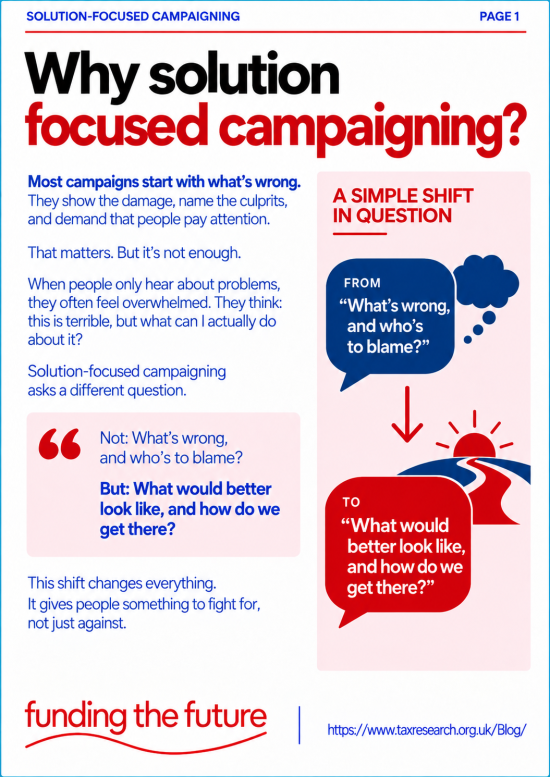
The first part is an overview of my approach to solution-focused campaigning, and the second, longer part addresses the need for imagination if we are to create a vision of a better world that solution-focused campaigning might make possible, because that is what it is all about.
The combined PDF of these materials is available here. Please feel free to use them, share them and agree or disagree with them, as you will.
The short-form summary of this thinking is reflected in this infographic:
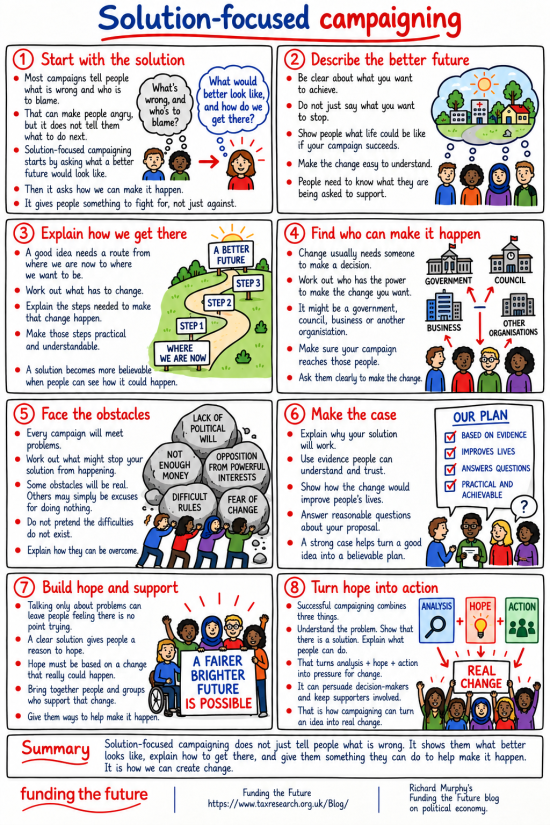
As I noted in the podcast, and yesterday during our sessions, the idea of solution-focused campaigning is partly derived from what is called solution-focused therapy, where the intention is to make someone feeling burdened by problems imagine that a better world is possible by asking them to consider what it would look like if it were to exist. As campaigners, this is what we need to do.
Whether we campaign politically, as NGOs, civil society organisations, or simply as individuals with a cause that creates a bee in our bonnet, complaining is never enough. Moaning might be a common human pastime, but it has rarely, if ever, produced positive outcomes for society. To achieve that, we must imagine what the better world we want looks like so we can communicate what we are working for, why it is imperative that we achieve it, who opposes it, and how we can overcome the obstacles in our path.
I am not pretending that I think everyone who attended yesterday will now be fully versed in these techniques. But if we are to break the hegemonic poverty of opinion based upon the singularly acceptable patterns of thought that have created the neoliberal world in which we now exist, we have to imagine that a better world is possible, or we will get nowhere.
That is why I so often say that looking out of the window is the most important activity any campaigner can undertake, except, that is, going for a walk to see what is really going wrong in the world about us so we might imagine how to do better.
Thanks for reading this post.
You can share this post on social media of your choice by clicking these icons:
There are links to this blog's glossary in the above post that explain technical terms used in it. Follow them for more explanations.
You can subscribe to this blog's daily email here.
And if you would like to support this blog you can, here:

 Buy me a coffee!

The Solutions-Focussed Campaigning booklet is excellent. The techniques work for problem solving more generally. Defining and agreeing the root problem is the foundation of change. Too often politics, like poor management, seems to be the art of avoiding this stage.
Thank you
I can’t help noticing that a great many problems of 1926 are largely solved. Almost everyone has access to new technologies or then nascent technologies such as communications, transport, potable water and electricity. Deaths from communicable diseases and poor sanitation and pollution are low. I think Barbara Castle once said that poverty is largely absent in the United Kingdom, meaning the genuine poverty of not having shoes, an adequate diet that sort of thing. So poverty got redefined as relative income inequality. Even Oxfam are now self-confessed inequality campaigners.
I wonder if there’s a sect within our political activist class that always wants something to solve, and they want to be the ones doing so. Call me an outsider with a view but I don’t want progress towards a Final Solution.
That is an astonishingly complacent argument. The fact that most people now have electricity, running water and shoes does not mean poverty has been solved. It means that the minimum standard required for participation in society has changed since 1926.
Poverty has always been about whether people have the resources necessary to live with dignity in the society of their time. A child without internet access today is disadvantaged even though a child in 1926 had never heard of it.
And invoking the phrase “Final Solution” when discussing people campaigning against poverty and inequality is particularly distasteful. Wanting people to have decent housing, adequate food, warmth, healthcare and economic security is not evidence of some sinister activist pathology. It is called wanting society to make progress.
By your argument, almost every improvement since 1926 should have stopped as soon as everyone acquired a pair of shoes.
Your comments to date have appeared to be from the far right, or trolling. I am treating them as such from now on. You will not be appearing again.
Thank you Richard and Co, just circulated the link to our campaigners.
Critical thinking piece.
It’s very difficult politically to sell a negative message, far better to sell a positive.
Though I may add the Brexit campaign succeeded on selling a negative, though if enough people are convinced in the first place that helps greatly.
I think most people are convinced we need fundamental economic change, giving a positive message on top can only succeed.
Brilliant!
Much needed.
Thank you
I think this blog and the accompanying literature and explanations are already pointing the way to a future that is also outlined within that content. The only people who can bring about the changes needed are politicians brave enough to face up to an exceedingly hostile media who deny them ( and you) a fair hearing, while using every trick they know to discredit logical arguments that should herald the better world they are offered.
The scornful rejection of new ideas seems to be embedded in the media in the same way as the false household analogy. I think it will take some shifting, but I still see signs that the wider public know that change is inevitable and it’s coming. I know all about confirmation bias and I don’t believe my optimism is just wishful thinking because I read the sympathetic comments on here.
The fly in the ointment is that we need Andy Burnham or other Labour and left-leaning politicians to deliver the brave new world that we here can see so clearly. As you regularly point out, he’s a very long way from doing that any time soon.
And yet, he seems to be the best hope we have, so the way forward is to write to our Labour MPs or ministers with the main points that this blog makes, perhaps including a few infographs for those who don’t understand.
Thank you.