
How do you actually change the world?
In this Funding the Future podcast, I talk with my old friend and fellow Tax Justice Network co-founder John Christensen about what 24 years of campaigning have taught us.
Our argument is simple: problems without solutions breed despair.
Campaigning cannot just identify what is wrong, explain who is responsible or make people angry. Successful campaigning has to describe what a better future might look like and then develop credible proposals for getting there.
John and I discuss how this approach shaped our work on tax justice. When we first met in Jersey in 2002, we began developing what became country-by-country reporting. That campaign eventually contributed to major changes in international tax transparency.
We discuss what we learned from that experience: imagine the outcome you want; develop workable policies; understand your opponents' arguments; build networks; create a story people can understand; engage with political power; and have the persistence to keep going.
We also consider how solution-focused campaigning could be applied to today's problems, from social care and the NHS to inequality and climate change.
For decades we have been told that there is no alternative.
There are always alternatives.
The challenge is to imagine them, make them credible and build the support needed to make them happen.
This is the audio version:
This infographic supports this video:
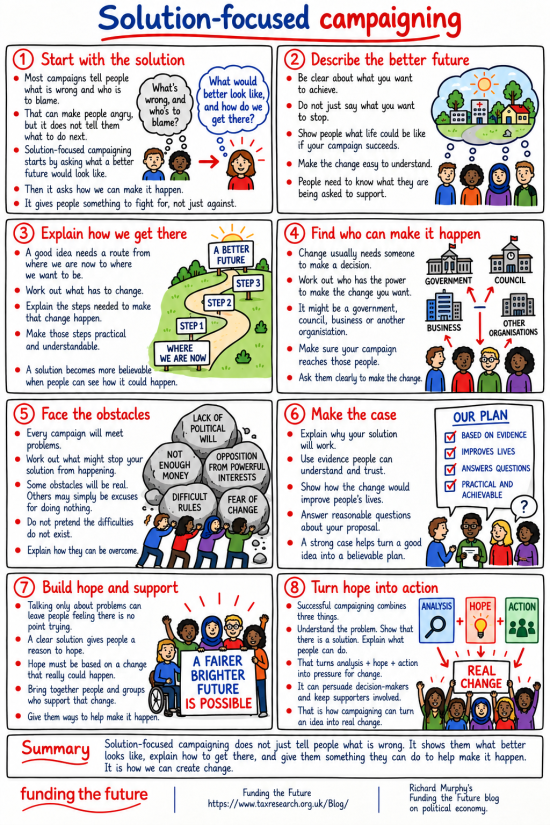
There is no transcript for this video. This, however, is my summary:
In this Funding the Future podcast, I talk with my old friend John Christensen about something we have both spent much of the last quarter of a century doing: campaigning for change.
The conversation preceded the Funding the Future event in Ely, where solution-focused campaigning was a central theme, but it covers much of the same ground.
John and I have worked together for 24 years, beginning with the creation of the Tax Justice Network, and we used that experience to ask a simple question: what makes campaigning actually work?
Our answer was that successful campaigning cannot simply be about identifying what is wrong. Problems matter, and so does understanding why they exist, but endlessly describing them can leave people feeling powerless. Campaigning has to offer something more. It has to describe what a better future might look like and explain how we might get there.
That is what I mean by solution-focused campaigning.
John recalled our first meeting in Jersey in 2002. Within minutes, we were discussing what eventually became country-by-country reporting. The problem was clear: multinational companies disclosed too little information about where they made their profits and paid their taxes. Instead of simply complaining about that lack of transparency, we developed a specific proposal to change it.
That experience taught us several lessons.
First, imagine the better outcome. This is harder than it sounds. It requires moving beyond criticism and asking what the world would look like if the problem had actually been solved.
Second, turn that vision into a practical proposal. Country-by-country reporting worked as a campaign because it was not merely a slogan. We developed a detailed proposal that could be discussed with governments, international organisations, businesses, NGOs and journalists. Campaigners need enough technical understanding to show that their solutions could actually work.
Third, understand the system you are trying to change. Our tax justice campaigning was never simply about individual tax abuses. We wanted to change the structures that allowed multinational companies and wealthy individuals to avoid accountability. That was particularly important for countries in the Global South, which needed sustainable tax revenues rather than permanent dependence on aid, debt relief or trading arrangements determined elsewhere.
Fourth, build networks. The Tax Justice Network succeeded because it was never just a handful of tax specialists. We worked with organisations including Publish What You Pay, Global Witness, Christian Aid and others. We developed relationships with journalists and filmmakers. We talked to politicians and officials. We also engaged seriously with those who opposed what we were proposing.
That last point matters. Effective campaigning requires understanding the arguments of your opponents. John and I spent considerable time listening to objections to our proposals and working out whether they were valid. When they were not, we made sure we could explain why. That meant that when we eventually sat in meetings at the OECD, United Nations, the IMF, World Bank, the Treasury and elsewhere, we were prepared.
Campaigning also requires political salience. Technical proposals on their own rarely change the world. Tax justice became politically powerful because technical work was combined with campaigning, media coverage, parliamentary scrutiny and grassroots activism. By the time tax avoidance became a major political issue after the global financial crisis, we already had solutions available.
There is a broader lesson in this.
A campaign needs a story that people can understand. Country-by-country reporting is technically complicated, but its basic message was simple: multinational companies should be accountable for the profits they make and the taxes they pay in each country where they operate.
Similarly, describing tax havens as “secrecy jurisdictions” helped change the way people understood their role. The language of a campaign matters because people need a narrative they can grasp and repeat.
We discussed how the same approach could apply to current political challenges, including the creation of a national care service. Announcing that such a service should exist is not enough. We need to imagine what it would actually look like. What people would be required? What training would they need? What infrastructure would support them? How would care be delivered where people need it?
The starting point is real resources. If we know what we want to achieve and the resources required to achieve it, finance can follow. Simply announcing money without designing the system that the money is supposed to create is not enough.
There is another requirement: staying power. Country-by-country reporting did not become international policy overnight. We were prepared to campaign for ten or fifteen years because systemic change takes time. Campaigning requires conviction, expertise, networks and persistence.
The central point of our discussion was straightforward: problems without solutions breed despair.
There is no shortage of problems to worry about: poverty, the NHS, education, care, inequality and, above all, climate change. Simply describing those problems more loudly will not necessarily persuade people that change is possible.
Campaigners therefore have a responsibility to offer hope grounded in practical possibility. They need to describe a better future, work out how it could be delivered, build the networks required to support it, create a compelling narrative and then persist until the political opportunity for change arrives.
John and I have seen that happen. Country-by-country reporting became a reality. Automatic information exchange became a reality. International cooperation through initiatives such as Tax Inspectors Without Borders has helped countries recover substantial additional tax revenues.
None of these ideas began as inevitable reforms. They began because people imagined that things could be different and then did the detailed work required to show how.
For decades, neoliberal politics told us that “there is no alternative”.
There are always alternatives.
The task of solution-focused campaigning is to imagine them, explain them, make them credible and build the support required to turn them into reality.
That is how campaigning can change the world.
Thanks for reading this post.
You can share this post on social media of your choice by clicking these icons:
There are links to this blog's glossary in the above post that explain technical terms used in it. Follow them for more explanations.
You can subscribe to this blog's daily email here.
And if you would like to support this blog you can, here:

 Buy me a coffee!

Fabulous day yesterday. Great to meet you and John, and fellow attendees. It’s hard to influence people; neoliberal thinking is so ingrained, but events like yesterday give everyone an extra bit of motivation.
Many thanks, Kevan. Good to meet you.
Richard, country-by-country reporting has a longer history than your account of a 2002 conversation in Jersey suggests. Mandatory country-by-country reporting initiatives are often presented as recent, but academic authors and the United Nations Centre on Transnational Corporations proposed similar ideas as early as the 1970s. Matti Ylönen’s historical study traces that lineage and quotes one early call for foreign financial reports furnished on a country-by-country basis, a quarter of a century before your draft.
The modern push did not begin with you either. Ylönen identifies a key milestone in 1999, when an NGO, Global Witness, published A Crude Awakening about oil revenues in Angola. That work produced Publish What You Pay and the EITI, both of which set the standard for disclosing payments country by country. These are the organisations you yourself name as allies.
The reforms that actually became law came from other people. Section 1504 of Dodd-Frank, sponsored by Senators Cardin and Lugar, was one. The EU’s 2013 bank disclosure rules were another. Most significantly, OECD BEPS Action 13 came from a G20 mandate negotiated by governments, and it produced confidential reports to tax authorities rather than the public disclosure you had argued for.
You certainly advocated for this. But the idea had many authors. It is disingenuous of you to claim all the credit.
I am afraid this is simply wrong, and it conflates several quite different things.
I am aware that suggestions were made in the 1970s about multinational companies providing information by country. They were brief asides from which no developed system of country-by-country reporting emerged, and I was entirely unaware of them when I developed my proposal.
The same problem applies to your references to Global Witness, Publish What You Pay and the EITI. Their original concern was disclosure of payments by extractive companies in individual countries. That was important work, but it was not country-by-country reporting as I designed it: a comprehensive accounting framework requiring multinational companies to disclose turnover, profits, employment, tax and other information for every jurisdiction in which they operated. PWYP later enthusiastically adopted my work because to was superior. I worked very closely with them.
As for Dodd-Frank, the EU rules and OECD BEPS Action 13, these came later and all are based my work. I worked with the EU and OECD on these ideas. Of course politicians, campaigners and governments were responsible for turning ideas into legislation. I have never claimed that I personally legislated CbCR around the world. That would be absurd. What I have claimed is that I created the modern country-by-country reporting proposal from which those subsequent developments drew.
The OECD has described me as the originator of the idea of country-by-country reporting. I was the person who agued it through to adoption there, working closely with its then tax director, Pascal St Amans, who was a major supporter.
Your are, then being disingenuous. My claim is entirely correct.
As ever an entertaining and very informative video, this one with an especially strong message. I never cease to be humbled by how much the two of you have achieved over the last few decades while I’ve just been bumbling along.
I have unwittingly dobbed myself in to talk about modern money sometime soon at the local U3A discussion group I attend every Friday and I think this message is one I need to include. What are the problems to which a better understanding of how money works can provide a solution?
Kit WN, as Richard has noted many times in previous blog posts, the limit on ‘what’ can be done is not money, but whether the resources required to do something exist.
For example, unemployment is unnecessary- there are plenty of things for people to do, for those people who do want something to do.
I enjoy walking along old canals, for example, and England there are many miles of disused canals that could be made navigable again, and many local groups that volunteer to restore them that do not have the money (to do so)…. or alternatively better fund the Canals and Rivers Trust so that *they* carry out that work…
There is so much that ‘could’ be done.
Marc,
Much to agree with!
My sister and her husband spent a considerable amount of time clearing out canals around Manchester in past decades. There’s a great deal of satisfaction to be had from navigating 70 feet of barge into a lock without hitting the sides.
Richard – yes – campaigning wotks! In todays final plenary at conference, the Green Party of England and Wales have just voted in favour of the Economy Policy Working Groups proposal for a new fiscal framework..
So yes, organising, campaigning, communicating and caring does work.. thankyou from many of us to you Richard for your feedback ans for your ability to communicate real-world economics.. and thankyou for this blog and your YouTube resources..
Our work continues.. I think there are a number of members who would be great in talking through the policy with you on camera sometime, if you’d be interested.
Best wishes..
Adey Peterkin
I am very pleased.
Thank you.
Might you send me the finally adopted document?
[…] I made clear in advance, and as was reiterated in yesterday's video and supporting blog, the focus was on solution-focused […]
In relation to having in mind a vision of what could be (if that’s a fair characterisation), I just read this, https://pluralistic.net/2026/10/03/full-employment/, and noted a hidden nod to MMT as well as the whole thing offering a vision of better. I don’t know if you’ve come across Cory Doctorow before …
We have corresponded