
Politicians and economic commentators constantly talk about “taxpayers' money”. In this video, I argue that this phrase fundamentally misrepresents how government spending and taxation work.
The conventional story says that the government collects taxes and then uses that money to pay for schools, hospitals, pensions and other public services. I argue that the actual monetary process works in the opposite order: government spending creates money, while taxation subsequently removes money from circulation.
When the UK government spends, payments are made through the banking system. Taxation then withdraws spending power from the economy. There is no pot containing individual taxpayers' payments waiting to be spent again on public services.
But that does not mean tax is unnecessary. Far from it. Tax plays essential economic and social roles. It helps control inflation by removing spending power, can redistribute income and wealth, and can encourage or discourage particular activities.
Tax can therefore be used to tackle inequality, discourage pollution and harmful consumption, support socially desirable activities and strengthen the relationship between citizens and government.
The mistake is treating government finances as though they work like household finances. Households need income or credit before they can spend. A currency-issuing government operates differently.
Understanding that difference changes the way we think about government spending, taxation, inflation and the supposed financial constraints placed on public policy.
This is the audio version:
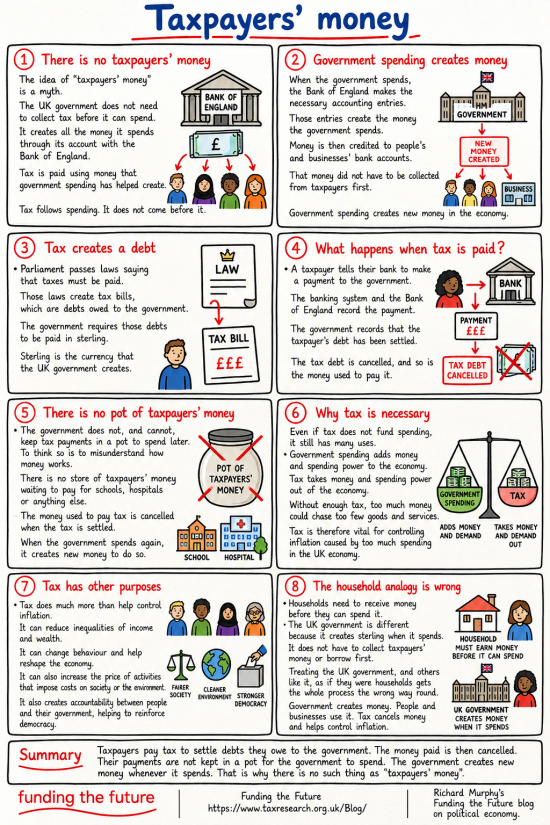
This infographic supports this video:
This is the transcript:
Every time you watch some economic commentator on the television or listen to a politician, they will talk about ‘taxpayers' money'. And let me assure you of something: there is no such thing as ‘taxpayers' money'.
What they're trying to do is pretend that the tax that you pay to the government is what the government then spends out on the services it provides. But that is technically impossible and is not what happens inside the UK economy. They are pretending that the UK government is like a household, and it isn't.
As a matter of fact, the UK government does never need to collect tax before it can spend because every time it does spend, it does so by creating new money to fund the spending in question, which the Bank of England provides on demand. Tax is then used as a way to reclaim the money that the government has spent into the economy.
Tax does then follow spending. It does not come before it. And as a consequence, the government can never spend the money that you pay. That does not happen. There is no such thing as taxpayers' money. This is a complete myth meant to mislead you about the way in which government works. And let's be clear, it does mislead people about the way in which government works. Politicians mislead themselves. The political commentators all believe the myth, and as a consequence, we get bad economic policy.
But let's go into this in some more detail. When the government spends, the Bank of England makes the necessary accounting entries to record what the government wants to do. Those entries create the money the government spends. They record that they have increased the government's overdraft with it. And they record that they have passed the money that they have created to whoever it was that the government wanted to pay.
That is how all money is created in the UK. There is no such physical thing as money. It is all just an entry in an accounting ledger. And the Bank of England does it for the government, the same as your commercial bank does it for you.
So what happens then? Well, the government has created new money, but it can't do that endlessly, of course, because if it did, we would have massive inflation in the UK economy. So it has to reclaim some of the money it has spent. How does it do that? It does it via taxation.
Parliament passes laws that say that taxes must be paid, and those laws are used to create tax bills, which are debts owed by you, by me and everybody else in the UK to the government.
The government then requires that we pay those debts using sterling, which is the currency that it has created and put into circulation with its spending. That is what the government demands of us, and it does so because, by paying tax, we cancel the money that the government created.
When the tax is paid, a taxpayer tells their bank to make a payment to the government. The banking system, and then the Bank of England, records the payment. And the government then records that the taxpayer's debt has been settled. It has been cancelled, in other words. There is nothing more due.
And in the same way the government records that the money that it put into circulation in the economy has now been repaid. The tax cancels the money created. The money no longer exists. That is what tax is for. Don't pretend it's for anything else directly because it isn't. Tax only primarily exists to reclaim from the economy the money that the government put into circulation in it as a consequence of its spending.
I know that is an intellectually very difficult thing to grasp because we have all been told that tax funds government spending, but there is not a word of truth in that statement. As a matter of fact, tax exists to cancel the money created by government spending. And so the right ordering of events is not tax then spend; it is spend then tax. The world goes round in a different direction to that we've been told.
This is a bit like a Galileo moment if you've never heard this before.
Galileo said that the Earth moved round the Sun. Before he said so, most people thought that the Sun moved round the Earth. You've just got to get your head around this because as a matter of fact, what I've just told you is right and it is technically impossible for it to be the other way round.
And as a matter of fact, then the government does not keep a pot of payments made by taxpayers, which they can then spend later. That is, again, a technical impossibility because the money that you pay when your tax is settled cancels existing money. It no longer exists. It can't therefore be used again. There is no such concept with regard to money and accounting, and money and accounting are the same thing in this sense. Money does not exist if it is not recorded in an accounting ledger. So what is not possible in that ledger cannot exist otherwise.
There is then no store of taxpayers' money waiting to pay for schools, hospitals, or anything else. The money used to pay tax is cancelled when the tax is settled, and when the government comes to spend again, as it will, often within minutes of you making payment of your tax, it creates new money to do so. It never in any way at all is impacted in its decision to spend by whatever you might have paid.
But that does not mean that tax is not necessary, far from it, in fact. Even if tax does not fund spending, it still has many uses. As I've just noted, government spending adds money and spending power to the economy. That drives our economic well-being, as well as providing the essential services on which we all rely. And taking money and spending power out of the economy by taxation reduces the amount of money in the economy, and that controls inflation.
Without enough tax being charged, too much money could chase too few goods and services, and we all know that that can lead to inflation running out of control. The point is it hasn't run out of control most of the time in the UK, except in the exceptional circumstances where we have an external price shock. That means tax works. As a mechanism to control inflation in the UK economy, tax is amazing. It has stabilised our economy for a very long time. This is the mechanism that works. We don't need interest rates to control inflation. We only need tax.
But tax has other purposes as well, and I need to emphasise those. It can reduce inequalities of income and wealth, and tax is deliberately used for this purpose. If there is one tool that produces a fairer society in our world, it is tax. It helps shape the world we live in, and this is what I called ‘The Joy of Tax' when I wrote a book of that name in about 2015.
It can also change behaviour and help reshape the economy. If the government wants to discourage an activity like pollution, it could do so by whacking an extra tax on oil, gas, and other emissions. At the same time, if it wants to encourage an activity like healthcare, for example, it can apply no VAT to its supply, and as a consequence, that activity is promoted. The same is true with education and many other socially desirable activities and some products that the government wants us to consume, like books and newspapers.
At the same time, the government can also use this mechanism of taxation to tax the bads in our world. Things like tobacco, and alcohol, and petrol, because they create pollution or harm health, and gambling is another activity that falls into this category. That is tax working to deliver social policy.
But there's one other aspect to tax as well, which is really important. Tax creates accountability between people and their government, helping to reinforce democracy. People who know they pay tax, and that is those who pay income tax in particular, do appear to have a much stronger inclination to vote than those who are not aware of themselves paying that tax.
This is important because we do want a democratic society, and people appear to be motivated to vote when they pay tax because they want to have a say on what that tax rate might be and what is going to be taxed.
But let's come back to the key point in all of this. The thing that is wrong is the household analogy. This belief that the government should work like a household. That belief underpins microeconomic theory. It underpins macroeconomic theory. It underpins neoliberal thinking. It underpins the thinking of our politicians. It underpins the thinking of our political commentators and our economists.
But the point is households do need to receive money before they can spend it. And the UK government is different because it creates sterling when it spends. This means that the government and households have fundamentally different forms of economic behaviour, and that means the government does not have to collect taxpayers' money or borrow before it can spend.
As a result, it is not like a household, and to pretend that it is, which all those commentators claim, is just false. There is therefore no pot of taxpayers' money that the government needs to be able to spend, even though we, if we want to spend, either have to have money in our bank account or a line of credit, a credit card, an overdraft, or a loan to be able to do so. That is not true for the government, and therefore there is no concept of taxpayers' money, which makes any sense at all.
Our government creates money. People and businesses use it. The two are entirely different. Tax cancels money, and it helps control inflation. Taxpayers pay tax to settle debts they owe to the government. That is the point of taxation. The money paid is then cancelled. Their payments are not kept in a pot for the government to spend. The government creates new money whenever it spends.
That is why there is no such thing as taxpayers' money, and you now have my permission to yell at the television, the radio, or whatever media you use to hear the news, to shout at it and say, “That's not true,” because there is no taxpayer's money and anybody who claims otherwise is telling you economic nonsense.
That's what I think. What do you think? There is, of course, a poll down below. Let us have your opinions. Please do like and share this video. Please do subscribe to our channel, and please do hit that bell button because you'll then be told when we make another video. And if you'd like to buy us a coffee, there is a button to let you do that down below. It's called Ko-fi, K-O-F-I or coffee if you want to say it in the way that I think they intend, and that helps us make these videos and keep them flowing.
Poll
Thanks for reading this post.
You can share this post on social media of your choice by clicking these icons:
There are links to this blog's glossary in the above post that explain technical terms used in it. Follow them for more explanations.
You can subscribe to this blog's daily email here.
And if you would like to support this blog you can, here:

 Buy me a coffee!

It’s a tad bit easier to understand in german.
The german word for tax is “Steuern”.
Which literally can mean “to pilot” / “to navigate” / “to control” / … .
And the singular “Steuer” can be translated with “rudder”.
The picture “Dropping the pilot” of Bismark, when he was forced to retire as Reichskanzler in 1890, was quite adequate in this regard.
So if e.g. politicians say “Taxes for fighting climate change needs to be lifted”, this could be translated to “We want to give up control of the ship, the iceberg ahead will move out of the way itself”.
Obviously doesn’t help much though when politicians are deliberately illiterates in financial terms.
Thanks for yet anothe “root of the matter”article!
Might the word “lie” be a reasonably accurate alternative word for “pretend”?
Might the past and current transfer of massive power from Parliament to sets of unelected officials prove that the U. K is not a democracy but, in practical reality, a subverted polyarchy?
How might it be improved into being a genuine, valid, transparent polyarchy, which seems to be a the nearest structure/system to a democratic form of national governance?
I was being polite
I’m generally in favour of politeness but, after years of being so widely and repeatedly lied to for the benefit of a very small privileged section of the population, is politeness still appropriate?
No.
And the demand for it is a weapon is suppression.
The phrase is often used to decry x spending on y, people want to see value for money with said spending/taxation as well.
Labour came door knocking yesterday, campaigning for the locals. My two ward councillors plus helpers.
I was able to work through a long list of reasons of why, although I too had doorknocked for them in 2019, I would probably never vote for them again. Your material was very useful, and I explained about tax and the household analogy. I also showed him my copy of “The Fraud”, by Paul Holden which he hadn’t read. Then there was Gaza… He was eventually dragged away by one of the councillors after about 20mins. Nice lad.
The leaflet they left had not a single policy detail in it -100% fluff, and a promise to listen.
But they won’t dump their beloved household analogy…
Thank you
The ‘business analogy’ is equally wrong. Many politicians criticise their opponents for lack of business experience, believing that governments need to operate either profitably or by breaking even. This is, of course, the wrong approach. The only grain of truth in this approach is that govs strive to be efficient, not wasteful. Businesses can run out of money whereas, despite what some desperate politicians claim, govs who are sovereign and create their own money, cannot.
Govs simply cannot afford to fail, so need to ensure they avoid inflation and devaluation of their currency, by strictly controlling the supply of money so that it matches the resources available in the economy. Indeed, govs have a duty to ensure their is enough money available to fully utilise the resources that are available. If we can do something, then we should do it and not use lack of money as a reason for inaction.
Much to agree with
Again, this cannot be said often enough – one of Thatcher’s biggest lies and her stickiest. It’s made us into a country that just continuously argues about who pays the bills and has turned that into something apparently noble and meaningful. It’s the biggest decoy ever created in my view.
Richard, you say economists all rely on the household analogy. They do not, and the right has rejected it as firmly as the left. In 1948 Milton Friedman proposed financing deficits by creating money. Alan Greenspan said the US could never default because it can always print dollars. Ben Bernanke, appointed by George W. Bush, made the same point. On the centre and left, Paul Krugman, Olivier Blanchard, Simon Wren-Lewis and Jonathan Portes have attacked the analogy for years. I could list many others.
Yet none of them concludes that fiscal constraints vanish, and that is the part you leave out.
They accept that money creation has a cost. Since QE, the Bank of England has paid Bank Rate on reserves, so new money costs roughly what gilts do. You have written about this yourself, so you know it.
They accept that the order of ledger entries changes nothing. If tax is cut, the government must either borrow more, with interest funded by future taxpayers, or accept higher inflation. Either way, the public pays, and that cost is what “taxpayers’ money” means.
They accept that markets impose limits. The 2022 gilt crisis showed that even a currency issuer can be punished for losing credibility.
And none of them believes tax alone can control inflation, because tax changes are too slow and too political to do the job.
As an accountant, you know the difference between mechanics and constraints. Presenting one as a refutation of the other is not a Galileo moment. It is sleight of hand.
This is a pack of misrepresentation.
I have never said that recognising how money works means fiscal constraints vanish. I have said repeatedly that the constraint is the availability of real resources and the inflation that results if government tries to spend beyond them.
Nor does creating reserves inherently “cost roughly what gilts do”. The Bank of England pays Bank Rate on reserves because it chooses to remunerate them at Bank Rate. That is a policy decision. I have repeatedly argued for tiered reserve remuneration precisely because there is no necessity to pay Bank Rate on every pound of reserves.
Your tax argument simply assumes the conclusion. A tax cut does not mechanically require either additional borrowing or inflation. The inflationary consequence depends upon demand, saving and the economy’s capacity to supply what is demanded.
And 2022 does not demonstrate what you claim. The Bank of England’s own account says leveraged LDI funds faced collateral calls and forced gilt sales, producing a self-reinforcing spiral and market dysfunction. The Bank then stopped that dysfunction by buying gilts.
Of course mechanics and constraints are different. That is precisely my point. The mechanics tell us that the constraint is not “running out of taxpayers’ money”. The constraints are inflation, resources and productive capacity.
Calling an accurate description of those mechanics “sleight of hand” does not answer the argument. It is bankrupt reasoning.
What you say is correct.
But what really irks me about “taxpayers’ money” is the implication that those that pay income tax have some greater say in how the government spends money.
You covered this with regards to billionaires threatening to leave the country but the attitude trickles down.
Agreed
That’s a good info graphic 🙂 It is, I agree, the way money works.
Unfortunately the government deliberately obfuscates what is actually happening.
You say, and I agree, “The tax debt is cancelled and so is the money used to pay it”. But, in practice, through the debt is cancelled the government pretends that the money isn’t cancelled. Instead it adds it to the government’s account. I don’t think it should do this. I think it should just admit that the money is, actually, cancelled. I think crediting money that has been cancelled is false accounting.
On the other hand, when the government creates money by spending, it records this as a debit in the government’s account. That doesn’t make sense either because the government owns the Bank of England and you can’t owe yourself money. Again, I consider recording a debt when none actually exists to be false accounting.
You may disagree and think that this is mere sophistry. But the point is that the government, Treasury, and the Bank of England go to great lengths to disguise what is actually happening. At the root of this is ignorance, greed and selfishness. The wealthy wish to maintain the fiction that the government is like a household so that they can justify high interest rates, and other measures, to transfer money from the poor to the wealthy. That is why your work, debunking this nonsense, is so important. 🙂
I agree with much of your underlying argument, but I would not call this false accounting. On that I do disagree.
Accounting records relationships between different legal and institutional entities. The Treasury and Bank of England have separate accounts precisely because they have separate institutional roles, even though both are ultimately parts of the state.
The mistake comes when those accounting entries are interpreted as though they describe a household borrowing from an entirely independent bank, or when tax receipts are treated as though they are a pot of money available to fund subsequent spending. That there is a banking relationship is, however, a fact.
So I don’t think the accounting itself is necessarily dishonest. The problem is the story politicians, economists and others tell about what those accounts mean. That story disguises the government’s capacity to create money and encourages the entirely false idea that government must obtain taxpayers’ money before it can spend.
To deny that this story matters is to deny the truth.
Yes I think you are right.
I guess the issue is, as you have addressed previously, that the creation and cancellation of money is hidden. It is only revealed in the Whole of Government accounts. This is always late, full of ambiguity and inaccuracy and includes lots of other stuff that disguises the true monetary process.
That’s my point really, that the true nature of money is hidden. It’s not obvious from the way government finances are presented, that there’s not such thing as tax payers money.
I welcome the use of the word “cancelled” with respect to what happens when tax is paid, rather than “destroyed”. Hopefully, this will go some way to reducing the likely emotional response from taxpayers who cannot (or will not) understand why their money isn’t being used to fund the government. In my view, the use of the word “government spending” in this context is also a misleading household analogy, which is partially responsible for the myth of “taxpayers’ money” that you describe. It implies in most people’s minds that the government is paying for things “using our money”. I am not sure what a better word would be, however. It needs to be a word that communicates the essential role of the government in creating money for the economy to operate.
What is it if it is it government spending? Who else is doing it? I don’t get this objection. Let’s credit the government with capacity to spend its own money
The idea of ” taxpayers money” seems utterly entrenched. For example, my HMRC app provides a breakdown of “how my income tax has been spent”. It shows that the highest percentage (21.3%) is spent on welfare. Lots of politicians and economists keep saying we must cut welfare because it’s not “fair” on the “taxpayer”. I also note that 10.8% of “my income tax” is spent on national debt interest. I have heard some commentators say that this is more than is spent on the education budget (10.3%) and cannot be justified, therefore we must have “fiscal consolidation” and cut public spending. I don’t agree. Having read your articles for the last year or so, I now feel much more informed about how money and the economy really works. And yes, I do find myself yelling when I hear people referring to “taxpayers money”, because I now know this is nonsense!
HMRC is run by people who are neoliberal to their core. They would not be there otherwise.
You say “It never in any way at all is impacted in its decision to spend by whatever you might have paid.” Which implies that paying, for example, NI for 40 or more years doesn’t give you any right to a pension. There is an implied contract there, but Parliament could abolish it at any time. This could make a lot of people very unhappy. Perhaps if NI and income tax were merged, which is a good idea for many other reasons, people would not feel they could expect a pension, but this would add considerably to a sense of insecurity.
There is not an implied contract in NI or tax. There is only trust. Politicians can break it.
Reform have already considered abolishing almost all state pensions. Trust in politicians is very low — we do not expect them to be consistent or helpful. So while you are undoubtedly correct in saying there is no need for govts to supply pensions, NHS, education — they have a free choice in this matter –, a population confronted with this insecurity might well prefer the comfort of “rights”, even if mistakenly. A govt must have some level of trust from its people, and “rights” are part of relying on this trust.
Box 5 also does away with the notion of a ‘war chest’, money tucked under the government mattress for a rainy day.
It does
Hi Richard, this has me slightly confused( not difficult I grant you), how then does a sovereign wealth fund as in Norway work?
The profits of an industry were used to fund investments.
Not the same as tax at all.
Plus Norway’s sovereign fund is held in foreign currency (i.e. not NOK) as is it’s oil income which is in US dollars
This is a find created out of the profits of a state owned enterprise. That is not tax.
I don’t actually watch your videos; the transcripts and infographics are my preferred way of taking in information. But I do go to youtube and read the comments on them. A few comments this morning claim that what you are saying is just semantics, a sad result, of decades of children not being taught the importance of close interpretation of what is actually being conveyed by the written word
It seems to me that it might be useful to produce a video/infographic which would show what would happen if the state *didn’t* issue any new money into the economy but depended only on taxation and ‘borrowing’ to fund its expenditure.
Chatgtp came up with this for me. *I know you don’t need it* but I thought others might find it interesting.
“If the government stopped putting new money into the economy and could spend only money it had first collected in taxes or borrowed, it could no longer add to the amount of money available to people and businesses in Britain.
Banks can create money when they lend, but every pound they create in this way comes with a debt attached to it. The borrower has to repay the loan, together with interest, so bank lending cannot provide a permanent source of additional money for the economy.
The other way new money can come into Britain is by selling more to other countries than we buy from them. But Britain normally buys more from abroad than it sells.
So if the government stopped creating new money while Britain continued to buy more from abroad than it sold, there would be no continuing source of additional money for people and businesses in Britain. They could keep spending for a while by taking on more debt, but that cannot continue indefinitely.
Thank you for this, and you are right that the claim that this is “just semantics” misses the point. The words matter because they describe fundamentally different economic processes.
I would, though, seriously qualify the ChatGPT answer.
Firstly, foreign earnings have nothing to do with this. That is deeply misleading. The system I am describing is all in sterling.
Secondly, bank-created money is not necessarily temporary in aggregate because banks are continually making new loans as old ones are repaid. But every pound created by bank lending does have a corresponding private debt.
The more fundamental point is that government simply does not and cannot secure the money it needs from taxation or borrowing. That cannot happen: it is technically not possible, any more than people can repay loans before they have received the loan itself.
That means saying that the government must obtain existing money through taxation or borrowing before it could spend is to ask a question to which there is no answer because in a fiat currency economy that cannot happen.
In that case the description “taxpayers’ money” is not merely an unfortunate choice of words. It denies reality.
But I do note your point on another infographic. I am working on a series on money now.
Thank you Richard, sorry to disturb your Sunday with rather an inane question, thinking about it.
I think the most insidious thing about this ‘lie’ (what else can we call it) is the fuel it gives to people who want to complain about what the government is spending ‘my’ money on, encouraging them to think about government spending from a purely personal and individual point of view.
Putting the cart back where it belongs, and pointing out that all money is created by the government in the first place might, perhaps, allow them to think about the bigger picture. Or am I just being naive?
No, you are living in hope.
I watched the video, excellent! I will return to it and hype it as I’m hyped out this week.
Excellent video, I will hype it when I can, being out of hypes today.
Thank you.
It is interesting that on here all comments on here are 100% in agreement but on twitter it’s the reverse. Do you refuse to put up dissenting posts on here?
In a word, no. Unless they are trolling of course. But you even got around that.
You are also entirely wrong. I just checked. The comments are interested and positive. Why are you wasting your life?
I believe that those who talk about taxpayers’ money do so because that is what they were taught. I don’t think Thatcher was informed enough to mislead, when she said there was no such thing as government money, only taxpayers’ money. And it suited her aims of defunding government in order to privatise public services. Milton Friedman would have laughed all the way to bank.
“Taxes for revenue are obsolete.” (Randall, p. 19 quoting: Beardsley Ruml, “Taxes for Revenue Are Obsolete”)
“Taxes are critically important, but there’s no reason to assume the government must raise taxes whenever it wants to invest in our economy. [..] Your taxes don’t actually pay for anything, at least not at the federal level. The government doesn’t need our money. ” Kelton, Stephanie. The Deficit Myth (p. 22).
“the UK Government creates new money and purchasing power when it undertakes expenditure, rather than spending being financed by taxation from, or debt issuance to, the private sector” (Berkeley, A. et al, 2022, Abstract)
“The new perspective also debunks as a myth the notion that “the taxpayer” finances government spending. Since the government is always creating new money as it spends, tax payments do not serve to finance it” (Ehnts, 2024, p.11)
Thank you
Bambi Burnham today trying to give the impression he is prepared to carry out radical reform to social care but immediately claims he does not want to put ‘extra strain on the public purse’. So whilst Starmer and Reeves had a household budget Bambi has been further reduced to a purse. With Healy as Chancellor the overall direction of travel is clear and we are certainly not heading in the right direction. The change of PM is the equivalent of a quick cosmetic spray tan which may be more appealing to some. The tan will wash off before long.
Much to agree with
“Tax plays essential economic and social roles.” Agree. In this case:
https://www.theguardian.com/politics/2026/sep/27/high-court-floodplains-development-safety-test-north-somerset-yatton
the developer wants to transfer (flood) risk to gov (well who else will pay-up when it all goes underwater?). The gov should respond by a 500% tax up-front on houses built on floodplains – said tax being used to cover when – you know – the houses flood.
One paragraph law would do it & the parasites mentioned in the article would desist.
Their household analogy is also strange one, it paints the household as a paragon of financial prudence and ‘balancing the books’, when the reality of this economic model is the vast majority of households in UK are living in debt, high mortgages, and financial insecurity.
The household analogy that can’t sustain households!
I think the irony of this might be lost on them though….
Very good.
According to the “UK Insolvency Services” website, total consumer debt is around £1.94 Trillion, and total annual interest payments on this debt are £87.4 Billion. Defaults are apparently rising. Consumers can’t create money. But we’re told we must worry about Government debt and interest payments while consumer debt, where the real concerns are, barely gets a mention.
The Bank of England says consumer credit is about £230bn right now and mortgages are £1.5 trillion. With that distinction, I think you are right.
AI is telling me that official Bank of England metrics exclude student loans, loans from family and friends, unregulated Buy Now, Pay Later (BNPL) balances, and high-cost doorstep or logbook lending. If this is so, it suggests an alarming degree of complacency. But hey, reduce Government spending and all will be well!!!?
Agreed
Exactly, the household analogy that ignores the real households out there in the real economy are sinking in debt.
Delusional.
Corporate Debt (~£1.5 Trillion) is nearly 6 times larger than consumer debt (~£0.253 Trillion).
Sources: Who finances UK business? (Bank of England)
Office for National Statistics
That is nit true. You are ignoring mortgages.
That’s a good info graphic 🙂 It is, I agree, the way money works.
Unfortunately the government deliberately obfuscates what is actually happening.
You say, and I agree, “The tax debt is cancelled and so is the money used to pay it”. But, in practice, through the debt is cancelled the government pretends it isn’t. Instead it adds it to the government’s account. I don’t think it should do this. I think it should just admit that the money is, actually, cancelled. I think crediting money that has been cancelled is false accounting.
On the other hand, when the government creates money by spending, it records this as a debit in the government’s account. That doesn’t make sense either because the government owns the Bank of England and you can’t owe yourself money. Again, I consider recording a debt when none actually exists to be false accounting.
You may disagree and think that this is mere sophistry. But the point is that the government, Treasury, and the Bank of England go to great lengths to disguise what is actually happening. At the root of this is ignorance, greed and selfishness. The wealthy wish to maintain the fiction that the government is like a household so that they can justify high interest rates, and other measures, to transfer money from the poor to the wealthy. That is why your work, debunking this nonsense, is so important. 🙂
I agree with much of your underlying argument, but I would not call this false accounting. On that I do disagree.
Accounting records relationships between different legal and institutional entities. The Treasury and Bank of England have separate accounts precisely because they have separate institutional roles, even though both are ultimately parts of the state.
The mistake comes when those accounting entries are interpreted as though they describe a household borrowing from an entirely independent bank, or when tax receipts are treated as though they are a pot of money available to fund subsequent spending. That there is a banking relationship is, however, a fact.
So I don’t think the accounting itself is necessarily dishonest. The problem is the story politicians, economists and others tell about what those accounts mean. That story disguises the government’s capacity to create money and encourages the entirely false idea that government must obtain taxpayers’ money before it can spend.
To deny that this story matters is to deny the truth.
I think the American comedian Chris Rock (and probably also The Taxpayers’ Alliance) would benefit from reading this post. On a comedy tour in the late 1990s, one part of a routine was “You don’t even pay taxes they take taxes…You get the cheque. Money gone! That ain’t a payment, that’s a jack”.
With that said, Chris saw the error of his ways. At the 2012 Sundance Film Festival he was quoted as saying “I’ll pay higher taxes. I look at it this way. I can pay higher taxes and people can have jobs, or I can pay lower taxes and I have my kid’s teacher asking me for a loan”.
Could you comment on the role of the OBR which seems to assess government spending as a household does?
It does just that