
Modern monetary theory, or MMT, is frequently attacked for supposedly saying that governments can print unlimited amounts of money, ignore inflation, abandon taxation, accumulate endless debt and destroy the value of their currency.
But is that actually what MMT says?
In this video, I explain what modern monetary theory is and address most of the common criticisms made of it.
MMT starts with a simple observation: a government such as that of the UK, which issues its own currency, creates money when it spends. Taxation and government borrowing perform important economic functions, but they do not provide the pounds that the government needs before it can spend.
That does not mean there are no limits on government spending. The limits are real resources: people, skills, energy, materials, productive capacity and the things actually available to buy. Push demand beyond those limits and inflation can result.
That distinction between financial constraints and real resource constraints is at the heart of MMT.
I also look at taxation, government debt, exchange rates, inflation, Zimbabwe and Weimar Germany, and the claim that MMT is inherently left-wing and dismiss all of the nonsense talked about MMT when it comes to these issues.
MMT is not a political manifesto. It is an explanation of how money works. Understanding that changes the questions we should be asking about what governments can do.
Perhaps most importantly, though, I say this:
You can no more do MMT than you can do gravity. MMT explains how money works. Gravity explains why we are stuck to this planet. You can either understand MMT, or you can misunderstand it, but you can't do it because it is what is.
This is the audio version:
This infographic supports this video:
And because that one is a bit dense, there is also a version without images:

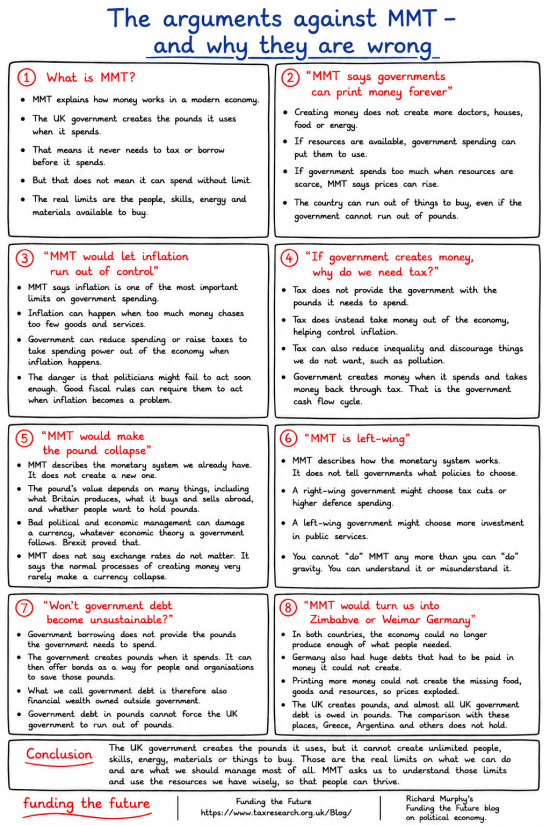
This is the transcript:
In my opinion, modern monetary theory provides the best explanation of how money works in a modern economy that is currently available to us anywhere. Warren Mosler, who created modern monetary theory in the 1990s, reckons I am its biggest and most widely noted exponent in the world. And I'm surprised to note that, but if it is, well, I'm happy to be in that position because understanding matters if we are looking at our economy.
But the point is, modern monetary theory, or MMT for short, has many critics; many people who don't want to understand what it says. And so, in this video, I want to talk about what those criticisms are after I've briefly explained what MMT is.
What MMT says
MMT explains how money works. That's it. It doesn't do anything else. It's not a manifesto. It's not a description of a political policy. It is not an explanation for the choices that economists and politicians should make. It just says how money works. Nothing more or less than that. And the description it supplies is of the way in which the system works now. You don't have to imagine that we're going to adopt it because we are doing it, and let's explain what we do.
The UK government creates the pounds it uses when it spends. It asks the Bank of England to make a payment, and so long as the Bank of England is satisfied that there's a budget to cover the cost of the spending in question, it is legally obliged to make the payment whether the government has any money in its bank account or not. And, as a matter of fact, it quite often hasn't, and the Bank of England simply marks up an overdraft for it.
It can do that whether or not tax or borrowing has come in, because tax and borrowing do not fund government spending. They can't because, until the government creates money by spending, there is no money available to tax or to lend to the government. So spending must come first. That is a critical insight that modern monetary theory provides.
But that does not mean any government can spend without limit. There are limits in the economy, but money is not the one that imposes the constraint.
The constraints are created by the availability of people, skills, energy and materials that are available to buy to make the things that we want. The real world imposes the constraint on the economy, and money doesn't. Now, this sounds radical, but as a matter of fact, it's true, and that's why I talk about MMT.
Does MMT mean unlimited money printing?
But now let's talk about the critics, because the critics have a series of arguments which I will run through and try to make brief because the arguments actually make no sense. The critics say that modern monetary theory, or MMT, says governments can print money forever, and the fact is, I've just said that MMT does not say that. MMT never says that. That is the exact opposite of what MMT says because MMT is obsessed with inflation and its control.
And MMT realises that spending more money does not create more doctors if there are no doctors available. It doesn't build houses if they're needed because builders have to do that. It doesn't grow crops. It doesn't create energy. Money cannot do any of those things. If they are available, we can buy them. If they aren't available, we can't. And so MMT says, when the resources run out, stop spending. If you don't, you will get inflation. And that is the whole point of inflation policy within MMT.
It provides a perfect explanation of how we get inflation and, what is more, how we can manage it. We can manage it by the government spending less or by taxing people more. And that is the way in which, when those resources aren't available, but there is excess demand, we can reduce that demand within the economy and therefore bring inflation under control. The country can run out of things to buy even if the government cannot run out of pounds, and that is perhaps the most important lesson that MMT supplies.
We have to manage the real economy. Our obsession with money is completely false, even though MMT does, in fact, spend much of its time explaining how money works. And that relationship between the real economy and money is vital.
Would MMT let inflation run out of control?
What else do the opponents of MMT say? Well, they say MMT would let inflation run out of control. But, as you've just heard me say, that is not what MMT does. In fact, MMT makes it clear how we can control inflation. But what it also says is that the way in which we try to control inflation is wrong. There are two causes of inflation.
One arises because of external price shocks. That is, oil price increases. That is, price increases because of reopening too quickly from Covid. That is a price increase in wheat and fertiliser as a consequence of war in Ukraine, and so on. That is the consequence of Donald Trump's tariffs. Now, all of those things change prices over which we have no control at all.
So, therefore, MMT says, don't try to control them. You can't. You are wasting your time. You're hitting your head against a brick wall if you try to change something which is beyond your limits to control. Instead, let your exchange rate float. Let that absorb the shock, and that's the only thing we can do. Let's be clear about that. We can't do anything else, so let's not pretend otherwise.
But the second thing that we can do, and which is inflationary, is have excess demand. I've already talked about this in the previous section, and the government in that case has to take action to reduce demand. Now, there are people who say that the government won't take that action and therefore MMT is at fault and can't work. But MMT has been operating for decades now. So let's not pretend that that's the case because, by and large, we've been quite successful at keeping inflation under control, and we've done it through taxation and not interest rates because interest rates don't work. And good fiscal rules, if we wrote them properly, would require governments to act when inflation became a problem, and we would therefore take control of it. But that's what a fiscal rule should be about, and not limiting the normal role of action by government because there's supposedly too little money available when that is never the case.
So, all of the arguments made against MMT on this issue just deny what MMT says. They are straw man arguments. They do not deal with the reality of what MMT talks about, and it makes inflation control the very centre of its thinking, which is unsurprising because it talks about money, and that therefore means inflation is always a matter of concern to it.
If government creates money, why do we need tax?
Let's look at another criticism. This is that if the government creates money, why do we need tax? And the critic will point out that we do need tax. And they'll say, therefore, that because the government doesn't need tax to spend, the argument for MMT must be wrong. But that's nonsense. MMT talks about tax. It makes it clear that tax is fundamental to the government's economic cycle. The government spends money into the economy, and of course that would be inflationary if we left it there, but we don't. Tax exists to take the money that the government has created out of the economy, and the primary goal for doing so is to control inflation. We are back to that point yet again.
But at the same time, and because tax does not fund government spending, which is a critical point, tax can be used as an instrument of social policy. It can be used to reduce inequality. It can be used to discourage those things we do not want to happen, such as pollution. It can be used to correct market failures. And we do that with regard to things like carbon, and we do it with regard to things like education, which is lightly taxed when it comes to VAT, and so on.
The government creates money when it spends, and it takes that money back through tax. If it didn't, we'd have inflation. That's what tax is for. But critically, the spending comes first, and the tax comes second. But most economists put the events the other way round, and that's why they're wrong.
Would MMT make the pound collapse?
So, let's deal with another criticism, and that is that modern monetary theory, or MMT, would make the value of the pound collapse. Well, as I've pointed out, this is nonsense. We've had MMT in operation because it describes the way in which the economy has actually worked for decades, and the value of the pound has not collapsed. In fact, we've seen only three significant falls in the value of the pound this century.
One was after 2008, and that's because the City of London fell over. And unsurprisingly, because the UK economy is so focused upon activities in the City, that gave rise to a fall in the value of the pound.
The second occasion was when we had Brexit, and that put real barriers to trade into the UK economy, meaning that our pound was not worth so much. Blame Nigel Farage for that one.
And the third one was in 2022, when Liz Truss put forward a stupid budget, and the value of the pound fell for a short period of time, and then recovered, by the way, because she departed the scene. And that was also because of a political action.
MMT has never caused the pound to collapse, and by itself it can't because the value of the pound depends on many political and fundamentally economic factors, including what Britain produces, what it buys and sells abroad, and whether people want to hold pounds. And all of those things are external to MMT.
It doesn't tell us what to make. It doesn't tell us what the interest rate should be: it explains how interest rates work. And it doesn't decide what Britain produces. So MMT cannot have an impact upon the value of the pound. Bad politics and poor economic management can do that, and they have, but not MMT.
So, MMT does not say exchange rates do not matter. As I've noted, there are occasions when it says we should allow them to float and change because of external price shocks. But it says the normal processes of creating money very rarely, and hardly ever, make a currency collapse, and the situations where they do are far beyond those which are experienced in the UK.
Is MMT left-wing?
Then critics say, “MMT is left-wing,” which is quite absurd because as many right-wing governments have operated systems which are described by MMT as have left-wing governments. In fact, in the UK, because we normally have right-wing governments, that has very often been true of many governments, including all those run by the Tories.
MMT simply describes what is. It does not tell a government what policies to choose. A right-wing government might choose tax cuts or higher defence spending if it properly understood the way in which money works in our economy. And a left-wing government might choose more investment in public services, but MMT doesn't say one of those is better than the other. It says they might be possible if the resources are available to deliver them. Then the money will be, and that's the point where MMT becomes important.
You can no more do MMT, which is the assumption implicit in this claim, than you can do gravity. MMT explains how money works. Gravity explains why we are stuck to this planet. You can either understand MMT, or you can misunderstand it, but you can't do it because it is what is.
Would government debt become unsustainable?
So, are there any more objections? Yes, there are. Won't government debt become unsustainable? That is the next one. Government borrowing, however, is not a source of funding for the government. That is something that MMT makes clear. How do I know that? Because all government spending is funded by money creation through the Bank of England. Government borrowing, as it is called, is in fact a way in which people who have excess money to spare can deposit it with the government because the government provides the safest place for them to put their money.
Government borrowing is a savings bank facility. If a bank borrows from the public, it owes those people back. If the government takes deposits from the public, it owes those people back. There is no difference between money being placed on deposit with a bank and money being placed on deposit with the government. But when we look at a bank, and we say it's got lots of deposits, we say, “Isn't it doing well?” And when the government does exactly the same thing, we say, “Ooh, we're in deep trouble.”
It's not true. MMT makes clear that we are not in trouble when people choose to deposit money with the government because they know that the government can always pay them back, and they do not know that banks can do that. And why can the government always pay them back? Well, that's because the government creates the money to ensure that the repayment can be made, so that is a sign of strength in the government's banking facilities. It is not a sign of weakness, and the government will not, as a result, deliver unsustainable debt because of MMT. What we will do is properly understand the so-called government debt that the government has.
Would MMT turn us into Zimbabwe or Weimar Germany?
And finally, let's deal with this criticism, because I've heard it so many times in my life now. MMT would turn us into Zimbabwe or the Weimar Republic in Germany that existed in the 1920s, and we would have runaway inflation so bad that we would not survive the shock of having such a system in operation.
Well, let me make it clear. First of all, MMT is in operation. We have not had inflation like Zimbabwe, or the Weimar Republic, or Greece when it had a meltdown after the collapse in 2008, or France, which looks as though it could have a meltdown now, or Argentina, or Venezuela, or anywhere else. In all of these countries, there are constraints.
In countries like Greece and France, the problem is they do not have their own currency, but we do.
In the case of Zimbabwe and the Weimar Republic, the underlying capacity of the economy was basically destroyed. In Zimbabwe, by choice; in the Weimar Republic, in the aftermath of war. And in both cases, they had debts denominated in currencies other than their own. The Weimar Republic owed money back to the UK, to France and the USA for war reparations. It couldn't earn the money in question. Zimbabwe, Venezuela and other countries, including Argentina, all owed money in dollars, and they had to earn it, and they couldn't. So that's why they failed.
But the UK only has debts in pounds. That is what our government has rather wisely done because, to this extent, it has learned the lessons of MMT, and as a consequence, comparison between the UK and those countries is absurd.
First of all, our economy is not being racked by war at this moment. We do have our own currency. We do have debts that are only payable in that currency, and so these comparisons are just absurd. They make no sense. They cannot happen here because our government can always pay its debts. We would not turn into these places as a result.
Why MMT matters
So let's be clear: MMT describes what is. It describes what actually happens. It describes your lived experience, although it has not been explained to you in the way that MMT does. The UK government creates the pounds it uses, but it cannot create unlimited skills, energy, materials or things to buy. And therefore, there are risks of inflation in our economy if we push those limits beyond what is reasonable. And that is why we need good government policies that understand the causes of inflation and the way in which money really works to control the risk that inflation might happen.
MMT is the best explanation we have of how those risks arise, and that's why it's important. And what it does is help us to understand those limits and then use the resources that are available to us wisely so that people can thrive. MMT is not about telling politicians what to do, but it does help them decide what is best to do, and that is why it's so important.
Poll
Thanks for reading this post.
You can share this post on social media of your choice by clicking these icons:
There are links to this blog's glossary in the above post that explain technical terms used in it. Follow them for more explanations.
You can subscribe to this blog's daily email here.
And if you would like to support this blog you can, here:

 Buy me a coffee!

Many thanks again for the lighthouse infographics!
Might significant sources of opposition to M. M. T include the following vested interests?
1) The Bond Market with its selfish and undemocratic influence/power over government
2) The Wealthy Dominant who selfishly distort our democracy faced, flawed polyarchy
3) Deficit-Focused/Neoliberal Invested Politicians and Journalists who strive to limit regular- people-focused socio-economics in order to benefit the wealthy dominants
4) An Ill-Educated and Ill-Informed Public unaided by a mass eduction set up which discourages analytical questioning and personal research
[Some from AI Overview]
I hear all of those criticisms all of the time.
This is a very,very helpful post.
What has always struck me about MMT is how ‘deliberative’ it is. It lends itself to planned and thought through action.
These days, state funding is more conditional isn’t it than automatic, Neo-liberalism has turned the state into just another market actor deciding on what to invest in, what to divest and also made it forget on whose behalf it does this.
Long term thinking – other than to roll the state back – seems to have gone out the window and MMT seems to be the baby in the bathwater.
Thank you
Richard
In Box 3 you talk about Fiscal Rules, would it be better to use a different term?
I suggest Fiscal Choices to make it clear that it is a political decision not some sort of external imposition.
Noted.
You morph a technical description of settlement mechanics with a free lunch. Yes, central banks technically create reserves before tax receipts clear — that’s plumbing, not proof that resource constraints are politically manageable in real time. You wave away currency risk by noting the UK “only” borrows in sterling, ignoring that sterling-denominated debt still collapses in value when markets doubt fiscal discipline — see Truss, dismissed here as mere “bad politics,” which is exactly the point: MMT provides rhetorical cover for politicians who’d rather spend than tax, then blames “insufficient resolve” when inflation arrives. A government that believes spending is unconstrained until inflation “shows up” will always spend too late to stop it — asking central banks to slam brakes after the crash, not before it. You simply cant trust politicians with this kind of ammunition.
So basically, you want an authoritarian or totalitarian state? That seems to be your argument. And all because of what?your desperate desire to preserve the wealth of the already wealthy, and to burn the planet. Please say how you disagree with my summary.
You’ve just proven my point by not engaging it. I never argued for authoritarianism, protecting the wealthy, or burning the planet — I argued that “the state can always print sterling” says nothing about whether it can time tax rises fast enough to stop inflation once it’s moving, and that Truss shows markets punish that gap regardless of your models. Attributing fascist and eco-cidal motives to me instead of answering that is a strawman, not a rebuttal. If MMT’s inflation brake genuinely works in real time, defend the mechanism — don’t recast a mechanical objection as a moral confession.
But you are saying democracy cannot work, and you do not trust it. That was written all over your comment and this one.
As a matter of fact, MMT is working now. It is how our monetary system works.
Are you denying that? If so, how do you think it works?
What would you do instead?
And what are you proposing to replace the elected politicians we have? Please tell, because you have not, so all my conclusions are entirely fair, and your protests are totally hollow.
I trust democracy — that’s exactly why I want checks and balances on it. Elected politicians facing short election cycles have every incentive to spend now and let someone else deal with consequences later. That’s not a hypothetical; it’s basic incentive structure. MMT’s operational description of how money creation works is fine as accounting. But treating “the government can’t run out of currency” as license for open-season spending ignores that the real constraints — inflation, currency confidence, bond markets — hit hard and fast once crossed, as the UK’s own 2022 gilt crisis showed. Institutional independence (central banks, fiscal rules) exists precisely to check that temptation. That’s not distrust of democracy — it’s designing it to survive itself.
This argument is profoundly anti-democratic, despite your claim to trust democracy.
You say elected politicians cannot be trusted because they might spend too much. But apparently unelected central bankers, Treasury officials and financial markets can be trusted to decide how much democracy is permitted.
Why? What makes their judgement inherently superior, and who holds them accountable when they get it wrong?
And please don’t suggest that I advocate “open-season spending”. I have said endlessly that government spending is constrained by the availability of real resources and by inflation. MMT does not remove discipline. It identifies the discipline that actually matters instead of inventing arbitrary financial constraints. Your claim is a fiction and has nothing to do with MMT.
Your reference to 2022 is particularly revealing. The Bank of England’s own account says that vulnerabilities in leveraged liability-driven investment funds amplified the shock into a self-reinforcing spiral in gilt prices. The Bank stopped that spiral by doing precisely what supposedly could not be done: it intervened and bought gilts to restore market functioning.
So your example of financial markets disciplining an irresponsible state actually ended with the state disciplining dysfunctional financial markets.
Of course democracy needs checks and balances. I support them. But a fiscal rule based on an economic forecast is not a constitutional safeguard, and giving unelected central bankers the power deliberately to create unemployment through interest-rate policy is not democracy protecting itself: it is performative cruelty in action.
The contempt for elected government implicit in your argument is extraordinary. Apparently politicians cannot be trusted with economic policy because they face the electorate, while those who never face the electorate should be trusted precisely because they do not. I cannot think of a more perfect statement of the neoliberal view of democracy, or a better reason for rejecting it.
Bravo, Richard! For me these are two of the best paragraphs you’ve ever written, and that is saying something.
“Your reference to 2022 is particularly revealing. The Bank of England’s own account says that vulnerabilities in leveraged liability-driven investment funds amplified the shock into a self-reinforcing spiral in gilt prices. The Bank stopped that spiral by doing precisely what supposedly could not be done: it intervened and bought gilts to restore market functioning.
So your example of financial markets disciplining an irresponsible state actually ended with the state disciplining dysfunctional financial markets.”
You speak of the controls required as if government spending can only ever be too high, and not too low.
The damage done to this country by governments irresponsibly UNDERspending for the last 50 years far outweighs any damage we have ever seen from overspending. The economic growth of the last 50 years has had to be funded by private debt due to underinvestment and mismanagement meaning huge proportions of the Net Financial Assets that have been created in the pockets of a tiny amount of people. The current misunderstanding of economic function means the government is now flooding billions of pounds into the pockets of bond holders a year, whilst leaving ordinary people with barely enough to get by and spiralling private debts.
It’s frankly incredibly offensive to suggest that this is all necessary because if we told people in charge how things really worked, they might mismanage it!
I think you are identifying an important asymmetry in the way this debate is conducted.
I certainly do not argue as though government spending can only be too high. I have spent years arguing that UK government spending and, most especially, investment have been inadequate in areas ranging from the NHS and social care to housing, education, transport, energy and the green transition.
That matters because the constraint on government spending is not an arbitrary financial limit. It is the availability of real resources. If people are unemployed or underemployed, infrastructure is inadequate, essential services lack capacity and investment that could increase future productive capacity is not taking place, then the problem may very obviously be too little government spending rather than too much.
This is also why I object so strongly to the assumption that the principal danger from politicians understanding money is that they might spend irresponsibly. Why is underspending not treated as equally irresponsible? A government that refuses to employ available resources, permits public infrastructure to decay and leaves people dependent upon excessive private debt is making economic choices with enormous consequences.
The answer to possible misuse of government spending cannot be to maintain a false account of how government finance works. We do not normally argue that democracy is safest when politicians and voters are deliberately misinformed about the powers available to government.
Tell people how the monetary system actually works. Explain the real constraints. Create democratic institutions capable of monitoring inflation, resources and productive capacity. Then hold governments accountable for both overspending and underspending.
Anything else builds the supposed safeguard upon economic ignorance, and I cannot see how that can possibly be defended as good democratic government.
You ask who holds central bankers accountable. Parliament does. It granted the Bank’s independence in 1998 and can withdraw it by simple majority. The elected Chancellor sets the inflation target each year. The Governor must explain any miss in a public letter and faces regular questioning by the Treasury Committee. The Treasury even retains reserve powers to direct rates in extremis. That is delegated authority under democratic control, the same principle behind an independent judiciary and independent oversight of MPs’ pay. Nobody claims judges are wiser than voters. We simply accept that some decisions work better at arm’s length from those with most to gain from getting them wrong.
I take you at your word that MMT is constrained by real resources and inflation. My question is about enforcement. MMT relies mainly on tax rises to cool demand, which means asking politicians to impose visible pain before an election. Identifying the right constraint doesn’t solve the problem of who will act on it, and when.
On 2022, LDI leverage amplified the shock, but an unfunded budget caused it. The Bank’s gilt purchases were temporary, capped and ended on schedule, and they were credible only because nobody mistook them for monetary financing. The spiral ended when the government reversed its budget and replaced its Chancellor.
Finally, every effective inflation tool reduces demand and costs jobs, MMT’s included. Which tool does least harm is a serious question worth debating. Labelling the other side’s answer “cruelty” is precisely the mudslinging you rightly object to.
Answer 1.
You have rather neatly demonstrated my point.
Parliament can theoretically withdraw the Bank of England’s independence, but that does not make every decision taken by the Bank democratically accountable in any meaningful day-to-day sense. The Monetary Policy Committee does not face election, and Parliament does not determine its interest-rate decisions. Explaining a decision afterwards to a select committee is scrutiny, but it is not democratic control.
Nor is the comparison with judges persuasive. Judges are deliberately insulated from politicians because their task is to apply law impartially and protect the rule of law. Setting interest rates is economic policy. It creates winners and losers, redistributes income and wealth, affects employment, mortgages, rents, investment and government spending. Those are inherently political choices.
Your enforcement argument also assumes that taxation is the only mechanism available for controlling inflation. It isn’t. Tax can withdraw excess demand, but government can also use credit controls, regulation, targeted taxation, supply-side intervention and, where necessary, selective spending restraint. More importantly, preventing inflation by deliberately creating unemployment through high interest rates is itself an intensely political decision. Calling that decision “independent” does not make it neutral.
Answer 2.
And your description of 2022 is much too convenient. The fiscal announcement undoubtedly triggered a substantial repricing, but the Bank’s own subsequent analysis says leveraged LDI funds amplified that repricing into a self-reinforcing spiral. The Bank intervened because forced selling had made the gilt market dysfunctional. It bought £19.3 billion of gilts and broke that spiral. That is not an incidental detail. It demonstrates that market prices were being driven by a destabilising financial mechanism and that public intervention could stop it.
Finally, I do not accept your claim that every effective response to inflation must cost jobs. If inflation results from an energy shortage, increasing renewable-energy supply, insulating houses or reforming energy pricing does not require unemployment. If excessive bank credit is driving property prices, controlling that credit does not require throwing unrelated workers out of their jobs. If monopoly power permits excessive price increases, tackling that power does not require a recession.
That assumption is precisely the problem with the present approach. We have become so accustomed to using unemployment and reduced household incomes as our principal anti-inflation tools that imposing those costs is presented as an unavoidable law of economics. It isn’t. It is a policy choice, and describing the consequences of that choice is not mudslinging.
So let me summarise: you have provided no argument at all. You have only delivered prejudice which you cannot disguise. You are nit portraying yourself as the kind of person any decent individual would want to spend time with. Unless you can actually offer reasoned comment, don’t call again.
Banning critics isn’t rebuttal, Richard. Your own remedy for inflation, taxing away demand, cuts household incomes just as surely as interest rates do. You object to the cost only when someone else imposes it. Delegation to the Bank was a democratic choice, renewed annually. Try answering that, not shooting the messenger.
Politely, Philip, I just explained that was a very long way from my only solution to inflation. I come to three conclusions about you. You are deeply prejudiced, probably wealthy enough to think those prejudices reasonable, and plenty stupid enough to think we will not not notice that is exactly what you are.
Fair point: you listed credit controls, regulation and supply-side measures too. My point stands across all of them. Each restrains demand or credit, and each has costs someone bears. The question is who decides, how fast they can act, will they work and who answers when it goes wrong. As for prejudice, wealth and stupidity: you know nothing about me, and guessing at my bank balance isn’t an argument. When a debate turns to the person rather than the point, it’s usually because the point is harder to answer. I’m happy to leave it there.
So, you concede. What u have said contradicts all your claims. You just didn’t trust democracy. That’s it. Thank you. And, let me add to the list of issues you reveal: I now add trolling to the tendencies in the patterns of posting I can see.
Things can go horribly wrong if you provide a child with a knife…but they’ll almost certainly go even more wrong if because you don’t trust them with a knife, you give them a knife and tell them it’s a spoon! Much better to explain how the knife works and you’ll probably find that once they understand the risks, they use it far more responsibly than you gave them credit for.
🙂
The criticism conflates operational description with political prescription.
The academic paper The Self-Financing State documents UK mechanics:
That does not mean resources are unconstrained.
MMT says the binding constraint is inflation, not solvency.
The “plumbing” matters because it shows the financial constraint is not the real one.
Truss was not a test of MMT. It was unfunded tax cuts, incoherent with the Bank, into high inflation. Markets repriced sterling assets because of inflation & credibility risk—not because the UK “ran out of money.”
MMT does not deny currency or inflation risk; a floating rate absorbs external shocks,but fiscal-monetary coordination is essential.
Nor does MMT say spend until inflation appears. It says replace an artificial revenue constraint with a real inflation constraint, managed through automatic stabilisers, a job guarantee, & tax policy.
Politicians will always face real trade-offs; MMT makes them visible rather than hiding them behind “affordability.”
The trust objection is political, not economic.
Politicians already control taxes, budgets, war, and law.
Central bank independence is also a political choice; the Bank cannot legally refuse parliamentary spending.
The ammunition is already loaded.
MMT’s contribution is to make the real constraints—resources, inflation, distribution—democratically accountable, not to pretend they don’t exist.
Phillip
You’re just angry with politicians.
And that is understandable. But you seem to be taking it out on MMT.
It is YOU who seems to be undermining MMT by mentioning the dead giveaway ‘free lunch’ trope – always used by people with no imagination whatsoever. I mean associating MMT with being a ‘free lunch’ is just crass and really scraping the bottom of the barrel.
Yours is so typical of today’s pseudo-intellectual critique of everything- you attack the institution or the concept but ignore the reality of what makes it crap – and that is usually bad decisions and choices being made by……..crap politicians who have been bought to keep the capital order as it is.
It’s like blaming gravity for a plane crash instead of the human beings flying and servicing it. It’s stupid Phillip!
Please tell where MMT has given any recent politician ‘rhetorical cover’ for any of them: all they’ve done especially since 2010 is taken money away or said ‘there is nothing we can do’.
As for Truss, all she was was an indicator of just how messed up the country’s perception of the fiscal system is. Her tax cuts were seen as funding gap which is bollocks because what the real risk was, was inflation! That was her lack of resolve right there, and it had very little to do with going further into debt to fund stuff. And to think, the Government has never not paid interest and principal payments on its bonds/gilts. Ever.
Which brings me to the people you have not mentioned in your ‘critique’ – the bond markets themselves walking around with their chests puffed up and being high and mighty. Giving into them is OK then is it? Yeah, right!
Thank you
Philip? Try debating – not mudslinging.
“But MMT will never work!”
You have answered that objection with your observation that MMT provides the best explanation of how money actually works in a modern economy. It’s here already. It’s just that critics deny it.
Thank you Richard
The point that has always hits home with me is that MMT is not a policy or a proposal or a choice or an alternative. MMT IS. It just is, as (as you say) like gravity.
It baffles me as to why people do not get that.
Argue over the policies by all means, but not the mechanics.
I’m watching it directly on YouTube, but unless I’m missing something obvious the actual video isn’t on this page? Or linked to?
Apologies. Most of the time, coding that embeds video inside my blog post works really well. There are also days when it becomes a little bit of a nightmare, and this morning was one of them. Even then, whilst I managed to embed the audio, it looks like the video failed, but I have corrected it now.
I could not explain this part (ie floating pound) of your video to my husband. How can I help him understand please? “You’re hitting your head against a brick wall if you try to change something which is beyond your limits to control. Instead, let your exchange rate float. “
The point is, I think, quite simple.
Suppose the world price of oil or gas rises sharply. Britain cannot control that price, because we do not produce enough of what we need and cannot dictate the price charged by overseas suppliers.
If we then try to defend a particular value for the pound, we have taken on another problem as well. We may have to raise interest rates or otherwise damage our domestic economy simply to persuade financial markets to maintain that exchange rate.
A floating pound means accepting that the exchange rate may move instead. That can make imports more expensive and so create inflation, but raising interest rates cannot manufacture the missing oil, gas or food either.
The appropriate response is therefore to deal with what we can control: protect people from the resulting price shock and invest in reducing our dependence on the scarce imported resources that caused the problem. Don’t damage the domestic economy trying to control something that is fundamentally beyond our control.
Does that work?
Your message about MMT needs constant repetition by all of us whenever and wherever possible to prevent it being drowned out by the mainstream media and their captive “experts”. On another point, I have just watched an interesting debate with Jamie Driscoll on the Byline Times podcast regarding his report (published today) “Hostage Nation”. I am waiting for the mainstream attack dogs to be let loose on him! Like wise I watched a depressing interview with Andy Haldane on last night’s Channel 4 news about how the UK is skating on very thin fiscal ice. He had nothing positive to say. It was just another repeat of the same old story that has been told for the last 50 years or so.
Jamie and I discussed that report…..
Haldane was utterly dire.
I wrote to all my contacts in C4 offering my services.
I wrote to C4 to complain about the meaningless mishmash of metaphors, the need for proper analysis and to question the assumptions in the models.
Thanks
I’ve always liked Jamie Driscoll. I was pointed to his Hostage Nation report today (currently reading) and was really pleasantly surprised to find it exceeded expectations. The guy clearly understands MMT and there is a lot of great stuff in there.
Since Richard has ruled it out, Jamie has now shot up to my top pick for Number 11.
Good with me. He gets it.
Richard, big fan and big believer in MMT. This post / video goes some way to answering my question. My 2 take aways are you can run a budget deficit if there are resources to be used. And you don’t need to be in hock to bond markets. Tell them 2%, take it or leave it. I do worry the markets would bet against this, black Wednesday style. How would a govt respond? MMT not currently challenging neo liberal consensus.
Those are broadly the right conclusions, but Black Wednesday is actually a useful example of why I favour a floating exchange rate.
In 1992 the government had promised to maintain sterling within the ERM at a particular exchange rate. Markets could therefore test whether it could keep that promise. Eventually it could not, despite buying sterling and threatening extraordinarily high interest rates.
With a floating pound there is no such target to break. Traders can sell sterling and its price can fall, sometimes sharply, but government does not have to defend an arbitrary exchange rate.
The same applies to gilts. If markets demand an excessive return, government does not have to accept it. It can issue fewer gilts, change their terms or not issue them at all. Government spending has already created the money; gilt sales provide an alternative savings asset.
The real constraint remains inflation and the resources available to the economy. That is where government should concentrate its attention, rather than trying to satisfy financial markets.
And you identify the political problem correctly. Understanding this is one thing. Having a government willing to challenge the neoliberal consensus built around market power is quite another.
The point is that once markets realise that the government is not going to pander to them, or let them profit at its expense, there is no gain to be had by them in trying to achieve that goal, because all they might do by seeking to do so is sell their own asset at an under value.
The storm would pass very quickly in that case. It would be a price worth paying – and there may be no price at all.
In today’s Guardian, Gaby Hinsliff has written: ‘Every serious party needs billions of pounds to fund their promises, and everyone knows there’s an obvious place to find the money … And so a deferential silence shrouds the pension triple lock … ‘ She writes at length about how money can be spent, but has nothing to say why she thinks some of the poorest should suffer. For those unfamiliar with this blog, there are alternatives:
* Restricting pension tax relief to the basic rate of income tax (Likely yield £14.5 billion)
* Recreating an investment income surcharge in the UK tax system (£18.0 billion)
* Reforming national insurance charges on higher levels of earned income in the UK (£12.5 billion)
* Charging capital gains tax on the final disposal of a person’s main residence (£10.0 billion)
These are just 4 of 38 proposals [Richard Murphy taxingwealth.uk]. They would tax ‘richer’ rather than ‘poorer’ people but many would want that.
[Gaby Hinsliff (and ‘everyone’ as in ‘everyone knows’) but please, everyone, have a look!]
Why is there such ignorance among so many politicians and commentators?
Do they simply follow the ‘party line’ or their journal’s policies? Do they think a document like Richard’s Taxing Wealth Report would be too difficult to understand? Most likely, I suppose, they are too busy and there are too many topics to keep abreast of … but I’m perplexed.
I have submitted a letter in response.
For a concentrated dose of the sort of dire economics rhetoric we are up against, try this (but not unless you are sitting down with a nice warm cup of camomile tea first and the whale calls playing in the background.)
Every single paragraph a whopping great blooper! It’s even illustrated with a PIGGY BANK!
I will not despair!
I will not despair!
I will not despair!
I will not despair!
https://www.theguardian.com/commentisfree/2026/sep/22/britain-pensions-triple-lock-andy-burnham
I am not sure what to say, except, I agree.
There is plenty plenty plenty more on the BBC today, as there usually is when an “economics” story is accompanied by a “Have Your Say”. Ignorance abounds. I’ve posted a few replies, but they are easily drowned out.
Unexpected UK borrowing surge adds to pre-Budget pressure on chancellor
“If I ran my household finances the way this govt does…”
“WE ARE BANKRUPT, WORSE THAN 1947” (yes, in capitals)
“Of course the government have to tax, how else can you fund the spending”
It’s just a seemingly imepentrable wall of ignorance.
I have banged a letter into the Guardian.
And had constructive exchanges with C4 News. Let’s see.
Someone said to me ‘MMTers don’t believe in deficits’. I am not sure what they meant or how to respond.
I am not sure what they meant either. MMT certainly recognises that government deficits exist, and explains why they matter.
A government deficit means that the government has spent more into the economy than it has withdrawn through taxation. The accounting consequence is that the non-government sectors have, in aggregate, received additional financial assets. One sector’s deficit is necessarily another sector’s surplus.
What MMT rejects is the idea that a government deficit is automatically evidence of failure, or that it must be eliminated. Whether a deficit is appropriate depends on what is happening in the real economy. If there are unemployed people, unused resources and unmet needs, a deficit may be exactly what is required. If government spending is pushing total demand beyond the economy’s capacity to supply, then taxation or other measures may be required to reduce demand.
So MMT does not say “deficits don’t exist”. It says that obsessing about the size of the deficit is asking the wrong question. The important questions concern employment, inflation, public services, investment and the resources available to the economy.
Dont quite understand why this is so ‘difficult’.<p>
The BoE quarterly in 2014? explained the government creates money. They are not MMT? – but they do say what MMT says<p>
The obvious evidence staring us in the face. Govt created hundreds of £billions in 2008 to save the banks, and more hundreds of £billions in 2020-21 to furlough parts of the economy <p>
https://www.taxresearch.org.uk/Blog/2026/09/22/what-critics-get-wrong-about-mmt/#comment-1094079
@Philip Mills
Philip – After 14 years of Tory austerity and 2 years of Labour austerity, I find your argument about an irresistible temptation to spend on behalf of elected politicians, “unconvincing”.
On the most notable occasions when they HAVE created more money, and spent it into the economy, it wasn’t electoral popularity they were seeking but national survival. (2008/9 the global crash, and 2021/22 the global Covid).
That was sensible.
Pretending that the poorest then had to “pay back the debt” was a bad political choice, based on economic lies, and validated by the enormously persuasive economic power of UNelected, supra-national institutions, and often foreign, very wealthy individuals, organisations and states. Even George Osborne admitted it was unnecessary and that the recession was not caused by us nearly going “bankrupt”.
Your posts IMHO, also constitute a fire risk, owing to the number of anti-MMT straw men they contain.
https://politicsandinsights.org/2017/10/31/osborne-finally-admits-he-lied-and-that-labour-did-not-cause-the-recession/
🙂
“Instead, let your exchange rate float. Let that absorb the shock, and that’s the only thing we can do. Let’s be clear about that. We can’t do anything else, so let’s not pretend otherwise.”
I’m familiar enough with MMT that I get (and agree with) the basic arguments in the excellent infographic(s) embedded in the post. But, as someone who is definitely not an economics/finance/accounting expert, I still find exchange rates with regard to MMT (or, well, anything) still mysterious. (Obviously, the topic is touched on in the infographic regarding the false idea that the pound might “collapse.” And Warren Mosler, advising the government of Argentina at one point, said the Argentinian peso should be allowed to “float”—which is a little beyond me.) I’d really appreciate some explanation at some point, if possible, that clarifies the topic somewhat, even if it’s a bit too elementary for most of your audience.
As you have pointed out, for the UK the ultimate constraint on an MMT-style fiscal expansion is real resources, both domestic and foreign.
A substantial and strategically important proportion of the resources required to satisfy UK demand are foreign sourced, either directly or through imported inputs embodied in domestic production.
The exchange rate therefore becomes one of the principal mechanisms through which that external resource constraint is transmitted into the domestic economy.
If MMT permits a fiscal expansion that neoliberal economics would constrain, how do we know in advance how much additional foreign resources the UK can command? That will depend not only on the quantity of domestic spare capacity, but on the import content of the additional spending and on the willingness of foreign entities to hold sterling or sterling-denominated assets.
It seems to me that there is a chicken-and-egg problem: if foreign resources are important to the UK’s real-resource capacity, and their sterling price depends on an endogenous exchange rate, how can the government know where the real-resource constraint lies before undertaking the fiscal expansion? The exchange rate itself may change as a consequence of the expansion, thereby changing the sterling cost and availability of those foreign resources.
Have you looked at exchange rate history, Tim. Where is the problem?