
Does creating more money cause inflation? We are repeatedly told that “money printing” inevitably pushes prices higher. But that claim misunderstands both how modern money works and what actually causes inflation.
Governments create money when they spend. Commercial banks create money when they lend. Both processes happen every working day. If creating money automatically caused inflation, modern economies would be permanently experiencing rapidly rising prices. They aren't.
In this video, I explain where money actually comes from, why government spending is not inherently inflationary, and why hundreds of billions of pounds of quantitative easing did not produce the inflation its critics predicted.
The crucial constraint on government spending is not money. It is the availability of real resources: people, skills, energy, materials, technology and productive capacity.
Inflation can occur when demand exceeds the economy's ability to supply what people want to buy. But much of the inflation experienced in the UK in recent years has instead resulted from external shocks, including energy shortages, war and disruption following Covid.
I also look at sterling, Brexit, the financial crisis and Liz Truss to explain why exchange rates cannot simply be understood by looking at the amount of money being created.
Understanding inflation requires understanding the real economy. Money is only part of the story.
The audio version is being released this morning, but it is available here.
This is the transcript:
Does more money cause inflation? Time and again, I am told that what people like to call money printing will cause prices to go up. But the reality is that this is simply not true. Money creation and inflation are not the same thing, and they aren't even very closely related, if at all. So we do need to understand what this relationship is and when it can cause a problem and when it doesn't.
This claim assumes that there is somehow a fixed amount of money in the economy, as if we were still on the gold standard. That's not true. There is no fixed constraint on the amount of money on which our economy in the UK, or that in the USA, or those in Europe might depend. The amount of money in the economy does, in fact, vary every day. The governments of all of those countries create money with their spending, and they cancel it by taxing their population.
Banks also create money. Banks create money by lending, and they cancel it by asking for loans to be repaid. That's how commercial banks put all their money into circulation. There is no other way by which we end up with having money in circulation but by one of those two routes. The government has to spend, or banks have to lend, and that's it.
The idea that money creation is then something unusual is just wrong because it does quite literally happen every working day of every year, and it has done so throughout your lifetime.
So, what does that mean? Let's just talk in detail about what a government does. The government does actually create new money when it spends. I know most people think that governments have to borrow or tax to be able to spend, but that is not true. There is no evidence for that being correct, and in fact, the double-entry bookkeeping to suggest that it's possible simply does not exist.
The government spends because it has a legal budget, and when it spends, it asks the Bank of England to make a payment on its behalf. Effectively, the Bank of England marks up the government's overdraft, and I know at the end of the day that they then issue bonds and Treasury bills to sort of balance that equation. But the point is the government spends first. The money comes back in later, and even the mechanics of this process look like that.
So, if money creation always caused inflation, all government spending would be inflationary, but we know that is not true. We had a decade of stable prices, near enough, between 2010 and 2020, and that was despite the fact that the government pumped hundreds of billions of pounds of new money into the economy through the quantitative easing process, QE, as it was commonly called. And let's be clear: although tax did take some of that money back out of circulation during that period - that is the sole purpose of taxation; it exists to take money out of the economy to control inflation - the government didn't take all the money that it created out of the economy. It left some of it in use, and that was a good thing.
First of all, that allowed for the very modest rates of inflation we did have, and most of the economists agree that we do need a modest rate of inflation.
And secondly, that allowed for a growing economy.
And thirdly, that allowed for a growing population.
All of those things meant we needed more money, and government spending created that money and left it in use.
So money created by the government cannot by itself explain inflation, because as I've just explained, the government does create vast quantities of money. It has a mechanism to manage the system of inflation as a consequence, which is called taxation, and as a result, we don't get it.
So money creation and inflation are not then intimately related to each other unless we bring all those other variables like quantitative easing, quantitative tightening, taxation, and more into consideration. The link is too tenuous to make it worthwhile worrying about as a result.
And there's another point to make as well. I did mention that commercial banks do create money, and they do whenever they make a loan. A commercial bank does not lend you the money deposited with it by savers. They can't do that because that money is owed back to savers. So they can't pick up a saver's money without their permission and shovel it to you. That is just not how modern banking can possibly work. There is no mechanism in which that is possible. As a result, and the Bank of England agree that what I'm saying here is exactly right, every mortgage, every overdraft increase, and every single payment on a credit card creates new money at the time a purchase is made.
But bank lending does not automatically cause inflation. Again, creating money is not enough to explain rising prices because we have to repay those loans, and the balance between these two events is the factor which creates the possibility of inflation, but there's more to it than that as well.
So, what can cause inflation? In essence, there are just two things. One, which is what we have experienced in the last five or so years, is an external price shock. In fact, almost every form of inflation that many of us will have seen during our lifetimes has arisen as a consequence of external price shocks, heading right back to the 1970s when we had an inflation spike created by war in the Middle East to today, when we have rising inflation because of an oil price increase as a result of war in the Middle East. Nothing much changes.
And my point is that these external price shocks, whether caused by war, or COVID reopening, or oil price shortages whether manufactured by war or OPEC, it doesn't really matter, all of them create external shocks which will give rise to relative price increases, and there's nothing we in the UK can do about these. We did not cause them. We cannot stop them. They happen. We just have to accommodate them over time, and we cannot adjust our systems to prevent them from happening because they're beyond our control. In that case, to say that money creation in the UK had anything to do with this inflation is just complete and utter nonsense.
But there is a situation where we can create inflation entirely within the UK economy, and that arises when there's too much demand in the economy, and that then creates an excess demand for goods and services, which physically can't be supplied, and the price is therefore bid up. Now, the fact is we haven't seen inflation of this type for so long that, again, hardly any of us can ever remember it. I can't really plausibly explain an event like this for over 20 to 30 years. It just hasn't happened in most people's living memory.
And spending can only cause inflation when the economy cannot meet demand. What that means is that the economy is operating at full capacity. There is full employment. Everyone is at work. Everything is humming along nicely, and people still want to spend more. That means that resources are scarce and supply might be unable to meet the expanded demand quickly enough, and in that case, demand can push prices upwards. But as I say, this is such a rare phenomenon in the UK economy because we haven't had full employment for decades and we haven't seen the economy humming along nicely for so long that we can't recall it. And so this type of inflation is possible, but in practice very rare. But it is unfortunately what the Bank of England thinks we have all the time, but they're just wrong.
Spending does not create inflation in most circumstances, and in fact, nor does additional spending, if there are resources available to buy. Take the current economy, for example: we can afford to put labour to work because there's an ample supply of it, which is sitting unused. We have a lot of unemployed people, especially young people. So we could put those people to work, and we wouldn't get inflation because there is a resource available to meet the demand. And that might be true of many aspects of our economy because services dominate in the UK economy right now; goods don't.
So spending need not be inflationary, but the condition is that resources must be available to buy. The government can then employ people who would otherwise be unemployed, and they can put them to work. For example, they could build houses when construction capacity is available. They could be put to work on renewable energy and transport because there is the capacity available to deliver those resources. New money can then result in more economic activity rather than higher prices.
And in fact, spending on investment can actually increase the productive capacity of the economy and, as a consequence, reduce the risk of inflation. And that's because the greater capacity that is created allows more demand to be met in the future without higher prices. So, better infrastructure does, for example, remove constraints on economic activity whilst renewable energy can increase available resources. So in these situations, money creation can therefore finance investment that actually reduces future inflationary pressure: the exact opposite of the popular narrative.
But what about the value of sterling? That's the argument I'm always presented with. “Oh, you can say we can create more money, but what about the value of sterling? That will plummet if we create more money.” Well, the answer is, “No, it won't.” We've been operating the system I'm describing here, which is that of modern monetary theory in the UK since 1971, at least. And the reality is that all modern monetary theory describes is the world as it really is: the world of money as it really is.
And in that situation, let's just look at this chart, which shows what has happened to the value of sterling against the dollar and against the euro, our two main rival currencies during the course of the current century.
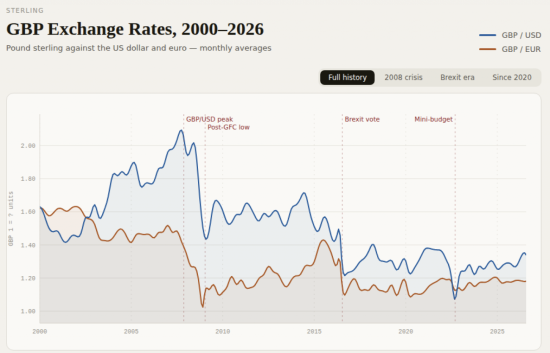
Let's look at the dollar mainly. That's probably the most important currency in the world. And if we look at that, we can see that the value of the pound rose from 2004 until 2008 because we let the City of London run away with itself, and money poured in as a consequence, and the exchange rate went up. And what happened? The City fell over, and the exchange rate fell. And that was the inevitable consequence. It had nothing to do with money creation. In fact, the quantity of money in the economy went down after 2008, but the exchange rate collapsed. So there was no link in this case between the creation of new money and the fall in the exchange rate. The fall in the exchange rate was because nobody wanted the products of the City of London anymore.
And then we had a period of relative stability created by quantitative easing, and that lasted until 2016. And what happened then? Brexit. At that point, we saw a significant fall in the value of the UK exchange rate because of politics.
In other words, all the changes that we see of great significance in the dollar exchange rate happened because of politics. The rise of the City, the fall of the City, and Brexit.
And what happened in 2022? Another political disaster. What was that? That was Liz Truss. She caused another little dip, which you can see on the chart. And then we've stabilised again.
Now, I'm not saying things are absolutely flat in the intervening periods. There will be oscillation. But the point is this fear that because we create money all the time and remove it all the time through taxation or loan repayment, we will be out of control, is nonsense. This is how the money system works.
And so let's talk about what the real constraints within the economy are. Money is not the constraint. The government can always create it. Banks seem willing to lend it. So we don't have a shortage of money in the UK economy. That's not the issue. What we do have are shortages of people, skills, energy and materials, plus the technology to use them, and they are the real constraints. If we don't have them, we don't have the productive capacity to absorb demand, and so we can get inflation. And that's what the government should be concentrating on if it really wants to beat inflation.
A true anti-inflationary policy is one that increases the demand that the economy can absorb. It produces more supply, in other words. That is the vital point I'm trying to make here. Money does not create inflation. A shortage of industrial and production capacity does. That's the issue we're facing.
So money creation does not necessarily cause inflation. Spending beyond the economy's capacity to respond can cause inflation, but the reality is that most of the inflation that we have seen in recent years has been caused by events far beyond our control and has nothing whatsoever to do with our money supply.
So let's come down to the simple fact that money creation is not the primary cause of any inflation we have suffered this century in the UK, and any claim that money creation causes inflation is then basically wrong because there's no evidence to support it. The claim ignores the facts and what actually happens in our economy, and the fact that we have got a system that does work reasonably well to manage inflation and which could work so much better if we only understood that interest rates do not control inflation, most especially when it's created by external shocks, but taxation can. That is the lesson we need to learn.
That's what I think. What do you think? There is a poll down below. Please do let us have your comments. Please do like and share this video. Please do subscribe to the channel. Please do hit that bell button because then you'll be told when we've made another video, which will be tomorrow. And if you'd like to buy us a coffee, there is a link down below; that would be great. And there are also playlists down below which highlight the more important videos that we think we've made and which you might like to watch.
Poll
Thanks for reading this post.
You can share this post on social media of your choice by clicking these icons:
There are links to this blog's glossary in the above post that explain technical terms used in it. Follow them for more explanations.
You can subscribe to this blog's daily email here.
And if you would like to support this blog you can, here:

 Buy me a coffee!

What might be the purposes/motives/reasons for “economists”, politicians, main stream media journalists etc. rarely, if ever, differentiating inflation into external and internal inflation?
Might a purpose of not using this basic differentiation be to use unanalysed inflation as a frightener which facititates an unstated policy of government reduction/weakening?
I agree entirely, but how do you manage short term supply shortages?
For example, you may want to spend more money building houses, or on the NHS, or whatever, but, despite levels of underemployment there are limited numbers of unemployed brick layers, plumbers or nurses which might take years to train.
Does it come down to government planning and training for future spend/demand?
Yes. We need to plan.
“Plan “. A four letter word which strikes fear and anger in the hearts of neo-liberals.
Indeed
Well put. BBC this morning was as usual interviewing people who said the BoE will have to raise interest rates to reduce inflation – sigh!!!
One for the never-ending to-do list for the glossary, ? “Liz Truss”. You have mentioned her often, (thx for the improved search box) but because opponents use spurious references to her, to counter progressive spending proposals, it would be useful to give her, her very own glossary entry summarising WHY she didn’t crash the economy, simpy by failing to fund her tax cuts. Most of the material needed is here:
https://www.taxresearch.org.uk/Blog/2025/01/10/liz-truss-and-rachel-reeves-have-a-lot-in-common/#gsc.tab=0
A View on is in draft on her. It may happen by the weekend.
I think in the past we have seen the availability of private bank lending causing bubbles that can have knock on effects on inflation.
But the economy out there – in the markets in particular – the supposedly best ‘information processor’ according to Neo-liberalism – they seem to have lost the skill and intelligence to discern what other inflationary causes are and how to handle them appropriately. ‘Inflation’ is now seems to have taken on a life all of its own and a standard, knee jerk response as well which is about putting one’s foot on the neck of the money supply. And Government just goes along with it.
Inflation is ‘the precious’ and society is ‘Gollum-ized’ as a result.
As you have pointed out recently, inflation is a form of ‘project fear’ used to justify and enable the cost increases of money and products – is it really right that a section of society benefits from this project? And is it also right that so little attention and work goes into heading off the actual causes of the inflation (resolving conflicts, refining trade agreements, looking for new sustainable markets, self-development of green alternatives). It seems that disaster capitalism is still with us? Why? Because it obviously benefits somebody, doesn’t it.
As we well know, it does.
Thank you. The only part I didn’t understand was why the exchange rate dropped in 2008 because of the city of London. Didn’t the crash happen in the US too, and affect the dollar in the same way?
George.
But London massively increases the UK’s exposure to financial services risk. And it did crash as a result.
Thank you. So the city investing in US securities increased our exposure/risk and that mattered in this context?
No, other people pouring money into London did.
I often get rebuffed with the claim that the “money printing” in the decade after 08 did cause inflation, just in assets like housing, stocks etc. That on the face of it seems true. What am I missing in terms of a counter to that point?
You are not missing much. I think there is considerable truth in that argument. QE created new central bank money, although it did not create equivalent new net financial wealth because bonds were exchanged for reserves.
But it did change the form and liquidity of wealth dramatically. The resulting liquidity, combined with very low interest rates and inadequate controls on credit and speculation, encouraged money into property, shares and other assets. That helped inflate asset prices and increased inequality.
The mistake is to conclude from this that “money printing causes inflation” as a general rule. What matters is where newly created money goes, what demand it generates, and whether the supply of what people then want to buy can respond.
Tha answer is that the new money should have been matched with strict credit controls, i.e. what the banks could do with it. They could have happened. The problem was failing to deliver them. That is not an MMT issue. That is always true, and is why we have had excess house price inflation for decades.
So the implication in their argument that the money creation HAD to cause inflation (and in that case it was house prices etc, but if the money went elsewhere it would have been there), is where the flaw lies. It did cause inflation there because the money created ended up in places where the supply was limited (houses weren’t being built etc), but if it had been directed to the right places (public services, supporting those who had lost their jobs in the aftermath of 08) it wouldn’t have caused inflation there, because there was plenty of capacity within the real productive economy to absorb that extra money.
Yes
Absolutely ‘where’ in the economy is the key issue as to how money production is most beneficial or not – the point I was alluding to above.
Another example of a waste of money production and also where it is harmful is in the Central Bank Reserve Account (CBRA) which is used as a crash mat for highly irresponsible and under regulated banking practices.
The mechanics might be different but the principle seems the same – support anything that makes money already obtained by a small group grow in value but cut off new money supply to the economy that is more widely distributed?
Really?
One must be blind AND pleonexic not see how one-sided this really is.
I would qualify your description by saying that reserves are not simply a crash mat for irresponsible banks: they are also essential to the payment system. The real issue is what we choose to use the state’s money-creating capacity for, who benefits, and why support for finance is considered acceptable when support for the wider economy is so often condemned.
There’s Prof Werner’s Quantity Theory of Credit which further highlights credit use and impact on inflation depending on whether used in financial economy (pushing up asset prices) or real economy (helping expand amount of goods/services)
[…] By Richard Murphy, Emeritus Professor of Accounting Practice at Sheffield University Management School and a director of Tax Research LLP. Originally published at Funding the Future […]
IMO I have detected a slight change in the narrative that the MSM economists plus the finance world are putting out these past couple of days. In the past, it was that interest rates would have to rise to address inflation, now they are adding the caveat that yes raising interest rates for inflation from lack of supply will not address the lack of supply, BUT the concern is a wage inflation spiral triggered by the initial inflationary shock of Trumps war. I see that as a slightly hopeful sign that they are being influenced by your sort of arguments, Richard, but still have much further to go.
A long way to go, I am afraid.
Thanks, that would make a great Christmas lecture on BBC, causing a few people to choke on their chestnut stuffing. They know who they are. The rest of the viewers would benefit enormously by having the blinds removed from their eyes and be educated to great national benefit. The BBC would do a great service to the country and the licence payers by inviting you on.
I can wish….
I have spent time this evening looking at the Youtube comments. I get the feeling many just want to find a fault to put themselves one up. Usual sort of critic or troll. And got a lot of likes. Some appear to have knowledge and several seem convinced that foreign trade makes MMT impossible. I don’t know enough to counter them but I do recall that at regular intervals over the last 100 years, the majority of the ‘experts’, or those who made the decisions, got it wrong.
Churchill’s gold standard 1925; the response to the 1931 crisis, the defence of an over valued pound in the 1960s, the experiment with shadow banking under Heath, Monetarism in the early 1980s, the ERM in the 1990s, the light touch regulation of the City until 2008 and one might add austerity and Brexit.
I admire the way you keep going. But there are signs some people are listening. And many are less and less convinced of the “cut welfare to be better off” narrative. Hopefully, the pendulum will swing.
Thanks
I need to keep addressing that absurd foreign currency issue
Do tariffs qualify as a price shock that would cause inflation?
They could
To fail to plan is to plan to fail!