
What if one of the biggest problems with conventional economics is that it misunderstands human beings?
Mainstream economic theory frequently starts from the assumption that people pursue their own self-interest. But that is not how most of us actually live. We care for our families, our friends and our communities. We also recognise obligations towards people we will never meet.
I call this economic empathy.
In this video in my Understanding Economics series, I explain why empathy should be considered an economic issue. I look at how our willingness to care for each other helped underpin social security, universal healthcare, free education and social housing, particularly in the decades after 1945.
I also consider how economists including Friedrich Hayek and Milton Friedman promoted a very different view of society, one that placed markets, individual responsibility and self-interest at its centre.
That change in thinking mattered. When hardship is treated as individual failure rather than something society has a responsibility to address, the consequences extend far beyond those directly affected.
Economic empathy is not simply about kindness. Ensuring that everyone can participate in society supports spending, economic activity, opportunity and democracy.
A successful economy depends upon recognising that human beings depend upon each other. Economics needs to recognise that reality too.
This is what Understanding Economics is all about.
This is the audio version:
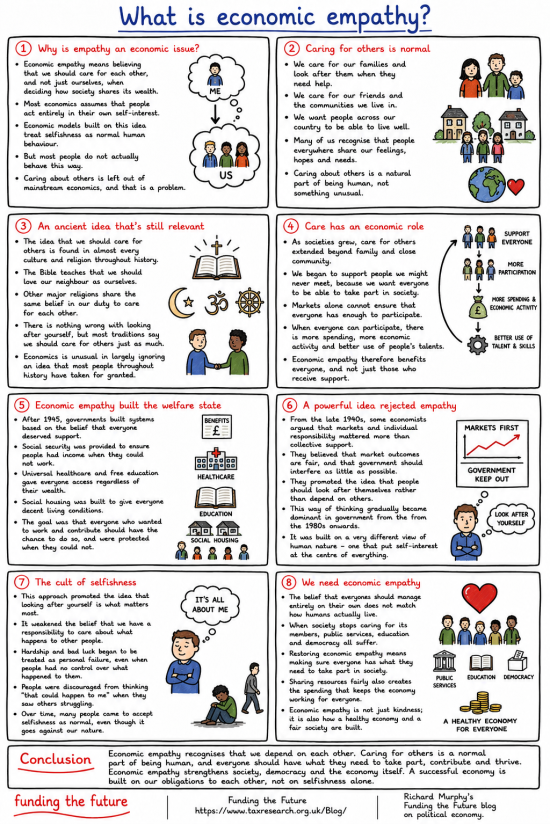
This infrogarphic supports this video:
This is the transcript:
Hello, I'm Richard Murphy, and this is Understanding Economics. That's the series of videos that I'm making in which I try to explain economics as I see it. This is not economics as it is conventionally taught, but this is economics in the way that I think we need to understand it if we are to make the world a better place, and that's why I think this series is important.
In this video, I want to discuss an issue which is basically never mentioned in conventional economics, but which is fundamentally important, and that is empathy as an economic issue.
Economic empathy means believing that we should care for each other and not just for ourselves when deciding how society shares its wealth. Most economics assumes that people act entirely in their own self-interest and other people can just, well, get on with it themselves. Economic models built on this idea treat selfishness as normal human behaviour, but most people do not actually behave in that way. Just look around, and you will see that is the case.
Caring about others is left out of mainstream economics, and that is a problem because, as a matter of fact, we care for our families and we look after them when they need help.
We care for our friends and the communities that we live in.
We want people across our country to be able to live well.
And many of us recognise that people everywhere share our feelings, hopes, aspirations and needs.
Caring about others is a natural part of being human. It's not something unusual, and it's certainly not aberrational as conventional economics treats it.
The idea that we should care for others is well rooted in our society. It's rooted in our culture and in every major religion that has existed throughout history. The Bible, for example, teaches us that we should love our neighbours as ourselves. I'm not here to convert anyone to anything, but every major religion shares the same belief in our duty to care for each other. There is nothing wrong, they say, with looking after yourself, and I would agree with that. But most traditions say we should care for others just as much. And as a matter of fact, most of us evidence that in our lives.
Economics is unusual in largely ignoring an idea that most people throughout history have taken for granted. And as a matter of fact, as our societies grew, care for others extended beyond family and close community. We began to think it appropriate to support people we might never meet, because we want everyone to be able to take part in our society. That is the foundation of the social security systems that exist in almost every developed economy.
And the logic of these is that markets alone cannot ensure that everyone has enough to participate in our society, and as a matter of fact, that is true. But when everyone can participate, and again, this is the logic of social security and so much more of government activity, there is more spending, more economic activity and better use of people's talents.
Economic empathy does therefore benefit everyone; not just those who receive benefits or other forms of support, but those who might be involved in providing those benefits and that support because they enjoy the benefits of a stronger economy, and that's what economic empathy delivers.
After 1945, governments built systems based upon this belief that everyone deserved support. Social security was provided to ensure people had incomes when they could not work. Universal healthcare and free education gave everyone access regardless of their wealth. Social housing was built to give everyone decent living conditions, and the goal was that everyone who wanted to work and who could contribute should have the chance to do so, and were protected when they could not, whether through no fault of their own or because the economy prevented it.
From the late 1940s, though, some economists argued that markets and individual responsibility mattered more than this collective support. They believed that market outcomes are fair and that government should interfere as little as possible. Friedrich Hayek and Milton Friedman are most closely associated with this idea that people should look after themselves rather than depend on others. This way of thinking gradually became dominant in government from the 1980s onwards, and it was built on a very different view of human nature from that of economic empathy.
This idea puts self-interest at the centre of everything. It does literally tell us to ignore everyone else. The idea promoted the thought that looking after yourself is what matters most. It says, based upon a misquote from Adam Smith's Wealth of Nations from 1776, that self-interest is what drives an economy, and it weakened the belief that we have a responsibility to care about what happens to other people.
Hardship and bad luck are now treated as personal failure, even when people have no control over what has happened to them. People have been discouraged from thinking “That could happen to me,” when they see others struggling. And over time, many people have come to accept selfishness as normal, even though it goes against all our human nature.
The belief that everyone should manage entirely on their own does not match how humans actually live. When society stops caring for its members, public services, education, and democracy all suffer. And restoring economic empathy means making sure that everyone has what they need to take part in our society.
Sharing resources fairly also creates the spending that keeps the economy going for everyone. Economic empathy is then not just about kindness. It is also how a healthy economy and a fair society are built in which everyone can flourish, and that, in my opinion, is the goal of economics.
Economic empathy then recognises that we depend on each other. Caring for each other is a normal part of being human, and everyone should, on the basis of economic empathy, have what they need to take part in our society to contribute to it and to thrive. Economic empathy strengthens society, democracy and the economy itself. A successful economy is built on our obligations to each other and not on selfishness alone.
That is what I think, and that is what Understanding Economics is all about. If you'd like to know more about this series, there is a playlist right down below this video. I suggest you start with the first video. Someone once said it's a good place to start anything, but in this case, the videos have been produced in a particular order to create a narrative that will, I hope, assist understanding. So give it a look. See what we're talking about. Understand economics. That is my goal.
Poll
Thanks for reading this post.
You can share this post on social media of your choice by clicking these icons:
There are links to this blog's glossary in the above post that explain technical terms used in it. Follow them for more explanations.
You can subscribe to this blog's daily email here.
And if you would like to support this blog you can, here:

 Buy me a coffee!

I actually agree also about individual responsibility. And that can come from owning something or having a stake.
But tell me, in an ever increasingly unequal society, what do those at the bottom actually own? They certainly don’t have a stake in the economy because that is increasingly taken from them. They don’t have much power or agency. All they seem to own is their own poverty or other problems bequeathed by ‘market forces’.
The agency of people to be responsible for their lives seems to me to be on a downward trend even though it is preached by Neo-liberals. We also see the effects of this in communications because for people to be responsible, they also need facts, reliable information etc. Well, we all know what is happening there don’t we?
It’s another typical way in which the consequences of Neo-liberalism makes itself known. The freedom it talks of is not about people at all, but about the freedom for the ‘special’ people – the rich.
If everyone cares for everyone else, they will have taken on their individual responsibility.
Thanks again for another “lighthouse” infographic!
Might it be that all relationships, individual and group, can be placed and plotted on a spectrum between the poles of symbiosis/cooperation and predation?
Might the same be true of socio-conomic theories and their associated practices and omissions?
Might some socio-economic theories and practices, not least Neoliberalism, be designed to aid the selfish powerful to exploit the less powerful groups in society?
Might we be experiencing much the same now with the mooted policies of further depriving the seriously disadvantaged to increase the wealth and protection of the affluent?
In a word, yes
Just seen our 97 year old neighbour being helped off the bus by the driver.
What would a modern economist make of that?
They would probably be upset at the thought that he’s being helped to be active and as a result living longer.
I think this essay, together with yours two days ago on “What if labour was not a cost” present two especially important proposals. As has been commented, the one about labour is revolutionary in the sense of turning about. It is also revolutionary in the Copernican sense, by putting Labour at the centre. Today’s might also be seen as revolutionary in the sense that it is a return back from the path of neoliberalism. However, a key phrase of yours above is, “economics is unusual in largely ignoring an idea that most people have taken for granted”. Therefore. in this case, I prefer to see neoliberalism as the revolution, a bad revolution, one with tragic consequences, which we need to remove in order to reveal what should be natural in our economy. I very much welcome what you are putting forward. We won’t have healthy people if we don’t have a healthy society.
Thank you. Much appreciated. There is more to come….
Economists may have overlooked the fact that people tend to stick up for others who have shared values – cultural, religious, linguistic etc. – more so than others who are dissimilar to themselves. Take for example the number of Islamic charities in Britain. Muslims, collectively, donate millions to them every year but few non-Muslims donate anything to them. Conversely, Muslims don’t give all that much to secular British charities, unless specific individuals have a strong interest in one – such as those for certain medical conditions.
I’m not sure how well economists understand Britain as a multi-ethnic, multi-religious society, which has large factions with their own self interests and sub economies.
Pilgrim Slight Return
all the poor own is their own poverty
That’s a powerful phrase!