
Inequality is about much more than the difference between what one person earns and another. It is about income, wealth, opportunity, security and, ultimately, power.
In this episode of Understanding Economics, I explain what inequality is, why wealth is distributed much more unequally than income, and how inequality can become self-reinforcing. Someone who has enough income to save can accumulate wealth. That wealth can generate further income through interest, profits, investments and rents. That additional income can then create still more wealth. Meanwhile, someone without savings may be paying part of their income to someone who already owns assets.
As a result, inequality can reproduce itself, including across generations.
But inequality is not simply an inevitable feature of economic life. The rules governing wages, employment, ownership, inheritance, housing and public services all influence how unequal society becomes. Tax and social security can further alter the distribution.
And that is important because inequality wastes human potential. People with talent and ambition can be denied opportunities simply because they lack the resources, security or connections available to others.
Inequality is therefore not just about money. It determines who has choices, who has security, who gets opportunities and who has power.
The question is: how much inequality are we willing to accept?
This is the audio version:
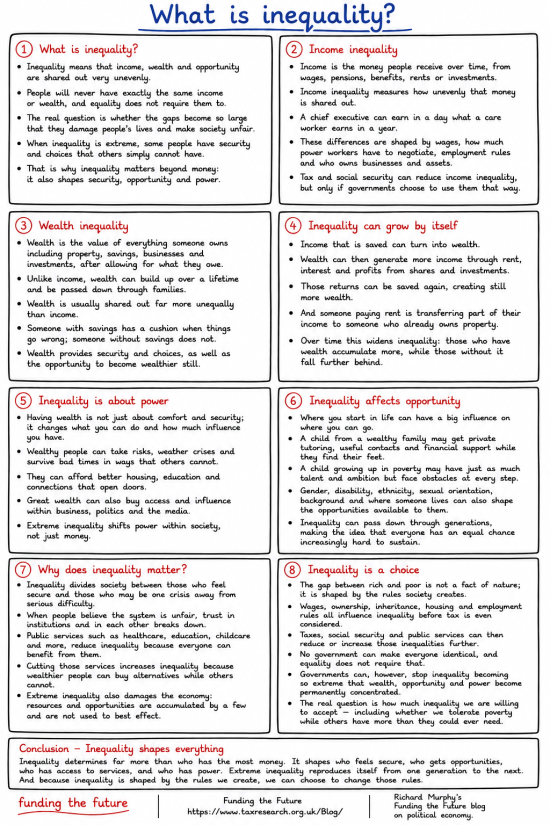
There is no Debate Ammunition for this video, but this infographic supports it:

As that is a little dense, this version excludes the images:
This is the transcript:
Hello, I'm Richard Murphy, and this is Understanding Economics. The series of videos that I'm creating, which explains economics in terms that I hope you will understand. What I stress is, this is my view of economics. It is not the conventional view of economics, but this is the economics which will provide us with a better world that I think we all aspire to. In this series, I hope to provide you with the understanding that you need to talk about how we can create a better economy, a better world, and even a stable future.
Today, I want to talk about inequality. What is inequality? Because inequality does matter within our economy, and it is too often ignored by conventional economics.
Inequality can refer to income, wealth, and opportunity, and all of these are shared out very unevenly in the world in which we live.
Now, I'm not suggesting that everybody should have the same income, wealth, and opportunity because that is wholly unrealistic. We are all different. The outcomes we get in life are going to be different, and I accept that point. Not only are we going to have some inequality in this world, but nobody expects otherwise.
The point is we must make sure that the gaps which are created by inequality do not become so large that they damage people's lives and make society unfair. That is the point that we are addressing, and when inequality is extreme, some people have security and choices that other people simply cannot have. This is why inequality matters and why it matters beyond money. Inequality also shapes security, opportunity and power.
The first type of inequality we do, however, need to deal with is income inequality. Income is the money people receive over time, whether from their wages, from pensions, from benefits, or rents and investments. Income inequality measures how unevenly that money is shared out across society. A chief executive can earn in a day what a care worker can earn in a year. Those differences are shaped by wages, how much power workers have to negotiate, employment rules and rights, and who owns businesses and assets.
Tax and social security can reduce income inequality, but only if governments choose to use them that way. And the government also has the choice to use regulation, most especially with regard to employment rules, to ensure that can be reduced in that way as well.
Wealth creates another form of inequality. Wealth is the value of everything someone owns, including their property, savings, any businesses that they might own, and the investments that they have after allowing for what they might owe. So if, for example, a person has a house which looks as though it's worth £400,000, but they owe a mortgage of £300,000 on it, their wealth is £100,000.
Unlike income, wealth can build up over a lifetime, and it can also be passed down through families. Our system of law permits people to pass on their wealth from one generation to the next. They might have to pay a bit of tax to do so, but we not only permit it, but it seems we encourage this process of passing on an inheritance.
But the consequence is very clear. Wealth is usually shared out as a result far more unequally than income, because whereas income concentrates over a relatively short period of time, wealth can be concentrated over a very long period of time, spreading across many generations. And that is why wealth inequality is so extreme.
Let me be clear: wealth matters. Someone with savings has a cushion when things go wrong. Someone without savings does not. That is the fundamental difference that wealth brings. Wealth provides security and choices as well as the opportunity to become wealthier still. This all matters in a society where too many are left behind.
And let me be clear: inequality can grow by itself. If a person has enough income that they can afford to save, that is turned into wealth. And that wealth can then generate more income through interest, profits, gains from shares and investments, and through rents, if they decide to become a landlord. Those returns can then be saved again if they have enough income to live upon, and that will create yet more wealth. And someone paying rent who does not have wealth is transferring part of their income to the person who does have wealth.
What this means is important. Over time, this wealth gap widens. Inequality grows as a result. Those who have wealth accumulate more. While those without it fall still further behind.
And having wealth is not just about comfort and security. It changes what you can do and how much influence you have. Wealthy people can take risks, weather crises, and survive bad times in ways that those without wealth cannot. They can afford better housing, education and connections that open doors for their children. Great wealth can also buy access and influence within business, politics and the media, and we've all seen that.
Extreme inequality does then shift power within society. And this is not just an issue about money; it is about access as well. And inequality in that case affects opportunity. Where you start in life can have a big influence on where you can go. A child from a wealthy family may get private tutoring, useful contacts and financial support while they find their feet as a young adult. A child growing up in poverty may have just as much talent and just as much ambition as the person from the wealthy family, but will face obstacles at every step in their progress towards getting on with life.
There are other issues which deny people opportunity as well. Gender, disability, ethnicity, sexual orientation, background, and where somebody lives can also shape the opportunities available to them. Inequality can pass down through generations, but it can also be created by current prejudice. All of this makes the idea that everyone has an equal chance in our society very hard to sustain.
And does this matter? I think it does. Inequality divides society between those who feel secure and those who may be one crisis away from serious difficulty. When people believe the system is unfair, trust in institutions and in each other breaks down, and we are seeing that at present. Trust in government is falling because inequality is so obviously rising.
Public services such as healthcare, education, childcare and more can reduce inequality because everyone can benefit from them. They do not have a direct cost. But cutting these services does create direct costs, which is why austerity is so unfair and does increase inequality because that means that the wealthy can still buy alternatives to the services that were previously provided by the state, but those who do not have wealth cannot.
And extreme inequality also damages the economy. Resources and opportunities are accumulated by a few and are not used to best effect. In particular, the abilities of many people are quite simply unused because they cannot access the resources they need to put them to use, and that imposes a massive cost on society.
Talent that goes to waste cannot be recreated. It is lost. This is the cost that inequality creates. We could all be richer if we had a fairer society because not only would those who have the least spend more, and therefore keep the economy going better, they would also deliver their best for the benefit of everyone, and that truly matters. And it is that more than almost anything else which worries me about inequality, because inequality is about lives that are blighted by the failure to provide people with the resources so they can truly be themselves.
And what I want to stress is that inequality is a choice. The gap between the rich and the poor is not a fact of nature. It is shaped by the rules that society creates. Rules on wages, ownership, inheritance, housing, and employment all influence inequality before taxes is even considered. Taxes, social security and public services can then reduce or increase those inequalities further, and that again is a choice. A choice made by government.
And I'm not saying that the government can make everyone identical . I started this video saying that is not the goal, but equality does require that we provide everyone with opportunity, and stopping inequality from becoming so extreme that wealth, opportunity and power become permanently concentrated is, in that case, a priority, in my opinion, for any government, because the alternative blights us all.
The real question is how much inequality are we willing to accept? Including whether we will tolerate poverty while others have more than they could ever need?
Inequality determines far more than who has the most money. It shapes who feels secure, who gets opportunities, who has access to services and who has power.
Extreme inequality reproduces itself from one generation to the next, and because inequality is shaped by the rules we create, we can choose to change those rules. That is what understanding economics is all about.
If you want to know more about this series, there is a playlist down below this video. You can look there at the previous videos in this series, and I would suggest you start at the beginning because, as somebody once said, that is a very good place to start. But the point is, we did create these videos in a precise order to help you understand the subject. And so there is a reason for following my advice. Have a look, enjoy, understand, and come back with questions. That's what this series is all about.
Poll
Thanks for reading this post.
You can share this post on social media of your choice by clicking these icons:
There are links to this blog's glossary in the above post that explain technical terms used in it. Follow them for more explanations.
You can subscribe to this blog's daily email here.
And if you would like to support this blog you can, here:

 Buy me a coffee!

Let’s just imagine there’s a useful concept called ‘bicycle inequality’. I’ve got a £300 bike in my shed which does the jobs I want, short trips in nice weather when there’s a little luggage to carry. My neighbour has two £1500 bikes in his shed which combined get used about the same amount of time as mine.
How unequal are we?
Is it 900%? Or is it about 10% as that is how much faster his can go?
As you can tell I’ve been working on and thinking about this issue deeply so my opinion should carry higher weight. The correct answer is the 2nd one.
Unequal in what terms? You certainly have bicycle inequality, as they have twice as many as you so can cope far better than you if each of you has a bike stolen or damaged. The fact you each choose to use your bikes is pretty irrelevant.
Clearly the issue is the depth of the inequality or the gap between one and the other (rich and poor). Inequality exists, but in modern times we seem to think exacerbating it will encourage us all to be (what?) – more productive, successful, independent (note to all Neo-liberal thickos – we are an inter-dependent species – as is the planet we live on).
Neo-liberalism has enabled the rich to actually become so rich that what inhibitors there were to be self aware and accept enough had been attained have been effectively turned off. The lack of real accounting (which would record where these riches actually come from and create awareness of who was actually losing) has not helped.
When you consider how much acquisitive AI is developed to extract data and spend, it behaves very much like capitalist human behaviour. All it can do is maximize and maximize without question, just like the human billionaires do. No wonder some of us are scared and we have every right to be too.
So, what happens when the few rich have everything? Well, just look at Donald Trump.
Indeed…..
Agreed. Inequality is a concern of an authentic democracy.
One function of an authentic democracy is to manage competing claims on resources and to give everyone a voice through a vote, so that people can live in peace and sufficiency.
The problem we have is that that vote has been usurped by party political funding and this has been done in broad daylight. Democracy has been purchased. That one vote by a millionaire can be turbocharged/enhanced by more pounds or dollars than you or I have. This is inequality in action.
This blindness to politics through out-paying others for it remains a running sore in so-called liberal democracies. It is obviously a problem but no one seems to want to put a stop to it – indeed the U.S. has openly encouraged this to happen. This deliberate act of enhancing what is essentially inequality, is very telling about the age we live in.
This morning’s headline shows just what an important topic inequality is.
A crypto-currency billionaire convicted for failing to implement anti-money laundering controls, but pardoned by Trump, has given £36 million toReform.
We thought £16 million from from Christopher Harborne, was a lot. This is more than double that. He gave £8 not very long ago. He has even given money to Restore.
We wait to see if Burnham will defend democracy or try to accommodate plutocracy.
Much to agree with
Have just seen Harborne is to match the £36 million.
That is taking the you know what. Our democracy really is under threat.
Could I just add to Joe Burlington’s post? James Callaghan was the only naval officer to become Prime Minster and he joined the navy as an Ordinary Seaman-the lowest rank before being commissioned from the ranks. He knew life on the mess deck in a North Atlantic gale.
Atlee served at Gallipoli but was sent home due to illness (many were ) but got off the boat at Malta and returned. In the interval many of his battalion died or were killed. ( It seems he never blamed Churchill for the for the failure of the operation.) In the evacuation -which was brilliantly executed in contrast to most of the campaign-Atlee was the second to last man off the beach. He was later wounded in Mesopotamia and ended the war as a Major.
Leaders need to be involved with the wider society.
Agreed
And think tanks are not wider society
When war in Europe ended in 1945, a general election produced a landslide Labour victory. People wanted the proposed NHS. They wanted nationalisation – and greater fairness. The press had been censored during the war. The newspaper owners assumed that Churchill would win. They would not make such a mistake again. Ever since they have favoured the rich and hammered Labour.
During her final parliamentary appearance in 1990, Mrs Thatcher was challenged, ‘… in many ways the Prime Minister has achieved substantial success … [but] over 11 years in office, the gap between the richest 10% and the poorest 10% in this country has widened substantially. … the poor are relatively much less well housed and much poorer …’ She replied ‘All levels of income are better off than in 1979, but the Member is saying that he would rather that the poor were poorer, …’ She repeated several times the lie: ‘You would rather that the poor were poorer. That way you will never create the wealth.’
The Eton and Oxbridge-educated Tories behind her loved it. Few had any idea of anything other than personal abundance. Her predecessor Ted Heath did not warm to her policies. He had been an artillery officer in France during WW2 and had seen for himself that there was no correlation between courage and relative wealth. Denis Healey, later a Labour Chancellor, had likewise worked with ordinary soldiers, some displaying extraordinary devotion.
In response to a Burnham speech recently, Kemi Badenoch remarked that she had not been born when Thatcher was in office. No! She has not experienced the sort of communal solidarity that existed before Mrs Thatcher came to power. But that solidarity is still worth thinking about.
I agree, Joe.
An excellent and thought provoking comment by you. You correctly mentioned ‘extreme inequality’.It exists and always has. Before it was hidden but now appears to be celebrated arrogantly. An excellent illustration being that of George Windsor pictured standing self assured and self entitled in his antiquated but revered school uniform on his first day at Eton..£65,000 fees…annually.
A thought occurred ..what was left in the bank account of the billionaire who ‘gave ‘ 36 million to a political party?..the mind boggles….