
Poverty is not a fact of nature. It is a political choice.
The UK considers a person to be living in poverty when their income is below 60% of median household income, after tax and housing costs. On that measure, at least 14.2 million people, including 4.5 million children, are in poverty today. That is about one in every five people, according to the Joseph Rowntree Foundation's most recent estimate.
The proof that poverty is a choice sits in our own recent history. Between 1997 and 2005, a Labour government cut poverty from around 25% of the population to 20%. Then progress flatlined: the global financial crisis of 2008 and the austerity that followed froze it for two decades. Poverty did not become harder to solve. We simply stopped trying.
Poverty is not only a lack of money. It damages health, holds back children's development, disables people by restricting their choices, and wastes human potential on a colossal scale, which in turn reduces national income itself. And every tool to end it already exists: more progressive taxation, better regulation, better housing law, more social housing and, of course, a much fairer social security system. What is missing is not the tools. It is the will.
This video is a part of my Understanding Economics series. Understanding poverty is therefore essential to understanding economics, inequality and the choices governments make.
This is the audio version:
There is no Debate Ammunition for this video, but this infographic supports it:
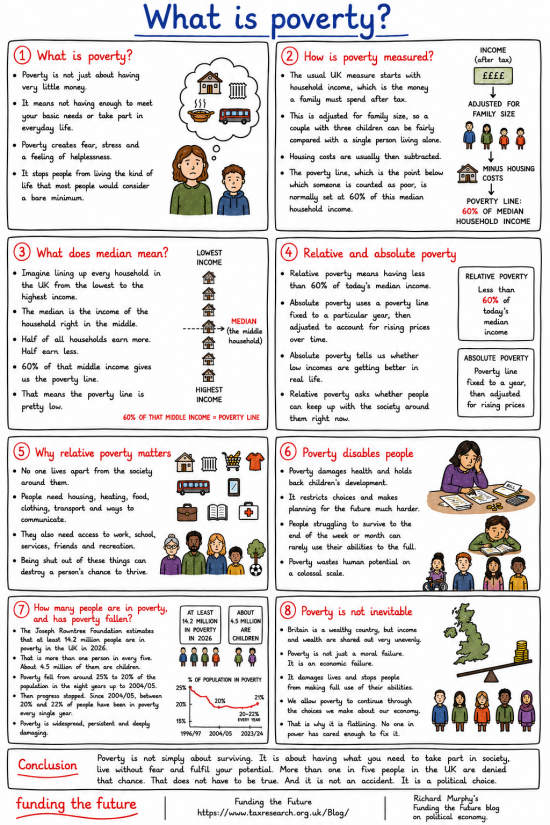
This is the transcript:
Hello, I'm Richard Murphy, and this is Understanding Economics, the series of videos in which I explain how I think the economy works in ways that I hope you will understand. In this video I want to talk about poverty: what is poverty and why is it important, and why should we be tackling it?
Poverty is not just about having very little money, although that is, of course, one way in which we can identify it. It means not having enough to meet your basic needs or to take part in everyday life. That's the reality of poverty, and that's why it really matters. It creates fear, stress, and a feeling of helplessness. It stops people from living the kind of life that most people would consider a bare minimum. It denies people possibility. Poverty really matters.
So what is poverty and how do we recognise it? We have ways of doing so that are formalised in countries like the UK, and this approach that is used in the UK is used in many other countries as well.
The usual measure starts with household income, which is the money a family has to spend after tax, and I stress that point: after tax. This is about what people have to spend, not what they have to pay tax from.
And that income is then adjusted for family size. So a couple, for example, with three children can be fairly compared with a single person living alone. That's important, or we would not get fair measures.
And housing costs are then subtracted. That's to show what people have to live on. It doesn't mean that housing costs are, of course, ignored. They are included in the calculation. But what we show is that having a roof over your head is absolutely essential. And what we're talking about when we come to poverty is what choices people have left available to them. That, again, is essential.
And then the poverty line is drawn on the remaining data, and that poverty line indicates whether somebody is in poverty or not. The line is normally drawn at a point where a household has 60% of this median household income. I will explain those figures a little more in a moment. So if you don't get it as yet, don't worry.
It's important to explain what this median means, then. Imagine lining up every household in the UK from the lowest earning to the highest earning. The median household is the one that is right in the middle of that order. Half of all households will earn more than the median household; half will earn less. 60% of that bottom part of the income spectrum is the point where we draw the poverty line. What that means, and let's be clear about this, is that the poverty line is pretty darn low.
To demonstrate that, let's use some data, because on this occasion, I think it will help. Most people do think they understand what an average is, but we are not talking about the average which most people refer to here. That's called the mean, and we are talking about the median.
To provide an example: suppose we have just five houses in the economy. One has an income of £1 million after tax and after housing costs, and the other four have incomes of £60,000, £50,000, £40,000, and £20,000. The average, or mean, is £234,000. The median is, however, the middle house, which, as you will note, is the one with £50,000.
That means if we draw the poverty line at 60% of the median income, the poverty line is drawn at £30,000, and the household with £20,000 of income will be below that poverty line. They are living in poverty.
Now, I stress, this is an example. I've used some simple numbers to make it all look as it works, nice and straightforwardly, but the point is just what I've shown. This is about the median, and you will note that the very high earners do actually have relatively little influence on this, partly because their incomes are way off the scale and partly because there are relatively few of them. So we're talking about the ability of people to live in normal society when we're talking about poverty, and I stress that point.
And we do actually have two measures of poverty. One is relative poverty, which is the term I've just been describing, where you have less than 60% of today's median income, and the other is absolute poverty.
Now, when we look at absolute poverty, we draw a poverty line in a particular year and then adjust it to account for rising prices over time. Absolute poverty tells us whether low incomes are getting better in real life, and relative poverty asks whether people can keep up with the world around them, right now.
So why does all this matter? That's the important question. Why does relative poverty matter? Because some people claim it doesn't, but I don't believe them. It matters because no one lives apart from the society around them. People need housing, heating, food, clothing, transport, and ways to communicate.
Yes, the mobile phone is now essential. You can't claim benefits. You can't book an appointment with your doctor. You can't do almost anything without it. So if you cannot afford one, you are most definitely in poverty, and anyone who denies that is talking total nonsense.
People also need access to work, schools, services, friends, and recreation, because none of us are intended to sit at home and do nothing all the time. Being shut out of these things can destroy a person's chance to thrive, and that happens when people live in poverty. That's why this measure is really important because at the point where people have 60% of median household income, they tend to be deprived of some or all of these opportunities.
And poverty damages health, and it holds back children's development.
Poverty does, in fact, disable people in a very real sense. It restricts their choices and makes planning for the future much harder, if not impossible, because life is reduced to day-to-day existence. The term hand-to-mouth exists for a reason.
And people struggling to survive to the end of the week or month can rarely use their abilities to the full. They have no choice to do so available to them. Poverty wastes human potential then on a colossal scale, and the cost of that to society is enormous. We all pay the price of this poverty, but some people really suffer it.
So how many people are in poverty, and has poverty fallen over time? The Joseph Rowntree Foundation, a Quaker Trust established over a century ago, estimates that at least 14.2 million people are living in poverty in the UK in 2026. Put that in context. That's about one in every five people in the UK as a whole, and about 4.5 million of those people who are living in poverty are children. They are being denied their futures.
And the truth is, poverty can be tackled. It fell from around 25% of the population at the time that the Tories left office in 1997 to around 20% of the population in 2005, and then progress stopped. Since 2005, partly as a consequence of the global financial crash in 2008, but mainly because of the austerity that was introduced by Tory governments from 2010 onwards, poverty has flatlined.
Between then and now, between 20% and 22% of all people in the UK have always been in poverty, even if the exact people who are in that group can sometimes change, but unfortunately not by a lot. Once you're poor, you tend to be poor. That is what neoliberal austerity did.
Poverty is widespread, persistent, and deeply damaging, but it is not inevitable. Britain is a wealthy country, but income and wealth are shared out very unevenly. Poverty is not a moral failure. It is an economic failure. It damages lives and stops people from making full use of their abilities, and we can tackle it. That's the point. By taxation, by regulation, by changing laws on housing access, by providing better benefits or social security, we can tackle poverty. Labour showed that between 1997 and 2005. Government can make a difference.
And doing so makes economic sense because poverty reduces our national income because people cannot fully take part in life, communities, and the economy.
We allow poverty to continue through the choices we make in our country about how we manage our economy, and that is why it is flatlining. No one in power has cared enough to fix it, but we should and we could. And that is what the tragedy of poverty represents.
We are in a situation where poverty is not simply about surviving. It is about that, but it is about much more. It is about being able to take part in society, to live without fear, and to fulfil your potential. More than one in five people in the UK are denied that chance. That does not have to be true, and it is not an accident. It is a political choice that those people are living that way. In this series on Understanding Economics, I'm highlighting what we can change in our economy, and poverty is one of the things that we can change.
If that matters to you, please do have a look at the playlist down below this video, which does include all the videos we've made in this Understanding Economics series. In them, I explain how our choices can be altered so that we can take a role in making this a better country for everyone. Tackling poverty is one of the priorities if we're going to do that.
Poll
Thanks for reading this post.
You can share this post on social media of your choice by clicking these icons:
There are links to this blog's glossary in the above post that explain technical terms used in it. Follow them for more explanations.
You can subscribe to this blog's daily email here.
And if you would like to support this blog you can, here:
-
Richard Murphy
-
Support This Site
If you like what I do please support me on Ko-fi using credit or debit card or PayPal
-

-
Follow me

 Buy me a coffee!
Poverty imposes a lot of costs on society, ill health being the obvious one
Clearly there would be measurable savings if it was reduced.
If we take the OBR’s multipliers seriously, the best use of money – from the perspective of economic growth – is to have the government spend on ‘investment’. This is followed by spending by welfare recipients (because they have the highest marginal propensity to consume), followed by government spending on public services. And right at the bottom of the list is spending by ordinary working people. If true, the obvious implication would be for the government to tax ordinary working people more, give more money to those who do not work, and give more money to itself.
Shall we assume the OBR are wrong on this issue, as they are on almost everything else?
I believe the technical term is reductio ad absurdum. Eg a Ford is better than nothing. Nothing is better than a Rolls Royce. Ergo a Ford is better than a Rolls Royce.
???
What Bob Parton is saying is to my mind illogical.
As usual, very well explained. Unfortunately, the present U.K Government, and several before, don’t seen either willing, or able, to understand that it is their policies that are causing the problem. I would suggest it’s the former, so in other words, a deliberate choice.
When you look at calls to restore the 2 child benefit cap, either those people are callous, or they do not know that 45% of children in households with 3 or more children are living in relative poverty – more than double the rate of 1 or 2 child households. It is a call for cuts to a group which is already very clearly struggling in general.
Yes, there are those larger families with 3 children and a good income, but even then once you take a good (top few percent) salary, take off the higher level of tax and divide it 5 or more ways, you have to be in the top 2% of incomes for the per-person net income to be above what someone working full time on minimum wage would have.
It is very much a political decision. After all, it is a political decision that the tax allowance of a stay-at-home dependent partner cannot be transferred. It is a political decision that there is a benefit cap which is the same regardless of the number of children you have. It is a political decision to remove child benefit based on single income meaning a double-income household can pay lower tax on higher earnings AND keep child benefit past a point a single income family loses it.