
Nationalisation has become the word British politicians dare not say, and the reason they give is always the same: it is unaffordable.
They claim that just taking water back into public ownership would cost over £100 billion, but that claim is outright nonsense, and it is worth understanding exactly why.
The trick is in what "cost" means. When we nationalised industries in the 1940s, we did not hand over a mountain of cash. We paid with government bonds, typically at 3% interest, repayable over thirty years or more, and in practice then rolled into the national debt.
The real cost of nationalisation is, then, nothing more than the interest on those bonds, and a nationalised business bought at a fair price should always be able to cover that from its own surplus. There is, then, no cash payout, and no one is "buying" anything at a fantasy price.
What might that mean for the water industry? Private investors and lenders have sunk around £100 billion into it, but the industry is not worth that now. Its shares are often worthless, and a fair price would reflect its current, depreciated value. That means shareholders accept their losses and lenders would take a haircut, meaning they get back part of what they lent. They knew the risk when they invested in a privatised monopoly, and they should accept the consequence.
The case for doing this is straightforward. Nationalisation protects essential services that are too important to fail. It lets us invest in their future at the lowest possible cost, because government borrowing is cheaper than private borrowing. And it future-proofs water, rail, energy, and other sectors against a repeat of the calamities privatisation has already delivered.
Nationalisation is not the problem. The misinformation about its cost is.
This is the audio version:
There is no Debate Ammunition for this video, but there is an infographic instead:
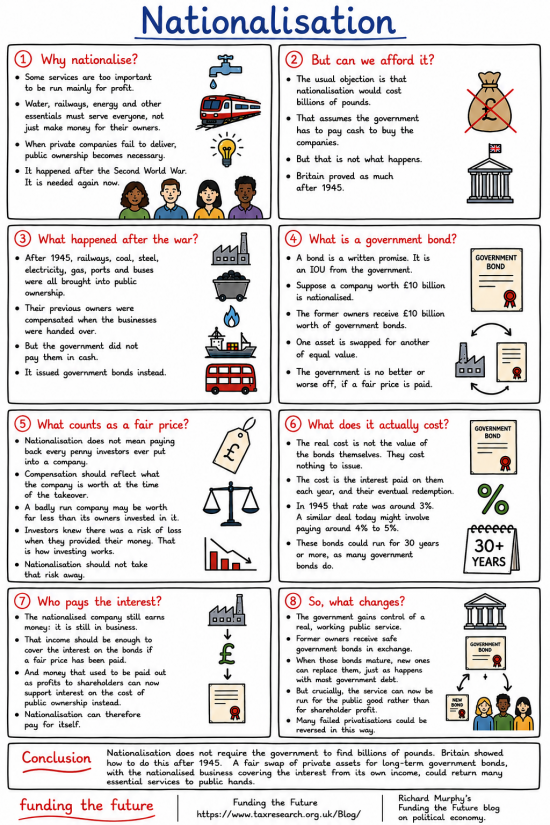
This is the transcript:
There's a word in British politics that no one is allowed to use. It's so taboo that it's never mentioned. And what is that word? It's nationalisation. The public ownership of companies that can undertake activities to meet our essential needs. And it's something that we do need to talk about, even though our politicians, including those from the supposed left wing of Labour, will not mention.
It's time that we talked about nationalisation because there are some services that are just too important to the functioning of our economy and the well-being of people in this country to be run by the private sector. The water industry, railways, energy, and other essentials must serve everyone and not just shareholders. And vitally, these services cannot fail. We cannot do without them.
But the whole logic of the private sector is that a company can fail. Well, that is a price in the case of these supplies that cannot be tolerated, so they must therefore be publicly owned. A private company that cannot fail is one that is bound to abuse, and we've seen that they do. Nationally owned businesses should then be an essential part of our economy. And we need to nationalise all the industries that I've just mentioned now, if we are to have the economy that we need going into the future.
So why is it said that we can't afford to nationalise these failing privatised businesses? Politicians say we can't because they presume that we would have to hand over an enormous pile of cash to the owners of the businesses in question. That is complete nonsense. They haven't gone back to look at what actually happened in the 1940s. That was the time when we nationalised so many industries, and every single industry that was nationalised then was paid for with government bonds.
They carried a moderate interest rate; 3% was the norm at the time, and they were repayable after 30 years or more. Most of them came up for repayment in the 1980s and were simply rolled over into the national debt. No cash ever changed hands as a result. I make that point. I make it very strongly. Every single politician who says that we cannot afford to nationalise because the cash cost will be too high is talking a load of old nonsense. They do not know what they're talking about, and I am not very tolerant of politicians who talk outright rubbish to put forward terrible arguments that harm the people of this country. But that's what they do when they talk about nationalisation. The claim that nationalisation will cost too much or is unaffordable is totally bogus.
And I'll go back and just talk about 1945 again for a moment. Steelworks, bus companies, mines, as well as railways and other industries, including canals even, were all nationalised. A fair value was paid for the businesses that were acquired by the state, and the fair value reflected the value that those businesses were in at the time that they were acquired.
The payment was made, as I've said, with bonds, and the government acquired an asset at fair value. In other words, national debt did not really go up as a consequence of buying these assets because, on the other side of the balance sheet from the debt that was issued to pay for them, there were assets to balance the equation. So long as the government did not overpay, the books still equated.
And as I've said, interest was then paid, payable for a period of around 30 years or more. And at that point, supposedly there was going to be a repayment, but in practice, the repayment was made by the issue of replacement bonds. So interest has been the only cost of nationalisation, and it's been pretty modest, and it's effectively being written off by inflation over time.
So what, then, is a fair price to pay for an asset that you want to nationalise? We keep hearing politicians say, we can't nationalise the water industry because it will cost more than £100 billion. Now, I don't dispute that private investors and private lenders have sunk, and I use the word with care, sunk a hundred billion pounds into the water industry. But that does not mean the water industry is worth £100 billion. What has the water industry done with that money? It's lost it.
The water industry itself is worth very little at present. The shareholders in the water companies are probably holding assets that are worthless. In fact, we know this is true. We know that many pension funds have written off the value of their investments in water companies if they're held in the way of shares. Those shares are now worthless. Why would the government pay for them?
Those who lent money to the water companies also know that they're going to have to take what is called a haircut. What's a haircut? It means that if they lent £100, they might get £30 back. That's what a haircut means. It means that they lent to a company that lost the money that they made available to it. The best that they can hope for is that they now get some of their money back.
The government would pay these lower prices as a result. So any politician who says that we have to compensate the private sector for the cost of the money they put into the water industry is again talking complete and utter rubbish. I'll be polite. It could be described very much worse than that, but they are spouting nonsense. The cost of nationalising the water industry might be a few billion pounds, and it would all be paid in bonds, and we'll pay an interest rate of 4% to 5% at best on that. The annual cost would be pretty modest, in other words.
And that actual cost is the interest we will pay on the bonds. That is the only cash cost of nationalisation. I cannot stress that more strongly. We don't pay for the nationalised asset. We issue a bond for it. The bondholder can then sell it; that's how they get hold of cash, but that's the process that has gone through. The interest is the only cost.
But remember, we're buying functioning businesses. The electricity industry isn't going to be nationalised to be put out of business. Nor is water, nor are railways. They're going to continue to function, and if the price paid for the assets is a fair price reflecting their current value, that business should be able to generate a sufficient surplus - I won't call it a profit in this case because nationalised industries don't, as such, make profits - but it should be able to make a sufficient surplus to cover the entire cost of the loan interest payable on the bond, which was used to nationalise it.
That means the price is fair. In fact, by definition, that's how we would know we got it right. And if that's the case, the cost to the exchequer and what the government calls taxpayers' money - quite inappropriately, because of course it is, government money in reality - will be precisely nothing. There will be no cost at all.
That's the great advantage of nationalisation. We force those people who have bought assets in privatised businesses that have turned out to be valueless to give up their assets to the government. The government gets them at a discount to reflect their current worth, and we get the benefit of running them in the future, but with a very low interest cost attached.
And there are three reasons to do this.
The first is to protect essential public services.
The second is to ensure that investment can be funded at the lowest possible cost. And there is a massive investment we know that is required in water, in the railways, in energy and transmission, and all sorts of other things as well. And the government can always fund that investment at the lowest possible cost. Its cost of borrowing is always lower than that of the private sector companies who have been running these assets to date.
And third, we do this to future-proof these essential services so that we do not run again into the calamities that are now facing all these sectors as a consequence of our negligence in privatising them over the last 40 or so years.
So is it time to put that word back on the political agenda? Should we be talking about nationalisation again? Yes, of course we should be. We should end the decades of taboo because they are ridiculous. The privatisation model has failed, and we can put it right quickly, easily, and cheaply, with the cost being paid by those who put their faith in Margaret Thatcher's promises, which have failed to deliver.
They knew the risk they took. They should now accept it. We should be allowed to compensate them fairly for whatever asset they have left and then put these assets into use in the public sector to ensure that we get the public services that we desire.
Any politician who says that is not possible is talking nonsense. Always call them out. Say, “Why are you saying it's not possible? Do you know we don't have to pay cash to nationalise these businesses? Do you know that we only pay a fair price? Do you know that the ongoing cost is only the interest paid, and the business should be able to generate that? So why are you objecting, Mr Burnham?” Or whoever else we are aiming the comment at?
That's what I want you to do. But if you disagree, let me know. There's a poll down below. Let us have your comments. Like and share this video. Please do subscribe to the channel and hit the bell button so you are notified when we make further videos, although we do that every day, so you will get a regular notification. And if you'd like to buy a coffee so that Tom and I can keep making these videos, that would be great.
Poll
Thanks for reading this post.
You can share this post on social media of your choice by clicking these icons:
There are links to this blog's glossary in the above post that explain technical terms used in it. Follow them for more explanations.
You can subscribe to this blog's daily email here.
And if you would like to support this blog you can, here:

 Buy me a coffee!


The £100 billion figure comes from a calculation by Ofwat of the “regulatory capital value”, which is derived from the assumed market value when the companies were privatised and the inflation-adjusted value of investments. It does not include the companies’ debt, which is massive. The true value of the water companies when debt is included is most likely zero. If the government removes the water companies’ operating licences the shareholders can only expect compensation based on the true value of the companies, which is zero.
More on this here:
https://www.common-wealth.org/publications/how-to-clean-up-our-water
And here
https://www.taxresearch.org.uk/Blog/wp-content/uploads/2023/06/Cut-the-Crap-June-2023-final.pdf
Might the objections [and misrepresentations] of recent and current politicians, plus main stream “journalists”, be that appropriate nationalisatons would bring real/deep competition to their beloved “privatised market” and so expose the flawed nature of Neoliberalism?
The attached is from AI Overview in answer to the question, “What are the weaknesses of Neoliberal socio-economic theory?”
https://www.google.com/search?q=flaws+in+neoliberalism&oq=flaws+in+neoliberalism&gs_lcrp=EgZjaHJvbWUyBggAEEUYOdIBCjIwODEyajBqMTWoAgiwAgHxBa7HDXUhmMvR8QWuxw11IZjL0Q&sourceid=chrome&source=chrome.rb&ie=UTF-8
When nationalised industries were sold off in the 1980’s there were, perhaps, two reasons. First is that they were deemed to be failing. British Rail might have fallen into that category, though that’s debatable. If they were failing it was because the government would not make the necessary investment. We were told the government “could not afford it” (which sounds familiar). Or they were functioning, the central electricity generating board, the water companies etc, but the government “couldn’t afford the investment needed”.
The argument went that private companies were so efficient that they could borrow the money, provide a better service and make a profit for their shareholders. That seemed implausible then and so it has proved. So the industries were sold of with minimal debt, so that companies could borrow to afford improvements. And companies did borrow, as they always do, to get corporate tax relief. Then they gave that money to shareholders and didn’t make improvements. And then they ran the businesses into the ground.
For example, mains water pipes have a lifetime of about 50 years. They are being replaced at a rate of 0.05% per year. It will take 2000 years, at this rate to replace them. No wonder we have leaks and hosepipe bans!
Now those businesses have little value. So yes, of course we could afford to nationalise them. If private companies were supposed to be able to invest and make a profit (surplus), and maybe they could have done so had they not asset stripped, then the public sector can certainly do so.
Much to agree with
Note the Save Water advert currently stridently being broadcast, which blames individuals (us – bill payers, not investors) for using water wastefully, instead of privatised companies for concentrating on profits and failing to maintain an efficient service. This is the message people are given: it’s your fault as careless individuals, nothing to do with corporate greed. And this is the reason for the ad – to divert criticism from the privatised companies, and privatisation in general.
Agreed. This is deeply neoliberally cynical.
It occurs to me that I have personally spent more in the last 8 years conserving water in my back garden (600l), than English water corps have spent actually building (not talking about or planning to build) new reservoirs. So I don’t take kindly to the government or the appallingly greedy incompetent shareholders, water corp executives and City creditors passing the buck (or the leaking watering can) for preventing water shortages on to me.
I understand no reservoirs have been built since 1992 although new investment is “planned”.
🙂
The reluctance wrt nationalisation by politicos reflects the balance of power between the City (+ its wholly owned subsidiary, the UK finance ministry – btw let’s use adult names not infant ones “The Treasury” ha! there is none) and politicos. The Truss saga was illustrative of this power balance & politiocs have been groomed to be terrified of the City. Water is/was a useful money making machine – the loading up of (odious?) debt onto water companies was a useful way of extracting profit (whilst paying zero tax) etc etc. The City wants to keep the show on the road so, Burnt-ham have been told hands-off. He just follows orders (yes massa) just like the last one. & in your local river?….One turd or two madam?
What happens to the debts the water companies have built up since privatisation. Are these taken on by the nationalised company? If so would it not be better to let them go bust and buy the assets?
No, they are what get the “haircut”: I describe in the video and transcript. This is what fair value payment does.
The post content appears twice.
(Excellent, btw)
Thanks. Corrected.
Good article in the FT a couple of days ago. Thames Water Lenders are pressuring Burnham to decide what to do….. which means they are getting twitchy. All the comments BTL said Burnham should do nothing and wait until October when they run out of cash…. at that point the government takes over and creditors will have to take what they are offered (nothing for shareholders, 3% 30 year bonds for lenders?).
Determining “fair” compensation is tricky but is best done when the company has completely run out of road. (Ie. October for TW)
As for the rest of the industry? Deal with TW first…..
I think TW first, too, but the rest in short order thereafter
They have all failed, after all.
They cannot supply clean water.
Yes, all water should be in public ownership. But, tactically it makes sense to ignore all except TW. The failure there is egregious and the involvement of Eliot Capital and other cultures makes politically easier to drive a tough conditions on nationalisation.
Once done, lessons will have been learnt and the rest will have been softened up.
Agreed
Vultures not cultures…..auto correct strikes again
Would it also be right to mention that we are already paying one third of our bills just to service the £80 billion odd debt that the water companies have run up and which almost exactly matches the dividends that they have paid out in the last 30 years? I think We Own It have estimated that in public ownership water customers would save £3 billion a year.
My own research shows that.
All this bullshit about cost from politicians is just selling our own ignorance on these matters back to us.
Jaron Lanier, page 132, 2018 puts it beautifully:
‘The foundation of the search for truth must be the ability to notice one’s ignorance. Acknowledging ignorance is a beautiful feature that science and spirituality hold in common’.
We can only continue to assail ignorance on all these matters.
All we need now is enough politicians with the conviction and determination to make this happen……… Oh……… s&&t!
All we need now is a mechanism that will empty Parliament of the worthless morons currently occupying most of the available seats and replace them with politicians with the conviction and determination to make this happen.
The one Labour MP who has the courage to speak out about this is Clive Lewis….he has run a fairly relentless campaign but I fear is a bit of a lone voice.
Try the 858 Project! Replace the House of Lords with a House of Citizens, appointed by sortition for one or two years to learn, discuss and decide. No political cronies, no party affiliations, no-one owing political favours, no party whips, no millionaire/establishment/Whitehall bias, just a representative spectrum of British citizens.
Sortition is grossly unjust. It could place an impossible burden on some selected. I cannot justify that.
As a long time reader and more recently supporter of this blog this is my first post. As usual Richard everything you say about nationalisation makes perfect sense. If I could add a small anecdote as a young activist in the early 70s I remember a party spokesman showing us the legislation by which the then Tory government had nationalised Rolls Royce. (Yes, Tory, yes, Rolls Royce. Hands up all those who would have Ted Heath back tomorrow…….) The legislation occupied half a sheet of paper. And most of that was the preamble.
Nationalisation an act of absolutely sovereign U.K parliament would knock out all the first order responses of the current creditors which they are even now growling. But my concern is how these aggressive American hedge funds, deprived of their inalienable right to make money out of suckers like us, would take a hair cut of any sort. And even if we just paid them the £20 billion full claim, using the methods Richard has been teaching us for ages, would that actually suffice to destroy their threat. Would they and others see danger to all investments in British utilities, and the Trump government retaliate against British companies – and their employees?
And if so how can we guard against that? And would it require in the first place, before there was any chance of dealing with the immediacy of Thames Water, the whole apparatus of the Courageous State? And where, on current showing, is that to be found?
I do hope I am being overly pessimistic. Anyway thanks to you Richard, supported by your regular correspondents, for always giving hope that things could be different than they are.
Thank you, and welcome to the comments.
The Rolls-Royce example is a useful reminder that nationalisation is not constitutionally difficult. Parliament can legislate for it. The difficult questions are political.
I would not underestimate the threats that might follow. Hedge funds and other investors could sell British assets, and an American government might threaten retaliation. But we should also be careful not to exaggerate their power.
A hedge fund that sells a British asset has to find a buyer. Once it has sold, it no longer owns the asset and has no further power over it. Likewise, sterling can only be sold to someone willing to buy it. Markets cannot punish us indefinitely from some position outside the system.
Nor should compensation necessarily mean paying whatever creditors currently claim. Parliament can determine the terms on which nationalisation takes place. The objective should be to protect essential public services, not guarantee every speculative investor against loss.
The larger issue you raise is, however, exactly right. Taking Thames Water into public ownership is one thing. Creating a state capable of standing up to financial interests, regulating capital, directing investment and defending democratic decisions against external pressure is another.
That is indeed the argument I made in The Courageous State. We need a government willing to govern rather than continually asking markets for permission.
Where is that government at present? I do not see it. But political possibilities change because people first understand that alternatives exist. That is why challenging the myths surrounding money, markets and supposed government financial impotence matters so much.
And thank you for your support. It is much appreciated.
The only caveat I would add is that, once nationalised, these services need to be properly invested in and managed.
The reason that they became prey to privatisation in the first place was because they were deliberately degraded to the point where the public would accept that a private company ‘would run it better, cheaper, more efficiently’.
Accepted
Oh no, I’m going to mention Singapore again!
One of the principles set by Lee Kuan Yew was that politicians and senior public servants should be well paid so as to attract and keep the best candidates who might otherwise chose to work in the private sector for higher wages. But if a well paid member of the government is found to be taking bribes they must be punished severely. Donations to politicians are tightly controlled and monitored as well. No 5M quid from a dodgy foreigner, even if you do declare it.
There is no point privatising any business or utility and then offering senior managers the kind of remuneration that only someone is inept as me would be willing to accept. Attract the best people and then make sure their plans are not hamstrung by ludicrously inadequate funding or excessive regulation and micromanagement from above.
You will never sell the idea that totalitarianism is a win here.
It is not. I have to say, I am bored with it. Not everything is about economic efficiency. You are ignoring a lot else. A quick Google search gave me this:
Singapore balances high economic development and safety with strict legal controls that limit civil and political liberties.
– Freedom of Speech and Assembly: Any public assembly or protest requires a police permit under the Public Order Act, which is rarely granted for cause-based events.
– Online Content: The government uses sweeping laws to order corrections or removals of online posts deemed false or harmful to public interest.
– Activism: Authorities frequently investigate or charge political activists, critics, and human rights defenders for organising peaceful demonstrations.
– Death Penalty and Criminal JusticeCapital Punishment: Singapore maintains mandatory and heavy use of the death penalty, primarily for drug-related offences, drawing ongoing criticism from the United Nations and international human rights organisations.
– Legal Restraints: Recent legislative adjustments have narrowed appeal avenues for individuals facing capital punishment.
– Migrant Workers and Discrimination: Migrant construction, domestic, and manufacturing workers often lack comprehensive labor protections and remain vulnerable to debt bondage or passport confiscation.
– Workplace Fairness: While newer legislation prohibits discrimination based on sex, age, and disability, it omits explicit protections for sexual orientation and gender identity.
Enough, I think.
The campaign group We Own It do great work on this, with a relatively small team:-
https://weownit.org.uk/
I have shared your blog today with them.
When a Government refuses to do something that is:
Then that tells you that whoever they are working for, it isn’t us (which we knew anyway).