
I was asked to do this one:
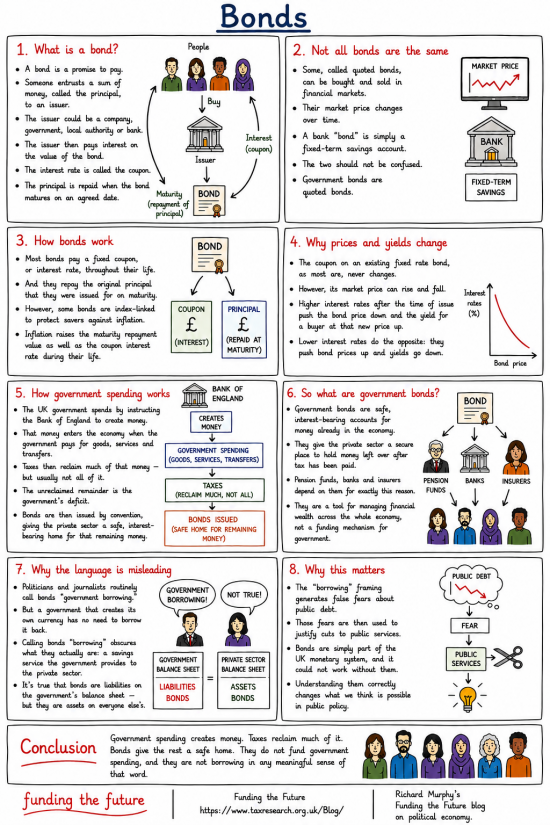
Please also look at the glossary entries on bonds, bond markets and bond vigilantes, as well as my View On article on bonds, available here.
How to expand this image
If you press CTRL or Command and Plus (+) on your keyboard, your browser should increase the size of your page every time you do this. Press CTRL or Command and the 0 (zero) key together to restore the screen to normal.
How to download this image.
If you right-click the image, you should be given the option to download it to your computer. So long as you do so without a view to making a profit, you may do so without further permission. Commercial use requires consent. But if you just want to share it, do so with whoever and wherever you want. That is the purpose of these infographics.
The image library
We have a library of these images. It is available here. All downloads are free, but donations help our work.
AI use.
I used AI, among other tools, when creating this post. I explain how I use that technology here. I also used about 50 years of experience observing, studying, and writing about these issues.
Thanks for reading this post.
You can share this post on social media of your choice by clicking these icons:
There are links to this blog's glossary in the above post that explain technical terms used in it. Follow them for more explanations.
You can subscribe to this blog's daily email here.
And if you would like to support this blog you can, here:

 Buy me a coffee!

Thank you
Very good.
Of course, I might have done it slightly differently but your approach is correct/ accurate and informative.
This hits the spot for me and glad to see Clive’s input.
…and it was well worth doing, Richard – thank you.
Thanks
It would be good if you could also include a definition of bond yield. I think the term “yield” is first introduced in box 4 without a prior definition? (unless I missed it). Perhaps add one more bullet point in box 3 to define it? That would make the infographic more self contained (e.g. I had to go off and google “bond yield” to remind myself of the definition and make sense of the box 4 comments).
I called it a coupon and said it was an interest rate. I try hard to avoid these issues, but I think most people would get this link.
I posted a link to this in my LP Whatsapp group. I got the following reply:
“I would not argue with the mechanics. The question is the relevance of it. The question is whether you can spend significantly more than you tax without damaging the economy. Whether you call the process ‘borrowing’ or not the crucial issue. I want an economist to explain how the car can be driven well, not how it works under the hood. The implication of what he says is that the government can spend as much as it likes.”
I pointed out that you knew that government spending should always take into account available resources. But maybe infographic should be tweaked to capture that constraint.
One infographic cannot do everything….
Let me do one on the limit of government spending
Thank you Richard for another informative graphic! Does the UK banking system mirror the US system in that sovereign bond issuance has a role to play in managing bank reserves and so indirectly set the short term interest rate?
In essence, yes.