
As rarely as looking at a stopped clock when it is telling the right time, the Daily Telegraph does sometimes have an interesting message to convey. That happened this morning.
In an article, they say that "The number of listed companies on the main market of the London Stock Exchange has plunged from nearly 1,700 in 2006 to just 909 in July 2026.” This chart plots the decline, with the particular impact of Brexit being very notable.
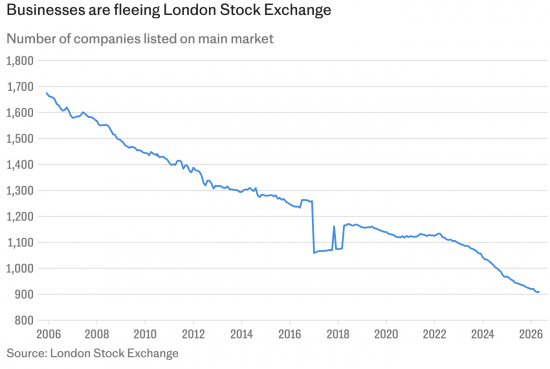
As they also note:
During that same 20-year period, the number of companies joining the market has also fallen. The number of new listings… is down from nearly 60 in 2007 to barely a handful in each of the last four years.
What is more, as they also note, the value of those listings, or new share offers, that might, potentially (but probably will not), lead to new investment in British companies, has declined to less than £2 billion a year, which might fairly be called an insignificant statistical blip in the overall need for investment finance in the UK economy.
Having noted something of use, the Telegraph does then, of course, get its analysis of the entire situation wrong. It goes on to blame pension funds for failing in their patriotic duty to invest in UK markets, whilst saying that if only tax relief were changed, increased funds from pensions might flow into them.
The reality is that, at present, UK pension funds enjoy overall tax relief worth more than £70 billion a year, making the cost of this subsidy one of the government's largest expenditures in any year, desoite which it goes almost unnoticed whenever any discussion of cuts takes place. A subsidy that is well over 30 times the resulting value of additional investment in potential job-creating activity in the UK economy appears to be more than sufficient for me.
In addition, the disparity between the subsidy and the investment is so great that it must be assumed that the London Stock Exchange's failure is systemic and that it cannot now deliver value to investors or to companies seeking to raise investment funds. In other words, stock exchange funding has ceased to be of any consequence in the UK economy when it comes to actually creating useful economic activity. In that case, why offer it more tax relief?
A better answer is to use these tax incentives more effectively. I have already suggested (chapters 25 and 26 in the main report, here) that, if the government were to make a change in this process, which I think it should, then the desired action is to require that one quarter of all new pension fund savings made in any year should, in exchange for the tax benefits provided, be directed towards investment in job-creating activity in the UK economy. If UK companies were unable to demonstrate their ability to supply this, either through the issue of shares or the placement of bonds on markets where the use of the resulting funds would be subject to rigorous scrutiny and independent audit to demonstrate their use in this way, then it must fall to the government to use the funds in question to promote public investment in things like replacement infrastructure, a Green New Deal, housing and much else that is critically needed within our society.
Inadvertently, what the Telegraph proves is that the London Stock Exchange is now utterly irrelevant, except as a casino or gambling den. What we need to do is redirect the wall of money that floods into pension funds away from it and towards useful economic activity instead. If there is one single change that could be made that could reignite investment in the UK economy, this is it, but the Telegraph entirely misses the point.
In its own way, that highlights the problem we have. There is a deep, pervasive, ongoing and entirely inappropriate belief in the UK that only markets can provide solutions to our problems. That belief is the problem that we need to address, and when we do, we will all be a lot better off.
Thanks for reading this post.
You can share this post on social media of your choice by clicking these icons:
There are links to this blog's glossary in the above post that explain technical terms used in it. Follow them for more explanations.
You can subscribe to this blog's daily email here.
And if you would like to support this blog you can, here:

 Buy me a coffee!

Richard, you’ve hit the nail squarely once more. The Telegraph finally notices the bleeding obvious – the LSE haemorrhaging listed companies from nearly 1,700 to a mere 909 – yet still manages to miss the point entirely, blaming pension funds for a supposed lack of patriotism while clutching at more tax relief as the solution.What you’ve laid out is devastatingly clear. That £70 billion-plus annual subsidy for pensions produces a pathetic £2 billion or less in actual new listings that might (but rarely do) fund real investment. Thirty times the outlay for a statistical blip. It’s not a market failure that needs patching; it’s a system that long ago stopped serving any useful economic purpose beyond shuffling existing paper around a casino.I keep coming back to the same thought. We’ve been conditioned since Thatcher to treat the “economy” as some sacred entity that must be fed first, with ordinary people expected to make the sacrifices. But as you show, that economy is really just capital extracting value, not creating it. The LSE has become irrelevant precisely because it no longer channels savings into job-creating activity. Redirecting even a quarter of new pension savings toward audited productive investment – or, failing that, public infrastructure and a proper Green New Deal – is the obvious corrective. Markets are not the only answer; insisting they are is the real problem.Pleonexia again: the endless desire for more by those who already have plenty. The Telegraph’s faith in more of the same tax breaks is just another expression of it. You’ve cut through the fog. The LSE can keep its gambling den status if it must. The rest of us need the money pointed at things that actually matter.
Thank you, Richard.
Over the autumn of 2022, I did some consulting there and wondered why the LSE group existed. The bourse was and is dying a slow death, so it got the Foreign Office to help market its facilities in emerging markets, especially Africa, and get their firms to secondary or even primary list in London. It’s not working as the Foreign Office scrapped the partnership a year ago.
The group operates foreign exchange and retail investment advice arms, too.
Odd bods in management, too, so little prospect of change. Perhaps, à foreign bourse will buy it.
Now, no disrespect to the Company which is producing a physical product that people want and its employees in my experience are an interesting bunch trying to keep the customer happy BUT Games Workshop seemed to be in line to join the FTSE100.
No I dont know what you would expect to see in it normally but surely it indicates that many of the business’s you might expect to be listed there have either listed elsewhere or been bought by Private Equity.
In short the London Stock Exchange is irrelevant
Great post and great responses.
So, the question is what little ruse will the LSE and our compliant Civil Service and state ministers come with next then to save this ‘has been’ institution for the nation? And who will actually pay?
“UK pension funds enjoy overall tax relief worth more than £70 billion a year,”
1) it’s the members, not the funds, who 2) get a 75% tax deferral, not relief.
“but the Telegraph entirely misses the point” should be “but the Telegraph deliberately misdirects the point”
The decline in new listings is clearly concerning, but calling the LSE “utterly irrelevant” seems too strong. London still raises substantial follow-on equity capital; the more interesting question is why its role in bringing new companies to public markets has weakened so dramatically.