
Some infographics do not take long to write. Others take a lot of work. This one was in the second category, going through many drafts to get to this:
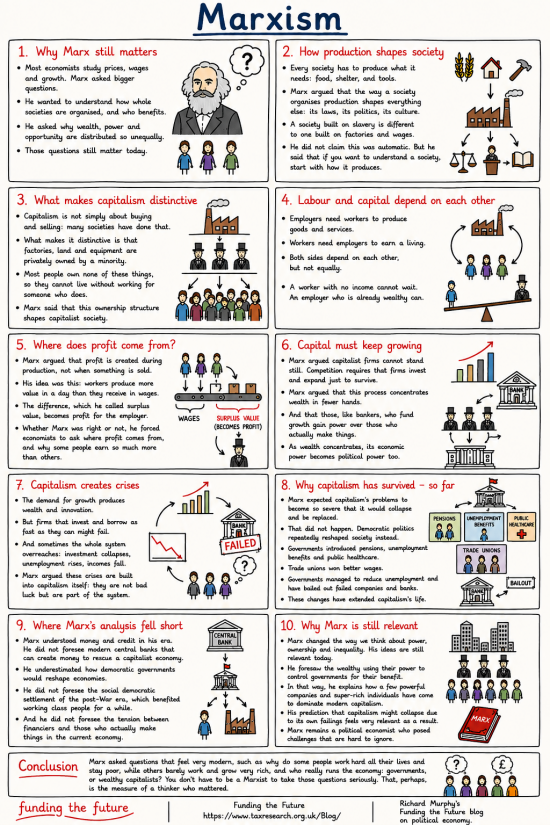
I would like to thank John Christensen for his editorial comments on this one. The errors are mine alone.
Note: AI use. In some way or other, I used AI in the creation of this post. I disclose how I use that technology here.
Thanks for reading this post.
You can share this post on social media of your choice by clicking these icons:
There are links to this blog's glossary in the above post that explain technical terms used in it. Follow them for more explanations.
You can subscribe to this blog's daily email here.
And if you would like to support this blog you can, here:

 Buy me a coffee!

Many thanks for such a usable synopsis!!!
From what I remember from ‘Debunking economics’ by Steve Keen, Marx’s prognosis depended on the labour theory of value. It doesn’t really work. Marx did also say in the later stages of capitalism, ‘one capitalist kills many’. Wealth would concentrate in fewer hands.
That seems to be happening. I see a comparison with Columbus who set out for the (East ) Indies with an inaccurate map but they still discovered a new continent ( though it took a few voyages to realise it )
Grand theories ( especially conspiracy ) are attractive but in practice where we get to is rarely planned but more a mixture of factors.
I think the info graphic is excellent and Marx is treated fairly.
Thanks.
And phew.
About 15 drafts to get to that.
agree with Pilgrim
I was expecting Groucho not Karl
Its a lot denser than previous ones so I looked at the PDF instead and it wasnt very easy to read even when blown up – I think there are ‘resolution’ issues
I have just remade irt. It should expand now.
Another lesson learned….
Thank you
Well worht doing<p>
A bit too small to read easily – ‘rate of exploitation’?, ‘reserve army’?
But easy to increase the size on any screen
I have just re-rendered
It should be easier to read now
Tidy!
You say at the end of this piece:
I disclose how I use that technology here.
The use of the word disclose sits badly with me here – and on Substack.
Disclose means to make hidden, secret, or private information known to the public or another person. It can also mean to uncover something so that it can be seen.
The use of AI in this context is to facilitate production and enhance the veracity of the content.
Using the word disclose subtly leans into the trope that AI is of itself “a bad thing”.
I think the word “explain” is more accurate.
I like that. I will change my approach.
Actually explaining Marx theory with a picture makes it much more clearer than what words can ever do. Usually the words often read about Marx do not match the picture. And the worker know the picture because he sees it every day while working. What the worker doesn’t see is the financial reports and accounts. Clearly the worker can do his work without them but that is not true for the business owner. He can’t remain in business without those reports.
Good to see an intelligent assessment of a great and influential thinker, who is often used by the right to dismiss any socialist or left leaning arguments, and also used by the dogmatic left to demand purity of thought to dismiss the realities of modern monetary theory.
One tiny quibble. Could you not remove in box 5. the words “whether Marx was right or not” and still make the same valid point?
I think it an important issue for those who are not persuaded to say Marx needs consideration nonetehless
For those who want to take a deep dive into Marx (and let’s also not forget Engels) and capital I recommend David Harvey’s books, articles and lectures. He is great at modern-day interpretations and relevance.
Of his many works the latest is The Story of Capital: What Everyone Should Know About How Capital Works and he also wrote A Brief History of Neoliberalism.
https://davidharvey.org
The flaw in Marxist analysis is pointed out here by Steve Keen :
Keen-1993-marxs-fallacious-labor-theory-of-value
https://www.exploring-economics.org/media/uploads/2021/10/27/keen-1993-marxs-fallacious-labor-theory-of-value.pdf
Use, Value and Exchange: The Misinterpretation of Marx
https://profstevekeen.substack.com/p/use-value-and-exchange-the-misinterpretation
SK 99. How Marx was wrong on revolution
https://www.youtube.com/watch?v=2b1JETZ6-Ck
Value in economics Explained by Prof. Steve Keen
https://www.youtube.com/watch?v=9KjFH9_Zm88
Yes there are specific limitations to Marx/Engels that are fully addressed also by David Harvey, but the framework for understanding the ‘bigger questions’ as Richard puts it is compelling (in my view).
I think Richard will enjoy Harvey’s take on AI at:
https://jacobin.com/2026/07/marx-capital-harvey-economics-contradiction
Ironically, the academic discipline most threatened by the advent of AI is formal scientific neoclassical economics, while disciplines rooted in particularities (like geography and anthropology), particularly when more clearly synthesized within the framework of historical materialist methods, will prove far more resistant, if not immune. Only that wing of conventional economics that accepts, with the economist Jürg Niehans, that monetary policy is an art and not a science will survive (presumably anchored in vulnerable institutions like the Federal Reserve).
Enrollments in university economics classes are already falling. The prospects for many other forms of skill and knowledge (e.g., the law) are likewise bleak. All the more reason to embrace a form of political economy that is AI-resistant and focuses on what Marx called “the growing incompatibility between the productive development of society and its hitherto existing relations of production,” all expressed
But conventional economics must first be freed from its constraining bourgeois skin in favor of the far more inventive and flexible historical materialism of the sort that Marx so cleverly pioneered.
Thank you, and interesting views.
‘A Worker with no income cannot wait, an Employer who is already wealthy can’
That sums it up brilliantly and the infographics are an excellent way to get an introduction to Marx
Yes…. that line really struck me as important.
Also, the last bit – you don’t have to be a Marxist to think Marc important.
I was very keen to emphasise that.
Neither John or I are Marxists. We both think Marx important.
Did Marx say that all Capital is dead labour? Part of the labour theory of value I suppose.
The problem with Marxism is how is value measured and reflected…
Marx believed that labour created value.
It did and it does..
But value means what?
Labour is by definition limited – we cannot work 24 hours a day..
Marxists believe labour is responsible for value and so value is limited by the availability of labour – true of course.
But value is definitely not money, which Marxists invariably seem to think that their labour translates into – because in effect, it usually does.
But when labour is necessarily limited, it really doesn’t mean that money is limited.
Nowadays of course money is created by government in order to motivate people to get things done.
That is the value of money and all of our labour is that value.
But what Marxists seem to suggest from that – is that their labour value actually ‘creates’ money, when of course it certainly doesn’t.
They appear to confuse effort and monetary value because, I suggest, their ideas of value seem to be entirely reflected in monetary terms, because Marx was still on the actual Gold Standard.
Thus considered, Marxists are pretty much as bad as the neoliberals.
But of course as Marx was writing at the time of the pervasive Gold Standard he thus had no concept of fiat currency.
So, for Marxists. we have to point out that value is effort and not money.
Money is created by (hopefully, democratic) government.
Effort is what government endeavours to get out of creating it…
And that, we have to hope, if government is properly functioning, is actually proper value!
That is why traditional Marxism is, I suggest, ‘money dangerous’ in that the Tories or Reform (and indeed, Labour) would be pretty happy with these basic Marxist ideas
It’s mentioned that factories are privately owned. That’s not, legally speaking, correct. Shareholders only own shares, not the company. Companies are legally self-owned.
[…] Marxism, this felt […]