
Many commentators here have asked for a different way to present ideas.
What about this?
And yes, AI was involved in this process. But the ideas are mine.
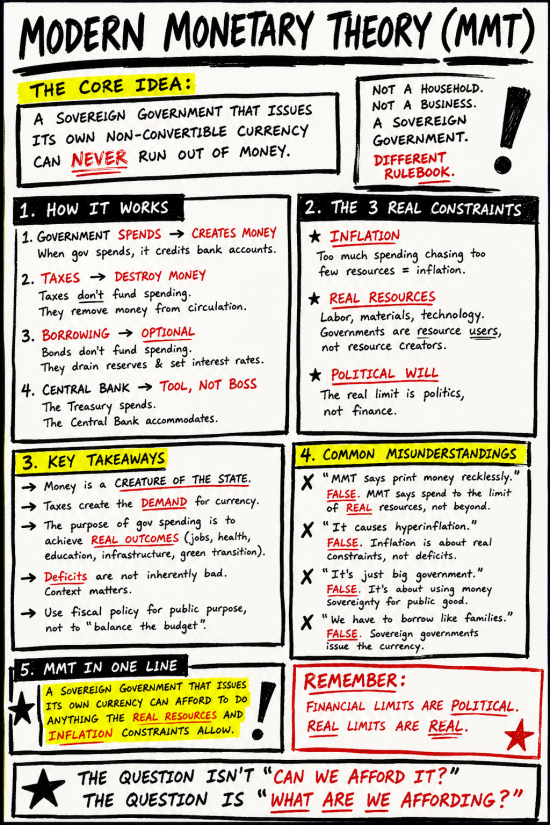
Thanks for reading this post.
You can share this post on social media of your choice by clicking these icons:
There are links to this blog's glossary in the above post that explain technical terms used in it. Follow them for more explanations.
You can subscribe to this blog's daily email here.
And if you would like to support this blog you can, here:

 Buy me a coffee!

Looks good. I think it sets out briefly and simply what MMT is. Most people find it difficult to actually read a blog post or document on the issue.
It really does look good, smooth, professional and eye catching.
Publish it!
Thanks
I love it! Thank you. Will try and share that as much as i can. Send it to Led by Donkeys?! They could stick it on billboards – i would if i could.
The presentation reminds me of comic strips. (bear with me) … I can picture the Mont Pelerin baddies (with Liz Truss? Sorry to pick on Liz, there are so many to choose from) in a mountain lair. A megalomaniac media owner in his tower (style of Jonathan Pryce’s character in a 90s bond movie) and for levity somehow, somewhere, a great big pie for a thudding analogy … I’m clearly not a script writer.
That said we are bombarded with neoliberal messages far too often so maybe there’s something in a new format!
Thanks
As with Count Binface some comic strip satire/comedy added as well.
This looks pretty impactful to me. It delivers a lot of information in a short space and in this age where attention spans have been shortened to seconds and the demand for new eyeballs is constant this really matters.
How wise and effective to use an attention catching medium to convey a profound socio-economic message!
Might a person’s attitudes to a message influence/control its reception, retention and applications?
”The medium is the message.” (Marshal McLuhan)
P. S. Benjamin Bloom’s Taxonomy is most informative on such matters.
Brilliant. But, can I suggest removal of the word ‘idea’. ‘Core fact’ maybe.
Noted
I agree that ‘idea’ should be changed.
you really should put your name and blog link on it somewhere.
I think it will catch a lot of attention.
I am working on improving the idea. Thanks for the comment.
Yep, that’s good. Very succinct and easy to remember for people like me, who have a head like a sieve.
I like it. It’s important to deliver the information in many different ways… and this is good.
One suggestion. The last line “What are we affording?” doesn’t really work for me. How about “What can we physically do?” / “What can we do?” or similar.
There is an exercise going on here this morning on this idea…..
James, and pout intern, Sam are hard at work
We are separating text and image generation to make sure things like this are right
Clive’s point was what stuck out for me too. Perhaps instead of “what are we affording” use “is it worth doing”.
And I agree with others that “destroy” doesn’t work in a cartoon context, it may need to be a bit more wordy. “Prevent excess money causing inflation”. Or “balance economy to prevent inflation”.
Thanks
Much as I understand the ideas in the poster, I would still ask: does it matter at all that bond yields are high (5.5% or so on 30 year bonds) and appear to rise further whenever the government talks about more spending? The government obviously has to pay the coupons, and fine: it can never default, but is the increasing “burden” of repayment in anyway relevant? Do we need to worry about it?
High gilt yields do not threaten the government’s solvency. The UK government can always meet sterling obligations as they fall due.
The question is whether paying unnecessarily high rates of interest is a sensible use of public money.
If markets demand punitive rates for long-term borrowing, the government has choices. It does not have to issue long-dated gilts on those terms. It can issue shorter maturities, adjust the mix of debt instruments, encourage other forms of saving, or, if necessary, borrow from the Bank of England.
In other words, the government is not obliged to accept whatever price the market seeks to impose.
There is another issue. Higher gilt yields mean higher interest payments, and those payments are income to the private sector. They are not money disappearing from the economy. The question is whether paying large sums, often to those who are already relatively wealthy, is the best use of public resources.
So, yes, I care about high gilt yields. Not because they threaten bankruptcy, but because they can represent an unnecessary transfer of income to holders of financial wealth and because politicians often use them to justify austerity.
The real issue is not whether the government can afford to pay the interest. It can.
The real issue is whether it should structure its financing in ways that minimise unnecessary costs whilst continuing to support productive investment and provide safe savings opportunities.
It is not as simple as “high yields = bad, low yields = good”. Gilt yields should represent a fair balance between savers and borrowers (whose interest rates will all be closely linked to gilt yields)…. and the key point is (as you say) that the BoE has it in its gift to push yields wherever they want them.
Too higher yields? The real economy finds credit to expensive and cuts back. Too low? Pensioners get very poor incomes when they come to buy annuities.
Getting this balance right is not easy but the institutional set up favour savers over borrowers…. because the BoE is run by bankers for bankers.
Hello Richard.
’Taxes > Destroy Money”
Whenever I have tried to explain MMT to people, this phrase becomes confrontational, and the point where they turn against listening further.
I think people feel that ‘Destroy Money’ means wasting perfectly good money. Basically the government physically taking notes out of one’s pocket and burning them. That was perfectly good money, that one owned, and could use, but now it has been destroyed for no reason! Ergo, taxes are bad!!!
I try to explain mmt now, without using that phrase.
Interesting
Does ‘cease to exist’ work better?
It may work.
Many people do not understand the concepts of money “money in circulation” vs. “money not in circulation” and “money created” vs. “money destroyed”.
“Destroy” certainly makes people sit up and listen so is, maybe, a good term in some circumstances where further explanation is possible. “Drain” might be better in some circumstances.
Different language for different situations.
Noted
disappear ?
cancelled out ?
Removing money to ‘dampen inflation’? (Since inflation often an attack line to MMT) Or play on Schumpeter’s ‘creative destruction’ but for that of money, also regarding sectoral balances, new money as private income etc
James, here, would like that
I say withdrawn rather than destroyed as it’s more palatable to the lay person
As Professor Bill Mitchell mentions in his presentation “Training the MMT trainers“, in his Module 3: Framing and Language, negating a frame of reference reinforces it. So claiming that taxes destroy money reminds people that it might not. I think the way to reframe it is:
1. Government spends money into existance (this is the framing we want)
2. Taxes reverse the process (this supports our original framing)
Noted
I often add Warren Mosler’s anecdote about early American colonial scrip(paper money). The colonial governments issued their own currency because they simply could not physically get hold of Sterling, coins in particular. This incidentally was a a major bone of contention with the British authority and contributed to the reasons for the American War of Independence.
However each year all the scrip collected from the taxes across colony would be burned on wooden pallets. Now the question is why would any authority do such a thing? Answer being it removed money from circulation and the allowed fiscal room for fresh spending with newly printed scrip.Some scrip was even dated so money had a sell by date .All this to control inflation. Of course this has to be carefully managed. Some colonies where more successful than others. Some colonies failed to be scrupulous and their scrip became practically worthless.
Perhaps “taxes withdraw excess money from circulation“. A bit wordy, but less contentious than “destroy”.
Paul
A favourite tweet:
MMTweeTruth
BoE quote → ‘money is a type of IOU’
Govt spends by creating/issuing/printing brand new IOUs
&
paying Taxes redeems & cancels those IOUs
#MMT
‘…that issues its own non-convertible currency…’
Is ‘non-convertible’ intended?
It means there is no other currency in use in the country
Perhaps the word “non-convertible” could be omitted. It is a diversion, I think.
We are working on ways to edit these after first run. James and our intern, Sam, are on the case.
I think the discussion that has arisen in the comments above about how to describe what happens to money received from taxation is very important. On the few occasions that I have been able to engage with people on this subject, I have found that they are usually very resistant to the concept of tax money being destroyed, even when they accept the fact that the government creates money by spending. This is not helped by HMRC misrepresenting what happens, stating that “we collect the money that pays for the UK’s public services”. Indeed, the term “tax revenue” is itself misleading. My preferred phrasing is to state that the money received from taxation is deleted from the economy. However, I do not know what is the best answer and would welcome further discussion on what I see as a crucial aspect.
I am hearing this, loud and clear.
I love it! I need to find my printer…
And thank you for all your informative and thoughtful output today. Having some days off and have come late to the feast.
Thanks
I think that this has got some good mileage in it.
If we can make it a bit more ‘MMT101’ or ‘MMT for Idiots’ then I could leave them lying around in ‘spoons .
I am creatively energised.
We are working on it.
The younger members of the team are not convinced….
Love it!!
I like it but constructive criticism:
1. I’m not sure it would have made sense to me before I’d read your MMT blogs. Needs testing against random people on the street.
2. I don’t get the “What are we affording?” question. Is it meant to convey that real resources not money are the limitations on what we can afford?
It was a first go
It will get better
Really good way of attracting popular attention; visual, punchy and with succinct accurate information. Well done!
How much would it cost for a full page in the non-progressive newspapers? Who might pay?
A lot….
An excellent, incredibly informative, cartoon.
It has the qualities of a Gillray.
An excellent start! But you must put yourselves in the linguistic mindset of Mrs Thatcher’s “every housewife”. Some humble suggestions:
‘Taxes – Destroy money’. As stated elsewhere, why would you destroy perfectly good money?. Replace with ‘Taxes – Reduce inflation’. Plain and understandable. I know inflation is mentioned elsewhere but it doesn’t matter.
‘Money is a creature of the state’. WTF? Delete.
Real Resources: Labour (with a ‘u’ please), materials, technology. The stuff government spending brings into productive use.
Use fiscal policy….. WTF? Delete. Replace with ‘Economy is the servant of the people. Not the other way round.’
Kit’s Rule No.1 for educators/experts (based on 16 years of professional experience). Don’t use your everyday professional jargon when talking to the proletariat.
This one will be updated. Design and language will be improved.
Richard has stated that he is not supportive of all the elements of MMT. Also that it is not a theory at all, but a description of how the economy actually works. Therefore retaining an inaccurate, outmoded headline seems counter productive. Make a clean break from the magic money tree with a phrase such as Macro Factual Finance?
A minor point in a very well put together synopsis. In resource constraints – could we use Labour instead of Labor? And I am not thinking politics so much as UK vs USA spelling.
I have now corrected for this
Excellent. Love it. Up-lifting. Accessible to more people. Nice quick read and overview.
Wonderful!
I am envisioning this as a proto type with an instantly recognisable FtF house style and more being pumped out for different audiences e.g one with more images.
The question at the end re ‘affording’, maybe pivot to people’s lives The question is ‘What do we need? Homes, NHS, Transport, Green Energy
And the first 1. when government spends maybe instead of it credits banks accounts, which may make new to MMT think money will be dropped into private bank accounts; again pivot to their lives
when government spends it creates financial capacity for public good. I understand MMT is neutral nevertheless that direction of capacity building is there, and this is FtF vision and values.
I hope this makes sense.
Thank you and keep going.
I am keeping going….on design version about 15 now
I missed this first time around – like I said about the later debt one, it is good to have as many ‘ways and means’ as possible and you also attempt to explain the sovereign nature of the central bank in this one too which is a key theme for me. However, my view remains that making sure people understand that the central bank is owned by the state must be continuously put out there until they get it – if ever. Otherwise the worries
As for tax ‘destroying money’ – can’t we say that tax is merely the state ‘claiming back’ excess pounds to help combat inflation, to help secure democracy by ensuring that money is not hoarded or used against democracy or inequality grows to much – tax as an act of fiscal hygiene to ensure pools of money are not left hanging around to cause trouble?
This will be revised. Soon. .
I was thinking of posting an idea this morning:
what about an open competition for students and others to create a short animation explaining money creation in a sovereign nation that issues its own currency? With a competition brief that disseminates Murphy’s view on MMT and a prize sponsored say, crowd funding and including publication.
Obviously lots of detail to thrash out – but then I find you are already working on the cartoon version!
That sounds like a lot of hard work – but the Insta version of these ideas IS being thought about by James and Sam, our intern.
Coming to this late but I love this semi-graphical format. Definitely could see this on a billboard 🙂
I would change “How It Works” with something else, maybe “How Govt Spending Works”? A minor point but using the word “It” still suggests MMT is a tool or a thing one can use, rather than an explanation of what is happening.
Can you see later developments?
I’ve sent this now to every major political party in Germany (as well as the austerity one).
With a text that says in more and more polite words:
“This way even you should be able to understand it, now act accordingly!”
I’m curious about if and how they’ll react.
This might not be much and they’ll most likely ignore it.
But for me, a very neurotic person, it’s a new and big thing to somewhat actively taking part in politics.
And your blog made me already do this twice with maybe even more to come whenever I’m able to get over my neuroticism. 🙂
We all live with worry.
Embracing it is essential.
I suggest framing it in terms of a pool of money. Government tops up the pool by its spending, and drains it by taxation. Everyone else is just splashing around in it.
But that is not true.
I didn’t realise taxes ‘destroyed’ money, but makes sense. I used to think of taxes like recycling money, I thought when the govt spends it is using a combination of created money and taxed money (recycled). But if money is a promise to pay, then it doesn’t exist when it is repaid.
It could be that money is more like light from electricity, it is there when you complete the circuit, and ‘disabled’ if you break it. If electricity is skills and resources, then making a promise to pay closes the circuit and the light goes on. If you switch off the light (taxes) you have ‘disabled’ the money, not destroyed it, and the electricity ‘potential’ still exists.
In some sciences there is the concept of ‘null’, if money is a container that can be set to any number, Zero, or ‘null’, and that way money isn’t ‘destroyed’ it is set to a ‘null’ value when taxes. Philosophically would I like to think that taxes restore money to its primordial state of ‘potential’.
Money as bneing aking to enrgy was a theme of a recent post here.
I am deeply stressed about AI being used to create infographics. There are many creatives losing work because of AI. I know you use AI a lot, and to some extent its use for the processing of information makes sense, so I have not expressed my discomfort before.
I caught an email a few weeks back that asked why engagement was down. One of the reasons some of us don’t engage with FTF, is sometimes it’s overwhelming to be sent so much information. So I’d push back on the idea you need to publish so much.
I am a visual learner, reading your blog for over 2 years, and still struggle to grasp concepts, so like the idea of infographics.
But seeing how AI is being used by some, without any acknowledgement of the environmental harms, coupled with the way artists/ designers work seems not to be valued (as historically UK society often does not), means I find this ethically compromising on your part.
There are many in the culture sector fighting against the creep of AI and arguing for a ‘human first’ approach to resource management, ie water prioritised for civic essentials before data centres / AI. Something I know aligns well with your politics of care. Forgive me if I’ve missed a blog where you outline how you square these values with the use of AI. But those in the culture sector (who are often visual learners) may just disengage from the outset if you publish AI generated design.
I would be more supportive of the idea if you paid a designer or artist to create. If that means less published output, that’s okay. Quality over quantity is no bad thing.
Thank you for always being transparent on your process and giving space for feedback.
I suspect these would cost £300 or more (maybe much more) with a designer, because they would go through various iterations, plus maybe VAT (and we are not VAT registered)
I want to produce hundreds.
Are you offering me £50,000 plus to produce them that way?
I doubt it.
The option is AI or nothing, then.
And given that there is a lot more automation in my photos than these, are you saying I should post no more photos, but employ an artist?
Or that the factory made chair I am sitting on is unaccptable and must be replaced with an artisan made one? Why?
Or come to that, reading this on a computer must end, and I must produce the blog on using a letterpress printing process? Why?
And why do you have no name? You have embraced the media age in some ways. Why not others?
I am confused by your argument.