
Loneliness is rising. More people feel isolated than they did a decade ago. Young people are particularly affected. Politicians talk about the problem. Commentators blame social media. Others blame technology, changing lifestyles or the decline of community.
But what if the real cause lies deeper?
What if loneliness is not an accident, but a consequence of the way we have been taught to think about ourselves?
In this video, I explore the idea that neoliberalism has not only reshaped our economy and politics, but has also captured our minds. We have been encouraged to judge ourselves by our income, our status, our careers and what we own. We are told that success is measured by consumption and achievement. We are encouraged to compete rather than connect with one another.
The result is a society in which many people feel they are never good enough, never successful enough and never wealthy enough. At the same time, relationships, community and simple human connection are pushed into the background.
Using data on loneliness in the UK, I examine why this crisis is growing, why young people appear particularly vulnerable to it, and why loneliness is increasingly affecting our relationships, our work, our politics, and our sense of well-being.
Most importantly, I ask what we can do about it.
The answer begins by recognising that neoliberalism is not just an economic system. It is also a set of values that many of us have internalised without realising it. Once we understand that, we can begin to challenge those values and replace them with something better.
The alternative may be found in a surprisingly simple idea: enough.
Knowing when we have enough frees us from the endless pressure to accumulate more. It allows us to focus on relationships rather than possessions, on people rather than status, and on well-being rather than wealth.
If neoliberalism has captured us, recognising that fact may be the first step towards freedom.
What do you think? Has neoliberalism changed the way we think about ourselves and each other?
This is the audio version:
The Debate Ammunition for this video is available here.
This is the transcript:
Are you living your own life, or has neoliberalism stolen it?
Do you think that you only matter if you have enough money, sufficient status, and can demonstrate your well-being through conspicuous consumption, your latest iPhone, your fashionable clothes, or whatever else it might be?
If that is what you think about yourself, I'm going to suggest to you that you have internalised neoliberalism, and that is the dogma that's probably grinding you down.
This is a terrible situation. It afflicts large numbers of young people, in particular, because they have never known another political system, bar neoliberalism. And the consequence of a life lived in a neoliberal way is real loneliness.
Loneliness is the consequence of neoliberalism. Wealth is not; loneliness is. And loneliness is now a social crisis, and it's getting worse. And this video is about how we got to this point and how we get out of it.
Internalised neoliberalism means the ideology is inside you, owned by you and driving you. It's not just around you. It's possessed you. You judge yourself by your income, your job title, and what you own. Your opinions come from the mainstream media and not from your own thinking. Simple pleasures have been stripped away and taken out of your life. If you don't pay for it, you don't think it counts. That's really worrying. And relationships become much harder in this situation because everything you have and do is measured by your self-interest. The end point of all of this is people living alone inside a silo, in relationship with AI and no one else.
And look at this chart. It shows you how this problem is growing. Right at the bottom, those who are really lonely, the figures are rising. And this data is only plotted between 2016 and 2025.
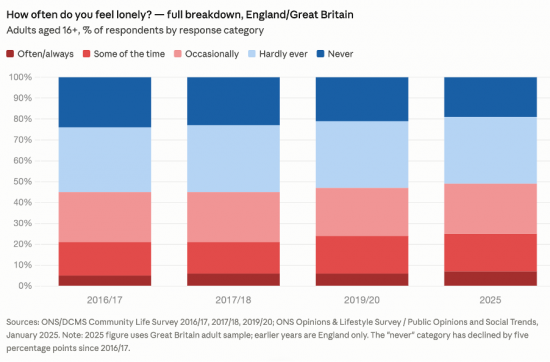
And right at the top, the number of people who are actually genuinely happy with their state of play and are never lonely, is declining.
Right across the age scale, we're seeing the problem too. In 2016-2017, nearly half of all adults were already reporting some degree of loneliness in this data produced by the Office for National Statistics.
Since then, the proportion feeling lonely often, or always, has risen from 5% to 7%. Those saying they never feel lonely has fallen from 24% to 19%. Loneliness is not just rising at the extremes, then; it is spreading across the whole population. And young adults are most affected, but I stress that no age group is immune.
Even the 70-pluses are impacted by this, and you would expect them to be because many of them have lost their partner, for example. But as you will note, the biggest problem is amongst those aged 16 to 29. These are the children of Thatcher's children, and they are lonely because they are truly neoliberal.
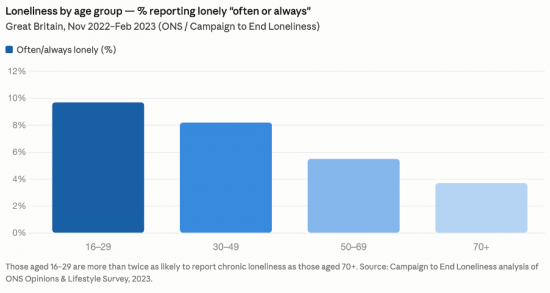
Loneliness is then the signature crisis of our time, and it does have real consequences; that's what I want to make clear. Unhappy people don't work.
We are seeing that amongst the so-called 'NEETS', those who are not in employment, education, or training.
We're seeing it amongst young people who can't get relationships.
We're seeing it in political alienation, which is giving rise to the rise of reform.
We're seeing it in the fact that young people are reported to be having less sex. We are seeing it in the falling birth rate.
There are real social problems arising from loneliness, which I think is the consequence of internalised neoliberalism; the creation of false goals for living.
But is there anything we can do about this?
The first step is to simply accept that this problem exists. We have to name internalised neoliberalism for what it is. That means questioning the values we have been told to take for granted. We need to open our minds to the possibility of living differently. We can't solve the problems we've got by using neoliberalism because it is neoliberalism that is causing the problems. It is telling us to become lonely and isolated, to pursue our personal goals, and that is the cause of our unhappiness.
We do therefore have to find other ways of measuring a good life, otherwise we can't move forward. That is why recognising the problem is necessary. Awareness is not the solution to this problem, but it is certainly the precondition for getting to that point.
Then we have to call out what is happening. Advertisers, for example, sell us expensive experiences and say they are "making memories". I always yell at the television when I hear that phrase. It annoys me intensely because they are right that memories matter, but they're wrong about how they are made.
Memories are not made by spending money. Memories are made by people. You do not need to go far away or spend a great deal to create a good memory. A conversation, a shared look, a walk, these are the raw materials for making memories. And these things cost almost nothing and last forever.
A meaningful life does not require a faraway destination. It requires a conversation, an exchange and presence with other people. A quiet smile, a held hand, a shared sense of awe at the world. These are enough to build memories. These things can happen on a walk outside your front door. Whether that door happens to open onto a city street or a country field, it makes no difference. The capacity for a rich life is already available to all of us. We do not need what neoliberalism says or what it has to offer, however much it seeks to indoctrinate us.
And the Beatles were right about this 60 years ago, when I was very young. They sang, "Money Can't Buy You Love", and they were right, but it's not only love that money can't buy. Money can't buy you health, although I admit it can help on occasions, and it most certainly can't buy you well-being, because in fact, the obsession about money can destroy well-being. There is no amount of money that can guarantee to buy you happiness, and that is a real-world fact.
But saying that, I recognise that sufficient material well-being and sufficient status, and therefore, sufficient money to guarantee those things, do have some importance in life; I'm not pretending otherwise. We have a hierarchy of needs; Maslow talked about this, and sufficient money, material comfort, and respect all matter.
But neoliberalism ignores that word 'sufficient'. It says we can never have enough, and that is where neoliberalism goes wrong. The antidote to neoliberalism is to be found in that single word 'enough'.
Years ago, I registered a website called enoughness.com. I still own it, in fact. And I believed in this concept then, and I still do now. Recognising that you have enough is the beginning of freedom. It doesn't solve poverty; I recognise we have to do that. But once we're out of poverty, this concept of enough is when you can start to live. Once you recognise you have enough, you are free to stop accumulating.
You can step back from the endless quest for another promotion, more money and more stuff.
You can build relationships instead.
You will have time to stop and look at the world around you or just look out of the window, and sometimes that's really important. That's when you reach your understanding about what things are and how things work. That is what makes things possible. 'Enough' that you do that.
But the neoliberal machine works hard to stop you from seeing this. Every political message, every media narrative, every form of advertising says that what you have is not enough, and that is deliberate. It is how neoliberalism sustains itself.
But those in genuine poverty do not have enough, and that is a serious concern. But they are not the concern of the neoliberal. They say that's their own fault. My comment is, we need to protect those who don't genuinely have enough and then we need to say sufficient is good enough.
That is the point; neoliberalism is telling us a lie. And recognising what it says is a lie is in fact an act of resistance in itself, and it is the precondition for living differently. Those who know they have enough can reject neoliberalism. They can live better, and at the same time, they can make a difference to others. They can freely support redistribution, whether by tax, or directly, because they know they have more than is needed. That generosity is what moves us beyond the neoliberal framework.
That's where we need to go. Neoliberalism is not just economically destructive; it is literally soul-destroying. I think it corrodes everything that it touches. Knowing you have enough is how we begin to build something better. It's how we get beyond neoliberalism and into a world that cares.
That's what I think. What do you think? This is a difficult subject. Let us know your opinion in the poll below. Let us have your comments. Please do share this video if you like it. And please, if you're willing to buy us a coffee, because that's all we'd like, then please do buy us one. There's a link down below.
Poll
Thanks for reading this post.
You can share this post on social media of your choice by clicking these icons:
There are links to this blog's glossary in the above post that explain technical terms used in it. Follow them for more explanations.
You can subscribe to this blog's daily email here.
And if you would like to support this blog you can, here:

 Buy me a coffee!

Very apt Richard<p>
I think Marx had a lot to say about how capitalism creates alienation – from ourselves as individuals, and from each other in society.
Few want to peek behind the curtain of our way of life and prefer to look for easier culprits to blame for the parlous state of our nation and the world in general. We are brought up to accept the system as is and game it as best we can with some naturally suited to this pursuit and others not – either through aptitude or given resources. Your analysis of Neoliberalism is, I feel, spot on and the loneliness is a feature that is instrumental in its continuance.
I am not given to conspiracy theories but while ‘the system’ does appear to have a life of its own there are also those who have captured it and are, if not in league, in lockstep in using it for their own ends. This can appear to leave us helpless in the face of such vast wealth and power but I firmly believe that we can develop a different way of being by creating local economies of care where help is freely given and reciprocated or, better still, passed on. A growing sense of community can build a sense of purpose around shared issues and from that a greater sense of agency in changing the status quo. This can also lead to more local financial economy where money circulates in the immediate area in increasing amounts.
People are doing it already.
Thank you, Richard.
I have been exploting these themes this week. Where all this goes I do not know as yet.
One of neoliberalism tools is advertising and marketing. Few have the critical thinking abilities to analyse this and see how much damage it does. There was a quote from years ago that said “consumer capitalism is built on getting people to buy things they don’t need, with money they don’t have, to impress people they don’t like”. This has always described the situation well to me, I would add that the people who are not liked will be paying no attention to the people buying stuff to try to impress them. The whole things is a bit of a pointless pantomime.
I have tried to point this out, quite often.
I dont know about Mrs Murphy but my wife would be overjoyed if I started buying fashionable clothes and stopped looking like the centre spread from Farmers Weekly
🙂
It is noteworthy that you have received far more comments (so far) in relation to the blogs today relating to specific political and economic subjects (the by-election and wealth taxes) as compared to the blogs on the highly detrimental effects of being captured by neoliberalism (here above) and on the politics of care. In my view, whilst the former specific, subjects are important, the latter ones on neoliberalism and care are of fundamental and overriding importance, because unless we address these, no amount of changing the specifics will result in the transformation that is needed. I strongly and warmly commend your two presentations today on these matters, which affect us all.
The politics of care theme appears especially important to me now. Thank you.
Richard, this is another excellent report. It is something I have been aware of for a long time. In the late 1980s, when I was much younger, I had the opportunity to work in the Middle East for a while. I was able to travel home every few months and one of things that struck me then was how much people just wanted run around buying more stuff. I found it a bit disturbing and when I look back it was one of the earlier signs of how much I did not fit in to society. Working as an engineer I was never interested in promotion as that would take me away from the bit of the job that interested me most, the status of these positions did not interest me either. In a way that has worked in my favour, having worked for 40 years I have a lot of experience, engineers with that much experience are becoming rare so I can pick an choose what work I do.
The loneliness issue is something I suffered a lot from when I was younger, I found socialising very difficult and meeting new people very stressful. I got around it by spending a lot of my spare time pursuing my own interests. I have recently found out that I and neurodivergent in a number of ways, the term “2e” applies. I can now spend some time meeting with people who see reality in a similar way to me which is very enjoyable.
Thanks Brian.
There is a world for neurodivergent people. Enjoy it!