
I keep warning of a crisis. But the question to ask is whether there is evidence of it happening.
There is. Take this chart from the FT on US oil reserves, which are falling rapidly:
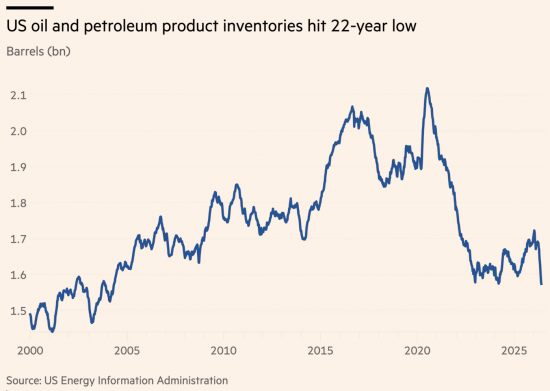
So far in this Crisis, releases of oil from strategic reserves have kept prices under relative control. The US has done this, Japan has done this, and so have other countries. But reserves are declining rapidly. And sometime soon, the release from them will stop. When that happens, the price will rise. The shortages will be apparent. The risks will be priced, and those risks exist.
And the signs of collapsing demand exist elsewhere as well. Take this, also from the FT:
Broadcom shed more than $300bn in market value on Wednesday, putting it on course for one of the largest single-day wipeouts, as the chip giant delivered AI revenue guidance that fell short of investors' highest expectations. Shares fell as much as 15.4 per cent in after-hours trading on Wednesday.
They added:
The massive haircut for the big player in the AI infrastructure boom comes after a substantial run-up for chip stocks over recent weeks that had pushed Broadcom's share price to a record closing high of $481.57 on Monday and a market capitalisation of more than $2.3tn.
Bubbles burst. Broadcom's is right now. Others might follow.
Then take this from an FT newsletter:
Trump's pledge to unleash a “golden age” for US manufacturing is sputtering as corporate commitments to build factories fail to translate into construction.
US private spending on manufacturing construction fell in April to $15.2bn, down about 16 per cent since Trump's second term began, while factory employment has fallen by 77,000 jobs over the same period, according to official data.
The reality is that AI hype is not the foundation of wealth. Making real things that meet human need is, and what is apparent from this data is that, despite the tariffs, and despite all Trump's talk about bringing jobs back to the USA, that is not happening. Instead, the real underpinning of the US economy is in decline, and nothing is being done to replace it. Stand back, walk around, look at the real world, and the message is obvious. Things are in decline. That is what this data says. When the bubble bursts, and it looks like it is, the reality that is left is looking pretty grim.
I apologise for having to keep saying so, but the view from behind the financial markets is that the real world does not reflect their euphoria, and nothing suggests that euphoria will last.
Thanks for reading this post.
You can share this post on social media of your choice by clicking these icons:
There are links to this blog's glossary in the above post that explain technical terms used in it. Follow them for more explanations.
You can subscribe to this blog's daily email here.
And if you would like to support this blog you can, here:

 Buy me a coffee!

The machine learning boom is about to burst. Why? US companies introduced it just to save costs. It is back firing. They are losing customers and rehiring people, think Klarna.
Allowing their software engineers unfettered access to machine learning models one US company recently spent $500bn in a few weeks.
OpenAI etc are tokenising costs and commercial users are discovering that the costs are not worth it. Uber has severely cut back it’s spending because of the high costs and poor results.
Look at the Naked Capitalism website article dated June 1 headed “Iran War: Iran rejects…” watch the video from Tech Report “AI Bubble Business Idiots”. Apologies I am not able to copy the link.
Thank you
There’s an interplay on the costs side. OpenAI, Anthropic and others used subscription models to entice people in, setting pricing that made a loss when fully utilised, banking on the majority paying for more access than they need. The advent of multi-agent models which could easily burn through many more tokens then meant too many of those subscriptions were loss-making. That brought changes to token-based billing, etc, which pushed up costs significantly for those who had adopted heavy usage of these systems.
It’s a mess right now, as the LLM providers are demanding each customer now pays their way, and some customers are finding that’s expensive – potentially more expensive than human staff in some cases.
However, the quality that you can get from local LLMs has continued to improve. Systems which were good enough with one model may achieve the same quality with a cheaper, newer model. Additionally, some users are learning how to balance which models are used for different tasks and how much data should be included. Tooling like hybrid search and Retrieval Augmented Generation become more relevant, and people think perhaps about graph flows of processing for some tasks over an LLM deciding which tools to call and potentially ending up running many expensive LLM steps for a modest task.
Where people use LLMs to perform necessarily unstructured tasks, it can be useful. Where it builds code that then performs a series of steps consistently and efficiently, it can be even more useful. Where people expect it to efficiently do everything without building efficiency in, it fails. Many are getting burned because it’s not magic and like most complex tools you need to learn more about it to ensure it works for you.
Agreed
It was US$500 million (not $500 billion). That is still a very large amount of money, but smaller by a factor of 1,000.
I’ve heard a rumour that the US company involved was Amazon, using Claude, so they can afford it.
Whoever it was, I suspect, like others, they were rewarding employees for using AI as much as possible, as often as possible, without any kind of cap, and then surprised when the bill arrived. Just like unexpected data roaming charges for streaming movies on your iPad while on holiday in Morocco.
Many of the AI companies e been providing a product essentially for free in order to generate demand, and now they are ramping up the price for customers who have embedded it within their businesses.
Agreed
We’d all be euphoric Richard if we all knew that we would be bailed out, wouldn’t we?
The reserves are probably even lower than these declared levels as I understand from folk who know more about this than me, that less than 100% is actually useable – there is a residual percentage lying at tank bottoms which is basically un-useable sludge, or to be useable requires much greater effort and energy to be refined into use-able product. It cannot be processed in standard oil refining facilities.
Thanks
That really depends on individual facilities’ maintenance & stock rotation procedures. Good practice should clear out such sludge on a regular basis.
But the belief is they have nor.
That is all that matters now.
Thank you and well said, Richard.
May I add that the US reserves are largely held in geological formations in Louisiana and Texas. There are reports that these caves could collapse when a big percentage of the oil is drained. This would make it more difficult to extract what is left.
Wow!
As a race we are not nearly as clever as we think we are.
The Scottish town of Coalsnaughton is apparently sinking due to past coal mining activities. Colonel Smithers’ post smacks of the same thing.
The hit on Broadcom may have something to do with Apple developing their own silicon C1 and N1 chips design to remove Broadcom from their component list. TIL now Apple provided Broadcom with 20% of their revenue. So a sell off of Broadcom would be expected.
[…] Continue Reading HERE […]
I agree they are over exposed to the demand for AI chips while losing out to comms chips that were its bread and butter (massive licensing earning) built on their own IP. But Apple’s action is devastating to Broadcom which, due to their historical relationship, I’m sure Apple is taking great pleasure inflicting.
UK Oil Watch are suggesting that we only have 19 days supply of diesel and 23 days of petrol. Things will start to get very messy if that gets worse.
https://ukoilwatch.com
On the AI front, Microsoft moved GitHub AI users onto a token based pricing model as of 1st June, removing the massive subsidies that have been in place to try to create demand. Claude Opus prices have gone up by 27 times.
https://levelup.gitconnected.com/github-copilots-secret-price-increase-annual-subscribers-facing-up-to-27x-cost-multiplier-c5249d17b3f1
In my opinion, any AI booster who has embedded this sort of AI in their workflows is soon to be bankrupt.
Also, I think the AI hyperscalers are having to increase prices far sooner than they wanted to as the mass market is not dependent on them yet but they themselves are running out of cash to burn. These price rises are a strong indicator that current AI technology will never be profitable. Those who have not jumped in with both feet have the time to change tack but those who went all in are about to learn some very harsh lessons on outsourcing your thinking and processes to a third party like Microsoft, OpenAI or Anthropic.
Agreed, Emperor’s Clothes.
A technology which drains the last bits of our faeces infested rivers to cool its data centres, to churn out child pornography and chatbots for lonely, stressed, jobless people. And not only does it do nothing to solve the wicked problems and multiple threats we face including ecological melt-down, it exacerbates these threats.
What a brilliant idea!!!
That’s the inevitable outputs of a patriarchal system that rewards and empowers narcissists and psychopaths, whilst divesting the rest of us.