
UK government borrowing costs are rising fast, and the official explanation does not make sense. Britain is paying far more to borrow than France or Italy, despite having its own currency, a central bank, and no meaningful risk of default.
So what is really going on?
In this video, I argue that the City of London is using the bond market to discipline government and protect wealth. The institutions that own most UK government debt are banks, pension funds, insurance companies, and wealthy investors. Rising interest rates mean rising income for them.
I explain who actually owns UK government debt, who receives the £111 billion a year in interest payments, and why most ordinary households see almost none of that money.
I also look at the role of the Bank of England, quantitative easing, central bank reserve accounts, and why UK rates are so much higher than those in much of Europe.
Most importantly, I explain why the government does not need to accept this situation. There are alternatives. A government that understood how money and central banking really work could take back control of interest rates and stop this ongoing transfer of wealth to the financial sector.
If you want to understand how bond markets really work, and why UK economic policy seems designed to protect wealth before people, this video is for you.
This is the audio version:
This is the transcript:
UK government borrowing costs are going up right now. The City is terrified of there being a new left-wing Labour prime minister, and they're pushing up these costs even higher than they already are, and that is something we need to talk about.
UK government borrowing costs are now above 5% on ten-year borrowing, and over 5.75% on 30-year borrowing, and that is expensive. How do I know that? I can look at the costs of France and Italy within the EU, and they are borrowing at less than 4%. That says we are paying too much. The UK is paying much more than comparable European economies, and that makes no sense at all, because there is no relationship here between economic fundamentals and the cost of our borrowing.
So, it is something else that is driving these costs upwards, and we need to ask what that something is, and why it is, because this is something the government should be tackling. We should not be putting up with borrowing costs that are this high, which are having an impact on the well-being of people in this country.
Now, the first thing to say here is that the numbers that the government provides so that we may appraise this data are not what they seem.
UK official national statistics around this issue are riddled with made-up numbers. For example, UK GDP is currently said to be £3 trillion a year. That's £3,000 billion, but of that sum, near enough, £300 billion is the rent that it is claimed that homeowners pay to themselves for the right to live in their own houses, and of course, homeowners don't pay that sum. So, the real figure is, in fact, around £2,700 billion, and you can ignore the official data because it is, to be polite, a great big pile of CRAP or a 'Completely Rubbish APproximation to the truth', to be slightly more polite.
Again, the Office for National Statistics figures on the national debt also include made-up numbers. They include something called the "Bank of England contribution to the national debt", and there is no such thing as a Bank of England contribution to the national debt. They just make the figure up. It's not real.
So, let's deal with the most reliable figure for debt that we can find, which is that from the UK Treasury's Debt Management Office, and they put that figure for the national debt at just over £2,900 billion. Unfortunately, yet again, they get the numbers wrong because included in that £2,900 billion is a debt of £200 billion, which is owned by the Debt Management Office. You can't owe yourself money. That's not a possibility. So the real figure is actually £2,700 billion. But the Debt Management Office likes to claim a bigger number, and bizarrely, so does the government when it comes to paying debt interest, because they include the interest paid on that Debt Management Office-owned debt in the total figure for interest paid.
None of this makes sense. If you think all of this is bizarre, you're absolutely right.
But let's come down to the nuts and bolts of this. The fact is that what we do know is who owns this debt that the Debt Management Office has put into circulation on behalf of the UK Treasury. That number looks to be reliable: at last, something we can talk about, which is sort of real. And here, the figures are clear.
One third of UK debt, 33% at this point in time, is owned by overseas investors. In other words, by governments and organisations and banks, and maybe people, but probably not, outside the UK.
Why do they own that? Well, they have good reason to do so. The UK is still quite an influential economy in the world. We might be struggling, we might feel as though we're having a bad time, but we're still the fifth or sixth largest economy in the world, and the pound sterling is still used for trade. As a consequence, people outside the UK want to hold the UK government's debts for two reasons. One, to facilitate that trade. They've got sterling when they need it to pay their bills, and two, because the UK government is the longest-established in the world, which has never, in effect, ever defaulted on its debt, and that makes UK government debt an attractive proposition for investors. And so one third of our debt has been bought by people outside the UK, and that is not a problem because that is a vote of confidence in the UK economy. Anybody who says otherwise has their understanding of this situation wrong.
But what about the remaining debt? There are three organisations that own most of this. The Bank of England is one of them.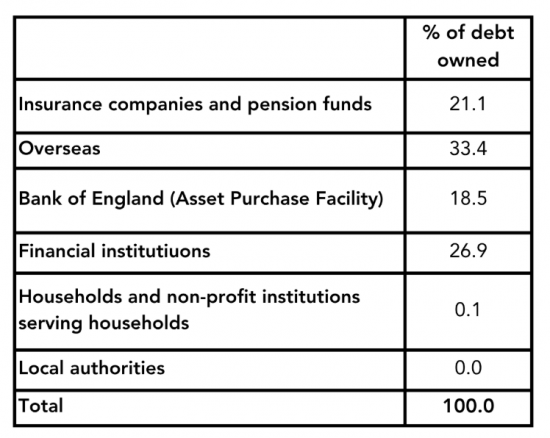
It owns 18.5% of UK national debt, and again, you might say this makes no sense because the Bank of England is owned by the government. The government, therefore, can't owe debt to the Bank of England because the government is the Bank of England. They are synonymous at the end of the day. But there is some logic to including this number inside the total national debt figure at this moment because the figure in question can be substituted with the balance held on what are called the central bank reserve accounts, which are the deposits that UK commercial banks hold with the Bank of England, which arose as a consequence of quantitative easing. So, let's substitute the 18.5% so-called national debt figure with the balances held by the commercial banks at the Bank of England and say this debt is real after all.
Then we need to note that 27% of the debt is owned by UK banks and financial institutions directly. In other words, between this balance that they own directly and the balance held on central bank reserve accounts, UK banks and financial institutions directly own more than 45% of UK national debt.
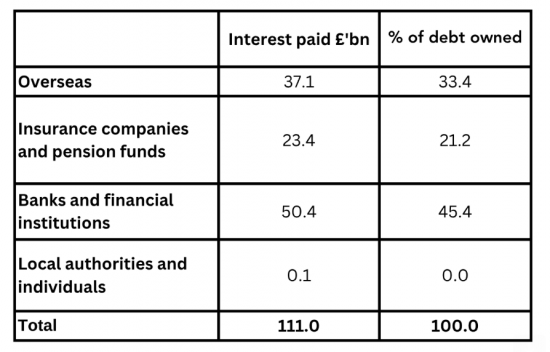
They are the biggest owners of debt in this country. They are the people who are the bond vigilantes, who are always talked about by UK journalists and others when they're trying to say that pressure is being brought to bear on the government to increase interest rates, and there's one other group to take into account as well.
That is UK insurance companies and pension funds. They hold 21% of UK government debt, and that holding is absolutely fundamental to their business operation. Why? Because they cannot survive without UK government debt, the offer that they make to pensioners to provide them with an income for life is underpinned by their ability to rely upon UK government debt to pay them interest forever if necessary, or until a person dies, and of course, they will. And the fact is that it is critical to the way in which they operate.
So too, by the way, is the holding of government debt critical to the way in which UK banks and other financial institutions operate. The whole of the overnight London banking market, which is enormous, depends upon the existence of UK government debt to operate. And therefore, to pretend that these organisations are not dependent upon the government to create this debt is completely ludicrous. All their ways of working are dependent upon the existence of this debt. That's why they own it. But let's be clear. What this data also tells us is something else.
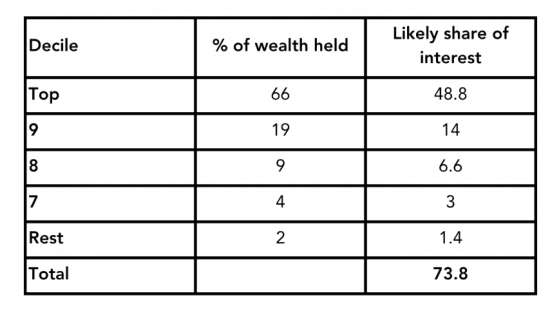
The UK government's debt is concentrated in the hands of institutions and the wealthy, and those institutions only exist to serve the wealthy. After all, it is only the wealthy who hold money in banks and financial institutions in any large quantity, and it is the wealthy who have the most money in pension funds.
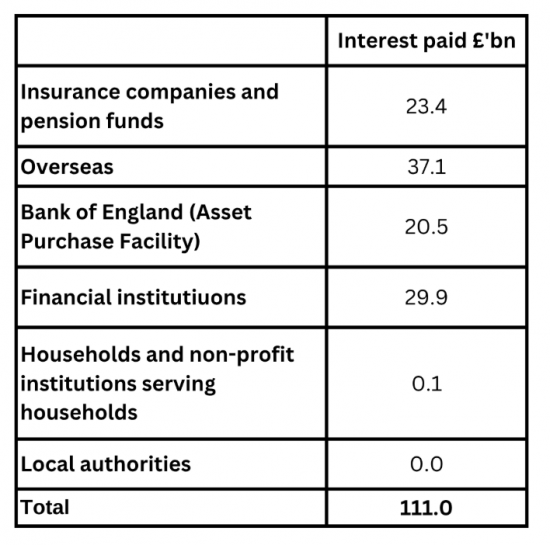
So, when it comes to interest paid, what is the story? Last year, in the year 2025-26, we think that the UK government paid about £111 billion in interest. I say 'we think', because again, this number might be subject to change after the event, but let's take that as our baseline at the moment.
Of that figure of £111 billion, which is roughly 10% of all government spending in the UK, around £37 billion went to overseas holders of debt. They receive that money, but let's be clear, they receive a sterling payment. We do not have to buy foreign currency to achieve that goal. What they do with the sterling when they get it is up to them. They can keep it, which is good news. They can sell it, which might depress the exchange rate, but the amounts involved are not big enough to make any real difference, or they might reinvest it in the UK economy, the best outcome.

 Buy me a coffee!

What about using National Savings to cut out the ‘middle man’
In addition to looking at the range and availability of National Savings products what about National Savings Pensions and life insurance?
Given the difference between the administration costs of the State verses Private Pensions and the requirement for financial advisers to sell the ‘best product’ a National Savings pension which was added on to the State Pension would be a no brainer.
I agree wholeheartedly
Well done – great post.
But I mean really………..what we have now is State sanctioned largesse to those who do not need it whilst as you point out many citizens go without the basics. The same beneficiaries then pour some of that money back into the political system that enables it, to keep the gravy train going.
That is not the behaviour of a modern country; it is the behaviour of a feudal kingdom. It also a waste of resources. That money could do so much – from potholes to any other problem but we are just giving it to a few people to hoard or buy political favours. These few people worship money accumulation and engorged power, nothing more.
In a word, totally unconscionable. Circulate this widely if you can.
I’m amused by the idea that the City is terrified of there being a left-wing Labour Prime Minister. Where are they going to find one of those?
🙂
This makes absolutely no sense. You fail at stage 1.
If UK institutions are the biggest holders of UK debt then be pushing up interest rates they are creating losses on their books – the value of the gilts goes down. Why would they do this? Realised and unrealised losses reduce the profits they can distribute to shareholders.
You say that by selling bonds they force a reduction in the market price (which is true), so the income on newly issued gilts increases, but this does not affect the income on the gilts they already hold, so they’ve created realised and unrealised losses on their balance sheets and their income is unchanged.
If they buy back gilts then the increased demand will have the opposite effect and increase prices / reduce yields, reversing what happened at stage one. But they will have incurred costs in doing so.
its a nonsensical argument and is simply not how financial institutions work – I should know, I’m a CIO for a large insurance company.
we seek to hold government bonds on our balance sheet to broadly match our liabilities – when inflation risks are higher, particularly due to government action or inaction, we hold less gilts and/or we seek a higher yield for doing so.
In seeking a real return to meet real liabilities, we look at which assets can provide the combination of liquidity, return and risk that we need. If yields on government bonds are too low then the risks implicit in holding those bonds are too high and we invest elsewhere.
Why should the government dance to your tune and make 70 million people suffer for 46 years?
We’ve had enough, it is literally killing us.
I’ll leave the detailed answer to Richard. I’ve been at the sharp end of austerity for the last 35 years or so – as a CPUPO (Chief Picking Up the Pieces Officer), now retired (but still picking up the pieces here in BS4).
Any chance, name withheld, that this disagreement can be turned to advantage and you have a dialogue with Richard to resolve how the serious underlying concerns he raises can be addressed? There can be little doubt that the way the bond market and interest rates are operating are both causing distortions in the economy that are affecting social policy in negative ways. So, come on, what’s the answer?
Non expert here. You say if yields on Government bonds are too low and risks too high, you’ll invest elsewhere. Where might that be? As Richard has pointed out, Government bonds are the safest there are, so least risky, while the UK Governments pays the highest interest rates, so where would you invest that is both safer and pays higher interest?
I guess you believe wholeheartedly that the kind of institutions you represent are some kind of force for good, and not really the besuited side of BetFred.
Come on “name withheld”! How about you and Richard developing an innovative, coherent intellectual framework joining together:
monetary reform,
infrastructure finance,
alliance contracting,
pension-fund investment,
and national productivity strategy
all into one integrated system! You know you can do it!
@ Name Witheld I really don’t understand your argument here.
Richard argued that financial institutions are the largest buyers of government debt, and consequently set the price in the bond market. He further argues that the interest being demanded on uk debt is unreasonably large given the costs Italy and France incur from essentially the same circumstances, therefore the premium must be due to other factors. He goes on to argue that we choose to accept this state of affairs by not intervening in gilt markets (as we could) to lower those costs, and are therefore subsidising the wealthy at the expense of the less wealthy.
Your argument appears to be that it makes no sense for financial institutions to drive rates up because they are damaging their current book? So by what magic do prices in the market move? If it is not in the interest of financial institutions to sell existing gilts with lower coupon rates in order to acquire new gilts then the price would never move? Clearly to drive rates higher there has to be more sellers than buyers, and we know the data says financial institutions are by far the largest market participants, therefore they have to be the cause of increased selling and reduced buying? How else do prices move in a market?
You yourself say that when inflation expectations are higher you hold less gilts (sell) and require higher returns (buy at higher yields). So what is the argument here? Financial institutions must be the cause of price movements in the gilt market. I struggle to see how else this works. If you are a CIO, I can understand why you would not want to attach your name to this post.
Well said
Well argued
Thank you
@name withheld
You say, and it seems to make sense, “If yields on government bonds are too low then the risks implicit in holding those bonds are too high and we invest elsewhere.”
The risk, presumably, is inflation because there is effectively no risk of default. The UK has never done that. Pretty much all other countries have defaulted including, I believe, USA (at least technically).
OK, so the yield on the bonds is lower that your institution would like. What are you going to do? If you sell the bonds you crystallise a loss, so what you buy had better be giving a yield that is not just better than the gilt, but also offsets the loss and is also zero risk. What would that be please? I want to buy some. I think a lot of other people would too.
Alternatively your institution could simply hold onto the bonds and continue to get the yield you knew when you first bought them.
I’m not seeing the motive to sell bonds.
In 2008 a lot of people were chasing yield. They were buying AAA rated securitised assets. We all know where that ended. At that time high yield, low risk, assets were not quite what they seemed, not quite as low risk as their rating suggested. I’m not sure they are any more available now. Certainly everyone would want then if they did exist, yet gilt auctions remain multiple times oversubscribed.
🙂
Passing legislation to remove the independence of the Bank of England, as you suggest and with which I agree, may be time consuming and politically difficult. But is it necessary; could the government work around it another way?
I wonder if, in the first instance, the government doesn’t need to abolish Bank? Could they not simply “borrow” directly from the Bank and instruct the Treasury to buy (or sell) as many government bonds as necessary to achieve their chosen interest rate? Sure, they might be fighting the official interest rate (and there is the issue of interest on reserves – perhaps they have to tax those reserves!) but they can certainly control the bond interest rate. And, as far as I can see none of this requires primary legislation.
I still feel there would be more anger if the calculations moved to per household costs £3bn is fairly abstract to many, but £100/year per household isn’t.
1% on bank interest rates Vs lower rent and mortgage payments saving £2k/year for an average household
When all of it is added together and it’s shown that an average household losses it to the tune of thousands a year, that’s where more anger might come from.
Set against the per household savings of recent disability benefit changes, or immigration related costs, it might also help illustrate how the likes of Reform are not pointing to the real problem
This is probably a stupid question but when you say The markets manipulate that situation to force up government borrowing costs.” the amount actually paid by the government will remain the same on existing bonds ( its a fixed interest rate) so it is only on new issues that there is an increase in the interest rate as the price has fallen. The new bonds to be issued compared to those already issued must be a small percentage , thus government total borrowing cost would only be marginally affected. So when we say government borrowing cost go up that only applies to future borrowing not the whole of government debt. Is that right or am I missing something?
Thank you for explaining something very complex in a way that I could gain insight into and some understanding. It very much sounds like the UK government and population as a whole are being treated like caged hamsters spinning faster and faster in their wheels, in the hope for getting the required rewards, but eventually something is going to fail and the wheels are going to stop spinning either due to mechanical failure, exhaustion, or something more severe; whilst those that have the food outside of the cage can walk away and go elsewhere.
So definitely new arrangements are needed, because the current ‘system’ is unsuitable for the needs of everyone nor is sustainable long-term.
Thank you for taking the time in explaining a complex area in a way that I could understand and gain some insight as somebody who doesn’t have a degree in economics nor work in the financial sector, but yet is impacted by the consequences of the current socio-economic and political climate by a number of intersecting issues.
Using an analogy, it very much sounds like the government and UK population is like a caged hamster, spinning faster and faster in its wheel, getting less and less rewards in return. At some stage this is going to fail due to technical failure of the wheel, or exhaustion of the hamster (or more severe health/wellbeing issues); whilst the one with the ‘treats’ externally can walk away.
Hence, something does need to change as the current mechanisms and arrangements in place are unfair, unsustainable for the long-term, and for whose needs are they meeting?
Just trying to get my head around what ‘Name withheld’ is saying about Richard’s analysis. Am feeling rather stupid<p>
He seems to be saying that his institution might sell some of the gilts it holds because of ‘perceived future inflation risk’ (fear of a left-leaning govt ‘printing money’?). If the institution , which say holds £100 worth of gilts issued originally at 5% interest, then it may sell off say £30 of the original £100 worth but may only get £25 from whoever buys it (another pension fund/institution?).<p>
The 2nd institution which has bought them for £25 is now getting £5*0.3 interest income on £25 worth of the second hand gilts , which is 6% interst.<p>
‘Name withheld’ suggests that the first institution will now invest / the £25 it has received by selling the original £30 gilts at a loss, in something which will pay a higher interest income but still be not too risky. But who /where is that ? <p>.
He says that selling off existing gilts at a loss not only provides the buyer of the second hand gilts this higher 6% interest rate but also says ‘the income on newly issued gilts increases’. Presumably that is only true if government decides to issue new gilts at the higher rate – but I think Richard is saying the govt doesn’t have to do that. It can just ‘borrow’ from BoE?<p>
‘Name withheld’ also says his institution ‘holds government bonds to match its liabilities’ and yet he is also seeming to suggest he looks for other assets – ‘we invest elsewhere’.<p>
So where is that?.
I don’t comment much these days as I never feel that I’ve much to add to what either you or other contributors have said. This video, however, is up there with the best of what you have produced since I have been following this blog. Your explanation and analysis are both clear and concise and, in my opinion, it is vital that this information and understanding is spread far and wide and repeated over and over again.
Thank you
That took quite a lot of writing
The Bank of England is part of the inherited flummery of the British state. No new country would start from here. One must hope that in an independent Scotland the central bank will be no more than a subsidiary department within the Finance Ministry.
Agreed
For the bond yield to increase the price of the bond must be below the face value of the bond, so why does the Bank of England just not purchase these bonds ? It would reduce the National debt and the total amount of money paid in interest.
It could…
Giving the government all the power makes it more effective to achieve its goal but if you have a British clone of Pinocchio Trump (who might look like Farage…), isn’t it dangerous. Wouldn’t it be better to review the guidelines of the Bank of England clearly in the interests of the ordinary citizens as its highest priority, with a democratic overview, more efficient and more ‘secure’ for democracy?
I believe in democracy and keeping Farage out.
Much to agree with. Clearly BoE and the FinMin need reform.
Perhaps one could start with modes of dress.
BoE and FinMIn fancy themselves as very important & dignified places. Given this I think there needs to be a dress code.
Wigs and hose (like in the late 18th cent) with natch a cod piece. – Visitors to these august institutions required to dress likewise. (that’s for the men, women – well 18th cent court dress).
On a positive note this would help the toursit trade (people queuing up to laugh at em) and it would provide much needed employment to costumiers.
It would also solve the problem of turfing out the noe-cons in the BoE and FinMin – who unused to being laughed at (& being readily identified) would give it up as a bad job.
Ridicule – not used enough.
A few quick questions for you:
1. If you think 10y Gilt yields at 5% are too high, where do you think they should be?
2. Why would international investors buy Gilts if there are less risky alternatives which also offer higher real returns?
3. Do you think that cutting rates and printing money for the BoE (under direct political control) would increase or decrease inflation and what effect would it have on the value of sterling?
A few answers from an amateur.
1. Richard has frequently said what he thinks interest rates should be.
2. We are all desperate to locate these alternative investments, that are safer than government gilts, and pay higher returns. Can you help?
3. Re “printing” money, and inflation, do see the glossary entries on inflation
https://www.taxresearch.org.uk/Blog/glossary/I/#inflation
MMT
https://www.taxresearch.org.uk/Blog/glossary/M/#mmt
and tax
https://www.taxresearch.org.uk/Blog/glossary/T/#tax
Where you will find answers to your third question.
Enjoy.
Thank you
Families before financiers.
People before profit.
Investment before interest accumulation.
I particularly like John Boxall’s National Savings suggestion. But then we can’t have competition for the private sector gravy train, can we.
Thank you for a really excellent post. I have been struggling to get my head around this for ages and your videos have really helped me.
I am left with one question. I’m assuming that the content of this video is referring exclusively to the secondary bond markets. I’m aware as Adrian Egglestone above also points out that the Government sells gilts in the primary market, and the interest rate paid by Government on gilts is that set in primary market at the time of sale.
Who sets the interest rates in the primary market? I read many economic commentators in the press who say interest on Government debt increased today for instance when it looks like a more progressive government might come to the fore. But bank base rates didn’t increase today. Are they simply confused like most people? Does the government/Bank of England set the interest rates paid on newly issued gilts in the primary market? Or as I’ve heard is there an auction and the purchasers set the interest rates in the primary markets based on the the strength of the secondary bond market into which they hope to sell the newly acquired gilts?
I would really like to understand the phrase ˋthe cost of government borrowing went up today because of a jittery bond marketˋ how does that happen? If indeed it does happen.
Any help to understand this would be much appreciated.
https://thecritic.co.uk/we-need-to-make-a-better-case-against-magic-monetary-theory/
In case you have not seen this
More hysteria
MMT is right: we need to find better ways to say it isn’t, is my summary
Is it Green Party policy to take back control of interest rates, cut the interest rate and cut the payment on central bank reserve accounts? I have a feeling not, and to me these policies seem like the very most important for any party at the moment. They underlie being able to do anything else. In which case, how do we get it right to the top of the Green Party list of policieis as a priority for when they form the next coalition government? Also more immediately what about Andy Burnham and Angela Rayner? Would they be open to it? Does anyone know of a way of getting it onto their priority list?
They are moving that way.
Thanks very much Richard as this has been very helpful for demonstrating that no UK government needs to be dictated to by the bond markets. I’m quite concerned at the recent coverage in the Financial Times which seems to forget your point about pre 2006 arrangements between the Treasury and BoE. I just wondered if you’d seen their latest article: https://www.ft.com/content/681c033e-de48-4edc-9214-339fde583c9a?syn-25a6b1a6=1
I’m getting quite worried at the number of Economists who don’t seem to understand the bond market. I’m an Economist and my speciality is Microeconomics and my knowledge of MMT and bond markets was limited until I came across your work and the work of Stephanie Kelton. There’s a “group think” amongst some Economists which is unhelpful.
Thanks again,
Neil
In The Times 18May 2026 Mehreen Khan [Bank accused of bond ‘punishment’] concerning the BofE continuing to sell gilts back to investors (‘QT’ £20bn 2026 so far), quoting Paul de Grauwe (LSE) ‘One wonders what the political agenda of the Bank was to put so much pressure on its own government, while other central banks, in particular ECB did not do so…..Bank acted as a super bond vigilante punishing its own government with higher interest rates’ . Article suggests that Bank action has contributed 0.8% rise to 10 year bonds since 2023.
I agree with that analysis