
Why do so many people feel alienated from politics in Britain today? Why has trust in political parties collapsed? And why do so many voters now feel politically homeless?
In this video, which I think is one of the most important we have made, I argue that seven words explain the transformation of UK politics over the last 50 years.
Once, politics was organised around nature, enterprise, work and society. Political parties represented identifiable interests, and most people could understand where they fitted into the political map.
The Conservatives championed enterprise. Labour represented work. The Liberals focused on society and democratic reform. The Greens emerged around nature and environmental concerns.
But neoliberalism changed all of that.
Today, I suggest British politics is increasingly organised around the financialised returns represented by rent, interest and product charges.
Property speculation, financial returns, and intellectual property extraction now dominate political priorities. Enterprise and work have been hollowed out and are now ignored. Financial capital has replaced productive activity at the centre of political debate. Our political parties have fundamentally changed as a result.
This video explains how that transformation happened, why it matters, and why it helps explain the rise of political disenchantment, Reform UK, constitutional tensions and the collapse of trust in mainstream politics.
If you want to understand why Britain feels politically broken, this video explains the process that got us here.
This is the audio version:
This is the transcript:
In this video, I'm going to suggest that seven words can explain how UK politics has changed beyond recognition over the last 50 years, which is the period for which I've been observing it.
50 years ago, most people felt politics served their interests.
Today, mass disenchantment and alienation define our relationship with most of politics.
This video will give you the analytical framework to understand what has created that change and how big the impact is, and stay with it to the end. I know that this is a longer-than-normal video for us, but this one will genuinely change how you see politics and how you understand what is happening now, and that is, I think, important. So stick with me on this one. It's going to be a good ride.
There's a framework for this video. I'm going to look at what happened in the past and what happens now.
Two sets of words capture the full story of that transformation, which is enormous and of great significance, and why we had the election results we saw in the UK - right across the UK - last week.
The first four words I'm going to use describe what politics was once about. The next three words will describe what it has become. Put them together, and we can see how the nature of politics in the UK has changed entirely and why we are in the mess we are now seeing.
The argument I'm presenting here is analytical, though, and not partisan, and that's why it's important to follow it through. I'm not supporting any one party, saying anyone is right or wrong. I'm just saying there's been a process of change.
When I first engaged with politics 50 or more years ago, four issues defined the political landscape, and those gave us the first four words that I want to look at.
The first of those was nature. Now, I know I was unusual in being interested in all things to do with the environment in the 1970s. Back then, it was a decidedly niche activity, but I have books on that bookshelf behind me right there that are from that era. I was interested back then in the relationship between human activity and the planet, and I wasn't alone. There were people writing about this issue at that time, and nature became an underlying and key issue within politics at that time and has remained so ever since. So that is our first word, nature.
The second word is enterprise. Now this one is more familiar to most people. Enterprise is the drive to innovate and create value across all sectors of the economy, and not just business, but let's be clear about this. This idea of enterprise, which in turn leads to the idea of the entrepreneur, is most commonly associated with business, of course. That's where we hear it most often. But let's not pretend we don't hear it elsewhere. The idea that we can innovate business processes or systems, processes or processes of change to add value exists right across society.
Of course, it happens in business, but it also happens in government. It happens in local government. It happens in schools, universities, hospitals and other public sector organisations. It happens in the voluntary and charity sectors as well. The fact is, enterprise is key to human development.
But in one particular case, that of business where the desire is to make more profit, this became an identifiable political force, and it became closely associated with one political party. Enterprise, then, is a keyword in political thinking. And back in the 1970s, it was everywhere, as it still should be. And I'm not arguing there's anything wrong with this idea that we should innovate and create value. The fact is, it's there, and it gives us our second word.
We have nature, and we have enterprise, and the third word that I want to talk about is work. Work is, of course, all about paid employment and rights and the rewards that people are paid, as well as other things which are just as important. There is a need for the social safety net that we should have in society to support those who cannot work, whether they are made unemployed through no fault of their own, or whether they cannot work because of ill health or disability or whatever it might be, and we must look at those issues as well. The point is, work is a key issue within our society and without work, there would be no wealth, and therefore, the world of work provides us with our third word with which we can view the world of politics as it was.
The last of these four words is society. Society is the word which I can use to provide the overarching narrative of politics, which looks at democracy, representation, culture, identity, and international relations. That's been key to many political parties over the years and is, of course, particularly important at this moment when we look at the fractures which exist within UK politics.
Together, these four words spell one individual word, and that is news, N.E.W.S., results in that mnemonic, which makes it easy to remember what these four words are.
And that's particularly important because our political parties mapped very clearly onto these words at the time that I'm talking about, 50 or so years ago, before the rise of the neoliberal era in British politics. Each major party had a primary focus within this framework.
Nature was clearly the focus of the Ecology Party 50 years ago, and that went on to become the Greens, who we still know now. This was their domain, and nobody else's for a long period of time. Others now talk about it, but the Greens should still own this space.
Enterprise was the priority of the Conservatives; let's be clear about that. Although it should have been seen everywhere, it was the profit-motivated form of enterprise that became associated with the Conservative Party, with business enterprise being seen as the engine of prosperity, although the issue was much bigger than that.
Work, in contrast, was the obvious heartland of Labour. Issues to do with employment, employee rights, collective bargaining, and the culture of care and the social safety net were all at the epicentre of everything that Labour was about 50 years ago. This was their part of the political terrain, and everybody knew it.
Society was where the Liberals were to be found, and of course, they later morphed into the Liberal Democrats as we now know them. They've always had a focus on ethics, on community, on voting systems and proportional representation, and also on international relations, hence their focus on issues around the European Union, for example. For them, these issues were paramount.
And in the 1970s, we did have the SNP, the Scottish National Party and Plaid Cymru, the party of Wales, and they emphasised national culture and distinct identity as well. They also came within that framework of society within the four words that I'm talking about.
So, we end up with this chart, and this chart is important because it shows this very clear mapping between a political party and one of these words.

Nature and the Greens.
Enterprise and the Conservatives.
Labour and work.
Liberal Democrats, the SNP, Plaid Cymru, and various aspects of society.
We knew where we were, we knew what the priorities of these parties were, and we knew that we could understand where we stood in relation to this chart as well.
If your priority was work, you were likely to vote for Labour.
If your priority was Welsh identity, you knew who you were going to vote for.
If you thought business enterprise was the most important issue, it followed that you voted Tory, and so on.
The point is this. This was a politics in which real interests were genuinely represented.
Enterprise and work between them covered most people's daily economic lives.
Nature and society gave meaning to the wider world people inhabited, and the parties were distinct. Their priorities were legible and real, but there were overlaps. Let's not pretend otherwise, but you could locate yourself within this map and feel represented.
And then the Thatcherite neoliberal revolution changed everything. The revolution fundamentally changed how parties define their purpose.
Three words now describe the actual priorities of the main UK political parties. Not all of them, but most of them, each describing the priority they give to a form of financialised return within the neoliberal economy.
That is the big change. We are not talking about the idea they represent. We now talk about these parties and the difference between them on the basis of the financial return that they prioritise, all within this neoliberal framework.
The first of these words is rent, and that, of course, is the income derived from property ownership and rising house prices. These have become an obsession for some.
The second word we need to use is interest, which is, of course, the return on money, and I use this word as a proxy for the interests of banks and the whole of the interests of the City of London. That word is about financialised returns other than rent.
The third word that I use is actually two words, but it's product charges, and these are the payments made on patents, copyrights, and intellectual property in a deeply financialised world in which there is a high proportion of tax haven activity.
Now, product charges in this sense are incredibly important because we are seeing changes in patterns of consumption as a result. We pay copyright fees in effect, when we reward Spotify or Apple or whoever it might be for the purchase of our music, which we don't own, we just rent. We pay patent fees inside most of the products that we buy. We buy intellectual property because so much of the world is now branded.
Together, these three words spell out R.I.P. That does not stand for rest in peace. It stands for rent, interest, and product charges.
Now, let's look at how that has changed the party political perspective.
The Conservative Party has shifted from being the party of enterprise to being the party of rent and property ownership. Rent is its obsession. Buy-to-let barely existed 50 years ago. Now it's seen as what enterprise is all about, and it has almost come to define middle-class wealth, whilst rising residential property values have become the foundation of the Baby Boomers' prosperity, and I, of course, am one of them. The party, once associated with business, now prioritises property exploitation as the basis of prosperity. This is why genuine enterprise in the UK has collapsed as a consequence. There is no political interest in enterprise anymore. There is only interest in property speculation from people like the Conservative Party.
So, how has Labour changed? Let's be clear. Labour has abandoned workers and everything to do with their rights. From the early 1990s onwards, Labour set out to convince the City of London that it was its friend. The strategy was simple. It was to persuade the City to provide it with donations and support that would ensure that the Tories, by then discredited, could be thrown out of office. Since then, Labour has aligned with all its major donors, and all of them have wealth rooted in the City of London. Trade unions, workers' rights and equality have been progressively sidelined, and Labour has become the party of the banker and not the party of the worker. This change has been absolutely fundamental. Labour is now the party of the City, the party of interest.
So, where does Reform fit into all of this? Where does the new kid on the block, who has arrived over the last 50 years, fit into the R.I.P. framework? Reform presents itself as the champion of ordinary people standing up against the establishment, but in practice it looks nothing like that. Its funding comes from people who appear to profit from intellectual property extraction and offshore activity, and the world of financial engineering and product charges, including the exploitation of crypto and gold, are its real domains. Richard Tice's promotion of lower taxation through the use of carefully engineered structures designed to reduce his tax bills reflects this. This is a type of activity closely related to product charging, and it perfectly reflects Reform's current alignment.
Reform might say it is a party of the people, but it actually looks as if it is serving the interests of those who are offshore, who are financial engineers and who have no interest whatsoever in creating real value. I do not trust what Reform says; instead, I look at what they do, and what they do is seemingly serve the interests of those who are funding them. In that case, Reform is the party of product charges. It is the P in R.I.P.
So, where are the Liberal Democrats in all of this? I suggest they are no longer a party of society. Since the time that Nick Clegg became leader of this party, sometime before 2010, and as was seen most clearly during the coalition years between the Conservatives and the Liberal Democrats, the party has changed its spots very decisively. Sir Vince Cable exemplified this with his alignment with the City and business interests when he was Trade Secretary in that coalition government, and its stance on Europe is now decidedly pro-capital and pro-financial sector orientation. The party that was once associated with a democratic society now also serves financial capital. I think that, like Labour, it is now a party for the bankers and of interest on this new map.
As a result, we come up with this map here.
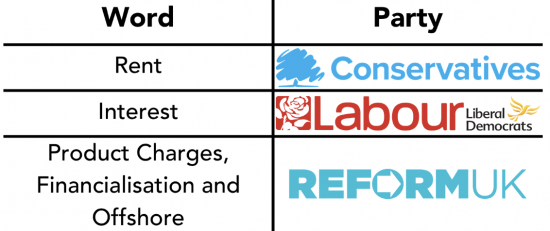
When we look at rents, property prices, and property speculation, we now think of the Conservatives.
When we think of interest, bankers in the City of London, we now think about Labour and the Liberal Democrats.
When we think about product charges, financialisation and the use of offshore, we think about Reform.
That is where those four political parties are now. That is where their allegiances lie. We have a totally different map now of what their priorities are.
At the same point, the map, which we saw previously, the one of N.E.W.S., that was nature, enterprise work and society, has been hollowed out. This is my new version of that map.

We still have nature being associated with the Greens. That thread still holds.
And society is now most closely associated with the activities of the SNP and Plaid Cymru because they are talking about society and the nature of what it is to be Scottish and Welsh, and the culture that goes with it.
But enterprise has been abandoned entirely. There is now no major political party that champions this activity. Business has been ignored by the political hierarchies of the UK, and work has also been abandoned. There is no major party that now genuinely sets out to represent workers' interests in this country, and as a consequence, care for people has also fallen aside.
The hollowing out is not accidental. It is the product of neoliberal transformation. Enterprise and work, once at the epicentre of British political argument, have now been displaced by the interests of financial capital. That is my point. The parties that once served producers and workers now serve rentiers and financiers. In England, there is now no party that speaks credibly for either enterprise or work.
And so we end up with this, my final map.

This is the new political map of the UK. We have joined the two maps together. Let's be clear. That's all I've done. We've taken the old map, which many of us still think should exist, and added to it the new map, which is how politicians think about themselves and their purpose in life.
The consequence is that we can see there is an identity crisis at the heart of British political life.
Industrial policy has been abandoned, enterprise has gone, genuine business activity is ignored, and that's true in business, but also in government and also in voluntary and other organisations as well. This idea that we innovate for the common good has disappeared altogether. No wonder we're a country which is losing its prosperity and its means to innovate.
Workers are now treated as a means to an end. And that is a general consideration across the political spectrum, and not as people with rights to protect.
Those who seek agency as people are, as a result, turning to the Greens or to the independence parties in Scotland and Wales, and we saw the consequence of that in last week's elections.
Whilst Reform exploits the language of agency but serves the interests of capital, a situation which it will try to maintain for as long as possible, but which will at some time in the future be exposed, at which point its whole edifice will collapse because that's what always happens to far-right parties. They cannot maintain the duality and the sheer hypocrisy of their positions.
Politics has moved from news, N.E.W.S. to R.I.P., and that shift is not metaphorical.
The old map represented real economic and social interests across society.
The new map represents the interests of property finance and capital extraction.
Most people's lives fall outside this new map entirely. That is the root cause of mass disenchantment with British politics.
This is the story of politics throughout my adult life.
We have moved from the N.E.W.S. map to the R.I.P. Map.
Understanding that requires that we see what has been lost as well as we see what has changed.
Enterprise and work have been lost from British political culture. That matters; that matters to me above all else in a sense. Without a culture of enterprise and without a culture of work, working together to achieve outcomes which are mutually beneficial, which, let's be honest, used to be the case - of course, there were tensions, of course, there always will be - but nonetheless, the combination of enterprise and work does produce value, and without that, we cannot restore British democracy. We cannot restore British business. We cannot restore British government. We cannot restore British schools, hospitals, universities, and all the other types of organisations that we need to make our society function, and without that, we cannot make our world work again.
We need to move on from this politics, which is wholly about financial concerns, unless you are supporting the Greens, the SNP and Plaid Cymru, and they are important and valuable exceptions because they highlight that there is another possibility, then we have no chance of going forward. That is my point. This is where we are. How we move on from here is the subject of the next video, but what I want to know from you now is, does this logic work for you?
Please leave us a comment. Please take part in our poll, which is down below. Please do share this video if you like it. I think the messages in here are important and help people understand how we have reached the mess we're in, and please also think about subscribing to this channel.
Poll
Thanks for reading this post.
You can share this post on social media of your choice by clicking these icons:
There are links to this blog's glossary in the above post that explain technical terms used in it. Follow them for more explanations.
You can subscribe to this blog's daily email here.
And if you would like to support this blog you can, here:

 Buy me a coffee!

This is very interesting.
For me, the NEWS categories represent personal values, with a very human connection (which is where politics should start, and end). The RIP categories are different – ownership and control. Therefore, I struggle to see them in the single merged table. I’m thinking about what would bridge from one to the other, because as citizens we are human and still care about NEWS despite RIP being offered. Is this a purely UK phenomenon or global? Has it been enabled by globalisation?
(btw I think in the final diagram Reform should sit where you have Conservatives, for consistency?)
First, edit made. I copied a draft. Thanks.
SEcind, of course there is a disconnect between NEWS and RIP – that is the whole point. Neioliberaslism has created that disconnet.
The major parties still believe in enterprise, they just seem to think that we can’t do it ourselves and need foreign investors to come in and provide it… hence the arbitrary fiscal rules to keep “the markets” happy and confident to “invest” in the U.K.
i also don’t think the SNP is a society party. Apart from their desire for Scottish independence, economically they are in the same camp as Labour.
Beanie, free tertiary education, free prescriptions, free bus travel for young people, Scottish child payment, baby box scheme, procurement policies that support local businesses. Unemployment at 3.7% compared to 5.1 for UK. As we say “what has the Scottish government ever done for us ?” I have more if you want but I think I’ve made my point.
Thank you
Beanie, as long as there is a UK, all the parties in the UK are economically ‘in the same camp’ as the governing party: the UK’s economic policies are dictated and controlled by the ruling party. If/when Scotland becomes an independent state its governing party will dictate and control its economy. In the recent past the SNP has, like all the UK parties, been under the miscomprehension that neoliberal economics is effectively the only policy available. Fortunately, within the Scottish independence movement, Tim Rideout and Jim Osborne have being doing important work in laying out how a Scottish currency and economy based on MMT principles would work (see http://www.reserverbank.scot).
On another tack, The National features a blistering piece by Andrew Tickell (a Law professor at Glasgow’s Caledonian University):
Anas Sarwar came, saw, lost. And still they don’t learn | The National
Well worth a read.
Agreed re that piece
The claim of major parties supporting Enterprise, it’s certainly not SMEs that are backed properly. Government tendering and grant processes lean towards preferring bigger businesses. In the case of grant funding, specifically so under Labour recently, as Innovate UK has paused Smart Grants, consulted on a potential replacement that would require finding equity investment as well (which more strongly affects early-stage companies who haven’t achieved a significant valuation yet), and stated that they are looking to back fewer but bigger projects.
It’s clear that big business interests have a loud voice with Labour, Conservative and also Reform, to shape the agenda, despite SMEs being such a key part of both current employment and future growth opportunities. SMEs are also much less likely to be syphoning off all their profits through international branding or debt.
So, it seems fair to indicate there is a shortage of parties adequately supporting Enterprise.
Thanksv
We can see the end point for “rent” in the housing scandal. You can also see other end points when the profit of the few is put before nature.
This example is from France, notice how the authorities know what is happening but are too terrified of the farming lobby to do anything:
https://www.theguardian.com/news/2026/may/12/i-couldnt-breathe-the-sinister-spread-of-frances-killer-seaweed
……….even though people are dying. Suggestion: don’t go on hols to Brittany in the summer – you might die due to hydrogen sulphide poisoning caused by French farmers.
Not a single word on immigration and yet it it the single most important issue in U.K. politics and the reason why Reform are the strongest party in the country. How can you ever be seen as objective? Instead you seem intent on pushing dogma.
Immigration is not an issue for the UK, except we might need more of it and need to cherish all those who have come here.
Without immigration, and in my case I mean from either India, or the African subcontinent, my late wife, who suffered from Alzheimer’s Disease, would not have been able to remain at home. I cannot praise too highly these people, mainly women, who travelled thousands of miles to help me over a number of years. Completely professional in their duties, they made life bearable, for both my wife, and myself. Apologies for a political point, just to say that Scotland is the only country in the U.K to provide free personal care at home for all adults, regardless of their age, assets or income.
Thank you and much to agree with
The current immigration debate (noise?) probably reinforces your point that Enterprise and Work are not valued. As evidenced through the deliberate restrictions on overseas students, researchers and academics in universities hollowing out their ability to add value through innovation and training.
I enjoyed that slightly longer format. I’d be interested in a deeper dive on each area (word) if that was practical. I’d certainly like to understand more about the role nature could play in helping rebuild Britain, for example. And understanding more about each of how RIP function might help make more sense of the madness!
A follow up is planned
Agreed – the issue is not immigration, Patrick is wrong.
The issue is politically planned continuous austerity that has been taking money away from the public services people value and much more. This got worse as of 2010 under the Tories who have damaged our society very badly, and in addition made BREXIT happen for good measure.
Patrick – are you sure that you are that so full of prejudice that you and people like you simply cannot work out that it is being made poor by your politicians that is your problem – not the immigrants, many of whom arrive here with less than you?
Thank you, both.
@ Patrick: Please don’t worry. We get the message. I know many immigrants, e.g. my parents (here since 1964), and their children (in my case, born and raised here), not just from the former colonies, but from the European continent and even USA, who are on the way out. In cases of mixed marriages, it was the English hubby, not the immigrant or child of immigrants wife, who suggested that, with Reform on course to win big in 2029, the whole family should up sticks. Please give my parents and me a couple of years to sort things out. Our Anglo-Italian friends and neighbours are on similar timelines.
I was born in Arsenal and Corbyn Country, but have lived in Buckinghamshire since a few months old. I don’t know anywhere else. It’s not easy starting again in one’s 50s, but start again, one must.
@ Richard: This morning and with no sense of awareness after their relentless platforming of Reform, the BBC featured immigrant NHS staff facing racist abuse. What does the BBC expect?
Thanks for sharing
And the BBC does niot thinks so it is continually surprised by the obvious
Wow. The ‘issue’ of immigration as you call it has been manufactured, first to engineer Brexit and now to further explain why so many people in the UK are feeling hard-up – which has nothing to do with immigration. You demonstrate perfectly the effectiveness of propaganda. I read somewhere that Margaret Thatcher looked likely to lose the 1979 General Election until she switched to an anti immigration stance. The rest is history and as Richard points out in his article, has led us to the sorry plight we’re in today.
@ Patrick Flynn
If you want more “objectivity”, Patrick, give us some well evidenced facts or valid personal experience, and less vague divisive rhetoric.
The most important thing is still “the economy st***d” – and how we are lied to about it, (especially in relation to immigration, by the last few governments, and especially by Reform UK.)
Richard’s contribution is to offer a politics of care and an economy of hope.
Yours is….?
Thank you
I worry that our politics, our systems and institutions, are fundamentally not fit for purpose to manifest fairness, equity, and justice for all – perhaps they never have been and we’ve optimised for the worst aspects of them – and that only radical change will transform life for most people.
I can’t see how someone willing to effect such change will ever achieve sufficient power to do so, therefore the direction of travel is increasing inequality and societal collapse.
So many civilisations have followed this pattern – why would ours be any different?
Thanks to all for an excellent analysis!
Might it be that we now have/suffer from pluralities of national economies?
1) A financial economy (Dominant)
2) A regular person+children econoomy (Subordinate and Exploited)
3) A diadvantaged person+children economy (Increasing via the political and mainstream associates of 1)
Might another possible analytical structure be age related in that the young tend to. be exploited by the older?
Might this be indicated by the increased costs and availabilities of transferable skilled and semi-skilled work plus rentier favouring policies which so impede independent family life for young adults?
P. S. Might there be an inconsistency in policies which obstruct family life for the young and underfund systems for the decent management of the needed input of immigrants?
P P S The Chinese government has clearly stated and used policies to assist young adults.
You thought about it
That was my goal
brilliant analysis of real life impacts of neoliberalism journey through our country since 1979.
Thank you
Although it fits in loosely with ‘society’ I feel it deserves a category of it’s own – Community.
No-one promotes or encourages a sense of community. How many people now claim to be politically homeless (no sense of community)?
Unions destroyed, working mens clubs gone, community centres closed etc. Even in my street where I’ve lived for nearly 30 years I can only name a handful of neighbours and maybe on nodding terms with a few more, not like times gone by when everyone knew each other.
That feeling of ‘belonging’ to a community in many capacities is desperately needed again.
I think that is society
The words “community” and “society” are often used as if they mean the same thing, but they refer to two distinct levels of human organization. A community is a close-knit group bound by shared values, geography, or common interests, while society is the broader web of institutions and relationships that governs how millions of people live together. Understanding how these two concepts differ – and how they depend on each other – is essential for making sense of everything from neighborhood dynamics to national governance.
https://evs.institute/environment-and-society/community-vs-society-differences-connections/
I accept that point
BUT the words I chose were meant to be very high level
50 years ago, I lived in an area of inner Birmingham. In my son’s first school, only three others in his class were ethnically English. In rural areas, the smaller proportion of immigrant children can more easily be managed than in one where English may not be the dominant mother tongue.
It’s not immigrants that are the problem, it is that our governments have been unwilling to invest in their well-being. Lack of available housing in many areas confounds the problem
Much to agree with
As the logical trajectory of the maximisation of profit by the neoliberal parties – Tory, Labour, Liberal Democrat, Reform and other far right becomes ever more glaringly obvious. This is in the form of the toleration of poverty and increasing inequality and complete ignorance towards the rape of the Earth, natural world and climates crisis. This leaves only Greens and Scottish and Welsh nationalists as our only hope of redemption.
Much to agree with
I agree with your analysis, but I think you also need to add into the mix that the change in our economy and the jobs people now do, and sadly the growing generational divide.
Labour traditionally represented the working classes who worked in manufacturing, the mines etc. and the Tories the middle classes who owned their own homes and worked in the professions. Thatcher extended home ownership and sold off council housing making many workers tied to a different way of thinking. The so called working class has massively declined and many are now university educated doing jobs their parents never dreamed of. However home ownership for the under 40s has become an unattainable dream for many despite having professional salaries and they are saddled with massive student loans. Neither major party has an answer for this growing group of younger adults who despite getting a good education and having a professional job are either forced to live at home with their parents well into their thirties or are paying very high rent to live in insecure often poor quality homes. These highly educated, articulate adults are rightly agrieved and are largely flocking to the Green Party. The older working class people in post industrial communities without the education to question the lies are flocking to Reform. Whilst I agree that Green Party policies need improving, especially the process that develops them, they for me answer the question better than any other party in England. Kier Starmer cannot answer any of the questions I have and not can most of his party.
Thank you
A very interesting article, thanks Richard. I would respectfully submit that the SNP does flirt with Enterprise, having three ‘enterprise agencies’: Scottish Enterprise, Highlands and Islands Enterprise and South of Scotland Enterprise – often abbreviated to SE, HIE and SOSE respectively. Each has a slightly different remit and priorities which could be broadly said to be met through a ‘place based’ approach and only HIE and SOSE include community-led development within theirs, but they are there.
I remember a conversation with a colleague probably twenty years ago when we agreed that it was a sad fact at the time that the properties we owned, by doing nothing, were effectively earning more than we were through being gainfully employed.
The third sector is pitching in, from the coal face.
They know where it’s hurting, and they also know that the politics of greed, hate and injustice isn’t working.
https://www.theguardian.com/politics/live/2026/may/12/keir-starmer-prime-minister-resignation-labour-leadership-cabinet-meeting-yvette-cooper-shabana-mahmood-andy-burnham-wes-streeting-uk-politics-latest-news-updates?page=with%3Ablock-6a03417f8f08676dd37f3022#block-6a03417f8f08676dd37f3022
13-20th May, https://millionactsofhope.org/#
Thanks
Thanks for the video Richard. In case anyone wants confirmation of your allegation in re Labour – here’s tonight’s headline on the Grauniad web-page:
JP Morgan could scrap £3bn London HQ if Starmer is replaced by PM ‘hostile to banks’
Re the JP Morgan threat… my neighbours here in BS4 are already on the streets protesting – they can’t face life without a new JPM HQ in the city. This council estate is rising up to protect the bankers, we stand shoulder to shoulder with the City elites! (Cough, cough)
[…] I argued earlier this week, Labour is now in office to keep bankers and not workers happy. And that is why it needs to […]