
Right now, a litre of petrol costs around 150p. Of that, 52.95p is fixed fuel duty and around 25p is VAT sojust over half the pump price is tax. The remaining cost is the oil itself, plus refining, distribution, and retail margins. If oil rises from $110 to $200 a barrel, which is an 82% increase, the most likely pump price is around 192p per litre, and it could hit 221p in a worst-case scenario. That could be a devastating hit to the cost of living when UK families are already struggling.
But let's be clear, this oil price crisis is not being caused by UK tax policy. Fuel duty and VAT are not the drivers of this price rise; the disruption to global oil markets is. But that means the government has a real choice because it could cut fuel duty, as other countries have already done, to stabilise prices and protect people. A cut from 53p to 30p per litre could make a material difference. On top of that, it could also look at rationing, speed limits, or other demand-reduction measures used elsewhere in the world.
The choices here are political. The question is whether the government will act.
This is the audio version:
This is the transcript:
Let's be clear about it. We are facing an oil price crisis. Bloomberg is now predicting that oil could reach $200 a barrel. That is an unprecedented price for oil around the world. It's never got anywhere near that in the past. Right now it's $110 a barrel, and we're already seeing the impact on petrol prices. We have a crisis coming our way. That's my point. That is the subject of this video. How are we going to respond to it is my question.
But first of all, let's have a look at how petrol pricing really works, because where is it going as a consequence of this potential oil price increase, which does look to be very seriously on the cards?
Let's be clear about it. Most of the price of petrol is not oil in the first place. Out of the typical 150p per litre at present, 52.95p is fuel duty. That is a fixed price per litre charged by the government. Of the rest, 20% is VAT, which rises automatically with price. At this moment, that means that the VAT is one-sixth of that total £1.50, and one-sixth of £1.50 is 25p. Add those two figures together, and just over half the price of petrol at present is made up of tax, but it is only the underlying cost of fuel that moves when the price of oil changes.
So, there isn't going to be a one-for-one increase in the price of petrol at the pump as a consequence of what is happening with regard to oil prices, but what are the likely reactions going to be?
Let's be clear about it. Let's review those issues again with regard to what the price of petrol is now and look at the consequences. The price of petrol at 150p per litre can be split into three clear parts. Around 72p of that 150p represents the cost of oil and its refining. 53p, near enough, is fuel duty, and that will not change, whatever the price of oil is, and around 25p is the VAT charged on the pre-VAT price of this oil at the pump. The result is shown on the screen right now. We get a price of 150p made up, where just under half the price of the oil sold to you as petrol is represented by the original cost of getting the oil to the pump.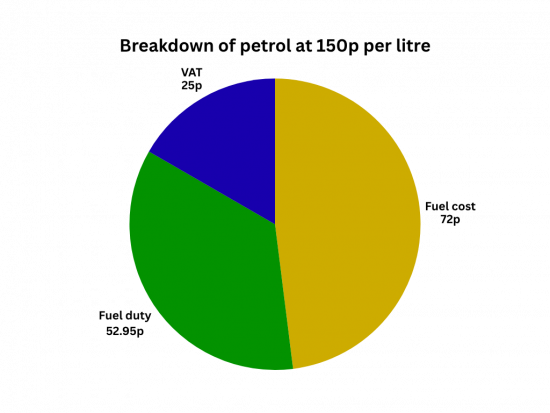 What happens now if there is a change in the cost of crude oil? Well, it isn't that there is a direct and absolute relationship with the price of petrol. That's because crude oil might be the main driver of the increase in the cost, but it is not the whole cost. Refining and distribution costs are also included in the 72p price of oil included in petrol when it's being sold at 150p at the pump, and retail price margins are also part of that final price, but those costs do not tend to change dramatically when the price of crude oil does. Refining costs and garage profit margins remain pretty fixed, let's be clear.
So, if oil were to increase from $110 per barrel to $200 per barrel, that's about an 82% price increase. But it's pretty unrealistic to think that the price of petrol will rise by the same amount, because it's only the crude oil-related part of petrol costs that has to rise. The non-crude oil-related part of the cost does not rise in the same way, and that means that there are a range of possible petrol prices that could result from this increase in the price of crude oil. The outcome depends on how much cost follows the crude.
My estimate is that if oil increases in price to $200 per barrel, the maximum price increase that we could go to is 221p per litre for petrol. Now, that's a massive increase from where we are at present, but let's break this figure down. As the table on the screen shows, the price of the fuel included in that 221p per litre would increase to around 131p per litre. The fuel duty would remain the same, and the VAT would increase from 25p included in the price of petrol, now at 150p per litre, to 37p included in the price of petrol at 221p per litre. So the price increase has nothing to do with fuel duty, 12p with regard to VAT, and the rest is all down to oil, but that assumption is the maximum increase.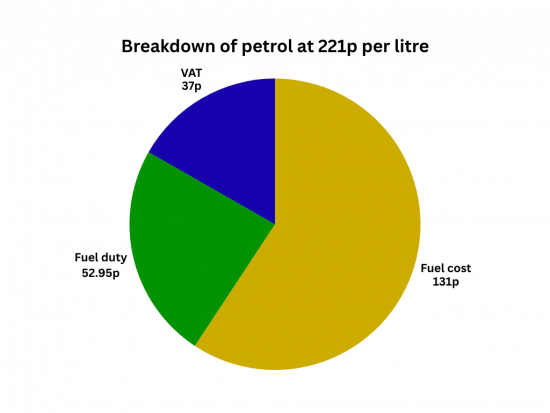 If we knock out from the price of crude oil the cost of refining and assume a fixed margin for the garage, as a consequence, we won't get to 221p per litre for petrol. We will instead get to something like 192p for petrol. That's because of the data now being shown on the screen. The price of the fuel won't increase to 131p because it will only increase to 107p because some of the cost of the fuel will be fixed. Those are the costs of refining and the costs of the garage and the cost of distribution, but the duty will also be fixed. It will still be 52.95p per litre, but the VAT will now be 32p per litre compared to 25p per litre at present. The result is a price of 192p.
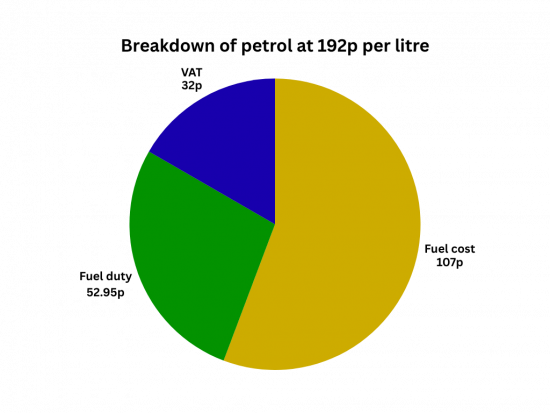
Now, my guess is that this 192p is the most likely price of petrol per litre as a consequence of oil going to a price of $200 a barrel. It is, of course, an enormous cost, a very high price for us to pay for oil, much higher than the 150p per litre we're paying at present, which already feels pretty uncomfortable, but let's do the comparison.
We're paying 150p now. We were paying somewhat less than that in January 2026. We could go to 192p. At worst, we could go over £2 per litre. All of that is possible, but the increase is driven mainly by crude oil prices.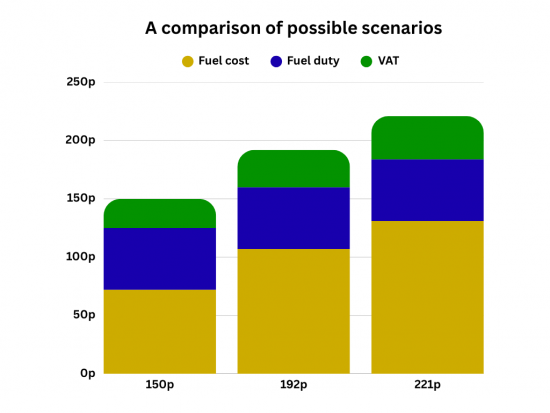 Fuel duty is not the driver of this because it does not change as oil prices change, and VAT changes are relatively small, counted in pence, and they are not a significant contributor. The state is, as a result, not causing the price increases that we are looking at with regard to fuel. They are caused by the oil market disruption that is being created by Donald Trump and Benjamin Netanyahu. If you want someone to blame for the hole in your pocket, they are the people you should be looking at.
But what does this mean? It does mean that we are going to suffer a significant economic shock. That price of fuel is going to go through into the economy. It's going to reduce our disposable incomes if we have to buy fuel. It's going to increase the price of everything else that we have to buy as a result.
So, is there anything the government can do to manage the potential increase in the price of petrol from 150p a litre to around 190p a litre? The answer to that is yes, of course, they could.
They could decide to reduce the VAT rate. I think that's unlikely because there isn't a system to do that within the UK economy, but they could instead decide to keep the amount of money that they raise per litre of fuel fixed in tax terms, and therefore reduce the fuel duty by maybe 5p-7p per litre at most, to keep their stake within the price of fuel constant. That would help, but it would still leave fuel at well over 180p per litre.
Is there anything else they could do? Well, they could cut the absolute price of fuel by cutting the fuel duty price even further. Instead of being 53p a litre, they could cut it to, say, 30p a litre. We have seen some states in the world already making drastic cuts in their rates of fuel duty for precisely this reason. So it is not impossible for the government to do this. They could stabilise fuel prices at a much lower price than that which markets alone would determine.
What's going to happen? I don't know. I do think that the price of fuel is going to increase significantly.
I do think my forecast that the potential impact of this upon the price of petrol at the pump is reasonable.
What I don't know is whether the government is really going to react to this by intervening in the fuel duty price that we pay for every litre that we buy.
Should the government cap taxes as a result, or should it be rationing instead, or should it be doing something else entirely to reduce our fuel consumption? For example, should it be imposing speed limits on motorways and A roads, or other measures which have been tried in other countries, like ‘no drive days' if you happen to have a certain car registration plate on a certain day: that's been done to make sure that the consumption of fuel is reduced to keep the price under control.
What do you think? Are you worried about petrol at £1.90 per litre, as is possible, in my estimation? What's the impact on you going to be? Let us have your comment. There's a poll down below, and if you liked this video, please indicate that by ticking the box down below, sharing it if you want to and subscribing to this channel.
Poll
Thanks for reading this post.
You can share this post on social media of your choice by clicking these icons:
There are links to this blog's glossary in the above post that explain technical terms used in it. Follow them for more explanations.
You can subscribe to this blog's daily email here.
And if you would like to support this blog you can, here:

 Buy me a coffee!

I estimate that my wife and I get through about 1000L of petrol a year
We were paying just under 1.30/L until about two weeks ago its now 1.50/L
So every 10p rise in fuel prices costs us about £100pa
Allowing for the fact that prices dropped over the winter clearly if they go towards £2/L and they have been there in the last few years thats going to take £500pa or £10pw out of our spending assuming we dont drive less which we probably will. This in turn will have an impact on wherever we are going – National Trust properties, Heritage Railways, Garden Centres etc (Very Middle Class retired I know)
I was going to a hospital appointment yesterday, there was a Range Rover in the car park, now we live in a rural area but it didnt look like a farmers one but it was parked ‘on the road’ as it would not fit any of the marked parking bays – made about as much sense as trying to tie up the QE2 – Aircraft Carrier or Liner at Clevedon Pier. Clearly I suggest that any regimes to cut fuel duty need to have some sort of mechanism -probably via Vehicle Excise Duty (Car Tax) so th eowners of these sorts of vehicles dont benefit from it.
Thank you
You don’t mention the price of diesel, which will be the main worry for commercial users unless they have already switched to electric vehicles. The forecourt price of diesel here is at least 30p a litre more than petrol, so around £1.82 to £1.86 a litre. As a result, the County Council faces big increases in its school transport bill, which of course is particularly significant in rural areas.
Australia has halved the duty on petrol and Tasmania has made public transport free to encourage peopler out of their cars.
I looked for an ‘All of the Above’ button, but there wasn’t one!
I chose Rationing/Restrictions because I felt it was the one which would affect them least (financially) and therefore the one they were most likely to do.
I never used to be this cynical…
I would have preferred to vote for all of the 3 options when the government does something, but reducing demand has to be the best option as it also reduces fossil fuel usage.
Personally there won’t be a direct effect on me. I have decided not to continue to drive as I have been driving so little I am no longer confident in my ability. My husband continues to drive, but having just had the MOT done, we did a total of 623 miles last year, much of which was helping friends when they needed transport. The real effect will be on utility and food price increases, which may be a struggle. My husband qualified for his state pension last month, so our annual income will increase, but I don’t expect it to increase enough.
Good luck.
Finding the key to the “magic money orchard”, where the fiat currency grows, let alone using it, isn’t within Rachel’s experience yet. Does she even know it exists? Will the monetarist angel Margaret Hilda, her of the flaming sword, twin set and pearls, guarding the gates of Threadneedle Street, even let her through? Can Rachel break the bonds of her PPE degree, disarm Margaret Hilda and fling open the vault doors to do something USEFUL as Chancellor?
Or will she continue with her feeble mantra “We can’t AFFORD it?”, while the weeds and brambles of the monetarist curse, choke the rest of us labouring sweating exhausted fallen creatures to death?
(for the key to this little drama, see Genesis Chapter 3)
I saw one of those civilian Humvee conversions the other day – the American military vehicle you can buy as an SUV – with god knows what sized engine (6.o litre V8 anyone) – brand new, custom reg’ plate – 4 to 8 miles per gallon? Ugly as sin.
Why is such a thing like that allowed to exist at all given that oil is on the way out – or was?
Oh of course! Markets! That most efficient allocator of resources.
Conspicuous consumption. All the fat Chelsea tractors clogging up our narrow roads and parking spaces.
It was a long time ago when I visited Tasmania but from memory outside Hobart there wasn’t much public transport so there may be an element of jesture politics in making it free
Reducing demand is the key factor here. Cutting prices will only keep demand high, driving further price increases.
Pushing Companies to allow greater flexibility in working from home would make a significant difference.
In the longer term, increasing taxes (both road tax and VAT) on oversized cars and decreasing them for more efficient ones could help shape the market.
On the plus side, it is well recognised that we need to move away from reliance on fossil fuels, so maybe this is the kick in the backside that we need? Like most kicks in the backside, it is painful at the time.
Richard, you wrote:
They could decide to reduce the VAT rate. I think that’s unlikely because there isn’t a system to do that within the UK economy
I am not sure I understand. Wasn’t VAT reduced during Covid for hospitality? And there are different VAT rates for various things anyway, so doesn’t the capability exist to change VAT?
It would certainly counter the righter wing press pushing the line that Rachel from Accounts will be raking in more money as the petrol prices increase.
The rate could be changed. I was suggesting i think it unlikely it will be when fuel duty would be easier. That’s all.
I’m not sure if I’m thinking about this in the right way, but from an MMT perspective, fuel duty exists because the government needs to manage demand for a commodity that drives the entire economy. Fuel is a high-impact input: it feeds into transport, food, logistics, etc. That’s why the real issue isn’t the first-order effect (cheaper fuel = short-term relief), but the second-order dynamics.
If you lower fuel duty, you reduce costs across the economy, but you also likely increase demand for a resource that is already constrained. The result isn’t necessarily long-term relief, but pressure reappearing elsewhere.
So the question becomes: how do we run an economy with less of a critical input while protecting those who rely on it most?
Lower-income households are disproportionately affected, not because they use more fuel, but because they have less flexibility. Instead of weakening the price signal (by cutting fuel duty), you preserve it. And compensate people directly so they can still participate (work, care, access services)? This needs to be paired with viable alternatives, such as improved bus services, efficiency measures, and a long-term reduction in dependence on fuel.
If fuel needs to stay “expensive” to reflect scarcity, how do we ensure people can still function within the system? And if we don’t adjust incomes, are we effectively allowing exclusion to do the adjustment for us?
If the economy must adapt to having less of this resource anyway, isn’t the real policy question not whether we remove the pressure, but who ends up carrying it?
There’s still a case for temporary or targeted interventions for critical sectors, but doesn’t broad cuts risk undermining the core signal?
These questions are rhetorical; I’m not seeking direct answers.
Let’s be clear: I am not saying the fuel price should be cut. I am saying inflation can be controlled via tax.
I think that a combination of the first three should be considered.
Maybe another option is, for those whose job can be done in this way, to increase the number of days people work from home. That could reduce demand and save money.
Craig
Don’t we already have a 5p reduction on petrol costs? Introduced when there was last an oil supply problem in 2022 – petrol reached about 192p/litre then I seem to recall.
As that shows, it may be easy to reduce a tax as a government gesture to help during a cost crisis but it is difficult to reverse it once normality returns.
I don’t know the answer, but there is also the argument it is the government’s responsibility to ensure there aren’t perverse incentives for people buying fuel-inefficient cars. While there have been peaks and troughs the price of petrol in the UK has stayed at broadly the same level for 15 years; coincidentally if it had risen with inflation it would now be a little over 190p/litre.
An alternative that has been discussed is reducing the speed limit, which would likely lead to around a 10% cut in fuel usage and thus effective cost; it was something done in response to the 1973 oil crisis. It would not be a politically popular move -the oil crisis probably did for Heath’s government – but in the present situation it could be clearly labelled as a direct consequence of Trump’s war, and of course it would be easily reversible.
A cut to fuel duty should be extended to reflect the rise in petrol prices,
The Guardian has just reported that Richard Walker, the executive chair of the supermarket chain Iceland (who has apparently, for who knows what reason, been appointed as the government’s ‘cost of living champion’ ) urged Keir Starmer to extend the 5p cut in fuel duty introduced by the Conservative government in 2022 by cancelling the planned increase in the levy in September, in light of the conflict in the Middle East. The Conservatives have also supported this and the LibDems (remember them?) have called for an emergency 10p cut. Sadly Zack Polanski and the Greens have not yet called for fuel tax cuts as far as I’m aware.
I hope this fuel crisis encourages more people to switch to electric vehicles. We should really not be underwriting and sustaining the fossil fuel industry by cutting taxes on the stuff.
I think there should be a VAT reduction.
Not on fuel, but on walking shoes, commuting and cargo bicycles.
Additional public transport subsidies should be introduced. Private car journeys should be discouraged unless absolutely necessary, allowing for buses to either operate more frequently or for bus routes to be extended to areas less well served. Less heavily trafficked roads would also encourage people to walk and cycle.
Employers should be encouraged to allow staff to work from home, otherwise flexible working should be considered where practical to reduce the working week for those who have to commute.
A ban on idling vehicles should be enforced. NSL (for cars) and motorway speed limits should be reduced to 50 mph.
Anyone walking or cycling should be paid 20 pence per mile. Valet cycle parking should be introduced in town centres and supermarkets, and for large employers. More free cycle training (bike ability) should be offered to adults.
Efforts to decarbonise the grid should be stepped up. More homes should be better insulated. More PV and heatpump installers should be trained up. And subsidy for solar PV and heatpump installation should be increased. Costs of fossil fuel generation should no longer determine the price of energy.
Talking about the cost of fuel is much to narrow in scope. This is an opportunity to shift and rejuvinate our economy, whilst stepping toward energy independence and climate sustainability.
Interesting
The quiz’s options are limited. I think (a) offering free public transport, (b) supporting businesses in the transition to greener rail-based or battery-powered transportation, and (c) helping farmers move away from fossil-fuel-based fertilisers, would be better than subsidising fuel.
Admittedly, in the short term this is not great for rural people, but if councils were given responsibility for running free bus services, rather than privatised companies being given the freedom to run profit-making machines, then there would be better services for rural communities.