
Should companies exist solely to make their shareholders richer? For decades, the idea of shareholder value has dominated corporate management, but I argue that this approach has fundamentally misunderstood what makes businesses successful.
In this Understanding Economics video, I explain what shareholder value means, where the idea came from, and why putting shareholders first can damage businesses, workers and society.
In 1970, economist Milton Friedman argued that companies should prioritise making profits for their shareholders. This idea became central to neoliberal economic thinking and helped transform how major corporations were managed.
Around the same time, economist Eugene Fama developed the efficient market hypothesis, encouraging the belief that share prices accurately reflect the value of companies. Together, these ideas helped make profits and rising share prices the dominant measures of corporate success.
But does a rising share price really mean a company is doing well?
I examine how the pursuit of shareholder value can encourage businesses to cut jobs, suppress wages, reduce investment and buy back their own shares to boost financial returns. These decisions may benefit shareholders in the short term while weakening the businesses they own.
I also explain why shareholders are not the only people responsible for creating a company's wealth. Workers, customers, suppliers, governments and communities all contribute to business success, yet shareholders are often given priority when the rewards are distributed.
UK company law recognises some of these wider responsibilities. Section 172 of the Companies Act 2006 requires directors to consider employees, suppliers, customers, communities and the environment, although shareholder interests remain central.
Drawing on my experience as a chartered accountant who has advised hundreds of businesses, I argue that successful companies prioritise providing useful products and services, treating workers fairly, maintaining good supplier relationships and respecting the environment.
Profit matters, but it should be the consequence of running a successful business rather than its sole purpose.
Companies should exist to meet people's needs and contribute to society. Shareholders deserve fair treatment, but so does everyone else who makes business success possible.
It's time to rethink shareholder value and ask what companies should really be for.
This is the audio version:
This infographic supports this video:
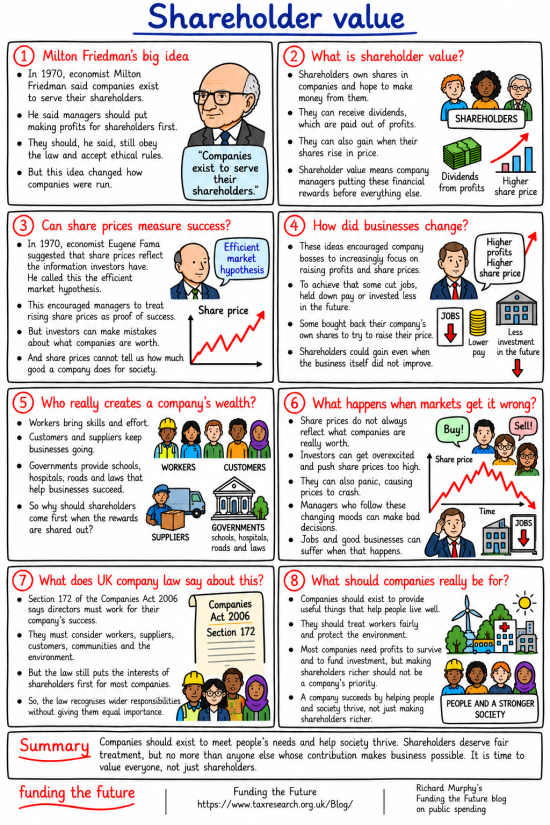 This is the transcript:
Hello, I'm Richard Murphy, and this is Understanding Economics. That's the series of videos that I'm making that explains economics in the way that I see it. Now, I stress this is the way in which I see it, and I do not see it as most economists do because I am a heterodox economist. That means I'm outside the economic mainstream. But I think that's appropriate. Economics as it is being taught in universities, as most economists talk about it, and as most commentators talk about it, has clearly failed us.
So this view of economics is about an alternative view of an economics that could work for you, does work for me, and which explains the world as it is based upon my experience of working within that world as a chartered accountant, as a campaigner, and as a university professor.
Today I want to talk about something which is important because it is fundamentally linked to the concept of neoliberalism, about which we made a video recently, and that is the concept of shareholder value, which has totally changed the way in which the world's largest companies have been managed over the last 30 or 40 years.
This concept was created by the economist Milton Friedman in 1970 when he wrote an article which said that large companies should exist solely to serve the interests of their shareholders. He said the world's corporate managers should put making profits for shareholders at the top of their list of priorities, and everything else should be a long way down. He did admittedly say that companies should obey the law, but beyond that, shareholders came first. And this idea of Milton Friedman's changed how the world's largest companies have been run. Shareholder value is the concept which now dominates corporate thinking.
And shareholders own shares in companies and hope to make money from them.
Let's be clear, shareholders don't work in companies. Shareholders do not participate in the management of companies. They just own a share in the ownership of the company, which gives them a right to receive dividends if the managers agree that that is appropriate, and these are paid out of corporate profits.
They can also gain when their shares rise in value if they're quoted on stock exchanges. And shareholder value means that company managers are meant to put these two types of financial reward at the top of their list of priorities before everything else.
So, can share price measure success? By coincidence. In 1970, the economist Eugene Fama, who went on, like Milton Friedman, to win the Nobel Prize in economics, suggested that share prices reflect the information investors have. He called this the Efficient Market Hypothesis (EMH). I will be honest, the concept is a little more complicated than that, but this idea encouraged managers to treat rising share prices as proof of success.
But investors can make mistakes about what companies are worth, and share prices cannot tell us how much good a company does for society. So how did business change as a result?
These ideas encouraged company bosses to increasingly focus on these two issues, raising profits and increasing share prices. Their own rewards were often aligned with these goals, and as a consequence, many of them set out to cut jobs, hold down pay or cut investment in the activity in the company because that would release money for current dividends rather than hold it back to generate future well-being.
Some also authorised the buyback of their company's own shares from stock markets, and that raised their prices, often, in my opinion, artificially. Shareholders could gain as a result even when the businesses that they owned did not improve.
So who really creates a company's wealth? That's the ultimate question to ask when it comes to this concept of shareholder value and putting that first amongst all other things. In my opinion, shareholders do not, of course, create a company's wealth.
Workers bring skills and effort.
Customers and suppliers keep businesses going.
Governments provide schools, hospitals, roads and laws that help underpin business success.
And so the obvious question to ask is: why should shareholders come first when the rewards come to be shared?
Why do they have priority when everybody else seems to have done more to create the success which they are meant to have priority upon?
And what happens when markets get share pricing and other issues wrong? Share prices do not always reflect what companies are really worth. Investors can get overexcited and push share prices too high. I think they're doing that with regard to AI shares at present. They can also panic, causing share prices to crash. They did that, for example, in the dot-com bubble in 2000 when it burst, and there were real companies subject to a crash at that time, which had lasting value.
So managers who follow these changing moods could make very bad decisions, and the evidence is that they do. Jobs and good businesses can, however, suffer when those bad decisions are made.
So what does UK company law say about all this? And I stress the point: I am talking about UK company law here, and not that in every country around the world, where this will differ.
UK company law on the purpose of companies is determined by Section 172 of the Companies Act 2006, and this says that the directors of the company must work for the overall success of the enterprise. They must, in the process, consider the interests of workers, suppliers, customers, communities, and the environment, and indeed the standing of their business in that community.
But the law still puts the interests of shareholders first for most companies, and I stress one point. It treats all shareholders as equal. The company cannot prioritise one shareholder over another. But that being said, the law recognises wider responsibilities without giving them equal importance, and that matters. Shareholders do come first in UK company law.
But what should companies really be for? That's the key question here. Companies should exist to provide useful things that help people live well. I've run many companies in my career. I've started quite a number. And what I know is that a company that does not produce something that somebody wants to buy is going nowhere.
And what I also know is that a company that does not treat workers fairly and protect the environment is likewise going to have a very short life indeed. People will walk out on it. The company will fail. And therefore prioritising profit before the interests of customers, workers, and the environment makes no sense at all. I would also add to that list suppliers, because they have to be treated fairly as well.
Companies need profits to survive in most cases, and they need that because they might need to pay a return to shareholders, but more importantly, they need to fund future investment in their activity as well.
Making shareholders richer is what I call an epiphenomenon of a successful company. It's the consequence of doing something really well. And the thing that a company has to do well is treat its customers by supplying them with good products, caring for its workers, caring for the environment, caring for its suppliers, and paying its tax on time. When it's done all of those things, and if it does them well, shareholders will benefit.
A company succeeds by helping people in society thrive and not just by making shareholders rich. And I cannot stress that point enough. In my experience as a practising accountant who has advised hundreds of companies in my career, and I'm not exaggerating when I say that, I have never seen a company that prioritised profit succeed as well, if at all, as one that prioritised providing good products, treating people well, managing supplier relationships so that everyone was happy and respecting the environment.
Companies that succeed do so because they're good at what they do and not because they only think about their shareholders.
So, companies should exist to meet people's needs and help society thrive. Shareholders deserve fair treatment, but no more than anyone else whose contribution makes the business possible. It's time for companies to value everyone and not just shareholders.
Now that's what I think, but in this series on Understanding Economics, there is, of course, room for you to disagree. That's what Understanding Economics is all about. We form our opinions by disagreement. Let us have your comments below. I'd be delighted to read them.
Poll
Thanks for reading this post.
You can share this post on social media of your choice by clicking these icons:
There are links to this blog's glossary in the above post that explain technical terms used in it. Follow them for more explanations.
You can subscribe to this blog's daily email here.
And if you would like to support this blog you can, here:

 Buy me a coffee!


When I did my “O” level Economics in the late ’70s we were taught that companies had a broad range of responsibilities… of which “making a profit” was one.
(I was also taught that banks lent first, then raised deposits, if required. Governments spent and tax/bond sales were optional).
50 years later we are still having to argue what was once self-evident.
Agreed
I agree with you Richard. One of a companies assets is the people that work for it. It has become obvious that they are viewed as a cost. Without the people who work for a company can a company exist, offer services or products. AI is not the answer although many will believe the sales speak and invest money to save on employees which seems to be it’s best selling benefit.
In the building industry despite many FE colleges closing their building and constructions departments there is still a requirement for skilled craftsmen, qualified and experienced to build houses etc. AI will have a hard time cutting a through mortice and tenon joint.
For far too long the bottom line has been the fixation of companies at the expense of their workers. The hospitality sector is one were many still have zero hours contracts and below the minimum wage despite what we are lead to believe.
Carry on getting the message out there but don’t deprive yourself of a little R&R in the form of bird watching.
Noted
Not this week, I am afraid.
All I could think of was two things (which is good BTW) reading this:
Ayn Rand – this is what she advocated all of the time – ‘rational’ self interest. Being the simple reactionary she was, she ignored thousands of years human development and concepts like ‘kindness’ and ‘altruism’. There’s nothing rational about selfishness.
Resource accounting – the lack of. If all you focus on is the ‘taking’ (acquiring) of something without asking where it comes from and the effects of that taking, you will end up with a mess to sort out. That is why people can’t afford housing, heating, food and why the planet is being degraded and heating up.
Much to agree with
How do water companies fit into your description of what makes a successful company?
They don’t, at all.
Yet water company boards reward their CEOs very handsomely for success and have done for many years. Many companies treat their workers and their customers badly and just keep going. You seem to be describing the world as you (and I) would like it rather than as it is. What am I missing?
I am describing what it should be and could be, and what I would make it.
Might the prioritisation of second hand shareholding be based on the astounding belief that people who are preoccupied with maximising money for themselves will bring the greatest good for everyone? (From John Maynard Keynes)
I think your assessment is predicated on what we’d think of “traditional” companies. Ones where folk get together and have an output for end user(s).
In reality, we have many different companies, set up for many different reasons, that benefit from limited liability but don’t honour wider responsibilities. You know this better than so many!!!
For example, some companies exist to allow an individual to have “flexibility” in use of how payments are made to them. (More efficient than being an employee – but don’t employ other folk, eg Farage). Some are set up to allow extraction of cash on basis of interest or brand use (private equity vehicles, Costa, etc). Etc etc.
I believe that the concept of companies emerged when folk took existential risks (raised capital for something novel, and limited liability encouraged the endeavour rather than nothing happening) is nothing like most modern company set-ups.
So maybe we need something that doesn’t give all companies the same benefits. Should Many individuals be able to reduce cost by operating under a company? (On other hand many subcontracts can only go to companies not individuals.) Should cash extraction offshore in form of interest be allowed if that interest is significantly above BoE rates – why do we allow these financial instruments to exist?
But there do seem to be very different types of companies. Perhaps only those that can demonstrate compliance with “greater good” should be allowed to operate with existing company beneficial treatment – and others should operate under a different set of rules? Sure, work exclusively for shareholders, but without the same grants, subsidies, protections, bailouts, etc. Tricky to do, but first step is to recognise they aren’t the same.
But most people have no idea there is a diversity of companies.
I cannot do everything at once.
This is an ask too far for almost any situation.
Richard,
I was suggesting you have to solve this (well, not today :). I was only suggesting (and I suspect it would be complex to disentangle existing arrangements) – but maybe it would help if there are terms to allow us to differentiate between the different companies.
Private Eye had something on Farage a couple of months ago where he talked about his “company” doing good things – it turned out the only employee was himself. This isn’t the same as companies that employ people, pay tax, produce something useful. He words suggested he was contributing to something more than himself and most or our journalists don’t seem to question anything.
And I suspect we shouldn’t treat companies that funnel profits or excess payments (I know, define excess?) via offshored companies should be designated as such – and not treated the same as ‘traditional companies’.
And, I know this isn’t the priority right now. Just a thought when I read your article. Good luck with keeping all the balls in the air this week!
Noted….
But I think most people make that differentiation already.
apologies. Should have read: I was NOT suggesting …..
It might be very useful if auditors included in their report the sort of things you suggest companies are really responsible for. A bit like an ofsted report which has to look beyond exam or Sats results. I’m sure some audits already do this
Larger companies should be legally obliged to have such an audit as part of their financial reporting obligations.
That is not an audit requirement at present.
At the start of my career in aerospace there was a meeting where the senior managers asked the audience “why are we here”. Answers like “to design and build aeroplanes” were proffered, but the answer was of course “maximise shareholder value”. I found this hugely de-motivating – it made me feel like a wage slave, which was pretty accurate. I later started to read about how things can be done differently, with more equitable business models – I mention just a few: The Rochdale Pioneers, Mondragon and Semco. The 1st pioneered the cooperative movement, and Mondragon is a modern incarnation of this, which provides not only employment, but a host of other socially beneficial services such as a university. Semco is a pioneer of “industrial democracy” where leaders are elected by those who work under them, and in which they are also shareholders. It would be great if such business ideas were somehow encouraged by government!
Thank you