
The FT said in an email this morning, linked to this article:
The Iran war has blown a near-£12bn hole in Britain's public finances, according to FT estimates, forcing chancellor John Healey to lean on Budget tax rises and spending cuts to fund efforts to ease the cost of living.
Higher borrowing costs and rising inflation have probably cut the UK chancellor's fiscal room for manoeuvre from the £23.6bn forecast by the Office for Budget Responsibility in March to about £12bn, according to the estimates.
The reduction in headroom means Healey could be forced to announce painful tax increases and spending cuts in the Autumn Budget to retain the confidence of the bond markets and pay for measures to ease the cost of living for households.
This is total nonsense. This infographic explains that:
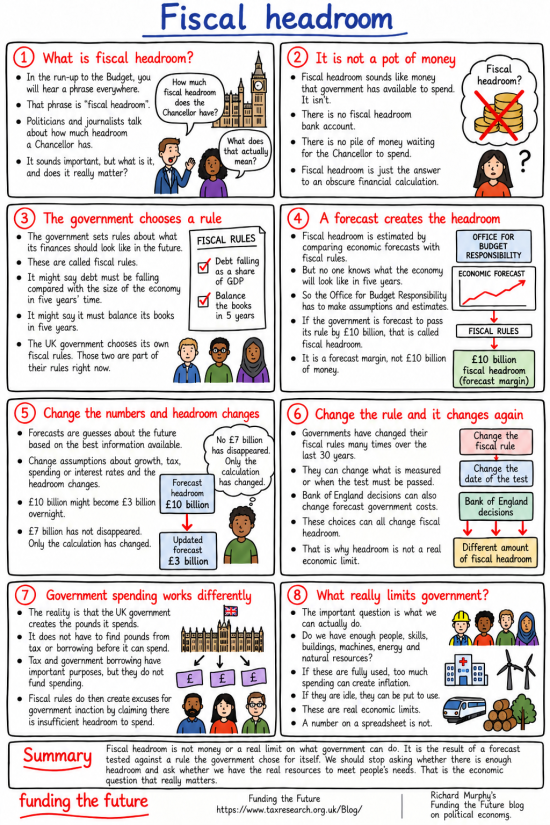
What the FT is faithfully reporting is, then, total drivel. Fiscal headroom is a work of fiction used to enforce austerity to create austerity:
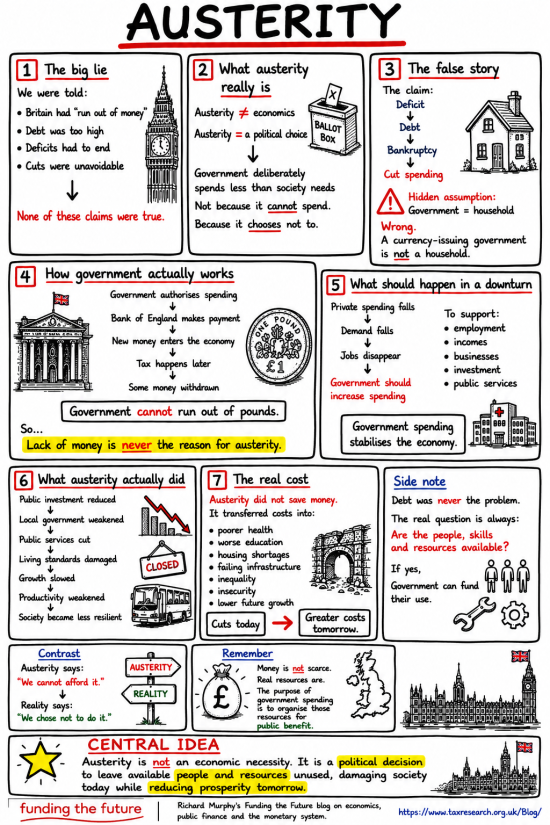
I think that one needs updating!
All of this happens within the context of fiscal rules:

That's another one that looks like it needs revisiting. But the message is clear: we are being told utter nonsense, and the FT happily reproduces it.
Why is the question to ask? Why all of this? What is this mechanism of control all for?
How to expand these images
Press CTRL or Command and the Plus (+) key on your keyboard to zoom in. Press CTRL or Command and the 0 (zero) key together to restore the screen to normal.
How to download this image
If you right-click the image, you should be given the option to download it to your computer. So long as you do so without the intent to make a profit, you may do so without further permission. Commercial use requires consent. But if you just want to share it, do so with whoever and wherever you want. That is the purpose of these infographics.
The image library
There is a library of these images. It is available here. All downloads are free, but donations help our work.
AI use
I wrote this infographic. I used AI to create the final image.
Thanks for reading this post.
You can share this post on social media of your choice by clicking these icons:
There are links to this blog's glossary in the above post that explain technical terms used in it. Follow them for more explanations.
You can subscribe to this blog's daily email here.
And if you would like to support this blog you can, here:

 Buy me a coffee!

“The Iran war has blown a near-£12bn hole in Britain’s public finances,”….strewth! what did they use? a drone? Who controlled it. I think we should be told.
I reckon the FT has an in-house trained AI that generates this nonsense whenever the editorial mob are contacted by the BoE or FinMin morons (give us a bit of supportive propaganda will you). Thing is, repetition works, even intelligent people swallow this shite & takes a great deal of convincing that what the FT spouts is nonsense. & those countering it – on high profile media platforms are very few and far between.
This post should be given to every MP to read and comment upon. Also put in the economics section of the National Curriculum and all university economics degree syllabuses. The drival of the Financial Times should be exposed for all to see.
Agreed
Brilliant to see three of your infographics together; they convey an idea so quickly and are both a great primer and a good reference. We need them more than ever now, and you’ve already done a fair few. Is it possible to link them under your videos? This would potentially spread them further.
I have realised I can put them on videos now – including on YT
I am beginning to think that if I want reliable and insightful financial journalism I would be better of reading The Beano than the Financial Times!!!
The Bash Street Kids might have known more. Desperate Dan might have become a market trader. Brick Lane style, though.
Neoliberalism has many of the features of a religion. For example, the Bond market creates a myriad of complex financial interactions that are given peculiar names that only the initiated understand, creating a kind of priesthood amongst traders. Similar use of jargon creates mystique and hierarchy in other areas of money flows and investment. So participants in the neoliberal structure are as much drawn to a form of exclusive worship as they are to the financial rewards. The temples of Neoliberalism, with their promises of Earthly salvation, make it much harder for critics to gain ground.
Have you ever wondered why it is OK for markets to be ‘elastic’ but not State spending power?
No, that has ‘rules’ and ‘headroom’. And contraction. And not meeting need.
Hmmm……(sniff, sniff)…..the smell of bullshit is overwhelming.
Wakey, wakey people, wakey, wakey – now!