
The FT has just published this headline:
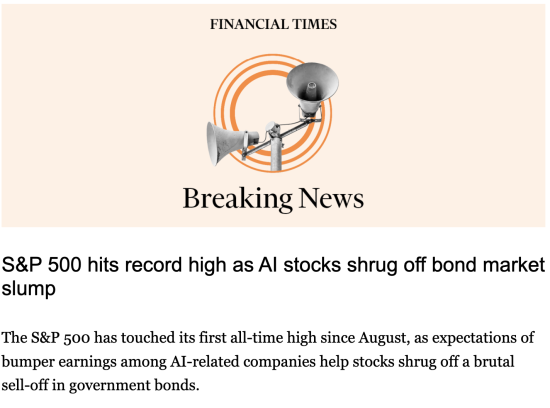
As stupid headlines go, that one does take some beating.
The whole reason why the S&P 500 has hit its first all-time high since August is precisely because funds are being diverted out of government bonds and into the purchase of AI shares, with a consequent deemed increase in the necessary interest rate payable on the bonds in question because their price has fallen.
The S&P is not shrugging off a brutal bond sell-off.
It is creating a brutal bond sell-off, and the FT appears to lack the wit to understand that.
No wonder we are in trouble if they cannot see the obvious when it stares them in the face.
Thanks for reading this post.
You can share this post on social media of your choice by clicking these icons:
There are links to this blog's glossary in the above post that explain technical terms used in it. Follow them for more explanations.
You can subscribe to this blog's daily email here.
And if you would like to support this blog you can, here:

 Buy me a coffee!

I’ve always been confused why the media seems to suggest that stock markets reaching a new all time high is some sort of achievement. Surely any capitalist economy with minimal GDP growth and at least some inflation should expect to see new record stock markets highs pretty much every day. If it’s not hitting a new high, something is wrong.
Out of curiosity I took a look to see who was the last US President not to see a new stock market high established during his presidency. Jimmy Carter, 46 years ago. Before him (ignoring Ford) it was Harry Truman, basically due to them still recovering from 1929. So it’s pretty rare for the market not to be at new highs. Of course it won’t go on forever, but anyone pointing to the stock market as a sign of economic success may just as well say the earth set a new record for number of days it has achieved…
I like that
Historically there is a correlation between rising interest rates/ bond yields and equity markets falling. That’s all the FT is saying.
You’re as stupid then. You believe that just because something is normal, everything will always be. Why? Why not try thinking?
Richard, I tune in to your blog frequently, as I tend to agree with your analysis of the economy – though, as a non-economist, I struggle to follow it. However, your first response above at 8.08 pm is unworthy of you – sneery, condescending and abusive. I understand you are a Quaker too. I am surprised.
I disagree.
Quakers do plain speaking.
I spoke plainly.
And it as not abusive. I called out a comment that showed a lack of thought from someone pretending to be an expert.
Such people are the problem when we face a crisis.
We do face a crisis. This is not the moment to be polite, and say it will all work out OK in the end – that is not going to happen.
Richard, all he said was “Historically there is a correlation …”
I know. I read it. And I said history does not relate to what happens in a bubble, unless you look at the data in bubbles, when normal times are suspended.
In this instance, I have to agree with Maria. It made me uncomfortable reading your response and detracted from the objective discussion.
I disagree it was plain speaking. Calling someone stupid is not speaking plainly, it is an insult. To speak plaining is using clear, simple words without jargon (i.e. speaking in layman’s terms). Calling someone stupid goes beyond that, it is a value judgement aimed to demean someone rather than a factual explanation.
Let me contextualise this. A person who has never posted here before, using an IP address usually associated with those trolling this blog from behind virtual private networks, made a suggestion that I thought was stupid.
Why? Because the whole point of what I am saying is that nothing is normal right now. That is apparent even from commentary everywhere. Stock markets are behaving irrationally. Bond markets are plummeting. Cash holdings by funds are reportedly disappearing. Major reallocations from bonds into shares appear to be taking place, alongside substantial borrowing to acquire shares, increasing the risk of a global financial crisis.
I think the probability that the person I addressed was called David Miller is small.
I think he is one of many people arriving here to say that everything happening is rational, normal, and to be expected. Many of those comments are deleted. Perhaps I should have done that with this one. In my opinion, they are all wrong. To describe me as desperately concerned about the world economy at present massively understates my worry. In that situation, being told by somebody who is almost certainly trolling that I should assume normal financial relationships still apply is asking too much.
You may think I overreacted. I hear that. But in the face of another global financial crisis, which I think is coming, politely suggesting that someone might perhaps reconsider their assumptions is absurd. I called out what I saw.
I thought the comment was stupid in the context in which it was made. I have explained why. So please don’t waste my time telling me from your totally anonymous account that I must be a nice chap when the world is falling apart around us. At least own up to who you are first.
Hi Richard,
Thank you for your detailed response, I appreciate that. I can hear, and have picked up on following your blog, that the relentless troll comments are exhausting and frustrating. I know you are human. This is the problem with the internet, people doing clever computer things and hiding where they are from, we’ve seen this with Russian interference! Merely you explaining that this ‘person’ has attempted to hide where they are posting from has helped me see that they too aren’t being honest in their discussion. May I suggest if you let future comments through on your blog of this nature, that you state at the start of your response that the where the comment has come from is very dubious and of not honest intent? Thanks again.
Thank you. SO LET ME ADD A TROLL WARNING, AS YOU ASKED ME TO. I HAVE NO IDEA WHO YOU ARE, AND YOU HAVE HIDDEN YOUR IDENTITY FROM ME. You fail your own test.
AI stocks are going up and bonds down does NOT imply investors are switching out of bonds into AI stocks. Traders/investors/speculators in the two assets are totally different animals.
Buyers of AI stocks are buying out of cash or on leverage. Sellers of USTs think rates are staying high or going up further.
If bond traders are right then the AI buyers will find the ‘cost of carry ‘ of their long positions will become too great and they will sell.
In short, the FT is right to highlight this divergence.
I disagree. Why else are bond sales continuing? It has nothing to do with risk.
Sorry, Clive, these aren’t normal times, I think, and suggesting there are no flows between these sectors just contradicts the evidence.
Why do you think otherwise? I will take a great deal of persuading that allocations do not change.
Trade between stocks and bonds is dwarfed by flows within bonds. That’s always been the case and although I don’t sit on a government bond trading desk these days, I am extremely cautious when someone (you) says “it’s different this time”.
Government bonds are selling off as inflation expectations rise and expectations for Fed policy tighten…. along with ever increasing issuance. Investors are shortening duration (selling long bonds buying short maturity bonds), not buying stocks.
In addition to rising government bond yields, credit spreads are sharply wider. The bond market is signalling serious trouble ahead.
Stock investors have a different view…. but, as we saw in 1987, 2000 and 2008, bond investors are usually ahead of stock investors. The FT is politely saying that people buying AI stocks are, given what is happening in bonds and credit, bonkers.
But what you describe actually supports my argument, Clive.
We agree that bonds are being sold. We also agree that there is inadequate demand for new bond issuance at existing prices. And there is evidence that investment funds’ cash holdings are exceptionally low.
So where is the money going?
Every bond sale has a buyer, of course, but falling bond prices tell us that buyers are only being found at progressively lower prices. That is evidence of a desire to reduce exposure to bonds. If investors were simply moving seamlessly between different parts of the bond market, that would not explain the wider picture of weak demand for bonds alongside exceptionally low cash holdings.
The money realised by those reducing their bond exposure has to go somewhere. If it is not being accumulated as cash, as many reports confirm, with cash balances in funds now being exceptionally low, then it must be moving into other assets.
And we know that enormous sums are currently being committed to equities, particularly the AI-related US equity market. That is exactly the flow I was describing.
You may well be right that switching from long to shorter-duration bonds is also happening on a very large scale. I have no problem with that. But it does not disprove the existence of a significant flow out of bonds and into equities.
Indeed, the combination you describe makes that conclusion more, not less, plausible.
Average traded volume in USTs is double that of all NASDAQ stocks combined. Furthermore, the bond market is more than just USTs, the mortgage market and corporate bond markets are huge, too; AI stocks are just a small part of the NASDAQ.
The amount of money that is driving up AI stocks would scarcely put a dent in the bond market.
No, bonds are selling off for other reasons….. reasons that should be hurting stocks, too. The FT is merely pointing this out. The bond market and the stock market can’t both be right and “bond traders are smarter than stock traders” ….. as we bond traders like today!!
We’ll have to disagree.
And yes, a crisis is coming, but not the one bond traders are imagining.
Sorry, I would like to say othrwise, but I can’t, and current bond issues are more like LPI than anything else, I think, but I need to do more on that.
The crisis this bond trader (ie. Me) imagines is a collapse in equity prices that could be responded to by doing nothing – good for bonds, or pumping in money with ever larger deficits – bad for bonds. But, which ever, when the dust settles, the 2.5% real yields on index linked gilts looks like a good place to be.
You massively understate the issues, Clive, which is why I think we see this differently.
The option of doing nothing in response to an equity crash does not exist. The whole financial edifice will follow it down.
Your good bond option is not there.
In that case, your conclusion is correct, but not for the reasons you give.
Honest question. If bond sale prices are tanking because people are pulling their money out to buy AI stocks, why does the government (US/UK) even need to offer higher rates if the government doesn’t need to sell bonds to pay for government spending? It seems like they often do, but what’s the consequence if the government spends and does not offer higher rates for bond issues? I feel like according to MMT, there’s no reason for government to issue bonds at all if the rates demanded are too high (or even at all).
If investors sell existing government bonds to buy AI shares, bond prices fall, and their yields rise. That does not mean the government suddenly needs to pay those higher yields in order to fund its spending.
If the government subsequently chooses to issue new bonds, it may have to offer a yield attractive enough for investors to buy them. But it does not have to issue those bonds in order to obtain the currency it spends. Government spending creates that money in the first place.
So if markets demand what the government considers an unacceptable interest rate, the government can simply decline to issue bonds on those terms.
The consequence is that more of the money created by government spending remains as money, rather than being exchanged for government bonds. That is not inherently inflationary. Whether inflation results depends on the overall level of demand relative to the economy’s capacity to supply goods and services.
There may still be good reasons for issuing government bonds. They provide safe savings assets and can be useful to pension funds and others wanting long-term secure investments. But that is very different from saying the government must sell bonds because otherwise it cannot spend.
Thank you very much for confirming that. The only follow up question I may ask then is that when government spends, it goes to Treasury General Account to issue payment (in the US), the government asks the Fed to credit the recipient’s account, does the Treasury General Account ever really need to be balanced, or reduced in any way by bond issuance? The Treasury General Account’s balance doesn’t technically need to be balanced nor does it count toward government debt – like a phantom liability? I asked AI and it suggested that the government creates “money-like liabilities”. It’s a hard concept to grasp as I’ve taken deep economic and financial classes many, many years ago and I feel like the complete absence of MMT did me a world of disservice. What was my tuition for?
I would put this slightly differently.
The Treasury General Account is essentially the US Treasury’s account at the Federal Reserve. Under the current institutional arrangements, the Treasury is required to have sufficient funds in that account before making payments, with taxation and bond sales replenishing it.
But that is an accounting and legal arrangement, not evidence that the US government must obtain dollars from taxpayers or bondholders before it can ultimately spend dollars. The Federal Reserve is the institution that creates the reserve balances used to settle those payments.
So I would not describe the TGA as a “phantom liability”. It is a real account within the present system. The important point is that the requirement to maintain its balance is self-imposed institutional machinery. It should not be confused with the financial constraint faced by a household or company.
And I sympathise with your final point. Much economics teaching begins with the assumption that governments must obtain money before they can spend it, rather than asking where the money being taxed or used to buy government bonds came from in the first place. Once you ask that question, the conventional story becomes much harder to sustain.
A touch pedantic perhaps but your words “…. with a consequent deemed increase in the necessary interest rate payable on the bonds in question because their price has fallen.” strongly suggests, to me at least, that the interest paid by the government on the bonds in question is going to go up which we, the enlightened readers of this blog, know to be untrue.
I understand that ‘deemed’ has a specific meaning here which relates to the effective interest rate received by the purchaser of the bond, but that is not widely understood and the above wording may be misleading to those who have not read and understood your previous explanations of how bonds work.
I’m obviously not cut out to to get a job in The City as my current thinking is that anybody with bucketloads of money to protect would be raving mad to sell government bonds at below face value in order to buy into a house of cards.
Fair point, but my caveat was there for a purpose, and it is not possible to make each post here complete in itself. This blog is, and always will be, a narrative and not a collection of independent pieces.
Did you read the full page advert from Edouard Carmingnac?
He entangles the price of credit and the cost of money . They are not the same thing.
The price of credit is going up because of the risks that the banks are taking , financing the AI boom.
The cost of money is the opportunity cost of not spending on Infrastructure, the Green deal and preserving public services.
He expects that governments will sanctify high returns for the banks as a price for supporting AI and space exploration; and is relaxed about demand in the rest of the economy and the inevitable fall in living standards.It’s a classical bankers viewpoint.
I would be interested in your response.
A blog is coming, but not yet. There is a video to make.